- Composer
- Wolfgang Amadeus Mozart (1756–1791)
- Work
- Symphony No. 40 in G minor, K. 550
- Composed
- Vienna; entered in Mozart’s own thematic catalogue on 25 July 1788
- Movements
- Four movements, about 30 minutes
I. Molto allegro (G minor)
II. Andante (E-flat major)
III. Menuetto: Allegretto (G minor)
IV. Finale: Allegro assai (G minor) - Scoring
- One flute, two oboes, two bassoons, two horns and strings; two clarinets added in Mozart’s revised version
- Trumpets and timpani
- None
You already know the first eight bars — ringtone, advert bed, dance remix, the thing an orchestra plays in a film when the script says tragedy. That familiarity trains you to hear the tune and stop listening. The interesting part of this symphony is what Mozart refuses to do with it over the next half hour.
Here is the claim this guide defends: Symphony No. 40 never lets you off the hook. Minor-key symphonies of Mozart’s era almost always found a way out — a major-key finale, a consoling coda, a blaze of trumpets. Mozart writes a piece with no trumpets and no timpani to blaze with, then ends it in G minor anyway. Listen for the escape hatch and you will hear a work quietly bricking it up.
Three symphonies, one summer, no commission
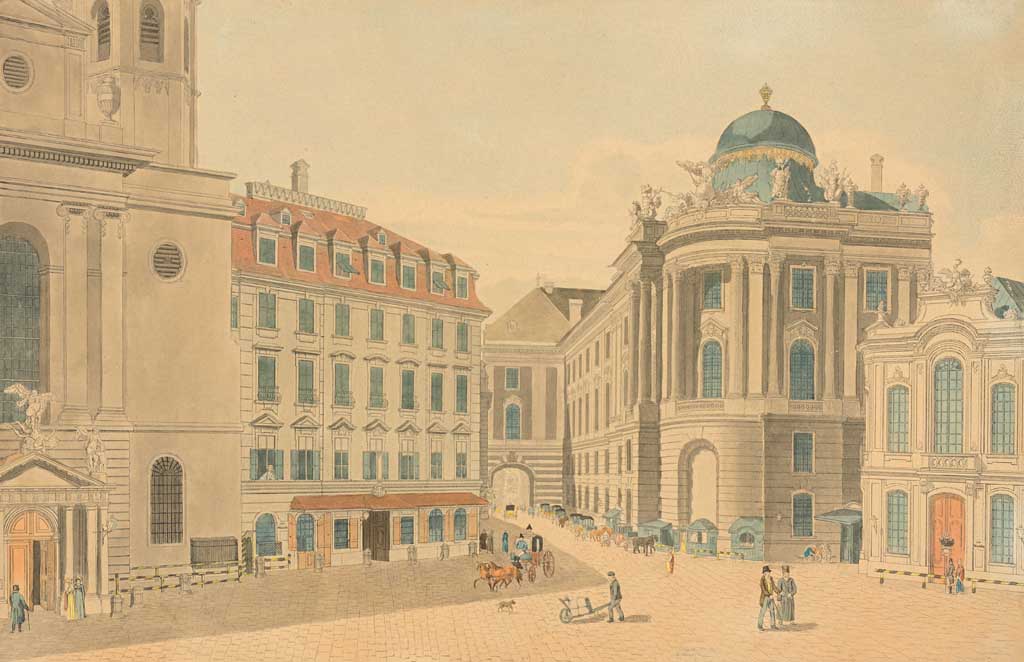
Mozart entered this symphony into his own thematic catalogue on 25 July 1788. He had logged Symphony No. 39 in E-flat major on 26 June 1788 and would log Symphony No. 41 in C major on 10 August 1788. Three large symphonies inside seven weeks, and no surviving document naming a patron, a commission, or a scheduled concert for any of them. That absence is unusual for a composer who badly needed the money, and it is why the summer of 1788 attracts so much speculation. Treat the romantic version — a private testament, written for nobody — as interpretation, not documented fact.
What is documented is the pressure. Mozart had been appointed imperial-royal chamber composer in Vienna in 1787 after Gluck’s death, at a salary of 800 gulden a year — a real income, but far below what the post had paid his predecessor, and nowhere near enough to cover the way the Mozarts lived. The letters he wrote to his fellow freemason Michael Puchberg that summer are begging letters, promising repayment schedules he could not possibly hold to. His subscription concerts, the thing that had made Vienna profitable, had dried up.
The three do not sound like one project. No. 39 opens with a grand slow introduction and spends its length being generous. No. 41 ends with the most famous contrapuntal showing-off in the classical repertoire — a landmark in the history of the symphony. No. 40 sits between them with the lights off. It is the only one of the three in a minor key. Of Mozart’s forty-one numbered symphonies only two are in a minor key at all, and both of those are in G minor: No. 25, written in 1773 when he was seventeen, and this one.
What to listen for
The accompaniment starts before the tune does. Divided violas play the churning quaver figure for a full bar before the violins enter with the famous theme. From inside that viola section it is the least glamorous and most exposed job in the piece: nothing anyone will hum, but you are setting the pulse rate for the whole movement, and if the section is even slightly ragged the tune arrives on top of mud. Listen to the opening bar of any recording and you can hear whether the conductor treats that figure as accompaniment or as the subject.
The theme is built from a sigh. The opening motif is a falling semitone repeated, then dropped a step. Almost everything in the first movement is that shape — stretched, inverted, stacked against itself. Once you hear it you cannot un-hear it, and the development gets much easier to follow: Mozart introduces no new material there, he just refuses to let the old material rest.
The colour is deliberately narrow. No trumpets, no timpani, no percussion of any kind. In 1788 those were the instruments of ceremony and triumph, and leaving them out removes the vocabulary a composer would need to end in glory. The orchestra Mozart does use — one flute, two oboes, two bassoons, two horns and strings, with two clarinets added later — is built for shadow rather than blaze.
Andrés Orozco-Estrada and the Frankfurt Radio Symphony, filmed in concert, are a good first pass because the cameras keep finding the inner strings. Watch the violas in the opening bar and the clarinets in the slow movement.
🎧 Also on: Apple Music · Spotify
Movement by movement
I. Molto allegro
There is no slow introduction, which for a symphony of this period in a serious key is already a statement — No. 39, written weeks earlier, has a big one. You are dropped into a movement already in motion. The second subject arrives in B-flat major and sounds like relief; Mozart lets you enjoy it for a few phrases.
Then the development takes the sighing motif apart. It gets passed around the orchestra, pushed through keys that have no business being in a G minor movement, and finally piled up in overlapping entries so that the texture thickens without the harmony ever settling. The tell that this symphony is not going to console you comes at the recapitulation: the second subject returns, but now in G minor rather than the major key it had before. The one moment of light in the movement is switched off on the way out.
II. Andante
E-flat major, and the surface is calm. Underneath it, two things keep the calm from settling. The bass line drifts downward chromatically — the same falling half-step gesture as the first movement, slowed to walking pace — and repeated syncopations pull against the beat so the music never quite sits square. This is where the added clarinets change the most: they blend with the bassoons and give the whole movement a darker, woodier core than the oboes alone produce.
Scale matters here too. Mozart writes this movement like chamber music: an oboe says something, pizzicato strings answer, a clarinet threads between them. Treated as a big-orchestra slow movement it turns to syrup. The good performances keep it conversational and let the dissonances bite.
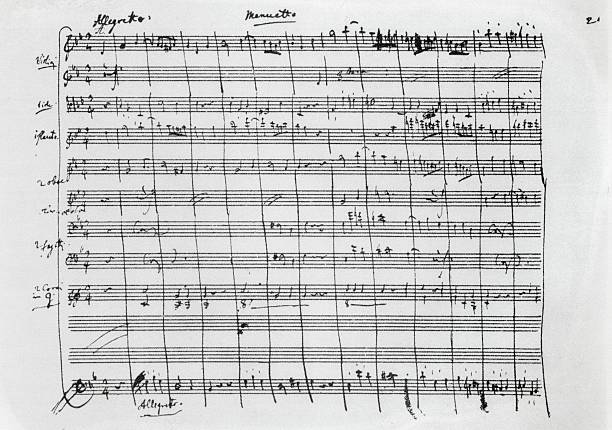
III. Menuetto: Allegretto
A minuet is a dance in three. This one keeps falling into groups of two against the three-beat bar, with hard accents landing where a dancer’s weight should not be. You could not dance to it, and that is the point: Mozart takes the most socially polite movement in the symphony and makes it unusable for its purpose. Underneath, the horns hold long pedal notes that grind against the harmony above.
The Trio switches to G major and is disarmingly simple — four-square phrases, horns finally allowed to sound warm. It is brief, and then the da capo drags you back. Schubert clearly knew this movement well: the minuet of his Symphony No. 5, composed in 1816, borrows both its chromatic colouring and its way of layering instruments toward a dominant chord, and he trimmed his orchestra to match Mozart’s. If you want more of that particular Schubert shadow, our guide to the Unfinished Symphony picks up the thread.
IV. Finale: Allegro assai
The finale opens with a rocket — a fast arpeggio shooting up through the G minor triad. The device came from the Mannheim orchestra’s stock of effects, where it was a bright, extrovert gesture. In minor and at this speed it sounds less like a launch than like panic.
Then comes the passage that makes musicologists sit up. At the start of the development the orchestra fires off a bare unison line running through eleven of the twelve notes of the chromatic scale — every note except G, the symphony’s own tonic — before any harmony arrives to explain it. For a few bars there is effectively no key. It is the single most modern-sounding thing Mozart wrote, and it happens in a piece from 1788, not from the 1900s. After that, the recapitulation has nowhere comfortable to go. The coda stays in G minor. Compare that with the trajectory Beethoven built into his Fifth Symphony, where C minor is defeated by C major in a blaze of trombones: Mozart had that option available as a convention and declined it.
The two versions, and why it matters to you
Mozart wrote this symphony twice, sort of. The original score has no clarinets. Later he added two clarinet parts and rewrote the oboe lines around them, redistributing existing material rather than composing anything new — not even a fresh full score, just a supplement carrying the new wind lines.
Nobody has a document proving when he did it, and no document records a first performance of the symphony during Mozart’s lifetime. The occasion most often proposed is a pair of Tonkünstler-Societät concerts in the Burgtheater on 16 and 17 April 1791, conducted by Antonio Salieri, whose orchestra included the clarinettist brothers Anton and Johann Stadler. That is circumstantial and should be labelled as such — the underlying argument is simply that composers do not re-orchestrate music for a drawer. (Salieri turns up in Mozart’s story more often than the movie version deserves; we untangle that myth separately.)
The difference is real. Clarinets warm and thicken the middle of the texture; the oboe-only original is thinner, more acidic, and the clashes stand out more. Neither one is the authentic version. Hear only the clarinet score and you are taking Mozart’s second thoughts for his first.
Four recordings, and what each one is for
Charles Mackerras / Prague Chamber Orchestra / 1986 / Telarc — start here
This is my first recommendation and it is not a close call. Mackerras conducts modern instruments but applies what the period-performance movement had learned: brisk tempos, hard-edged articulation, and the repeats actually observed — which matters, because the exposition repeat is what makes the development feel earned. The Prague strings are lean enough that the opening viola figure reads as a rhythm rather than a haze. If you own one recording of this symphony, own this one.
▶ Listen on YouTube · Apple Music · Spotify
Frans Brüggen / Orchestra of the Eighteenth Century / 1985 / Philips — the period option
Gut strings, natural horns, and an orchestra that smooths nothing over. The horns in the Menuetto sound slightly wild, and the tuttis have grit instead of gloss. Brüggen’s tempos are not the fastest on record; the effect comes from transparency, not speed. The trade-off is a dry sound, and if you grew up on big-orchestra Mozart the first minute may feel undernourished. Stay for the finale.
▶ Listen on YouTube · Apple Music · Spotify
Karl Böhm / Berlin Philharmonic / Deutsche Grammophon — the weighty classic
Böhm taped his late-Mozart set with the Berliner Philharmoniker for Deutsche Grammophon across the 1960s; session dates for the individual symphony are inconsistently documented. His Mozart is unfashionable now and I still reach for it. He takes the first movement broadly, keeps the string tone full and dark, and refuses to dramatise anything; the effect is grave rather than agitated, and it makes the Andante sound like the centre of the piece. What you lose is rhythmic edge: after Mackerras, the Menuetto’s cross-accents sound padded.
▶ Listen on YouTube · Apple Music · Spotify
Bruno Walter / Columbia Symphony Orchestra / 1959 / Columbia — the romantic reading
Walter recorded the symphony in Hollywood in January 1959 with a pick-up orchestra of Los Angeles players, and it is the warmest account here — phrases shaped, tempos flexible, the sighing motif leaned into rather than clipped. Historically informed it is not. But it documents a style of Mozart playing that has since vanished, and its slow movement is moving in a way the leaner versions do not attempt. Get it second, not first, or everything else will sound cold.
▶ Listen on YouTube · Apple Music · Spotify
Follow the score once
Do this once and the piece changes shape. The video below scrolls the score in time with the performance. It pays off hardest in the first-movement development, where you can watch the motif handed between instruments faster than the ear tracks it, and at the start of the finale’s development, where the eleven-note line is visibly one bare line on the page with nothing under it.
If you would rather turn pages yourself, the score is free at IMSLP, which carries both wind versions so you can see what the clarinet revision did to the oboes.
What happened to it afterwards
Most classical-era orchestral music fell out of the repertoire in the nineteenth century. This symphony did not, largely because Romantic musicians claimed it as an ancestor — though the reception history is stranger than that. Schumann heard Greek lightness and grace in it rather than turbulence, which reads bizarrely today until you realise he was describing the proportion and the finish, not the subject matter. Both readings survive: you can tell within the first page whether a conductor thinks this is a tragedy or a perfectly balanced structure that happens to be in a minor key.
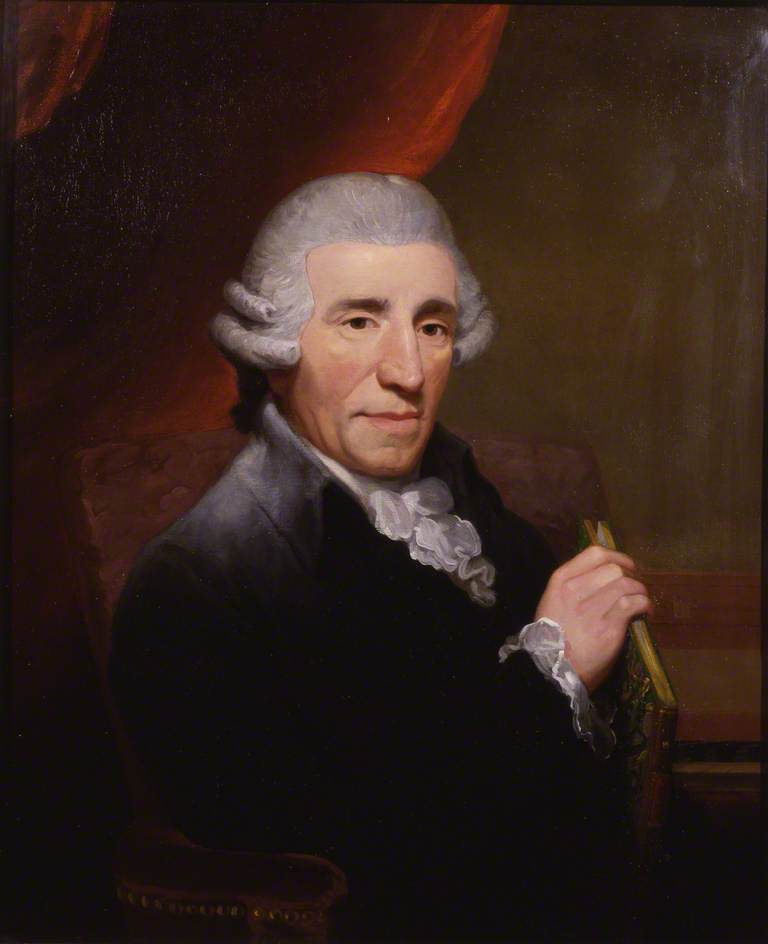
The quietest tribute came from Haydn. In his oratorio The Seasons, completed in 1801, ten years after Mozart’s death, the Winter section reaches an aria comparing winter to old age — and the melody that surfaces there is lifted from the Andante of this symphony. Haydn was near the end of his own working life. Borrowing a dead friend’s slow movement to say so is as close as eighteenth-century music gets to writing a name on a wall.
So the argument closes where it started. Plenty of music is sad; this symphony earns its reputation by setting up every convention that would have let it end in comfort — the major-key second subject, the sunlit Trio, the rocket theme that anywhere else launches a celebration — and then withholding all of them. For the version of Mozart where consolation is at least promised, go to the Requiem. Here, nothing is.
Frequently Asked Questions
How long is Mozart’s Symphony No. 40?
About 30 minutes. Where recordings differ is tempo and whether the conductor takes the written repeats. Period-instrument groups usually come in a little under half an hour; broad, heavy readings run well past it. Skipping the first-movement exposition repeat trims several minutes and, in my view, costs the movement its balance.
When did Mozart write Symphony No. 40?
He entered it in his own thematic catalogue on 25 July 1788, in Vienna. It is the middle of three symphonies logged within seven weeks: No. 39 on 26 June 1788 and No. 41, the Jupiter, on 10 August 1788. No commission or patron has been identified for any of the three.
Did Mozart ever hear Symphony No. 40 performed?
No document records a first performance in his lifetime, so the honest answer is that nobody knows. The most commonly proposed occasion is a pair of Tonkünstler-Societät concerts in the Burgtheater on 16 and 17 April 1791 conducted by Antonio Salieri. The supporting argument is indirect: Mozart added clarinet parts and rewrote the oboe lines around them, and that is work you do for a scheduled performance, not for a drawer.
Why is Symphony No. 40 in G minor?
Mozart used minor keys sparingly: of his forty-one numbered symphonies, only two are in a minor key, and both are in G minor — No. 25 of 1773 and this one. The key returns in other works where he is at his most unsettled, including the String Quintet K. 516 and the Piano Quartet K. 478. Eighteenth-century writers on key character linked G minor with discontent and anxiety, so the choice carried a signal his first listeners would have read.
Which version should I listen to, with or without clarinets?
Start with the clarinet version, because it is what most orchestras play and what you will hear live. Then find a period-instrument recording of the original scoring and compare the Andante of each: the oboe-only version is thinner and more astringent, and the inner-part clashes are easier to hear.