- Composer
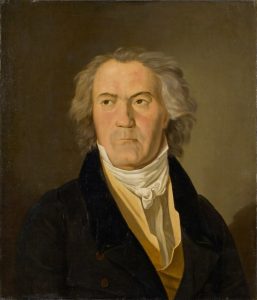
- Ludwig van Beethoven (1770–1827)
- Work
- Symphony No. 9 in D minor, Op. 125 “Choral”
- Key
- D minor
- Composed
- 1818–1824
- Movements
- 4 movements
I. Allegro ma non troppo, un poco maestoso (D minor)
II. Molto vivace (D minor)
III. Adagio molto e cantabile (B♭ major)
IV. Presto – Allegro assai (D minor → D major) - Scoring
- Solo voices (soprano, alto, tenor, baritone), mixed chorus, piccolo, 2 flutes, 2 oboes, 2 clarinets, 2 bassoons, contrabassoon, 4 horns, 2 trumpets, 3 trombones, timpani, bass drum, cymbals, triangle, strings
- Premiere
- 7 May 1824, Kärntnertortheater, Vienna
Michael Umlauf (conductor) - Duration
- c. 65–74 minutes
7 May 1824, Kärntnertortheater, Vienna
Ludwig van Beethoven stood on the stage that evening. Or rather, he was physically present — the actual conducting fell to concertmaster Michael Umlauf. Beethoven’s hearing had deteriorated to the point of near-total deafness. He could gesture tempo markings from the score, but he heard not a single note the orchestra produced. Rehearsals had been fraught: Beethoven’s tempo indications kept drifting from Umlauf’s real-time conducting, and the musicians were quietly instructed to follow Umlauf alone.
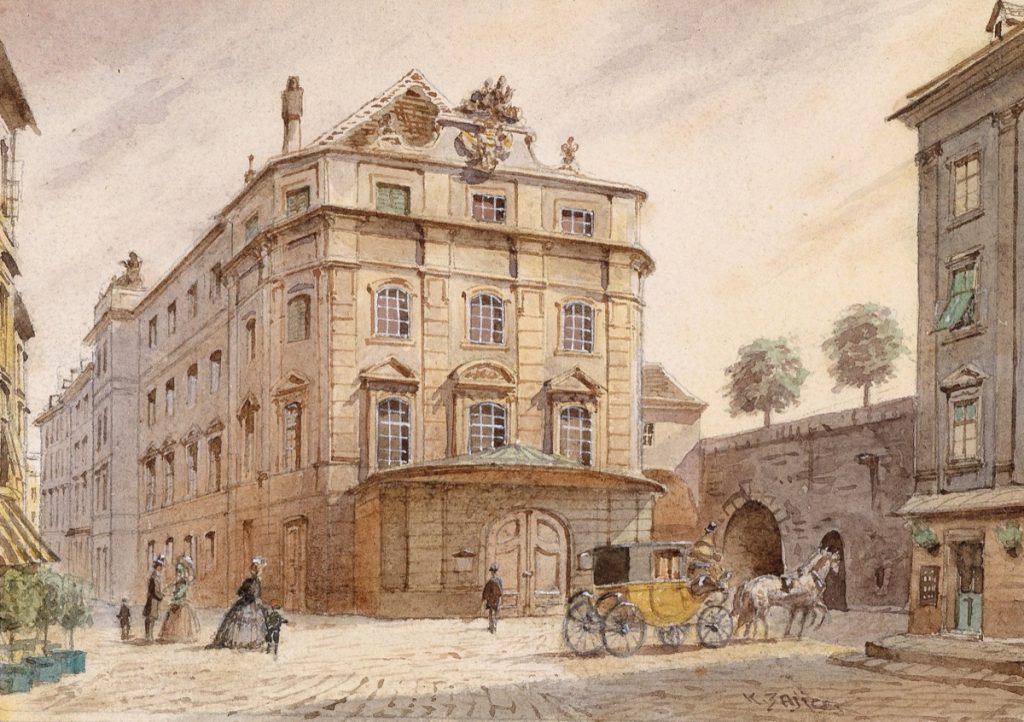
The program that night included more than the Ninth Symphony. Three movements from the Missa solemnis — the Kyrie, Credo, and Agnus Dei — appeared alongside the Overture “The Consecration of the House,” Op. 124. Because Viennese theater regulations prohibited sacred music on secular stages, the Mass excerpts were billed as “Three Grand Hymns.” A bureaucratic workaround, nothing more.
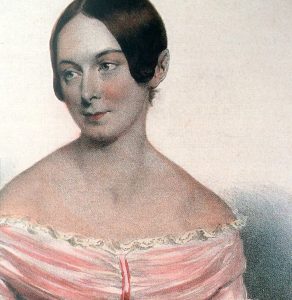
When the final chord died away, the audience erupted. A standing ovation, handkerchiefs and hats thrown into the air. Court etiquette permitted no more than three rounds of applause even for the Emperor — the crowd gave five. But Beethoven remained turned away from the hall, still facing his score. It was the alto soloist, Caroline Unger, who finally tugged his sleeve and turned him around. Only then did he see what his music had provoked. The applause he could not hear, he witnessed with his eyes. Observers reported that people throughout the hall wept openly at the sight.
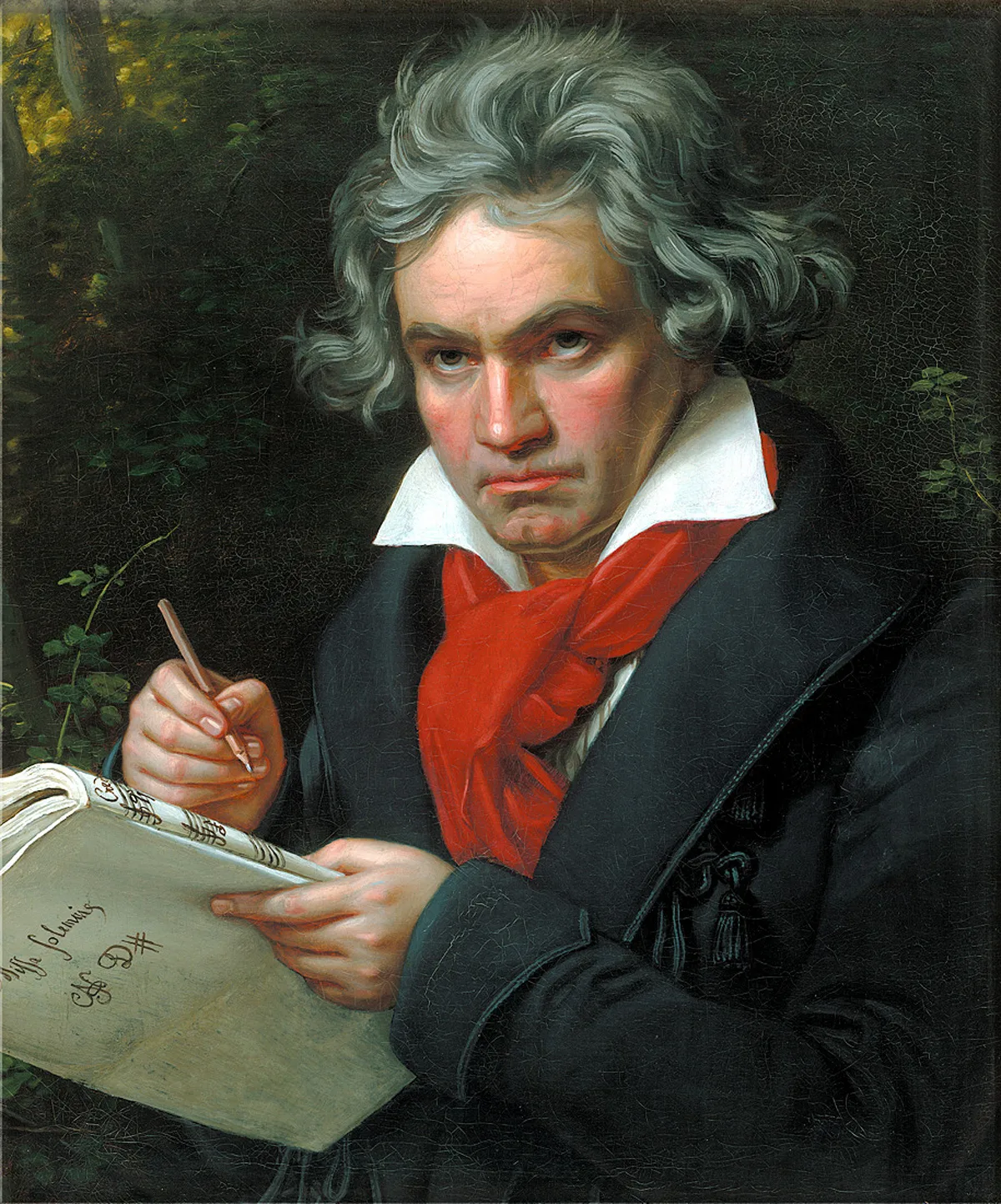
Ironically, the premiere was an artistic triumph but a financial failure. Beethoven’s share of the proceeds barely covered a few weeks of living expenses. He accused the promoter of embezzlement and flew into a rage, but the real culprit was the enormous cost of staging such a large ensemble — performer fees and theater rental consumed nearly all the revenue. The premiere of what would become the most consequential symphony in Western music left its composer with one unforgettable scene and an empty ledger.
The Road from Heiligenstadt
Rewind twenty-two years. In 1802, a thirty-two-year-old Beethoven was staying in Heiligenstadt, a small village outside Vienna, when he wrote a letter to his brothers. This was the famous Heiligenstadt Testament — a document he never sent. It was discovered in a drawer after his death.
“I could not bring myself to say to people, ‘Speak louder, shout, for I am deaf.’ How could a musician possibly confess that his hearing was failing?”
The trouble had begun around 1798. First came a persistent high-pitched ringing in his ears; gradually, following conversations became impossible. He visited doctor after doctor across Vienna, tried every treatment available, and found no relief. He had come to Heiligenstadt hoping the quiet countryside might help. It did not.
He seriously contemplated ending his life. The Testament contains this passage: “A little more of this, and I would have put an end to my life. Only art — only art held me back. I felt I could not leave this world before I had brought forth all that I sensed within me.”
That sentence is the seed of the Ninth Symphony. Immediately after writing the Testament, Beethoven threw himself into composition with redoubled ferocity. The Third Symphony (“Eroica”), the Fifth, the Sixth (“Pastoral”), the “Waldstein” and “Appassionata” piano sonatas — all poured out in the years following. Faced with the cliff edge of deafness, he chose not to retreat but to sprint.
After 1814, however, the situation worsened drastically. At his last public performance as a pianist, he struck the keys so hard that strings snapped. Conversation became possible only through “conversation books” — notebooks in which visitors wrote their questions while Beethoven replied aloud. It was in this state that he began serious work on the Ninth, sketching ideas from around 1818 and composing intensively between 1822 and 1824. A man who could hear nothing at all wrote a seventy-minute work for an orchestra and chorus of over two hundred performers — entirely inside his head.
Schiller’s Poem: A Thirty-Year Obsession
Beethoven first encountered Friedrich Schiller’s “An die Freude” (Ode to Joy) in 1792, while still living in Bonn. He was twenty-two, and he decided then and there to set the poem to music. We know this from a letter his friend and patron Bartholomäus Fischenich sent to Schiller’s wife. It would take thirty-two years for that promise to be fulfilled.
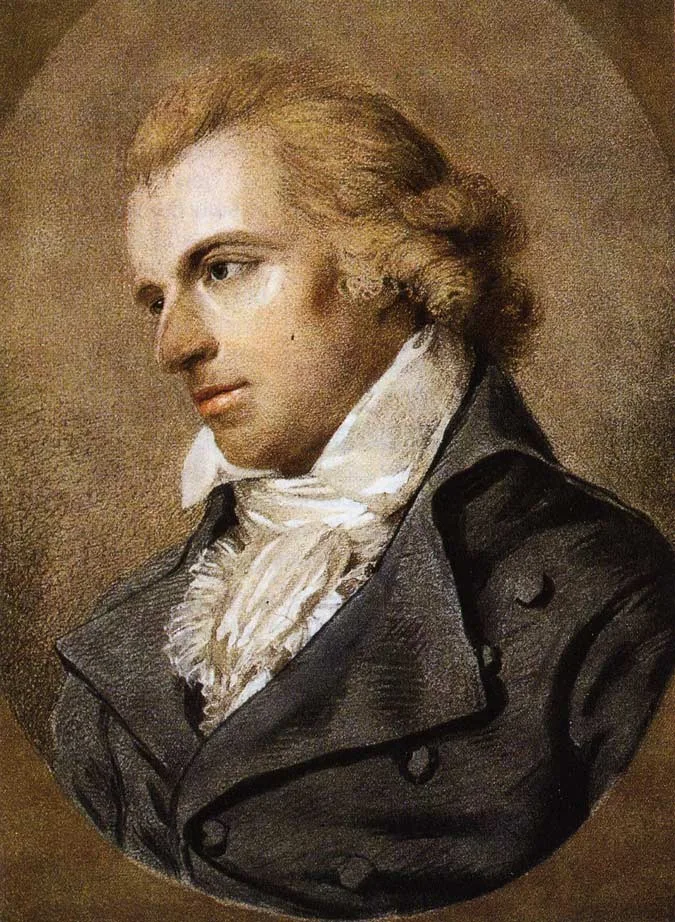
Why so long? Not laziness. For Beethoven, the subject was simply too vast. Schiller’s ode, published in 1785 on the eve of the French Revolution, sings of Enlightenment ideals at their most expansive: universal brotherhood, the unity of God and nature and humankind, the joy inherent in all existence. To set it to music meant composing a hymn not for a nation or a faith but for the entire human race.
“Joy, beautiful spark of the gods, / Daughter of Elysium, / We enter, drunk with fire, / Heavenly one, your sanctuary.”
“Where your gentle wing rests, / All men become brothers.”
Beethoven selected and rearranged several stanzas for the fourth movement rather than setting the complete poem. He chose passages centered on universal brotherhood and joy, then added his own introductory lines. He took the poet’s words and rebuilt them according to a composer’s logic.
The very idea of introducing voices into a symphony was radical. In the tradition established by Haydn and Mozart, vocal music belonged to opera and oratorio — not the symphony. A handful of obscure precedents existed (Peter von Winter had tried something similar), but none survived in the repertoire. Placing a full chorus and four vocal soloists at the climax of a symphony was an act of demolition and reinvention. Beethoven hesitated over this decision for years. His sketchbooks contain multiple drafts of a purely instrumental finale, one of which he later repurposed for the String Quartet Op. 132. In the end, he chose the human voice — and that choice altered the course of music history. Berlioz, Mahler, Shostakovich: the tradition of the vocal symphony descends directly from this moment.
First Movement: Order from Chaos
D minor. Allegro ma non troppo, un poco maestoso. A massive sonata-form movement that runs some fifteen minutes.
It begins from nothing. The strings sustain a hollow open fifth — A and E — trembling, tonally ambiguous. Is this D minor? D major? A minor? The harmony refuses to declare itself, like the primordial vibration before the universe takes shape. Wagner called this opening “the beginning of the world,” and the description is apt.
When the first theme finally erupts from this fog, the effect is volcanic. The full orchestra crashes into a D minor chord in unison — the mist swept away in a single violent gesture, as if declaring: this is reality. The theme descends in broad strokes, derived from the open fifth of the introduction, binding the movement’s architecture into a single structural impulse.
The second theme shifts to B-flat major and offers a lyrical contrast, but tenderness does not survive long in this movement. Tension rebuilds almost immediately as the exposition drives toward its close.
The development section is ferocious even by Beethoven’s standards. Themes are fractured, inverted, recombined — a controlled demolition that sounds like an entire drama compressed into a few minutes. A funeral-march passage buried in its center exposes the movement’s tragic core. When the first theme returns in the recapitulation, the shock registers differently each time: where the exposition emerged from a pianissimo fog into a fortissimo declaration, the recapitulation arrives already roaring at full force.
The coda refuses the usual Classical-era function of winding down. Instead, it operates as a second development — the tension never relents until the final bar.
Second Movement: Demonic Energy
D minor. Molto vivace. The scherzo.
In a conventional symphony, the scherzo occupies the third position. Beethoven reverses the order here, placing the scherzo second and the slow movement third. He had done this before — in the String Quartet Op. 18 No. 4, and in the “Hammerklavier” Sonata Op. 106. The intent is structural: by sequencing two fast, high-energy movements before the slow one, he sustains dramatic momentum and delays the release.
The timpani’s opening octave leap is still electrifying two centuries later. It hammers out D-D-D-D and the strings respond in fugato — imitative entries that pile up with relentless rhythmic force. Written in 3/4 time, the movement feels like it’s hurtling forward in single beats.
The trio section switches to D major and grants a brief respite. The oboe’s pastoral melody here faintly foreshadows the “Ode to Joy” theme of the finale — a structural premonition that only becomes apparent in retrospect. The breathing room is short-lived: the D minor whirlwind returns almost immediately.
What makes this movement extraordinary is the role of the timpani. Beethoven elevates it from a rhythmic support instrument to a melodic protagonist. Having the timpani announce the theme at the very outset was revolutionary. Haydn had featured timpani prominently in his “Drumroll” Symphony No. 103, but Beethoven goes further — he makes the drums lead.
Third Movement: A Song from Beyond
B-flat major. Adagio molto e cantabile. The slow movement.
After the violence of the first two movements, this Adagio opens a different world entirely. It is a double variation — two contrasting themes alternate and are progressively ornamented with each return.
The first theme, in B-flat major and 4/4 time, is a long-breathed melody sung by the strings. Time seems to stop when you hear it. Its beauty lies in its purity — an unadorned simplicity that needs no embellishment to speak. The second theme arrives in D major and 3/4 time, warmer and more dance-like. As these two themes alternate through successive variations, the strings weave increasingly elaborate figuration around them — some of the most refined orchestral textures Beethoven ever wrote.
There is something haunting about listening to this movement with biographical knowledge. Beethoven could not hear these melodies when he composed them. Every note existed only in his mind — he shaped each sonority, each harmonic color, purely through imagination. Knowing this, the Adagio stops sounding like a mere interlude and starts sounding like a confession drawn from the deepest part of a man cut off from the physical world of sound.
Twice, fanfares interrupt — horns and trumpets breaking in without warning. These intrusions hint at the “Ode to Joy” theme waiting in the finale, but the music dismisses them as premature and withdraws back into quiet meditation. The second fanfare erupts over a 12/8 rhythm with greater force, but once it passes, the movement sinks into its final, most profound silence — the stillness just before waking from the deepest dream.
Fourth Movement: Everything Converges
D minor to D major. Presto to Allegro assai. The longest, most structurally complex, and most ambitious symphonic finale ever composed up to that point — roughly twenty-five minutes of music that fuses free variation, sonata form, and choral cantata into a hybrid no one had attempted before.
The Schreckensfanfare and the Retrospective
The movement opens with what Wagner named the Schreckensfanfare — the “fanfare of terror.” Winds, brass, and timpani deliver a searing dissonance in D minor that jolts the listener awake. What follows is extraordinary: the cellos and double basses begin to “speak” in instrumental recitative, mimicking the operatic convention where a singer delivers text in speech-like rhythm. Here, instruments assume the role of the human voice — anticipating the baritone soloist who will appear later.
One by one, the themes of the preceding movements return — quoted, then rejected. The first movement’s fierce opening subject appears, only for the cellos and basses to push it aside. The scherzo’s rhythmic drive surfaces briefly and is similarly dismissed. The Adagio’s serene melody lingers a moment longer, as if Beethoven considers dwelling there, but ultimately shakes his head. The message is unmistakable: everything that came before was not enough.
The “Ode to Joy” Emerges
And then — quietly, almost tentatively — the cellos and basses introduce the theme. The “Ode to Joy” melody is strikingly simple: stepwise motion, narrow range, a tune anyone could sing. That simplicity is the point. A theme about universal brotherhood written in a language only trained musicians could parse would betray its own message.
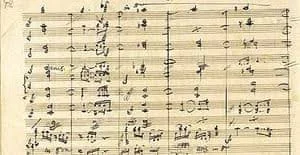
The theme grows through accumulation. Violas join the cellos and basses; then the first violins enter; woodwinds add their voices; finally, the full orchestra surges into the melody. A single thread of sound swells until it fills the entire hall. This gradual expansion is Beethoven’s deliberate dramaturgy: a whisper from one person spreading into a chorus of all humanity — the arc of the music precisely mirroring the arc of Schiller’s poem.
The Human Voice Enters
The Schreckensfanfare detonates once more, and this time the baritone soloist steps forward:
“O Freunde, nicht diese Töne! Sondern laßt uns angenehmere anstimmen, und freudenvollere!”
(“O friends, not these sounds! Let us instead strike up something more pleasant, more full of joy!”)
These words are not Schiller’s — Beethoven wrote them himself. His sketchbooks show dozens of revisions of this single introductory line. When the baritone sings the “Joy” theme that the instruments had previously carried, and the chorus answers, we witness one of the most shocking moments in all of orchestral music: for the first time in the history of the symphony, the human voice rings out.
The Turkish March and the Double Fugue
After the chorus has had its first exultant turn, the atmosphere shifts abruptly. Percussion instruments absent from the rest of the symphony — cymbals, triangle, bass drum — join the ensemble, and the tenor soloist launches into a military march over a “Turkish” rhythm. This passage borrows from the alla turca style then fashionable across Europe, an evocation of Ottoman military bands. Planted in the middle of a symphony, it lands with the force of an operatic scene interrupting a concert. Piccolo and contrabassoon stand out vividly in this section.
The large-scale choral passage that follows builds into a double fugue: the “Joy” theme (“Freude, schöner Götterfunken”) and the brotherhood text (“Seid umschlungen, Millionen” — “Be embraced, ye millions”) are woven together simultaneously, driving the musical complexity to its peak. Layered on top is the invocation of the divine — “Über Sternen muß er wohnen” (“Above the stars He must dwell”) — a passage that pushes the chorus to its technical limits.
The Final Surge
The closing pages accelerate relentlessly toward D major and pure elation. The solo quartet calls out “Freude, schöner Götterfunken!” and the chorus thunders back “Seid umschlungen, Millionen!” Chorus, orchestra, and four soloists fuse into a single force — the combined energy, experienced live, sends a physical tremor through the body.
As the prestissimo final bars detonate, audiences rise to their feet just as they did in Vienna two hundred years ago. And in that moment, you understand that this is not merely a piece of music. It is one of the most powerful declarations the human mind has ever produced.
Why This Symphony Matters
The Ninth occupies a singular position in music history. Consider just five dimensions of its impact.
It broke the genre open. The Ninth is the first major symphony to incorporate vocal forces. Every subsequent composer who placed voices inside a symphony — Berlioz in Roméo et Juliette, Mahler in the Second (“Resurrection”) and the Eighth (“Symphony of a Thousand”), Shostakovich in the Thirteenth (“Babi Yar”) — followed the path Beethoven carved. Without this precedent, those works might never have existed.
It declared that pure music was not enough. After exhausting what instruments could say across three movements, Beethoven announced “this is insufficient” and summoned the human voice. This was not a formal experiment — it was a philosophical statement about the limits and possibilities of art itself.
It became the anthem of Europe. In 1985, the European Community (predecessor to the EU) adopted the “Ode to Joy” melody as its official anthem, in an arrangement for wind instruments commissioned from Herbert von Karajan. No lyrics — only the melody, so that no single language would dominate. The music itself carries the message.
It has appeared at history’s turning points. When the Berlin Wall fell in 1989, Leonard Bernstein conducted a combined East-West German orchestra in this symphony on Christmas Day, substituting “Freiheit” (freedom) for “Freude” (joy). In Japan, annual year-end performances of the “Daiku” (the Ninth) have become a national tradition. In Chile under Pinochet, women’s choirs sang the “Ode to Joy” as an act of resistance. The symphony keeps materializing at moments when humanity confronts its own capacity for unity or division.
It may have determined how long a CD can play. The widely repeated story holds that when Philips and Sony were developing the compact disc, the decision to set the disc’s capacity at 74 minutes was influenced by the length of Karajan’s recording of the Ninth. The historical accuracy of this claim is debated, but the fact that people believe it — and that it sounds plausible — tells you something about the work’s symbolic weight.
Essential Recordings
Two centuries of performance history have produced countless interpretations. These three remain indispensable.
Wilhelm Furtwängler / Bayreuth Festival Orchestra (1951)
The legend among legends. This is a live recording from the reopening of the Bayreuth Festival after World War II — a performance charged with historical gravity. Furtwängler himself was returning to the podium after undergoing denazification proceedings. The mono sound is imperfect, but no modern recording approaches the spiritual intensity of this performance. The third movement’s meditation seems to suspend time itself. When the baritone cries “O Freunde!” in the fourth and the chorus erupts, every accumulated tension dissolves at once into an indescribable sense of release. Anyone who has heard this recording knows exactly what I mean. It belongs on any serious listener’s essential list.
Herbert von Karajan / Berlin Philharmonic (1962)
Karajan recorded the Ninth four times; the 1962 Deutsche Grammophon version is widely regarded as the most balanced. The Berlin Philharmonic’s massive sonority, Karajan’s characteristic long-breathed phrasing, and the fourth movement’s explosive energy converge into something close to an ideal realization. The solo quartet — including Gundula Janowitz (soprano) and Walter Berry (baritone) — is stellar. If you are hearing this symphony for the first time, start here: excellent sound quality, a reading that is both authoritative and deeply felt.
Georg Solti / Chicago Symphony (1972)
Solti’s Beethoven cuts with a razor’s edge. The Chicago Symphony’s blazing brass and pinpoint ensemble maximize the score’s dramatic extremes. The first movement’s forward drive and the scherzo’s taut energy are particularly impressive. Decca’s superb engineering captures the Chicago sound in its full brilliance. If Furtwängler is a spiritual experience, Solti is pure sonic exhilaration.
Follow the Score
The full score is freely available at IMSLP. View the Symphony No. 9, Op. 125 ‘Choral’ score on IMSLP
Frequently Asked Questions
How long is a typical performance?
Roughly 65 to 70 minutes, though interpretations range from the low 60s to nearly 80 minutes depending on the conductor. Furtwängler’s 1951 Bayreuth performance runs about 74 minutes; Karajan’s 1962 recording comes in at around 66. Period-instrument conductors like Roger Norrington and John Eliot Gardiner push it below 63. The fourth movement alone accounts for approximately 25 minutes — one movement that rivals the length of many complete symphonies.
Why was the “Choral” Symphony Beethoven’s last?
Beethoven sketched ideas for a Tenth Symphony and clearly intended to write one. But after completing the Ninth, he turned his focus almost exclusively to the string quartet — the late quartets (Opp. 127, 130, 131, 132, 135) represent some of the most profound music ever written. He died on 26 March 1827 before a Tenth could materialize. Some scholars suggest that Beethoven had simply outgrown the symphony as a form, seeking the more intimate and experimental world of chamber music. The seven-movement continuous structure of the String Quartet Op. 131, for instance, shows structural ambition that arguably surpasses even the Ninth.
Why is the instrumental introduction to the fourth movement so long?
By design. Beethoven demonstrated everything that instruments alone could accomplish across the first three movements, then opened the fourth by recalling and rejecting each previous movement’s theme. This systematic refusal — “not this, not that” — establishes that a new kind of expression is needed before the human voice finally enters. Without this eight-minute instrumental preamble, the choral entrance would lose half its dramatic impact. The delay is not a structural flaw; it is the argument that makes the voice’s arrival feel inevitable.
What exactly is used as the EU anthem?
The “Ode to Joy” melody from the fourth movement, arranged purely for instruments — no vocals. In 1972, the Council of Europe commissioned Karajan to produce the arrangement, and he created three versions: piano solo, wind ensemble, and full orchestra. The wind version is used at official ceremonies. By omitting lyrics, the anthem avoids privileging any one European language, allowing the music itself to carry the message of “unity in diversity.”
Where should a first-time listener begin?
Start with the “Ode to Joy” theme in the fourth movement — the melody you almost certainly already know. Once you’ve located it, go back to the beginning and listen to the entire symphony straight through. The work is conceived as a single arc from the chaos of the first movement to the joy of the fourth; experiencing it as a whole is the only way to feel its full weight. Karajan’s 1962 recording with the Berlin Philharmonic is an ideal entry point. For a more modern sound, Claudio Abbado’s 2000 live recording with the Berlin Philharmonic is equally compelling.
When and where did Beethoven’s 9th Symphony premiere?
The symphony premiered on May 7, 1824, in Vienna at the Theater am Kärntnertor. By this time, Beethoven was almost completely deaf and had to be turned to face the audience to see their enthusiastic applause.
Why is it called the “Choral” Symphony?
The work is nicknamed the “Choral” symphony because it was the first major symphony by a prominent composer to include a choir and vocal soloists. This groundbreaking addition occurs in the fourth and final movement, setting Friedrich Schiller’s “Ode to Joy” to music.
What text is sung in the final movement?
The final movement uses selected stanzas from Friedrich Schiller’s 1785 poem “An die Freude” (“Ode to Joy”). Beethoven’s setting of the text is a powerful declaration of universal brotherhood and the unity of all mankind.
Closing Thoughts
The Ninth Symphony belongs simultaneously to one man and to all of humanity. A deaf composer who declared that all people are brothers — and proved it in sound. Two centuries on, this melody surfaces at Olympic opening ceremonies, New Year’s concerts, and moments of historical reconciliation for a reason that transcends tradition or habit.
Schiller’s poem, carried in Beethoven’s heart for thirty years. A decade of composition through worsening silence. The result — this symphony — is the proof that the promise of the Heiligenstadt Testament was kept. “Only art held me back.” He poured everything into this score, and the result still reaches across borders and centuries to shake listeners who have no connection to early-nineteenth-century Vienna.
What is striking is how the work’s meaning has shifted with each era. In the nineteenth century, it was a hymn of revolution and liberation. In the twentieth, a symbol of war and peace. In the twenty-first, a question addressed to a fractured world. A two-hundred-year-old composition that keeps acquiring new meaning has encoded something deeper than any single historical moment.
Listen to it once, from the first hollow fifth to the final prestissimo. Seventy minutes. Then see what you feel when the silence returns.