- Composer
- Ludwig van Beethoven
(1770–1827) - Work
- Symphony No. 7 in A major, Op. 92
- Composed
- 1811–1812
- Movements
- 4 movements
I. Poco sostenuto – Vivace (A major)
II. Allegretto (A minor)
III. Presto – Assai meno presto (F major)
IV. Allegro con brio (A major) - Scoring
- 2 flutes, 2 oboes, 2 clarinets, 2 bassoons, 2 horns, 2 trumpets, timpani, strings
- Premiere
- December 8, 1813, University of Vienna Great Hall
Ludwig van Beethoven, conductor - Dedication
- Count Moritz von Fries
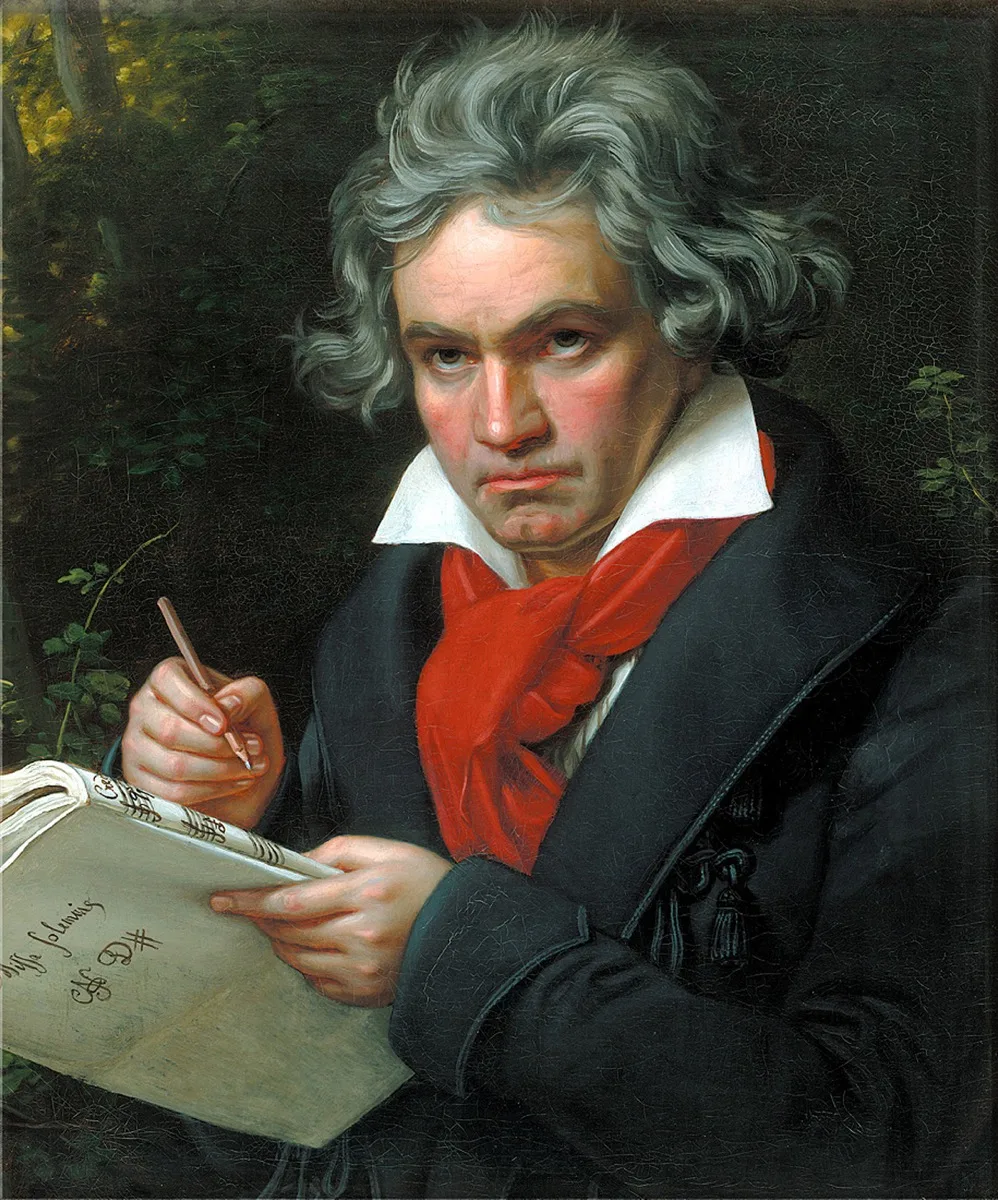
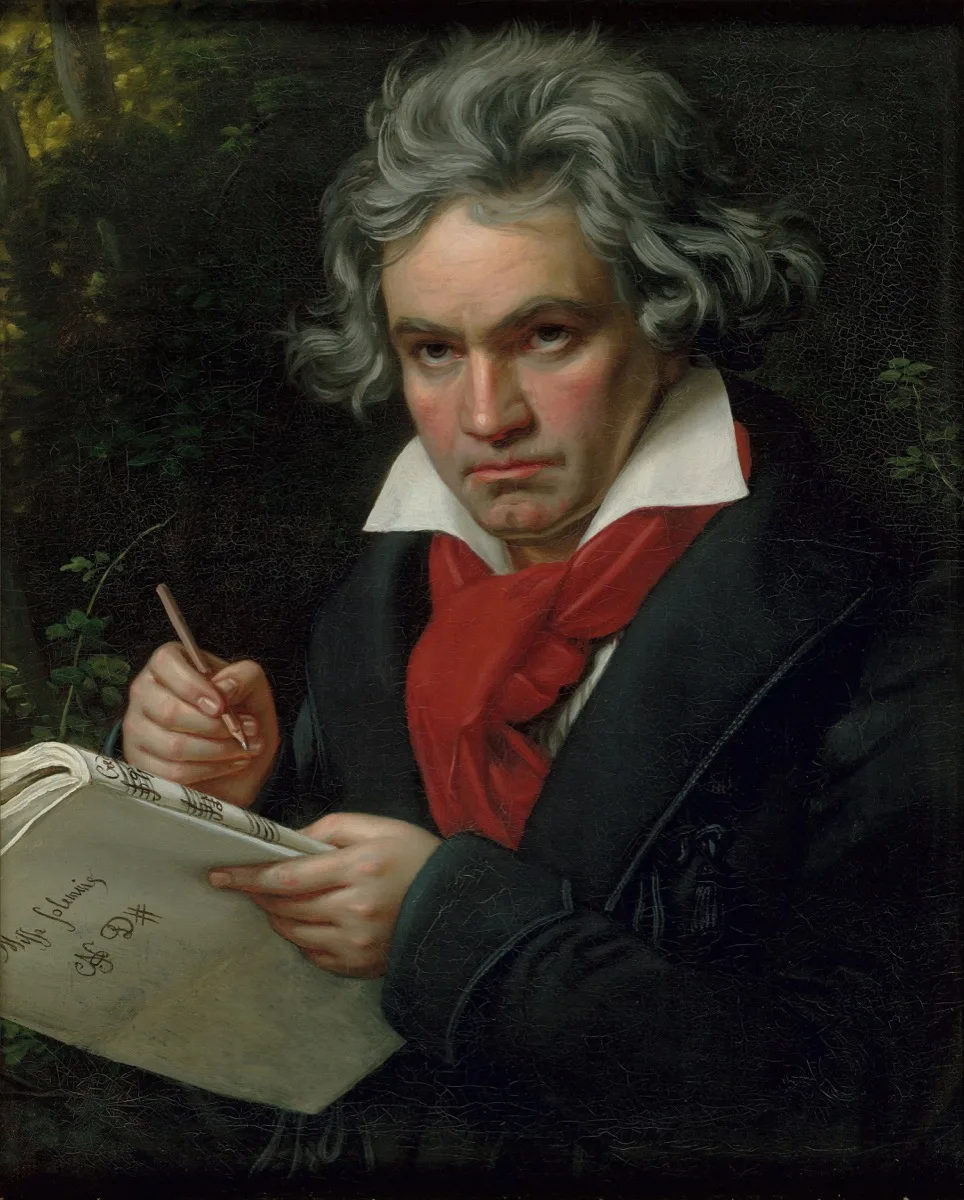
December 8, 1813. The Great Hall of the University of Vienna is packed beyond capacity. On stage, an orchestra stacked with the biggest names in Viennese music: Spohr and Schuppanzigh on violin, Dragonetti on double bass, Hummel on bass drum, and Salieri manning the cannon effects. At the podium stands a 43-year-old man who can barely hear the orchestra he’s conducting. Ludwig van Beethoven has two premieres tonight. One is a battle piece celebrating Wellington’s victory over Napoleon’s forces — complete with actual cannon sound effects. The other is his Symphony No. 7 in A major.
The battle piece gets the crowd roaring. But the real shock comes during the symphony’s second movement. When the Allegretto ends, the audience erupts. They want it again. Right now. An encore of a single movement at a symphony premiere — this almost never happens. Beethoven obliges. The Allegretto becomes the most requested piece in Vienna, inserted into other composers’ symphony concerts like a greatest hit.
What made this symphony hit so hard? The answer is deceptively simple: rhythm. Not melody, not harmony, not dramatic narrative. Pure, relentless, physical rhythm.
Born in the Middle of a War
Beethoven began serious work on the Seventh in late 1811. Europe was deep in the Napoleonic Wars. Austria had been crushed at the Battle of Wagram in 1809 and forced into the humiliating Treaty of Schönbrunn. Vienna’s economy was in ruins — hyperinflation had slashed Beethoven’s pension to a fraction of its original value.
His health was failing too. In the summer of 1812, Beethoven traveled to the Bohemian spa town of Teplitz to recover. It was here that he had his famous encounter with Goethe — the two giants walking together when they met a group of aristocrats. Goethe stepped aside and bowed. Beethoven walked straight through with his arms folded. Whether the story is true or embellished, it captures something essential about the man.
Much of the Seventh was completed during this Teplitz stay. And in the middle of war and personal crisis, Beethoven’s musical weapon of choice was not heroic narrative (that was the Third), not struggle against fate (that was the Fifth), not pastoral escape (that was the Sixth). It was rhythm — stripped down, obsessive, physical.
His contemporaries noticed. Carl Maria von Weber heard the Seventh and declared Beethoven “ripe for the madhouse.” Another critic claimed he must have been drunk when he composed it. Beethoven himself called it “one of my very best works.” The split reaction is telling: rhythm this raw registers as either madness or genius, with no middle ground.
The Premiere: Cannons and a Symphony
The premiere came at a charity concert for soldiers wounded at the Battle of Hanau. Johann Nepomuk Mälzel — inventor, showman, and the man who would later popularize the metronome — organized the event. He’d originally commissioned Beethoven to write a piece for his mechanical orchestra, the Panharmonicon. That collaboration produced “Wellington’s Victory,” Op. 91, the cannon-laden battle piece that shared the Seventh’s premiere night.
“Wellington’s Victory” was a massive hit at the time. History has been less kind. The Seventh Symphony, by contrast, has only grown in stature over two centuries. The premiere’s all-star orchestra — essentially every major musician in Vienna pressed into service — played both works to a wildly enthusiastic audience. The concert was repeated in January and February 1814 due to demand.
Movement Guide
I. Poco sostenuto – Vivace (A major)
The symphony opens with a slow introduction that stretches to 62 bars — the longest of any Beethoven symphony. The oboe sings a broad melody over sustained chords, and the music climbs through a series of scales like someone ascending a staircase, each step building tension. This isn’t just throat-clearing before the main event. Beethoven is loading a spring.
When the Vivace arrives, a single dotted rhythm launched by the flute takes over the entire movement. Once it starts, it never stops. Strings pick it up, winds amplify it, timpani hammer it home. Beethoven chose rhythmic propulsion over melodic beauty here. The 6/8 pulse gets into your body before your brain can process it. That’s the point.
II. Allegretto (A minor)
This movement alone would secure the Seventh’s place in the repertoire. A simple rhythmic pattern — long-short-short-long-long (the dactylic rhythm) — begins in the lower strings, barely above a whisper. Violas and cellos state it first. Then the second violins join. Then the first violins enter above with a melody. Layer by layer, like torches being lit in darkness, the pattern spreads through the entire orchestra.
Despite the “Allegretto” marking (moderately fast), many conductors take this movement quite slowly, treating it as a funeral march. Beethoven reportedly regretted not marking it “Andante” instead. His metronome marking (♩= 76) suggests a more flowing pace — a walking speed rather than a dirge. This tempo dispute has divided conductors for two centuries: Klemperer plays it as a solemn procession, Harnoncourt takes it briskly. Both versions reveal different truths about the music.
The middle section shifts to A major, and for a moment sunlight breaks through. It doesn’t last. When the minor-key darkness returns, the effect is devastating.
III. Presto – Assai meno presto (F major)
After the Allegretto’s weight, this movement arrives like a gust of wind. A whirling triple-time scherzo in F major tears through the air. Beethoven extends the standard scherzo-trio-scherzo structure by repeating it: ABABA, five sections instead of three. It’s a structurally bold choice that keeps the listener off balance.
The trio sections bring a dramatic contrast — a slow, hymn-like melody in the winds, supposedly derived from an Austrian pilgrims’ song. The alternation between the scherzo’s manic energy and the trio’s benediction-like calm is electrifying, and hearing it twice doubles the impact.
IV. Allegro con brio (A major)
The finale is a bacchanalian riot. From the first bar, the music hurls itself forward with unstoppable energy. A simple theme — possibly borrowed from an Irish folk tune — becomes the vehicle for ten minutes of orchestral frenzy. Wagner called the Seventh “the apotheosis of the dance,” and this movement is probably why.
Beethoven works with essentially one rhythmic cell for the entire movement. Monotonous? Not remotely. The accumulation of rhythmic energy produces something close to physical ecstasy. By the coda, the orchestra sounds like it’s barely holding together — timpani pounding, strings sawing, winds blasting. When it ends, the performers aren’t the only ones out of breath.
The Weight of “Apotheosis of the Dance”
Richard Wagner coined the phrase “apotheosis of the dance” (Apotheose des Tanzes) for the Seventh, and it has stuck as a kind of unofficial subtitle ever since. But it’s worth understanding what Wagner actually meant.
He wasn’t talking about waltzes or minuets. Wagner meant that rhythm — the most primal element of music — had been elevated to a governing principle. All four movements are dominated by a single rhythmic idea: the dotted figure in the first, the dactylic pattern in the second, the whirling triple time of the third, the headlong rush of the fourth. Remove the rhythm from any of these movements and nothing remains.
This makes the Seventh fundamentally different from the Ninth’s message of universal brotherhood or the Fifth’s narrative of fate overcome. The Seventh has no program, no text, no explicit message. Just the physical energy of rhythm filling forty minutes of music. It’s an extreme case of absolute music — and yet the emotional impact is anything but abstract.
The Seventh in Popular Culture
The Allegretto has become one of the most frequently used classical pieces in film and television. Its most famous screen appearance is in “The King’s Speech” (2010), where it underscores George VI’s climactic wartime radio address. The collision of a stammering king’s painful speech with Beethoven’s relentless rhythm created one of cinema’s most powerful scenes.
The movement has also featured prominently in “The Fall” (2006), Jacques Perrin’s documentary “Oceans,” and TV series including “Mr. Robot,” “The X-Files,” and “Westworld.” In popular culture, the Allegretto has become shorthand for solemn grief or steely resolve — which is remarkable for a movement Beethoven marked “moderately fast.”
Recommended Recordings
If there’s one recording that defines the Seventh Symphony, it’s Carlos Kleiber with the Vienna Philharmonic (1975, Deutsche Grammophon). This isn’t just a great performance — it’s the performance that shaped how a generation hears this work. Kleiber’s rhythmic instinct is uncanny: the music breathes, springs, pivots. The fourth movement’s controlled frenzy has never been matched.
The video above captures Kleiber live at Amsterdam’s Concertgebouw in 1983 — studio-quality energy with the electricity of a live performance.
Herbert von Karajan’s 1977 recording with the Berlin Philharmonic offers a different approach: the orchestra’s lush tone creates a sleek, powerful reading where Beethoven’s wildness meets Karajan’s controlled elegance.
Leonard Bernstein’s Allegretto with the Vienna Philharmonic deserves special mention. Bernstein takes it slower than most, wringing deep emotion from every phrase without letting the music stagnate.
For historically informed performances, seek out Nikolaus Harnoncourt or John Eliot Gardiner. Playing closer to Beethoven’s metronome markings, the Seventh becomes faster, rougher, more dangerous. The Allegretto loses its funeral-march quality and becomes something more like a march — brisk, purposeful, forward-moving. This may be closer to what Beethoven actually imagined.
Following the Score
Hearing the Seventh is one thing. Watching the score while listening is another experience entirely. In a work so dominated by rhythm, seeing which instrument picks up the pattern and when — watching voices stack on top of each other in the Allegretto — makes Beethoven’s architecture visible.
The video below syncs a full score with Carlos Kleiber’s legendary Vienna Philharmonic recording. Pay particular attention to the second movement, where you can trace the dactylic rhythm as it migrates from the lower strings upward through the entire orchestra.
The full score is available for free download at IMSLP, including the Breitkopf & Härtel edition (1862) and various pocket scores.
Frequently Asked Questions
Why is Beethoven’s Seventh called the “Apotheosis of the Dance”?
Richard Wagner coined this phrase in his writings, including “Opera and Drama” (1851) and his essay on Beethoven (1870). He was describing how rhythm dominates all four movements of the symphony — not referring to actual dance music, but to rhythm elevated to the status of a governing structural principle. The nickname has stuck ever since, though Beethoven himself never used it.
Is the Allegretto a funeral march?
Not officially. Beethoven marked it “Allegretto” (moderately fast), unlike the second movement of his Third Symphony, which he explicitly titled “Marcia funebre.” The funeral-march impression comes from the A-minor tonality and the repeating dactylic rhythm (long-short-short). Beethoven later said he should have marked it “Andante,” suggesting even he was aware of the tendency to play it more slowly than intended. His metronome marking (♩= 76) points to a flowing, walking-pace tempo rather than a solemn processional.
What is the best recording of Beethoven’s Symphony No. 7?
Carlos Kleiber conducting the Vienna Philharmonic (1975, Deutsche Grammophon) is the most widely recommended recording and has been voted the greatest orchestral recording of all time in multiple polls. For a weightier interpretation, try Karajan with the Berlin Philharmonic (1977). For a historically informed approach, Gardiner with the Orchestre Révolutionnaire et Romantique (1992) offers a revelation.
What is the tempo controversy around the Allegretto?
Beethoven’s metronome marking for the second movement (♩= 76) indicates a moderate, flowing speed. But the emotional depth and A-minor gravity of the music have led many conductors — Klemperer, Celibidache, Bernstein — to take it much slower, treating it as a solemn procession. Period-performance conductors like Harnoncourt and Gardiner tend to honor the faster marking. There is no “correct” tempo; the debate itself reveals the richness of the music.
How does the Seventh Symphony compare to Beethoven’s Fifth and Ninth?
The Fifth is about struggle and triumph (“fate knocking at the door”), the Ninth about universal brotherhood (with its choral finale setting Schiller’s “Ode to Joy”). The Seventh has no program and no text. Its subject is rhythm itself — the physical, visceral energy of musical motion. Where the Fifth tells a story and the Ninth delivers a message, the Seventh bypasses words entirely and speaks directly to the body.