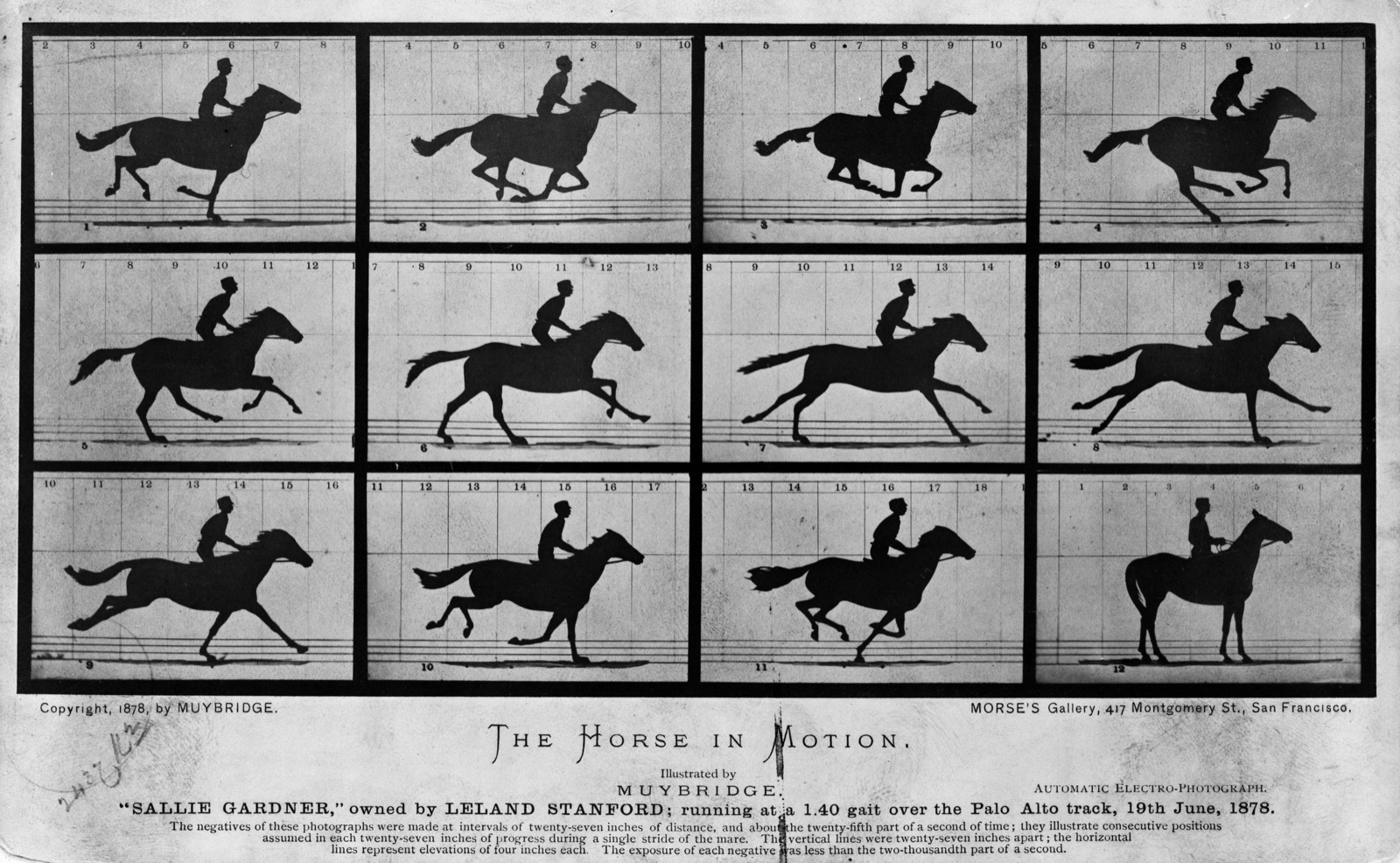
Real hoofbeats are not a rhythm you can clap. A galloping horse moves in a four-beat gait, one beat more than the three-beat canter, and like the canter it ends each stride with a moment where all four feet leave the ground at once — the suspension phase Eadweard Muybridge caught on camera at Palo Alto in 1878 and settled a long argument among painters. Four uneven beats, then nothing, then four more. Almost nobody writes that.
What composers write instead is a three-note kick — short-short-LONG, or LONG-short-short — repeated until you stop hearing it as rhythm and start hearing it as motion. That figure, plus a bass line that refuses to stop, is the entire illusion. Below are nine pieces that pull it off, ordered from the one you already know by heart to the one that has no business working. Each entry names the exact passage and the device, because “it feels gallopy” is not an explanation.
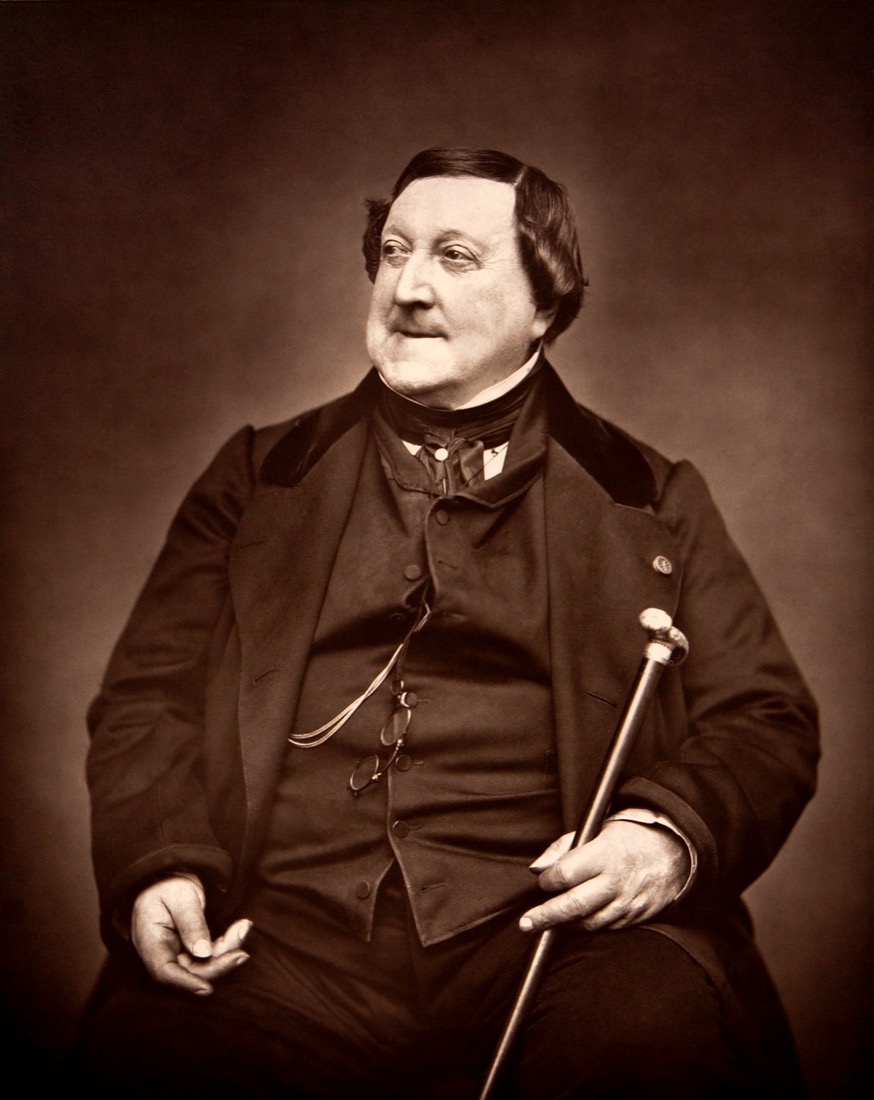
1. Rossini — Overture to Guillaume Tell, “March of the Swiss Soldiers”
Start with the obvious one so we can get past it. The last three minutes of Rossini’s overture are the reason a generation of Americans thinks classical music comes with a horse attached: The Lone Ranger debuted on WXYZ in Detroit on 30 January 1933 and opened with this music every week. The opera premiered on 3 August 1829 at the Paris Opera, and it was the last one Rossini ever wrote — he lived another 39 years and never went back.
The device is brutally simple. Trumpets bark a three-note call, the strings answer with the same three-note kick an octave lower, and the pattern locks into a loop that never once relaxes. There is no development, no contrasting theme worth the name — just acceleration by repetition. That’s also why it wears out faster than anything else on this list. Play the finale for the gallop, then go back and play the whole overture: the cello quintet that opens it and the storm that follows are better music than the bit everyone can hum.
🎧 Also on: Apple Music · Spotify
2. Suppe — Overture to Leichte Kavallerie (Light Cavalry)
The most literal hoofbeat on the list. Franz von Suppe’s operetta premiered at the Carltheater in Vienna on 21 March 1866 and has been essentially unperformable ever since; the overture escaped and has done fine on its own.
After the opening trumpet fanfare, the main theme arrives on a limping dotted figure — long-short, long-short — over a dry, detached bass that lands squarely on every beat. That pairing is the mechanism: a bouncing top line against a stiff bottom line, which is exactly what a trotting horse sounds like from the saddle. It is a trot, not a gallop, and that’s why it feels jaunty rather than desperate. Suppe also gives you the other half of the cavalry cliche, a slow minor-key middle section that every film composer scoring a defeated army has stolen since. Skip the operetta. Keep the overture. ▶ Listen on YouTube
▶ Listen on YouTube · Apple Music · Spotify
3. Wagner — “Ride of the Valkyries,” from Die Walkure, Act III
Die Walkure was first staged at the National Theatre in Munich on 26 June 1870, and the prelude to its third act has been detached from the opera for so long that most people have no idea the Valkyries are collecting dead soldiers while it plays.
Wagner’s gallop is heavier than Rossini’s because it swings in threes: a dotted long-short figure that rocks rather than sprints, so the horses feel enormous and airborne instead of fast. Underneath it the strings churn a rising chromatic line — each repetition edges upward in pitch, which your ear reads as effort. The brass leaps on top are the Valkyries’ war cry, not the horses. Test it yourself: the moment the voices enter, the galloping figure keeps going unchanged in the orchestra, which is why the concert version works at all. If you want to hear where Wagner learned this kind of scene-painting, our piece on the Weber Freischutz Overture traces the debt. ▶ Listen on YouTube (Royal Concertgebouw Orchestra)
▶ Listen on YouTube · Apple Music · Spotify
4. Schubert — Erlkonig, D. 328
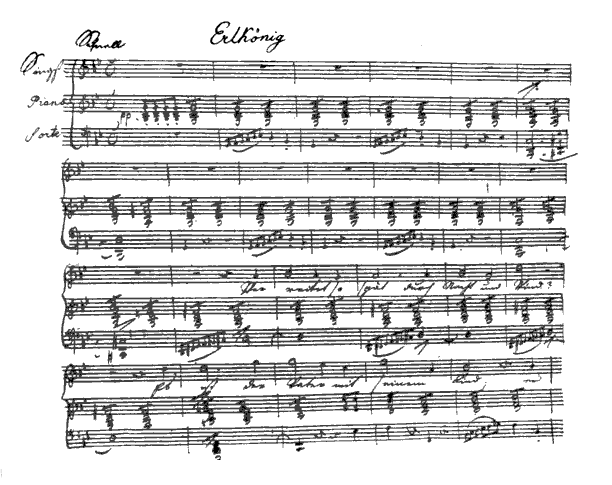
This is the best galloping music ever written, and it is a four-minute song for one singer and one pianist. Schubert set Goethe’s poem in 1815; he revised it three times and published the fourth version in 1821 as his Op. 1. The third version simplifies the piano part by removing the right-hand triplets — useful evidence, since it tells you the triplets were the hard part and the point.
The right hand hammers repeated triplet chords from bar one and does not stop for the entire song. There is no clever hoofbeat imitation here at all; the mechanism is pure relentlessness, a pulse that cannot be interrupted while a father, a dying child and the Erlking argue over the top of it. The tempo makes a pianist’s forearm burn, and you can hear that strain in any honest performance — the horse is exhausting the player. When the piano finally drops out for the last line, the silence hits like a wall. Nothing else on this list uses the absence of the gallop as its climax.
Baritone Samuel Hasselhorn with pianist Joseph Middleton, on the harmonia mundi channel.
🎧 Also on: Apple Music · Spotify
5. Liszt — Mazeppa, Transcendental Etude No. 4
Liszt built this on Victor Hugo’s 1829 poem about Ivan Mazeppa, strapped to a wild horse and dragged across the steppe. He reworked the piece in 1851 under the title Transcendental Etude No. 4 and published it in 1852; he then orchestrated the idea as a symphonic poem, premiered at the Court Theatre in Weimar on 16 April 1854.
The piano version is the one to hear, and the reason is physical. The melody sits in the middle of the keyboard, played by the thumbs, while both hands throw fistfuls of notes above and below it in a continuous rattling stream. The gallop is not a rhythm the composer draws for you — it is the sound of two hands doing something almost impossible, and the strain is audible. The orchestral version has more colour and much less terror, because a section of violins playing the same figuration sounds comfortable. Choose the version where you can hear someone struggling. ▶ Listen on YouTube (Daniil Trifonov, Deutsche Grammophon)
▶ Listen on YouTube · Apple Music · Spotify
6. Berlioz — “La course a l’abime,” from La damnation de Faust
Every gallop above is under control. This one is not. Berlioz’s dramatic legend was first performed at the Opera-Comique in Paris on 6 December 1846, to a reception so cold that the run was cut short; Scene 18 is the moment Faust’s ride turns into a fall.
The mechanism is a low ostinato that keeps the same shape while everything around it goes wrong. Accents land in the wrong places, brass and woodwind interject on off-beats, and the harmony refuses to settle on a home key, so the pulse stays fast while the ground under it disappears. Then Berlioz adds shrieking chorus and orchestral effects until the gallop is simply noise with a beat inside it. It’s the one entry here that will make you slightly sick, which is the intended effect — the ride ends in hell. Put it on loud and late. ▶ Listen on YouTube
▶ Listen on YouTube · Apple Music · Spotify
7. Sibelius — “Lemminkainen’s Return,” Op. 22 No. 4
Sibelius conducted the premiere of his four Kalevala legends with the Helsinki Philharmonic Society on 13 April 1896. The last of them sends the hero home, and it is the only piece here where the gallop is a blur rather than a beat.
The strings play a fast, whirring figure in a tight repeating loop, so dense that you cannot count it — individual notes stop being audible and what remains is texture and speed, like scenery going past a window. Over that, brass and woodwind fire short fanfare fragments that never quite line up with the string pattern, and the mismatch is what creates the sense of ground being covered. Sibelius keeps this up for roughly six minutes with almost no thematic contrast, then simply arrives. It is the most modern-sounding gallop on the list by fifty years. If you like the way this composer builds motion out of texture, his Symphony No. 2 does the same trick over a much longer span.
Jukka-Pekka Saraste conducting the WDR Symphony Orchestra.
🎧 Also on: Apple Music · Spotify
8. Vivaldi — “Autumn,” Concerto in F major RV 293, third movement (“La caccia”)
Vivaldi published The Four Seasons in Amsterdam in 1725, in the collection Il cimento dell’armonia e dell’inventione, Op. 8, and headed the finale of the Autumn concerto “La caccia” — the hunt. The sonnet printed with the score describes hunters setting out at dawn with horns, guns and hounds, chasing a stag until it dies. The horses are implied rather than announced, which is exactly why this one is worth including.
Baroque motor rhythm does the work: the whole string band stamps out an unbroken stream of even notes, all instruments locked in unison, with no rhythmic variation at all for long stretches. Modern ears hear it as a sewing machine, but at speed with period bows and a hard attack it is pure pursuit — and the solo violin’s answering calls are horn signals, the same three-note pattern a real hunting horn can play. Hear it on a period-instrument recording or the mechanism vanishes. For the rest of the cycle, see our full guide to Vivaldi’s Four Seasons. ▶ Listen on YouTube
▶ Listen on YouTube · Apple Music · Spotify
9. Grofe — “On the Trail,” from Grand Canyon Suite
Here is the pick that shouldn’t work. It is not a horse, it’s a burro. It is not galloping, it’s plodding. And it is still the most convincing hoofbeat anyone has ever written.
Ferde Grofe’s suite was premiered on 22 November 1931 at the Studebaker Theatre in Chicago by Paul Whiteman and his Orchestra, and the third of its five movements follows a cowboy and his pack animals down into the canyon. The device is an uneven two-note figure — a heavy step and a light one, repeated with a slight drag — that never settles into a clean beat. Every other piece on this list gets its horse from speed; Grofe gets his from awkwardness, because a real animal carrying weight downhill does not move in even subdivisions. He also opens with a violin slide that is unmistakably a bray, which is either the cheapest gag in orchestral music or the best. I’ve decided it’s the best. ▶ Listen on YouTube (Eastman-Rochester Orchestra)
▶ Listen on YouTube · Apple Music · Spotify
What to notice next time
Line these nine up and a pattern falls out. The pieces that name the horse in the title — Rossini, Suppe, Wagner — use a dotted figure you could notate on a napkin, and they are the ones that stop surprising you after three listens. The pieces that never mention a horse at all — Schubert’s unbroken triplets, Liszt’s two overloaded hands, Sibelius’s blur — work by making the performer or the texture do something physically difficult, and those hold up for a lifetime.
So if you came here for the sound of hooves, take Rossini and Suppe and enjoy them without guilt. If you came because you like the feeling of relentless forward motion, the honest recommendation is Erlkonig, and then Liszt, and then Berlioz when you want that feeling to hurt. And if driving, unstoppable rhythm is the thing you actually chase in music, you’re closer to a different corner of the repertoire than you think — start with our list of classical music that sounds like heavy metal, or see how directors deploy this stuff in classical music in famous movies.