- Composer
- Antonio Vivaldi (1678–1741)
- Work
- The Four Seasons — Op. 8 Nos. 1–4 (RV 269, 315, 293, 297)
- Composed
- c. 1718–1723
- Structure
- Four concertos, three movements each (fast–slow–fast)
Spring in E major · Summer in G minor · Autumn in F major · Winter in F minor - Scoring
- Solo violin, strings, basso continuo
- Published
- 1725, Amsterdam (Michel-Charles Le Cène)
Most people know about ninety seconds of The Four Seasons. It is the opening of Spring, and it shows up under car adverts, over supermarket speakers, and on hold with the bank. That fragment is why the whole set has a reputation as pleasant background music, and the reputation falls apart the moment you play the rest: there is a dog that will not stop barking, a drunk who cannot keep his feet, an animal chased until it dies, and a hailstorm written to sound like something going badly wrong.
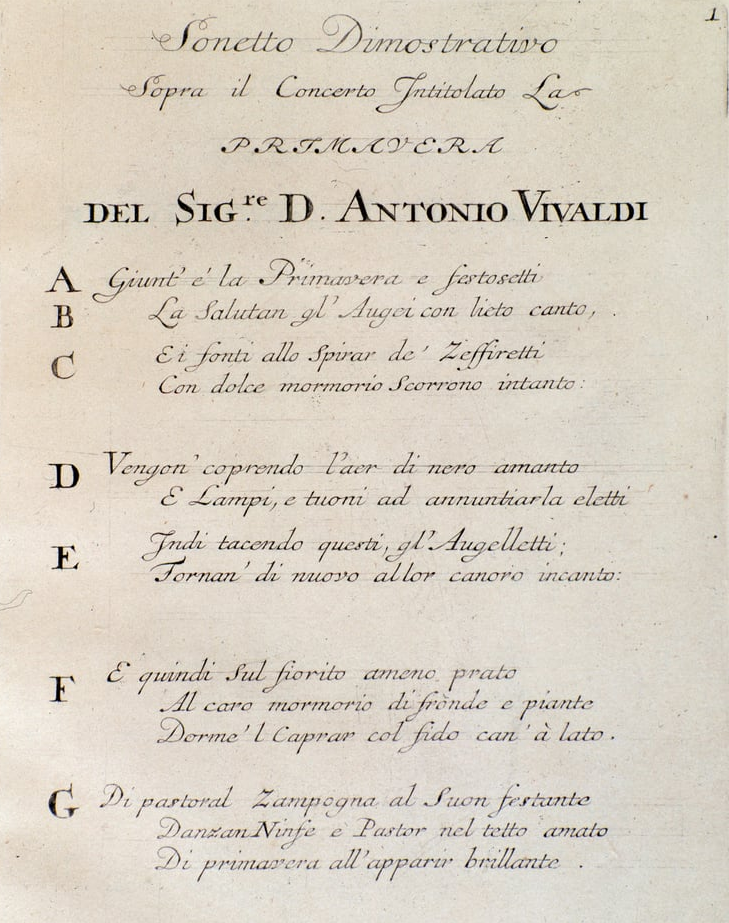
Vivaldi also shipped these concertos with the equivalent of a shot list. Each was printed alongside a sonnet, and letters set into the parts tie musical gestures to individual lines of verse. You are told what the music depicts, bar by bar. What follows is a walk through all twelve movements, the devices Vivaldi uses to fake weather with a handful of string parts, and a committed answer on which recording to buy.
A Set of Concertos That Shipped With Instructions
Antonio Vivaldi (1678–1741) spent most of his working life attached to the Ospedale della Pietà in Venice, a charitable institution for abandoned children whose all-female music ensemble drew paying visitors from across Europe. He was appointed there in 1703 as maestro di violino, and the job shapes the music in a very practical way: he had a permanent, unusually good string band on hand and a standing obligation to keep feeding it new material.
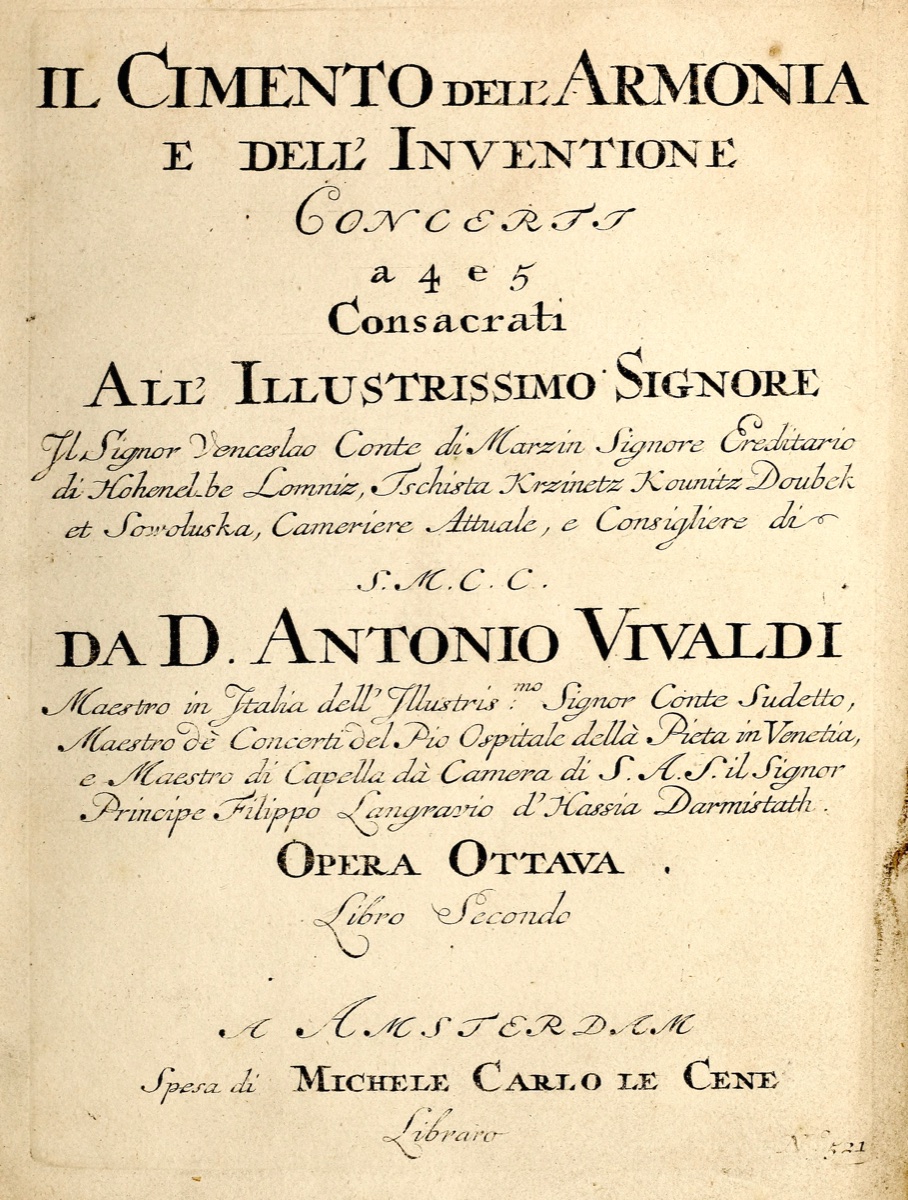
The four season concertos came later. The usual dating puts them at roughly 1718 to 1723, and they reached print in 1725, when the Amsterdam publisher Michel-Charles Le Cène issued them as the opening items of a set of twelve violin concertos, Il cimento dell’armonia e dell’inventione, Op. 8. The title means something close to the contest between harmony and invention, and the running order is a sales decision: the four most extrovert, most illustrative pieces sit at the front of the book where a browsing buyer would find them. The collection is dedicated to Count Wenzel von Morzin, a Bohemian nobleman in the service of the Habsburg emperor Charles VI.
One story needs correcting, because half the internet repeats it. You will read that The Four Seasons vanished for two centuries and was found in a library. What vanished was the rest of Vivaldi. The Op. 8 print circulated widely, was reissued by rival publishers, and never went missing. The lost material was the unpublished output — operas, sacred music, hundreds of concertos — that surfaced in Piedmont in 1926, when a monastery asked Turin library staff to appraise a stack of old volumes and the musicologist Alberto Gentili recognised autograph Vivaldi in bulk. The performing revival is usually dated to 1939, when Alfredo Casella organised the Vivaldi Week that put the composer back onto concert programmes.
A second source matters if you care what you are hearing. Manuscript partbooks now in the Henry Watson Music Library in Manchester preserve these four concertos in a text that appears to be older than the printed edition; they are associated with Vivaldi’s Roman patron Cardinal Ottoboni and were apparently presented to him in 1726. Several period-instrument groups work from that source rather than the print, and the differences are audible in ornament, articulation, and a scattering of notes.
How the Sonnets Are Wired Into the Score
Descriptive instrumental music was not new in 1725. What is unusual here is the resolution. Vivaldi does not just title a movement and leave you to imagine the rest — he prints the sonnet, letters the sonnet, and then prints those same letters over the exact bars they belong to. The effect is closer to a subtitled film than to the vague scene-painting most Baroque programme pieces settle for.
The devices are worth naming, because once you can hear them you hear them everywhere in the set.
- Ritornello form. Every fast movement alternates a fixed orchestral refrain with solo episodes. The refrain is the frame; the weather happens inside the episodes. That is why the storms land as interruptions rather than as build-ups.
- Split violins as birdsong. Vivaldi divides the upper strings so that two or three soloists trill against each other at different speeds. Birds do not sing in unison, and his do not either.
- Ostinato. A short figure repeated without variation, usually low in the texture. It is how he builds a barking dog, a sleeper’s breathing, and the drone of a rustic bagpipe.
- Tremolo and flooded scales. Reiterated notes across the whole band for thunder; long descending runs for rain.
- Pizzicato. Plucked strings as individual raindrops in the slow movement of Winter. This is probably the single most imitated idea in the work.
- Bariolage. The soloist rocks fast between a stopped note and an open string, which produces a shimmering, slightly unstable colour. It is a show-off technique and it is also, conveniently, the sound of wind.
From inside a string section, the striking thing is how little of this writing is decoration. The viola part is almost never handed a tune; it is handed a job — hold a repeating figure absolutely steady while everything above it moves. Whether the sleeping goatherd’s dog reads as comedy or as mush depends on whether the inner parts refuse to bend.
The Twelve Scenes, in Order
Spring (La primavera) in E major, RV 269
The famous refrain is over in seconds. What Vivaldi does with the space he has bought is more interesting than the tune everyone can hum: the solo violins break into birdsong, a murmuring figure in the lower strings becomes a stream, and then a short, sharp thunderstorm arrives and is gone again inside a minute. The refrain returns after the storm in a minor-tinged variant before righting itself: the same music, heard differently because of what just happened to it.
The Largo is the strangest thing in the set and my favourite three minutes of it. A solo violin plays a long, drowsy line over violas repeating a two-note figure that never changes and never lets up: the goatherd’s dog, barking through his master’s nap. There is no development. It just goes on, deadpan, for the length of the movement. Recordings that play the viola figure politely miss the joke completely; it has to be blunt and a little irritating or the gag does not exist.
The finale is a pastoral dance over a drone bass imitating bagpipes, and it is where the soloist finally shows off — leaping string crossings and wide arpeggios.
Summer (L’estate) in G minor, RV 315
If you expect sunshine, this is the shock of the set. Summer opens exhausted: sagging phrases, long silences, a texture that keeps stalling. The heat is written as a lack of energy rather than as brightness. Bird calls interrupt — a cuckoo, then a turtledove, then a goldfinch — and in context they sound less like song than like noise.
The Adagio is a masterclass in interruption: a weary solo line tries to settle and is cut off again and again by hammered orchestral chords — distant thunder and, in the sonnet, swarms of flies. Nothing resolves. It exists to make you dread the next movement.
Then the storm breaks. The Presto finale is three minutes of driving semiquavers across the entire band, with the soloist slashing through in scales and broken chords. It is the passage that gets licensed for thrillers and trailers, and for once the cliché is earned — nothing else in early eighteenth-century concerto writing is this violent for this long.
Autumn (L’autunno) in F major, RV 293
Harvest party, and Vivaldi writes the drink into the notes. The first movement starts as a foursquare peasant dance and loses its balance: the solo violin slurs across the beat, phrases arrive late, and a passage of unstable figuration depicts a man who has had far too much. It is funny if the performers commit and flat if they smooth it out.
The Adagio molto is the aftermath. Everyone has passed out. Muted sustained chords drift over the continuo and the movement barely moves — scored unconsciousness, and one of the few passages in the set with no pictorial event in it at all.
The hunt finale is the most cinematic thing Vivaldi wrote. Horn calls in the orchestra, a chase in the solo part, and then a long decline as the prey tires, is cornered and dies. The music does not soften it. A lot of performances play this as a jolly gallop; the ones that respect the sonnet let the last minute go grim.
Winter (L’inverno) in F minor, RV 297
The best of the four, and it is not close. Winter begins with no melody at all: stacked, clipped repeated notes entering one desk at a time, building a shivering texture out of nothing but rhythm and dissonance. The solo entry is a series of hard, biting scales. Vivaldi asks for a deliberately harsh sound here, and players who make it beautiful have misread the instruction.
The Largo is the tune everyone knows without knowing where it comes from. The scene moves indoors: the orchestral violins pluck out rain on the window while the soloist plays a broad, contented melody by the fire. The device is simple — sustained singing line against relentless pizzicato — and it works because the two layers never interact.
The finale sends everyone back out onto the ice. There is careful walking, then slipping, then a fall, then cracking ice, and finally the winds arriving in a passage of raw bariolage and rushing scales. Vivaldi’s last stroke is structural: the closing bars turn toward a brightness that points straight back at the opening of Spring. Play the set on repeat and the join is seamless, which I suspect is exactly the point of putting them first in the book.
Which Recording to Actually Buy
There are hundreds. Most are fine and forgettable. Four are worth your attention, and they divide by what you want from the piece.
Top pick — Fabio Biondi / Europa Galante (Opus 111)
This is the one that reset the piece — the record with which Europa Galante launched its career on the French label Opus 111. Gut strings, small band, extreme dynamic range, and tempi that go further in both directions than most rivals dare. The storm in Summer is frightening rather than merely fast, the barking dog in Spring is rude enough to be funny, and Biondi drew on the Manchester partbooks rather than the printed text, which is part of why details keep surprising you. The trade-off is real: ensemble frays at his tempi. Buy it anyway.
🎧 Also on: Apple Music · Spotify
The one that sold it to everybody — Nigel Kennedy / English Chamber Orchestra (EMI, released 1989)
Modern instruments, a full chamber orchestra, and a soloist playing with enormous rhythmic swagger. It was released in 1989 and has sold over three million copies worldwide, which makes it one of the best-selling classical albums ever made, and the snobbery it attracted has always been unfair. Kennedy’s strength is phrasing you can follow without a score: he shapes the storms like riffs. What he does less well is texture — the ECO strings are lush where Vivaldi asks for grit, and Winter loses its teeth. The best starting point for anyone who does not listen to much Baroque.
▶ Listen on YouTube · Apple Music · Spotify
If you want it as chamber music — Janine Jansen and friends (Decca, recorded 2004)
Jansen recorded it with one player per part — two violins, viola, cello, bass, theorbo and harpsichord behind her rather than a section apiece. The result is the most conversational version on this list. You hear every internal line, the continuo becomes an actual character, and the rubato is negotiated between individuals instead of imposed by a leader. It also loses something: the storms cannot generate mass, and Summer ends up sounding urgent rather than dangerous. Get this one if you already know the piece and want to hear its wiring.
▶ Listen on YouTube · Apple Music · Spotify
The historical document — Louis Kaufman / Concert Hall String Orchestra, Henry Swoboda (Concert Hall)
Some context on how new the recorded life of this music is: the first electrical recording of The Four Seasons was made in 1942 by Bernardino Molinari for Cetra, and the first American recording was made in the final week of 1947 by the violinist Louis Kaufman. Kaufman’s is the one that stuck. It won the Grand Prix du Disque in 1950 and entered the Grammy Hall of Fame in 2002. Do not make it your only version — the style is thoroughly mid-century, vibrato everywhere, continuo barely audible — but Kaufman plays warmly, and hearing the piece before the period-instrument movement reached it shows how much of what we now call Vivaldi was decided later.
▶ Listen on YouTube · Apple Music · Spotify
Follow the Letters: Listen With the Score
The fastest way to understand what Vivaldi built is to watch the notation go past while it plays. Watch for the moments where the texture splits into separate solo violins — that is the birdsong — and for the point in the Winter Largo where the accompaniment turns to plucked strings and stays there.
Where to Go Next
If the solo writing grabbed you, go next to Bach’s Violin Concerto in E major, BWV 1042, which takes Vivaldi’s ritornello architecture and makes it denser and stranger. For what this kind of writing costs the person holding the instrument, our honest answer on the Bruch concerto covers violin difficulty in plain terms. And Beethoven’s Piano Concerto No. 1 shows where the concerto idea went once orchestras grew.