Honest answer from the string section: the Bruch G minor is a genuinely professional-level concerto that happens to be the most approachable of the great Romantic ones — which is why it is so often the first major Romantic concerto an advanced student is given. It demands real technique: chords, double stops, fast passagework, octaves. What it doesn’t demand is the freakish, against-the-instrument athleticism of the Tchaikovsky or Brahms tier. The hard part of the Bruch isn’t playing the notes. It’s making the sound the piece is about.
Where it sits on the ladder
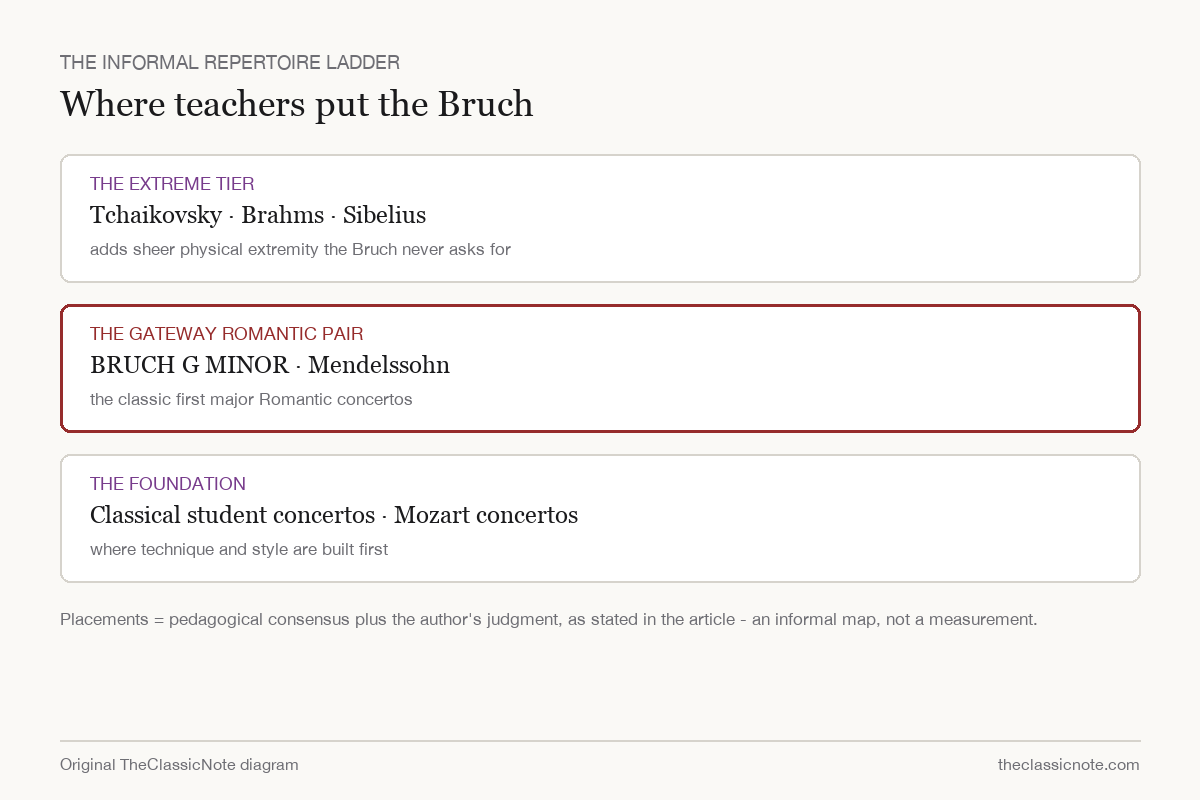
Violin teachers use an informal repertoire ladder, and the Bruch has a fixed rung on it. It comes after the classical student concertos and the Mozart concertos have done their work, and it typically arrives alongside or just before the Mendelssohn — the two are the classic gateway pair into the Romantic repertoire. Above them sit the Tchaikovsky, the Brahms, and the Sibelius — concertos that add a layer of sheer physical extremity the Bruch never asks for. That placement is pedagogical consensus, and it is also, roughly, my own judgment from years of sitting in string sections listening to what goes wrong in each of them: in the Bruch, what goes wrong is almost never a passage. It’s a phrase.
One caution about the ladder before we climb it: it measures finger difficulty, not musical difficulty, and the two come apart. The Beethoven concerto is the standard proof — technically less ferocious than the Tchaikovsky, yet routinely saved for last because there is nowhere in it to hide musically. The Bruch sits low on the finger axis and higher than its reputation on the musical one; keep both axes in mind and the question “how hard is it?” starts to have a useful answer instead of a number.
What’s actually hard, movement by movement
The first movement is literally titled Vorspiel — “prelude” — and it opens with the soloist alone, twice, in free recitative over the orchestra’s rumble. Nothing in these opening statements is fast. Everything in them is exposed: the entries have to bloom out of silence, the big multi-stop chords have to ring rather than crunch, and every listener in the hall already knows the piece. Exposure, not velocity, is the movement’s tax. The passagework that follows is real but idiomatic — it lies where a violinist’s hand wants to go.
The Adagio is where students and professionals part company, and it contains — this is the honest core of the answer — not one measurable difficulty. No fast notes, no extreme register, nothing a jury could mark wrong. It is a ten-minute test of tone, bow distribution, and the ability to keep a long melodic line alive through position changes without letting the seams show. You cannot practice your way around it with metronome discipline; you can only develop the sound. Ask a violinist which movement of the Bruch they’d least like to play cold for an audience, and the slow one wins more often than outsiders expect.
The finale opens with the violin’s most cheerful trap: the main theme arrives in double stops, and it keeps arriving in them, at energy, to the end. Add the octave passages and the coda’s accelerating drive and you have the concerto’s highest concentration of measurable technique — a movement that would not embarrass a conservatory audition anywhere. It is still writing that cooperates with the instrument: the double stops sit in friendly keys and familiar frames. Compare the finale of the Tchaikovsky, which fights you for every bar, and you feel the difference between difficult and hostile.
The misconception: “the Bruch is a student piece”
Because it’s the concerto students reach first, a lazy shorthand has formed around it — Bruch as training wheels, the thing you play before you can play something real. The concert world flatly disagrees. This is one of the most performed violin concertos in existence; it was voted the top work in Classic FM’s very first Hall of Fame poll in 1996; and every violinist you can name has kept it in their professional repertoire for life, precisely because the Adagio never stops being hard in the way that matters. “Easy for a professional to play, endless for a professional to play well” is the accurate version. A piece accessible to students that can still fill halls under the greatest soloists alive isn’t a lesser concerto — it’s an unusually well-made one.
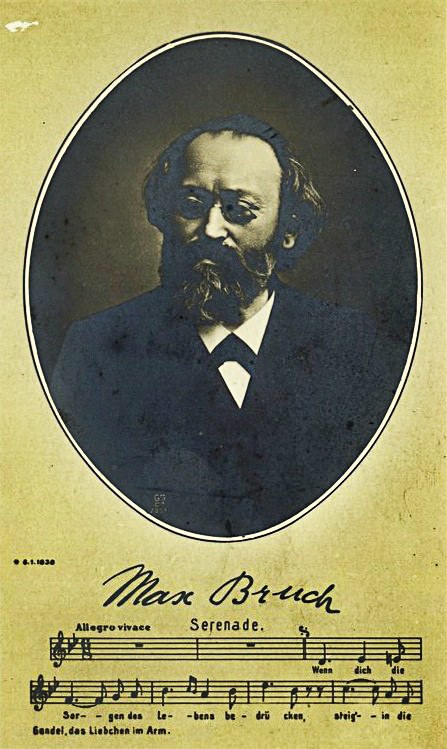
Its maker, incidentally, got almost nothing for it. Bruch sold the score outright to the publisher Simrock for a lump sum, so the royalties from the most popular thing he ever wrote never reached him; late in life, impoverished after the First World War, he handed his autograph manuscript to a pair of American pianists to sell on his behalf and died in October 1920 without ever being paid. He also came to resent the piece’s shadow — “Every fortnight another one comes to me wanting to play the first concerto,” he complained, while his two later violin concertos and much else went unplayed. The most approachable of the great concertos was, for its composer, a lifelong lesson in being reduced to one’s biggest hit.
Hear what “approachable” sounds like at full quality
Fittingly for the concerto’s rung on the ladder, here is a conservatory performance — the Royal College of Music’s orchestra with a student soloist, playing it the way it’s meant to go:
🎧 Also on: Apple Music · Spotify
Listen to the first solo entry — how much of the effect is nerve and tone rather than fingers — and then to the finale’s double-stop theme, where you can hear the writing meeting the player halfway. For how the piece sits in the wider landscape of the form, our violin concerto guide maps the whole territory.
Why it feels so playable: Joachim’s fingerprints
The Bruch lies well under the hand, and that is not luck. After the concerto’s first premiere in April 1866 — soloist Otto von Königslöw, the composer conducting — Bruch rewrote the piece extensively with the advice of Joseph Joachim, the era’s defining violinist, and the revised version Joachim premiered in Bremen in January 1868 is the concerto we play. A great violinist’s practical intelligence is baked into the solo part: the chords voice themselves under a violinist’s fingers, the running passages follow the geography of the fingerboard, the double stops favor frames the hand already knows. From inside the string section, this is the clearest difference between the Bruch and the concertos above it on the ladder — the hard ones make the instrument do things it resists; the Bruch asks the instrument for things it was always willing to give, and spends the difficulty budget on sound instead. That is also, not coincidentally, why it’s the right first Romantic concerto: it teaches a student what their instrument sounds like at full voice, before other pieces start charging for every note.
A realistic preparation picture, for anyone weighing it up: the notes of the outer movements come together in weeks for a player at the right level — that is the “approachable” part, and it’s real. What follows is the longer project: getting the opening recitatives to speak like a voice rather than an exercise, keeping the finale’s double stops ringing at tempo instead of merely surviving them, and building an Adagio you’d willingly play for people who know the piece — which, for a work this universally loved, is everyone. Teachers reach for the Bruch first not because it’s quickly finished but because every one of those problems is worth years, and the piece is generous enough to reward each stage of the work in public. That’s the honest meaning of “the easiest of the great Romantic concertos”: easiest to begin, like the others in never being done.
Sources and notes
The concerto’s dates and revision history — the April 1866 first performance with Otto von Königslöw, Joachim’s advisory role, the January 1868 Bremen premiere of the revised version, the G minor key and Op. 26 designation, and the first movement’s Vorspiel title — are drawn from the standard literature on the work. So are the Simrock lump-sum sale, the post-war manuscript affair and Bruch’s death in October 1920, the “every fortnight” complaint, the existence of his later, neglected violin concertos, and the 1996 Classic FM Hall of Fame result. The difficulty placements, the movement-by-movement assessment, and the characterization of the writing as idiomatic are the string player’s judgments this article was written to give, and are marked as such; where they align with pedagogical consensus, the text says so.