Most people meet classical music in a dark room with popcorn in their lap. You can hum the sunrise from 2001. You know the helicopter music. You have heard the sad string piece from the Vietnam film at three funerals since. What you probably do not have is the name of the piece, or any idea where to hear the whole thing without dialogue on top of it.
That is what this page fixes: the canon of classical music in movies, cue by cue, with the exact scene, what the director gets out of it, and one specific recording to go hear it properly. A pattern runs underneath all of it. A Mozart concerto has carried a Swedish film’s title on record sleeves for close to sixty years, and Barber’s Adagio became “the Vietnam music” for a generation that never opened a score. These films took the repertoire and handed it back relabelled.
Spoiler warning: this article discusses scenes from the films below, including endings.
Part one: the cues everyone can hum
Also sprach Zarathustra (opening) — Richard Strauss
The scene: the first frames of 2001: A Space Odyssey, sun rising over the curve of the Earth with the Moon lined up above it, and again when the ape picks up the bone. Two low Cs from organ and basses, a trumpet climbing C–G–C, timpani, then the orchestra landing on a major chord that turns minor and back.
Here is the running joke of its fame: the fanfare is ninety seconds of a half-hour tone poem, and most people who love it have never heard minute four. Kubrick had commissioned an original score from Alex North, recorded roughly forty minutes of it, then dropped it for the classical tracks he had been cutting to. North found out at the premiere.
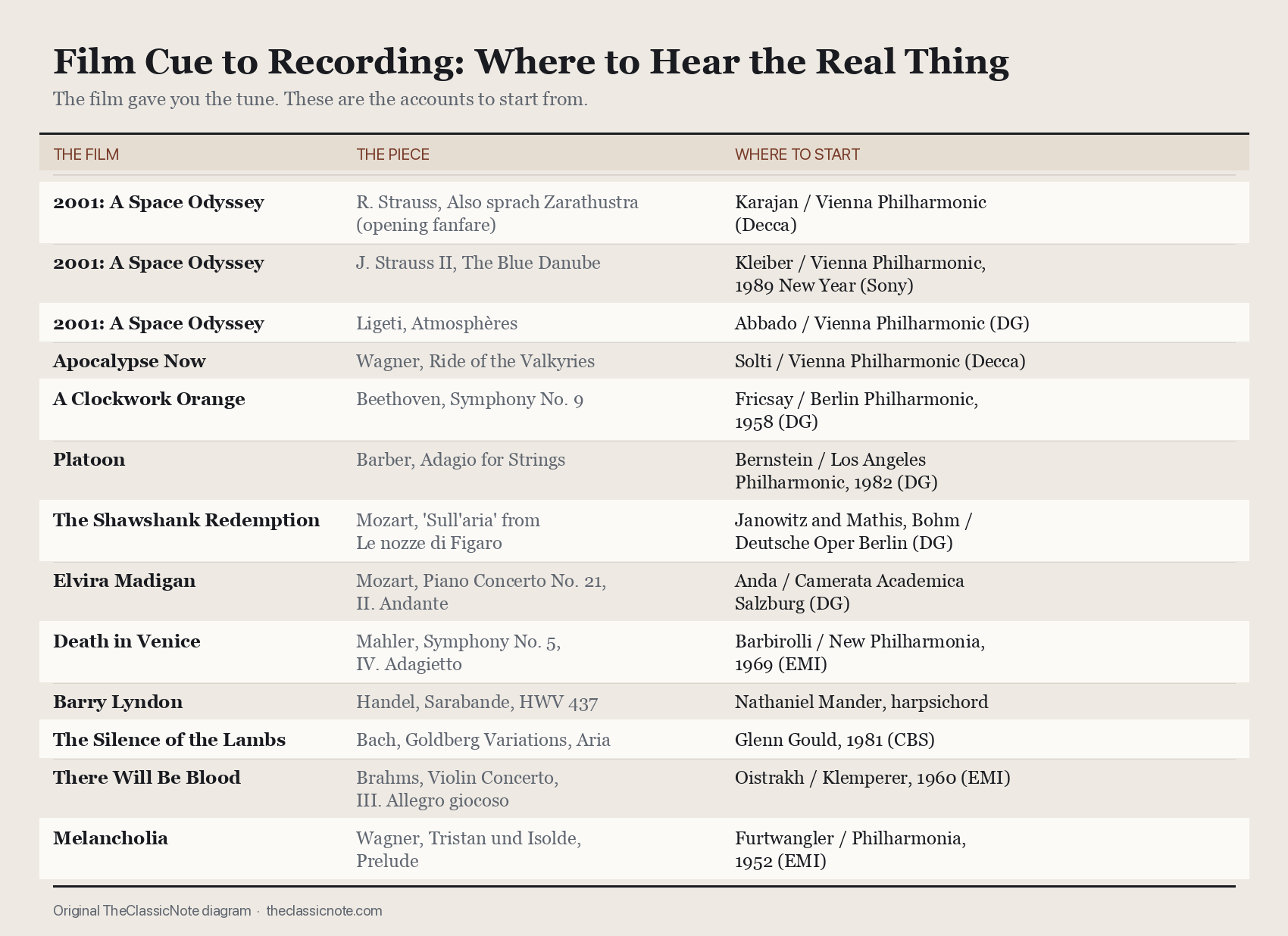
The film uses Karajan’s Vienna Philharmonic recording for Decca, uncredited on release because Decca did not want its recording associated with the picture. The MGM soundtrack album substituted Karl Böhm with the Berlin Philharmonic — so the album a million people bought is not the take they heard in the cinema.
🎧 Also on: Apple Music · Spotify
The Blue Danube — Johann Strauss II
The scene: the Pan Am shuttle turning toward the wheel-shaped space station, and later the descent to the Moon. Kubrick lets the waltz run at length while almost nothing happens on screen.
My reading of why it lands: a waltz is the most rigidly regular music there is, three beats forever, and docking a spacecraft is a problem of matching rotation exactly. The shuttle really does look like it is being led around a ballroom. Kubrick never explained it, so treat that as interpretation.
Go to Carlos Kleiber and the Vienna Philharmonic at the 1989 New Year’s Concert on Sony. Kleiber does the one thing separating a Viennese waltz from a metronome: the second beat arrives fractionally early, all night. Most other recordings sound square after it.
▶ Listen on YouTube · Apple Music · Spotify
Atmosphères and Requiem — György Ligeti
The scene: every appearance of the monolith, and the Star Gate sequence. The Kyrie of Ligeti’s Requiem covers the monolith; Atmosphères takes over as Bowman falls through the light. No tunes, barely any rhythm — dozens of independent lines packed so tightly they read as one shifting cloud.
This is the cue that made the film feel genuinely alien in 1968, and Ligeti had no idea it was happening. He learned about it from a friend after release, nobody had asked him, and he sued MGM. Aventures was used electronically altered and left off the credits entirely.
Claudio Abbado and the Vienna Philharmonic recorded Atmosphères live at the Musikverein in October 1988 for Deutsche Grammophon. Start there: it has the hall around it, which matters more here than in almost any other repertoire, because the piece is an experiment in what a room does to a sustained sound.
▶ Listen on YouTube · Apple Music · Spotify
Ride of the Valkyries — Richard Wagner
The scene: Apocalypse Now, Kilgore’s helicopter assault on a coastal village. The music sits inside the film’s world — Kilgore has it piped through loudspeakers on the choppers because, he says, it scares the enemy. The soundtrack album credits Georg Solti and the Vienna Philharmonic.
What Wagner wrote is eight Valkyries shouting across a mountaintop while collecting dead soldiers, so Coppola did not have to reach for the association. The dotted rhythm in the strings is the part your body reacts to: a galloping figure that never resolves, so it loops under the scene forever.
Solti’s Vienna Ring for Decca is still the reference, and this scene is where it is most obviously a studio production — the singers are placed at different distances, so the shouts really do arrive from across a mountain.
▶ Listen on YouTube · Apple Music · Spotify
Symphony No. 9 — Ludwig van Beethoven
The scene: A Clockwork Orange. Alex loves “Ludwig van”, and the Ludovico conditioning films he is strapped in front of are scored with the Ninth, so the treatment leaves him unable to hear his favourite music without nausea. Wendy Carlos, with Rachel Elkind, realised the Beethoven and the Rossini overtures on Moog synthesizers; the title music is her electronic version of Purcell’s music for Queen Mary’s funeral.
Carlos’s synthesized Ninth is the most quietly vicious idea in the film: take the symphony that ends with a plea for universal brotherhood, strip the human beings out, hand it back as something a machine performs. That reading is mine rather than a documented statement of intent, but the sound does the work.
For the original, Ferenc Fricsay’s 1958 Berlin Philharmonic recording on Deutsche Grammophon is the one I keep returning to — the finale sounds argued rather than proclaimed, and Fischer-Dieskau’s baritone entry lands like a man interrupting. Compare it with the more monumental accounts in our guide to the best recording of Beethoven’s Fifth.
▶ Listen on YouTube · Apple Music · Spotify
Adagio for Strings — Samuel Barber
The scene: Platoon — the slow-motion sequence in the burning village, and Elias’s death with his arms raised as the helicopter pulls away. Stone uses it as a recurring theme rather than a single cue, so by the end the piece and the war are welded together.
From inside a string section this piece is an exercise in nerve. No winds to hide behind, a line that climbs stepwise for four minutes, and a famous moment that is not the top note but the silence after it, which the whole orchestra has to sit in without anyone twitching. That silence is what Stone puts under a body falling.
Bernstein’s 1982 Los Angeles Philharmonic recording for Deutsche Grammophon runs past ten minutes and is among the slowest on record. It is close to unbearable, which I mean as praise. If you want the piece to breathe rather than grieve, take a faster account; we cover that repertoire in classical music for a funeral.
▶ Listen on YouTube · Apple Music · Spotify
“Sull’aria” from Le nozze di Figaro — Wolfgang Amadeus Mozart
The scene: The Shawshank Redemption. Andy locks himself in the warden’s office, puts a record on the prison PA, and lets a Mozart duet play across the yard until the guards break the door down. He gets two weeks in solitary for it.
The joke almost nobody in the audience is in on: the two women are dictating a fake love letter to entrap a philandering count. It is a scheming song. Red’s narration is right that the words do not matter — what carries is the second soprano echoing the first a beat behind, two voices agreeing over a plain accompaniment. That is as close as opera gets to two people conspiring in perfect sympathy, which is the film’s subject.
The performance in the film is by Edith Mathis and Gundula Janowitz. Böhm’s Deutsche Oper Berlin Figaro for Deutsche Grammophon is where to hear it in context, and context changes it: three minutes earlier the Countess is humiliated, three minutes later the plot detonates.
🎧 Also on: Apple Music · Spotify
Part two: the films that renamed the music
Piano Concerto No. 21, second movement — Wolfgang Amadeus Mozart
The scene: the 1967 Swedish film Elvira Madigan, a tightrope walker and a deserting officer in a summer field, heading toward a suicide pact. The Andante plays over the idyll, which is why it now sounds like doom in a meadow to anyone who has seen it.
This is the clearest case of a film overwriting a work. The concerto has been sold as the “Elvira Madigan” concerto ever since — on sleeves, in concert programmes, in streaming metadata — a Mozart piece from 1785 carrying the name of a Danish circus performer.
The recording in the film is Géza Anda directing the Camerata Academica of the Salzburg Mozarteum from the keyboard, on Deutsche Grammophon. Anda plays it straight and slightly cool, which is why it works under images instead of fighting them.
▶ Listen on YouTube · Apple Music · Spotify
Symphony No. 5, Adagietto — Gustav Mahler
The scene: Visconti’s Death in Venice, from the steamer arriving through the lagoon to Aschenbach dying in a deckchair with dye running down his face. Mann’s Aschenbach is a writer; Visconti made him a composer, which is what licenses the film to run on Mahler for two hours.
The Adagietto is harp and strings only — no winds, no brass, nothing to change colour with. From the stand it feels like a movement you have to carry on breath alone: every entry is exposed, and the harp is the only thing keeping time. That scoring is the reason it works over water and empty hotel corridors. Nothing in the texture can suggest anyone else is coming.
Barbirolli’s New Philharmonia recording from July 1969 for EMI is my pick. He takes the Adagietto broadly but keeps the string tone warm rather than pale, and the outer movements around it are properly savage — which stops the piece becoming a stand-alone mood track.
▶ Listen on YouTube · Apple Music · Spotify
Sarabande, HWV 437 — George Frideric Handel
The scene: the main title of Barry Lyndon, then every duel and reversal in the film. Kubrick had Leonard Rosenman arrange Handel’s keyboard Sarabande for orchestra and reused it so relentlessly that it works as a death knell. Rosenman won the Oscar for scoring adaptation at the 48th Academy Awards; the film’s other great cue, the second movement of Schubert’s Piano Trio in E flat, Op. 100, carries the marriage.
Handel’s original is a modest keyboard piece of a couple of minutes, a dance in three with a heavy second beat. Rosenman slowed it, added timpani and low strings, and turned a dance into a procession — the clearest demonstration in the movies that arrangement, not melody, is what makes music feel fatal.
Hear the original on a harpsichord, at speed: Nathaniel Mander’s performance is brisk and unsentimental, and it will surprise you if you only know the film.
▶ Listen on YouTube · Apple Music · Spotify
Part three: the modern picks
Goldberg Variations, Aria — Johann Sebastian Bach
The scene: The Silence of the Lambs. Lecter has the Aria on a cassette player in his cell in Memphis and keeps it running through the escape. The soundtrack credits the performance to Jerry Zimmerman, so the widespread belief that you are hearing Glenn Gould is wrong.
The choice works because the Aria is a sarabande too — slow, ornamented, utterly composed. It does not react to the violence, and a piece that refuses to react is more frightening than one that screams. We take the Lecter cues apart in classical music in the Hannibal movie.
For the real thing: Gould’s 1981 re-recording for CBS. The Aria is slower and plainer than his 1955 version, ornaments underplayed, and it sounds like a man who knows how the next eighty minutes go.
▶ Listen on YouTube · Apple Music · Spotify
Violin Concerto, third movement — Johannes Brahms
The scene: the last minutes of There Will Be Blood. Plainview finishes with Eli in the bowling alley, says the line about being finished, and the Allegro giocoso crashes in over the cut to black and runs through the credits. Jonny Greenwood’s score is scraped, dissonant string writing for two hours; the Brahms is the first tonal, jubilant music in the film, and it arrives immediately after a murder.
Anderson has not spelled out why and I would not pretend to know, but the effect is unmistakable: a Hungarian-flavoured dance tune, all triple-stopped chords and stamping rhythm, celebrating something the audience has just watched with horror.
David Oistrakh with Otto Klemperer and the Orchestre National de la Radiodiffusion Française, recorded in Paris in June 1960 for EMI, is my pick. Oistrakh plays the finale heavy and rooted rather than flashy, which suits the film’s version of triumph exactly.
▶ Listen on YouTube · Apple Music · Spotify
Tristan und Isolde, Prelude — Richard Wagner
The scene: all of Melancholia. Lars von Trier scores the film almost entirely with the Prelude, looping it from the slow-motion overture to the planet’s arrival, with the Act III prelude over the credits.
The Prelude opens with a chord that does not resolve, and Wagner spends four hours withholding the resolution. Von Trier attaches that to a woman who cannot function and a planet on a collision course, repeating the unresolved opening until the collision supplies the cadence the music never got. Whether or not he intended the parallel, it is the most structurally exact use of classical music on this list.
Furtwängler’s 1952 Philharmonia recording for EMI, made at Kingsway Hall with Kirsten Flagstad, remains the reference. The Prelude there is slow and unstable in a way later stereo versions smooth out — you can hear the orchestra hunting for the harmony.
▶ Listen on YouTube · Apple Music · Spotify
The standout: Ligeti in 2001
If one cue here does more work than any other, it is Ligeti under the monolith. Everything else is a director borrowing an existing meaning — Wagner already meant war, Barber already meant grief, the Blue Danube already meant elegance to be undercut. Ligeti’s music had no public meaning at all in 1968, and after 2001 it had exactly one: something that is not human and does not explain itself. Decades of science fiction sound design descend from those minutes.
The runner-up is Barber in Platoon, for the opposite reason. The Adagio already carried mourning with it, and Stone turned the dial up until the piece could not be heard as anything except a war elegy. A film does not need to change a note to change what a piece is for.
Where to go next
At the recent end of this story the picture changes — contemporary directors tend to use classical music ironically or inside the scene rather than for elevation, and we work through those choices in classical music in modern movies. For more cues, see classical music in famous movies and our breakdown of Vivaldi’s Winter in John Wick 3.