Every couple of years a film shoves a two-hundred-year-old piece of music back into people’s ears and the same question goes round: what was that? Here is the answer for eleven modern films — the exact scene, what the director gets out of it, and one recording worth hearing away from the picture.
One pattern first. The cues that stick are rarely the ones that agree with the scene. Barber’s Adagio over a dying man is the blunt version, working the way a hammer works. The ones that stay dangerous refuse to cooperate: Bach while a man plans an escape, Mozart drifting over a prison yard, Brahms in a bright D major straight after a murder. Directors raid the concert repertoire because it arrives pre-loaded with feeling nobody had to earn. The good ones aim it sideways.
Spoiler warning: this article discusses specific scenes from the films below, including endings.
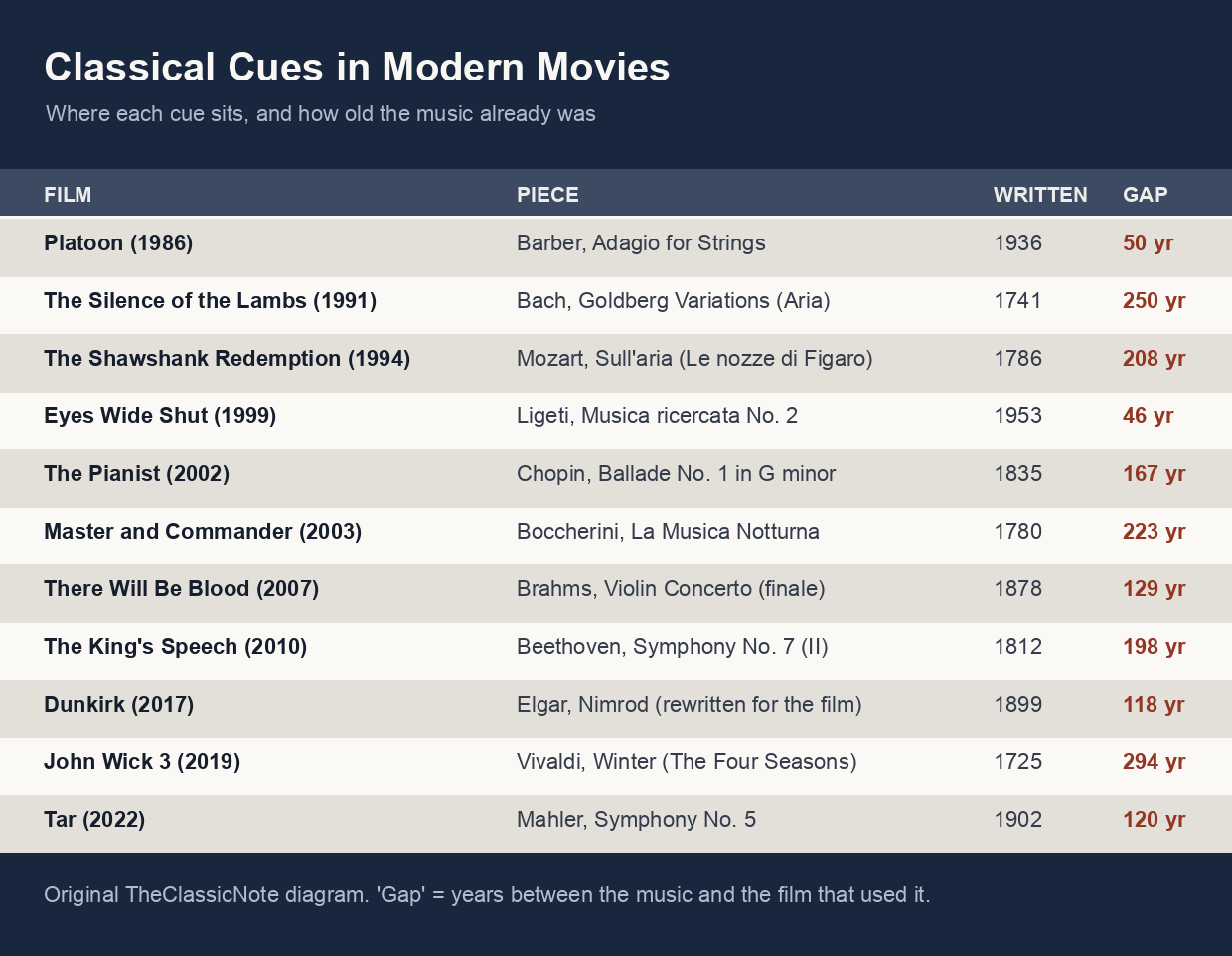
Eleven cues, film by film
Platoon (1986) — Barber, Adagio for Strings
The scene: Sergeant Elias, played by Willem Dafoe, breaks out of the treeline with the North Vietnamese Army behind him and his arms going up, while the helicopter carrying his platoon pulls away above him. Oliver Stone drops the gunfire and rotor noise and lets the Adagio finish the sequence.
Barber arranged the piece in 1936 from the slow movement of his String Quartet, Op. 11, and Arturo Toscanini gave the first performance with the NBC Symphony Orchestra in a radio broadcast on 5 November 1938. It is one long stepwise line that climbs, hands off between the sections, stalls on a huge unresolved chord and falls into silence — and Stone times that collapse to the moment Elias goes down. The least subtle cue here, and still one of the best: the piece was already a public grief object before the film existed. Stone borrowed a reflex, he did not invent one.
From inside a string section the Adagio is a nightmare of exposure: everyone is on the same slow line at different pitches, so a bow change not matched with the desk in front of you shows instantly. Good performances sound like breathing; bad ones sound like a stuck chord. Leonard Bernstein with the Los Angeles Philharmonic (Deutsche Grammophon) takes it slowly enough that the seams show, and holds them together anyway.
🎧 Also on: Apple Music · Spotify
The Silence of the Lambs (1991) — Bach, Goldberg Variations (Aria)
The scene: Lecter’s cage in the Memphis courthouse. He has a cassette player, the guards bring his dinner, and the Aria that opens Bach’s Goldberg Variations is playing when the attack starts and still playing after it.
The Aria is a sarabande — a slow triple-time dance leaning on the second beat — decorated to the point of primness, published by Bach in 1741 as the frame for thirty variations. Demme’s choice is not ironic in the cheap sense: the music is fastidious, patient and self-contained, which describes the character too. What makes it land is that nothing is cut to the beat. The music keeps its own tempo while the picture does something it has no opinion about.
For the piece itself, go to Glenn Gould’s 1981 remake for CBS. It is far slower than his famous 1955 debut, the ornaments are weighted rather than flicked, and when the Aria returns at the end it sounds like a different piece.
▶ Listen on YouTube · Apple Music · Spotify
The Shawshank Redemption (1994) — Mozart, “Sull’aria… che soave zeffiretto”
The scene: Andy Dufresne locks the guard in the warden’s bathroom, puts a record on the office turntable and pipes the duet out to the whole prison over the public-address system. This is one of the rare cases where the recording on screen is documented rather than guessed: Gundula Janowitz and Edith Mathis with the orchestra of the Deutsche Oper Berlin under Karl Böhm, credited on the film’s soundtrack album.
Here is the joke nobody in the yard is in on. In Le nozze di Figaro, premiered in Vienna on 1 May 1786, this is no hymn: it is the Countess dictating a fake love letter for her maid to write, a trap set for her own husband. Two sopranos in close thirds, one echoing the other phrase by phrase — it sounds like grace and it is a conspiracy. Red says he has no idea what they were singing about and does not want to know. That is the whole cue: the beauty travels fine without the meaning attached, which is either the most generous thing in the film or the saddest.
The Böhm is still the one I would hand somebody: unhurried, the two voices balanced so you hear the imitation rather than just the blend.
▶ Listen on YouTube · Apple Music · Spotify
Eyes Wide Shut (1999) — Ligeti, Musica ricercata No. 2
Ligeti’s cycle, written between 1951 and 1953, follows a rule: the first movement uses two pitch classes, the second three, and so on upward. No. 2 is therefore three notes — a repeated middle pitch with a hard low interruption — marked mesto, rigido e cerimoniale. Kubrick uses it as a recurring motif across the film rather than as one set-piece cue; the performance heard is by the pianist Dominic Harlan.
Why it works is almost mechanical. Three notes cannot build tension by harmony, so the piece builds it by repetition and by the gap between strikes: you start waiting for the next one, and the waiting is the anxiety. It is the closest thing here to sound design written by a major composer.
Pierre-Laurent Aimard’s Sony recording is my pick: he weights the repeated note slightly differently each time, so it never turns into a drum machine.
🎧 Also on: Apple Music · Spotify
The Pianist (2002) — Chopin, Ballade No. 1 in G minor
The scene: Wladyslaw Szpilman, found hiding in a ruined Warsaw house by the German officer Wilm Hosenfeld, is asked what he did for a living and told to play. He plays the First Ballade on a wrecked grand while Hosenfeld listens without moving. The soundtrack performance is by Janusz Olejniczak, who also doubled Adrien Brody’s hands.
Worth knowing: in Szpilman’s own memoir he played the Nocturne in C sharp minor at that meeting, not the Ballade. One commonly given explanation is that the Nocturne already carries the opening of the film and Polanski did not want to repeat it. Either way the Ballade, published in 1836, is the better dramatic choice: it opens with a bare rising line that stops on a chord which refuses to resolve. Krystian Zimerman’s Deutsche Grammophon recording takes that opening slower than almost anyone and lets the chord sit there.
▶ Listen on YouTube · Apple Music · Spotify
Master and Commander (2003) — Boccherini, La Musica Notturna delle Strade di Madrid
The scene: the last one. Aubrey and Maturin, violin and cello, playing in the cabin as the ship comes about. Boccherini wrote the quintet in 1780 to imitate a Madrid street at night — church bells, beggars, a military night patrol.
The last section, the Ritirata, is a set of variations over a march that starts almost inaudibly, swells as the patrol nears and fades as it walks off. Peter Weir ends a film about a ship that is always going somewhere with music about something passing by. The smartest cue here, and the one fewest people notice, because half the audience is already standing up.
Jordi Savall with Le Concert des Nations (Alia Vox) is the version I keep returning to: gut strings, a real crescendo out of nothing, and the guitar-imitation effects played as noise rather than decoration.
▶ Listen on YouTube · Apple Music · Spotify
There Will Be Blood (2007) — Brahms, Violin Concerto (finale)
The scene: Daniel Plainview says “I’m finished,” the picture cuts to black, and the finale of the Brahms Violin Concerto starts under the credits. After two hours of Jonny Greenwood’s scraping dissonance, it is the first cheerful music in the film.
Brahms wrote the concerto in 1878 and Joseph Joachim premiered it in Leipzig on 1 January 1879. The finale is a rondo with a Hungarian accent: a stamping double-stopped tune, open strings ringing, an ending that grins. Paul Thomas Anderson puts it straight after the ugliest thing in the film. People call that a joke at the audience’s expense; I read it the other way — the world simply carries on being enjoyable, which is worse.
David Oistrakh with Otto Klemperer and the French National Radio Orchestra (EMI): broad, unhurried, no gloss, and the finale lands like a dance rather than a sprint.
▶ Listen on YouTube · Apple Music · Spotify
The King’s Speech (2010) — Beethoven, Symphony No. 7, second movement
The scene: the 1939 declaration-of-war broadcast, George VI getting through it a phrase at a time. The Allegretto of Beethoven’s Seventh — premiered in Vienna on 8 December 1813 — runs under almost the whole sequence, credited on the album as “Speaking Unto Nations.” The film’s editor, Tariq Anwar, put it in; Alexandre Desplat, who wrote the score, defended it and said he could not have competed with it.
The fit is structural, not sentimental. The Allegretto is built on one rhythmic cell — long, short-short, long, long — repeated without really developing. It does not argue, it accumulates: one voice, then another on top, until the whole orchestra is on it. That is a man assembling a sentence out of syllables. The film uses only about the first third of the movement, which is why people who go looking are surprised by how long the real thing keeps going.
Carlos Kleiber’s Vienna Philharmonic recording for Deutsche Grammophon is the standard: rhythm dead level, inner parts audible, and he never leans on the sadness.
🎧 Also on: Apple Music · Spotify
Our guide to the best recording of Beethoven’s Fifth takes the same approach to a far more crowded field.
Dunkirk (2017) — Elgar, “Nimrod” (rewritten)
This is not a quotation, and calling it one is the commonest mistake made about the film. The cue is “Variation 15,” arranged by Benjamin Wallfisch with Hans Zimmer and Christopher Nolan. It takes Elgar’s ninth Enigma variation — the Adagio nicknamed “Nimrod,” premiered in London on 19 June 1899 — stretches it far slower than Elgar’s marking and strips out most of the swell that makes the original a Remembrance Sunday fixture.
My read: Nolan wanted the harmony without the ceremony. In its usual form “Nimrod” tells you how to feel about the dead; slowed to a crawl and thinned out, it stops being a memorial and turns into something closer to relief. Purists hate it. It is the most defensible reworking here, because it never pretends to be Elgar.
Hear the original with Sir John Barbirolli and the Philharmonia (EMI), still the warmest Enigma on record; “Nimrod” is the ninth variation.
▶ Listen on YouTube · Apple Music · Spotify
John Wick: Chapter 3 – Parabellum (2019) — Vivaldi, “Winter”
The scene: the Continental, Winston pouring himself a drink and asking Charon to open his personal armoury. The first movement of “Winter” — from the set Vivaldi published in Amsterdam in 1725 — plays as source music, all shivering repeated notes with a violin line cutting across them.
Beautifully cynical scoring: a hotel that runs on etiquette playing the most well-mannered music available while the staff arm for a siege. The odd part is that the cue is missing from the soundtrack album, which carries a score track called “Winter at the Continental” instead — we chased down what actually plays in Vivaldi’s Winter in John Wick 3.
Fabio Biondi and Europa Galante is the period-instrument version to hear: fast, scratchy, genuinely cold. For the full four-concerto argument, see the best recording of Vivaldi’s Four Seasons.
▶ Listen on YouTube · Apple Music · Spotify
Tár (2022) — Mahler, Symphony No. 5
The whole plot hangs on it: Lydia Tár is preparing to record Mahler’s Fifth, the last piece missing from her cycle. The Dresden Philharmonic recorded the symphony for the film with Cate Blanchett conducting, which is why the rehearsal scenes survive scrutiny in a way film rehearsals rarely do.
Mahler wrote the symphony in 1901 and 1902 and conducted the premiere in Cologne on 18 October 1904. The movement everyone knows is the fourth, the Adagietto, and its trick is subtraction: strings and a single harp, no winds and no brass, inside a symphony that opens with a trumpet fanfare. Nothing is loud, so every phrase depends on where the players put the bow and how long they wait.
That waiting is the fight. Mengelberg got through the Adagietto in about seven minutes in 1926; Bernard Haitink took roughly fourteen with the Berlin Philharmonic in 1988. The film knows this argument — it is about a conductor who treats tempo as a moral decision. Sir John Barbirolli’s New Philharmonia recording sits on the slow side without going limp.
▶ Listen on YouTube · Apple Music · Spotify
The one cue that does the most work
It is the Mozart in Shawshank, and it is not close. Every other cue here does one job: telling you how to feel (Barber), undercutting you (Brahms), setting a mood (Ligeti). The letter duet does three at once — it lifts the scene, quietly mocks itself, and makes an argument about what music is for that the narration then says out loud. Remove the Adagio from Platoon and you still understand the scene. Remove the Mozart and there is no scene left.
Runner-up: Boccherini in Master and Commander. It asks nothing of you and rewards you if you notice.
What is verifiable here, and what is not
There is a difference between the claim that a film uses a piece and the claim that a film uses one particular recording of it, and most writing about film music slides between the two. Everything in the first category above comes from soundtrack listings and the films’ own credits. The second is much thinner.
Two are documented: the Shawshank duet is the Janowitz/Mathis/Böhm performance credited on the album, and the Chopin in The Pianist is Olejniczak, credited on screen. Tár is a third case, since its Mahler was recorded for the film rather than licensed.
The one I will not tell you is The Silence of the Lambs. People say Glenn Gould, usually the 1955 recording, and I have found no credit that stands it up: the released soundtrack album is Howard Shore’s score and does not include the Aria at all. So the film uses the Aria, and the Gould pick above is mine, not a claim about the tape in Lecter’s cell. Where a scene placement could not be pinned down — the Ligeti, which recurs rather than sitting in one spot — I have said so instead of inventing a moment.
For the same exercise on a single title, where the choices get much stranger, see our breakdown of classical music in the Hannibal TV series.