The Continental has just lost its protection, John Wick has one hour before the hotel stops being neutral ground, and Winston’s answer to all of it is to pour himself a glass of wine and have Charon open the armory. Then a violin concerto starts.
The piece is Vivaldi’s Winter. If you went hunting for it on the soundtrack album afterwards, you probably found track 20 — it is literally called “Winter at the Continental” — pressed play, and heard something that was not Vivaldi at all. That track is a Tyler Bates and Joel J. Richard score cue. The Vivaldi is not on the album. So this is the forensic version: what is actually playing in that room, whose hands are on the violin, and why the movement the film picked is the least obvious one in the concerto.
Spoiler warning: this article discusses scenes from John Wick: Chapter 3 – Parabellum, including the final act.
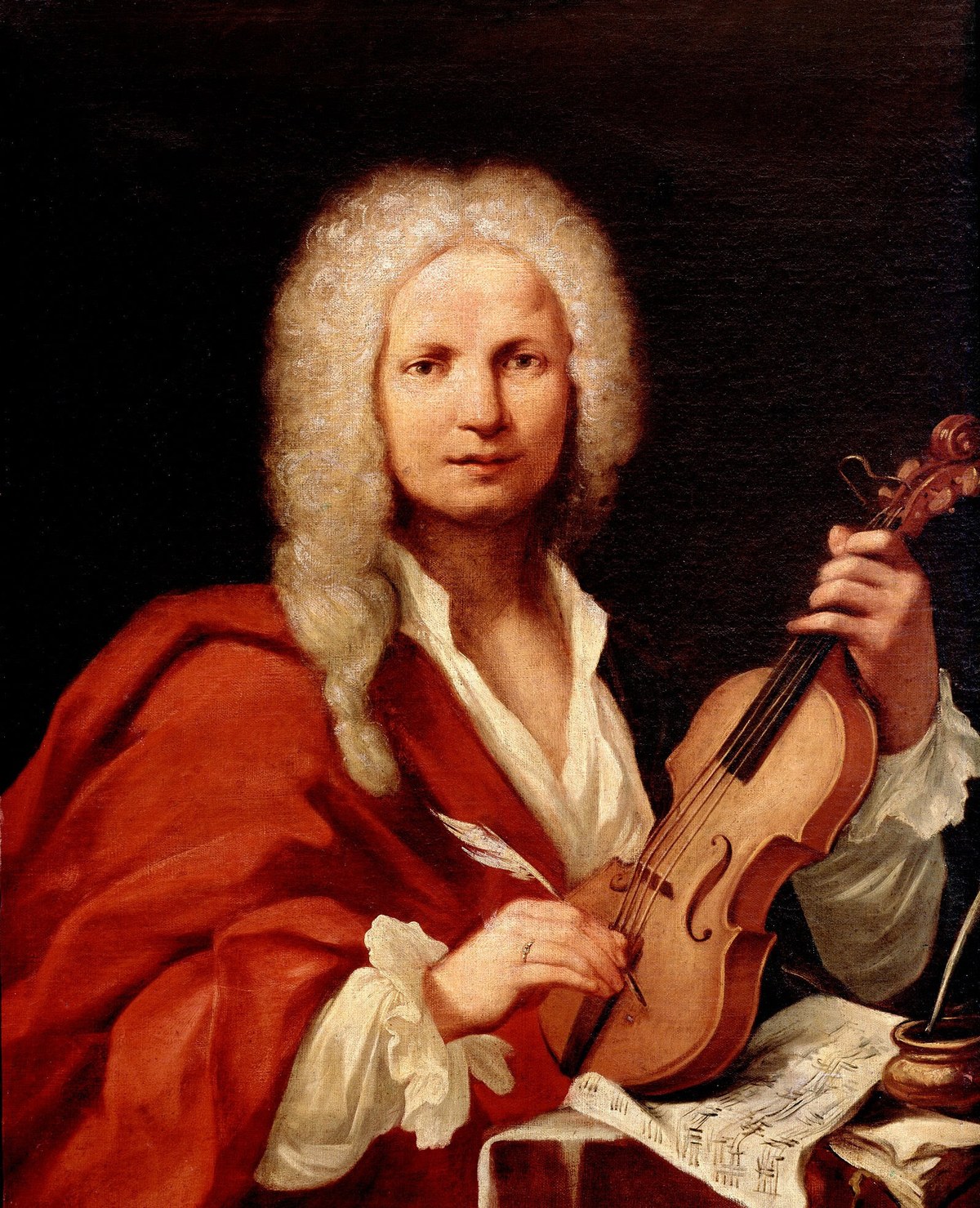
The scene, and where the music actually sits
Chad Stahelski’s third film spends its last stretch turning the Continental from a sanctuary into a target. In the sequence in question, Winston (Ian McShane) pours himself a drink and asks Charon (Lance Reddick) to open his personal armory and let John take his pick of the weapons. Charon walks him through the hardware. John chooses. Nobody raises their voice. The Vivaldi runs underneath the whole transaction.
What makes the placement odd — and good — is the contrast with everything around it. The score for this film, by Bates and Richard, mostly works in low synthesizer pulses, distorted low end, and percussion that behaves like machinery. Cutting from that into a concerto printed in 1725 is a genuine break in the surface of the film. Chapter 3 does it three times in total: a Tchaikovsky excerpt in the ballet sequence, this Vivaldi, and a Grieg Sarabande in the same late stretch of the film. If you want the map of all three, we covered how the Tchaikovsky and the Grieg divide up the rest of the film’s classical work in a separate piece; this one stays inside the Vivaldi.
My reading — and it is a reading, not something the film states — is that the concerto plays like source music rather than score. It has the flat, slightly indifferent presence of something already playing in the room, which is a very different effect from music laid over a scene to tell you how to feel. The film never underlines the point, so treat that as interpretation.
What is playing: Winter, first movement
The exact piece is the Violin Concerto in F minor, RV 297 — the fourth of the twelve concertos Vivaldi published in Amsterdam in 1725 as Il cimento dell’armonia e dell’inventione, his Op. 8. The first four of those twelve are the ones everyone knows as The Four Seasons, and Winter is the last of the four. The movement in the armory scene is the opening one, marked Allegro non molto — literally “fast, but not very”.
Dating the music is messier than dating the print. The usual position is that the concertos were written around 1718–1723, while Vivaldi was chapel master in Mantua, though some scholars argue for an earlier window — Karl Heller has proposed 1716–17. Treat any single year you see attached to The Four Seasons with suspicion; the 1725 date is the publication, not the composition.
Each of the four concertos was printed alongside a sonnet, broken into three chunks that line up with the three movements. Nobody knows who wrote the sonnets. One common argument for Vivaldi’s own authorship is exactly that three-way split, which suggests someone writing to fit music that already existed. The lines attached to the movement in the armory scene are these:
To tremble from cold in the icy snow, / In the harsh breath of a horrid wind; / To run, stamping one’s feet every moment, / Our teeth chattering in the extreme cold
That is not weather writing. It is body writing. Every image in it is something happening to a person — shivering, stamping, chattering — and Vivaldi set it as physical repetition rather than as landscape.
Here is what that sounds like in practice. The movement opens with no melody at all: one instrument repeating a single note in short, detached attacks, then a second joining a step away, then a third, until the orchestra is a stack of pulses grinding against each other in F minor. The harmony moves by half-steps, so the stack keeps souring without ever resolving. Only after that pile-up does the solo violin enter, and its first material is not a tune either — it is fast repeated notes and trills, the teeth-chattering figure, followed by scale flurries that rip upward and fall back. Vivaldi keeps deferring the cadence. The music accumulates and accumulates and refuses to arrive.
Cynthia Freivogel with Voices of Music, on gut strings and one player to a part. Watch the opening thirty seconds with the video on, not just the audio: you can see the repeated notes being taken as separate bow strokes, which is the thing the piece is built out of and the thing a big modern string section tends to smooth into a hum.
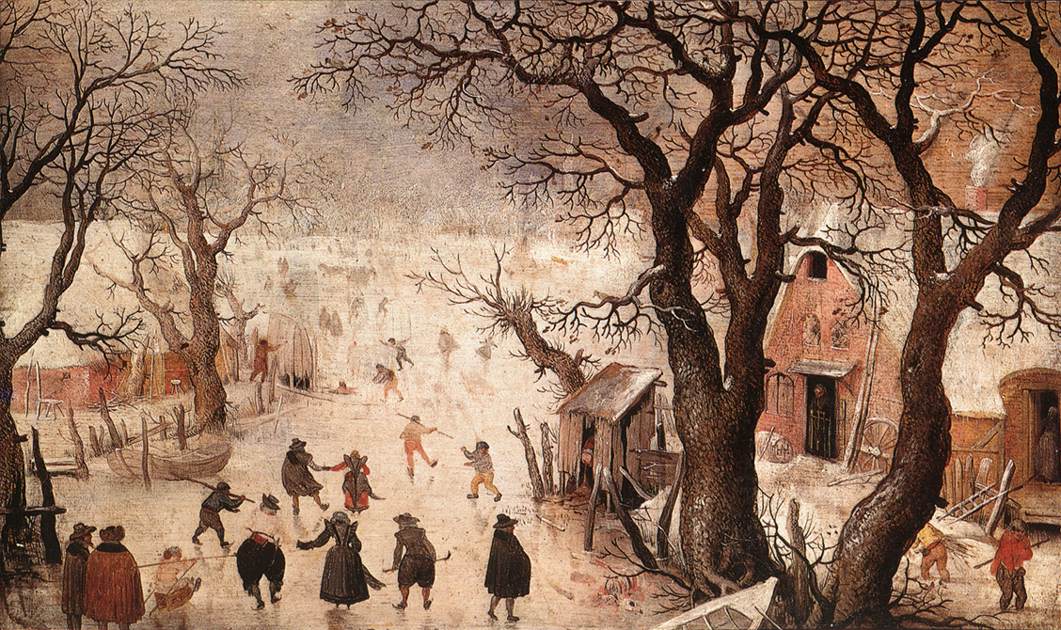
The movement they didn’t use
Here is the part I find genuinely interesting about the choice. Winter has three movements, and the first one is not the violent one. The finale is. Its sonnet section reads:
We tread the icy path slowly and cautiously, / for fear of tripping and falling. / Then turn abruptly, slip, crash on the ground and, / rising, hasten on across the ice lest it cracks up. […] The desert wind, the North wind and all the winds at war / this is winter, which nonetheless / brings its own delights.
Ice cracking, bodies hitting the ground, every wind in the compass fighting. If you handed a music editor an action film and told them to find something in The Four Seasons, that finale is what I would have bet on. It is the movement built for cutting to violence.
The film takes the first movement instead, and I think that is the smarter call by a wide margin. The finale is already the fight — it has the impacts, the falls, the storm. But the armory sequence is not a fight. Nothing is happening yet. Men are picking up objects and loading them, knowing exactly what is coming, and the music that fits that is not weather but physiology: repetition, no development, no release. The first movement is anticipation with the resolution withheld. The finale would have been the film shouting before anyone had drawn.
Hear the difference for yourself — the storm finale is ▶ Listen on YouTube in the same Voices of Music performance. Put it against the scene in your head and you can feel it arrive about ninety seconds too early.
Whose recording is in the film
This is the part almost nobody gets right, because two different things share a name.
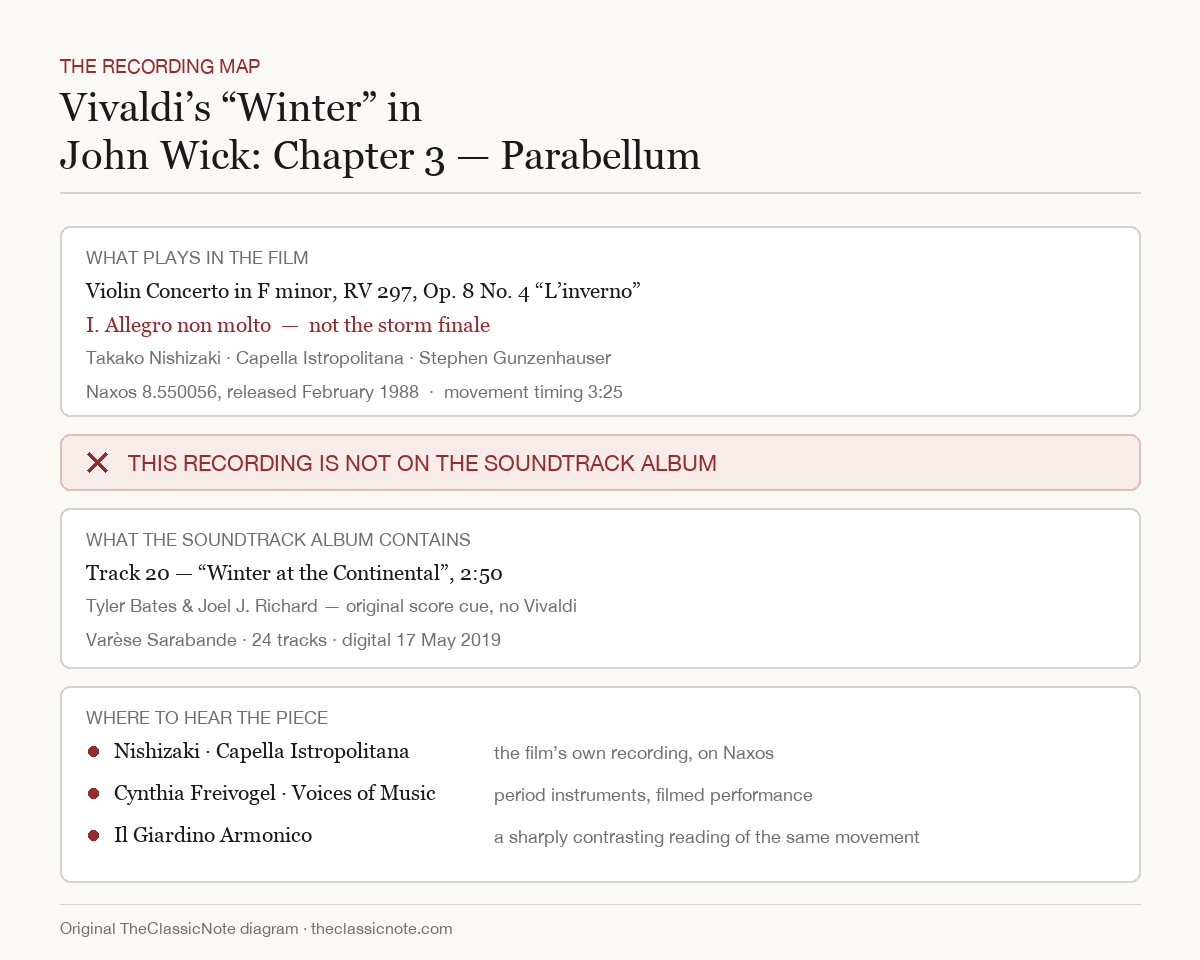
The film’s music credits list Winter as performed by Capella Istropolitana with Takako Nishizaki as soloist, conducted by Stephen Gunzenhauser, courtesy of Naxos. That performance sits on Naxos 8.550056, released in February 1988, where the first movement of Winter is timed at 3:25. Capella Istropolitana is a Bratislava chamber orchestra founded in 1983, and it recorded prolifically for Naxos through the label’s early years.
Which is to say: the Vivaldi in John Wick is a budget-catalogue Four Seasons. Modern strings, unfussy tempo, none of the snarl and rhetorical shoving that period-instrument bands brought to this music in the nineties. On its own I would not push it on anyone as a listening choice — it is competent and characterless, the kind of disc that ended up in every supermarket bargain bin.
And it is exactly right for the scene. A Fabio Biondi or an Il Giardino Armonico Winter is an interpretation with opinions; it performs at you, and in that room it would have pulled focus from three men counting rounds. The Naxos reading just plays. It sounds like a record someone owns rather than a statement someone is making — which, in a hotel that has kept the same manners for a century, is the correct texture.
One caveat, stated plainly: end-credit music listings are the best public evidence available for a cue like this. There is no publicly posted cue sheet for the film, so “this exact master is what you hear on screen” rests on those credits rather than on documentation from the production. It is strong evidence. It is not a document I can hand you.
If you want to hear the exact performance the film licensed: ▶ Listen on YouTube.
Why the soundtrack album sends people the wrong way
The album — Varèse Sarabande, released digitally on 17 May 2019 — has twenty-four tracks, and number 20 is a two-minute-fifty cue called “Winter at the Continental,” credited to Bates and Richard. It is named after the scene. It is not the Vivaldi. Vivaldi’s Winter, along with the Tchaikovsky and the Grieg, was licensed for the film and left off the album, which is completely normal for pre-existing classical recordings and completely maddening if you are the person searching for the thing you heard.
So if you bought the album and thought you had misremembered the scene: you didn’t. You were sold a cue named after a piece of music that isn’t on it.
The twenty seconds that do the most work
If I had to point at one stretch of this cue and say that is why the scene lands, it is the opening — the pile-up before the soloist enters. No melody, no beat you could march to, nothing to hum. Just short attacks accumulating, one voice at a time, in a key that keeps refusing to settle.
Set against men opening cases and filling magazines, the accumulation works like weight settling onto a shelf that has not yet given way. Nothing in the music spends what it gathers — and that restraint is the point, because spending is precisely what the storm finale exists to do, and the film is holding that in reserve. Vivaldi wrote the passage to make you shiver. In a hotel armory it plays like the last quiet minute the building will ever have.
That is my read, not the filmmakers’. I have not seen any statement from Stahelski or the music team explaining the pick, and I would rather flag the gap than invent a motive for them.
It is also, I think, the whole case for the first movement over the finale. Everything this opening does — accumulation without release, tension without impact — is exactly what the storm finale cannot do, because the finale spends its energy the moment it starts. If you skipped the section above on the movement they didn’t use, this is the evidence for it.
Where to hear Winter properly
Capella Istropolitana, Takako Nishizaki, Stephen Gunzenhauser (Naxos, 8.550056) — start here, because this is the film’s own recording. The entire point of this article is that the thing you heard in the armory is not on the album; this is where it actually lives. If what brought you here is that scene, no other version scratches the itch first.
▶ Listen on YouTube · Apple Music · Spotify
Voices of Music, Cynthia Freivogel (violin) — the embed above, for when you want to watch the piece being played, not just hear it. Gut strings, one player to a part, and filmed well enough that you can see the repeated notes taken as separate bow strokes — the physical gesture the whole movement is built out of. For a cue whose engine is articulation, seeing the bows matters.
🎧 Also on: Apple Music · Spotify
Il Giardino Armonico — the opposite temperament, and worth hearing once even if you decide you hate it. Sharp accents, extreme dynamic swings, tempos that lurch. Some listeners find it thrilling; others find it mannered showmanship. I lean thrilling, with the caveat that it is a poor first encounter with the piece.
▶ Listen on YouTube · Apple Music · Spotify
If this sent you down the Vivaldi hole rather than the John Wick one, the sensible next move is the other three concertos and how Op. 8 hangs together as a set — Summer‘s finale, in particular, does the storm thing better than Winter‘s does. And if you would rather keep watching films: we track what the franchise does with classical music across all four Wick films, and the pieces that keep resurfacing in movies generally.
Sources and notes
The identification of the cue as Vivaldi’s Winter and its absence from the album come from the published track listing for the John Wick: Chapter 3 – Parabellum soundtrack. The performer credit — Capella Istropolitana, Takako Nishizaki, Stephen Gunzenhauser, courtesy of Naxos — comes from the film’s music credits as listed on IMDb; I could not find a publicly posted cue sheet and have flagged that limit above rather than dressing it up. Recording metadata for Naxos 8.550056, including the February 1988 release and the 3:25 timing of the first movement, comes from the label’s own catalogue page. The scene description follows the film and a published review of it. Sonnet texts, translations, the 1725 Amsterdam publication of Op. 8, the 1718–1723 composition window and Karl Heller’s earlier dating all come from the standard reference literature on The Four Seasons; the authorship of the sonnets is genuinely unsettled and I have not written it as settled. Everything about why the cue works is my judgment as a listener and is marked as such.