Watch John Wick pull a record off the shelf before the last stand at the Continental, drop the needle, and square up against a small army — and the thing scoring the bloodshed isn’t a synth pulse or a trap beat. It’s Vivaldi. A violin concerto published in 1725, about a man shivering in the snow, suddenly becomes the sound of Keanu Reeves loading magazines into antique pistols. That contrast is the whole trick, and the John Wick films run it more deliberately than any action franchise this side of Kubrick.
Most people remember these movies for Tyler Bates and Joel J. Richard’s throbbing electronic score, and for the neon-and-blood club sequences. But scattered through the series — and concentrated almost entirely in Chapter 3 – Parabellum — is a small, precise set of classical cues that do heavy emotional lifting. Here’s every one of them: the piece, the exact scene, why it lands, and where to hear the real thing done properly.
Spoiler warning: this article discusses specific scenes from John Wick: Chapter 3 – Parabellum and Chapter 4, including late-film moments.
Why John Wick reaches for the classics
The John Wick sound is mostly original: Tyler Bates and Joel J. Richard built the pounding score across the series, and it’s brilliant at what it does. So when a real classical piece shows up, it’s not background — it’s a choice. In Chapter 3, those choices came through music supervisor Kevin Edelman, who slotted a handful of famous concert works as diegetic music (records playing, rehearsal-room speakers) rather than underscore. That distinction matters: the characters can hear these pieces too, which is why they feel like taste, like a world with its own rituals.
The result is a franchise that treats classical music the way it treats a good suit or a well-kept hotel — as a marker of an old, disciplined order underneath all the carnage. It’s worth noticing where these cues cluster: the first film leans on rock and electronic needle-drops, and the series’ classical moments arrive almost entirely in Chapter 3, once the story has expanded into the ritual-bound world of the High Table, the Ruska Roma and the Continental’s traditions. The more the series is about codes and old institutions, the more it reaches for old music. Below is the full map before we go cue by cue.
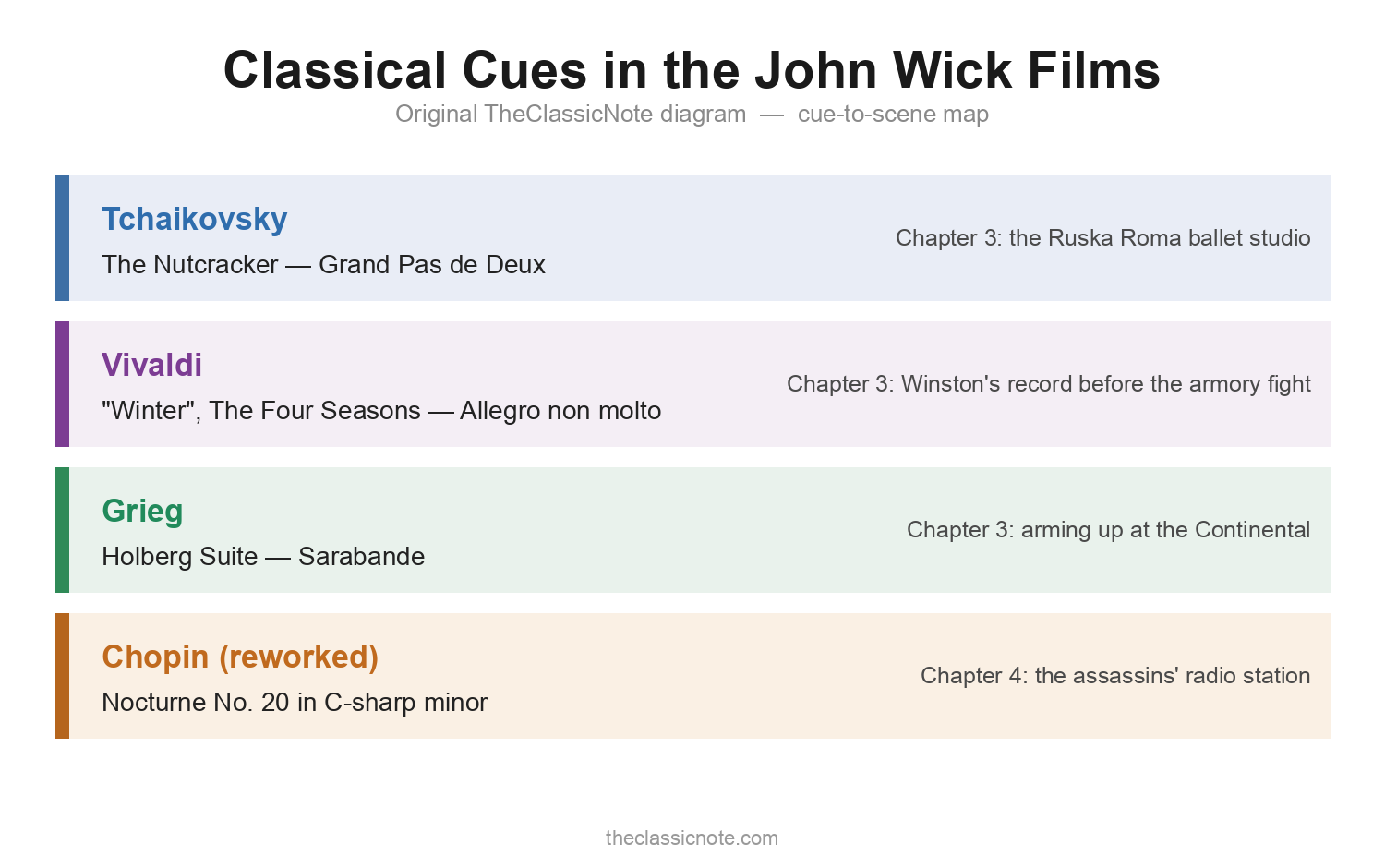
Tchaikovsky — The Nutcracker, grand pas de deux
The scene: Early in Chapter 3, John goes to the Tarkovsky Theater, home of the Ruska Roma, to call in an old debt with the Director (Anjelica Huston). The place is a ballet academy that doubles as an assassin factory. As John waits, a young ballerina rehearses under punishing supervision, dancing — and stumbling — to the great adagio from Tchaikovsky’s Nutcracker: the grand pas de deux of the Prince and the Sugar Plum Fairy. This is the sweeping number with the famous descending scale in the strings, not the tinkling celesta solo that usually gets called “the Nutcracker music.”
Why it works: One reading — and this is interpretation, not the filmmakers’ stated intent — is that the pas de deux is the most tender, most “civilized” music Tchaikovsky ever wrote, and the film sets it against a child being drilled into a weapon. The beauty of the melody makes the cruelty of the training land harder. Tchaikovsky knew how to make strings ache, and here that ache belongs to the dancer, not the killer.
Hear the real thing: The grand pas de deux is only about four minutes long, and it rewards a big, warm string section that lets the descending line bloom rather than rushing it. The performance below gives you exactly that.
If the lush Tchaikovsky string sound is what pulled you in, the same DNA runs through his Serenade for Strings, Op. 48 — start there next.
Vivaldi — “Winter,” The Four Seasons
The scene: This is the one people quote. Deep into Chapter 3, John and Charon prepare to defend the Continental. Winston opens the hotel’s museum-like cases of antique weapons, drops a vinyl record onto a player, and the first movement of Vivaldi’s “Winter” — Allegro non molto, from the Violin Concerto in F minor, RV 297 — comes rattling out as the two men arm themselves for the siege. Guns and knives from another century, scored by music from another century.
Why it works: “Winter” is storm music. Vivaldi published it in 1725 with a sonnet printed above the score describing teeth chattering in the icy wind, and the Allegro non molto opens with those clipped, shivering repeated notes in the strings before the solo violin cuts through like a gust. Dropped into the armory scene, the tremor in the music becomes anticipation — the calm-before-violence jitter of two professionals who know exactly how bad the next hour will be. It’s playful and menacing at once, which is the John Wick tone in a single concerto.
There’s a neat rhyme here, too. Vivaldi’s original concerto is program music — it was always meant to depict something, to tell a tiny wordless story of cold and fire and slipping on ice. So when the film borrows it, it isn’t draping abstract “prettiness” over a gunfight; it’s swapping one narrative for another and trusting you to feel the seam. A listener who knows the sonnet gets an extra layer, but you don’t need it: the music’s built-in unease does the work whether or not you can name the movement.
Hear the real thing: “Winter” lives or dies on bite. A period-instrument band with gut strings and a fearless soloist will make those repeated notes actually shiver; a plush modern orchestra can smooth the cold right out of it. This crisp period-instrument reading leans into the edge.
Want the full picture — Spring, Summer, Autumn and Winter, and what each concerto’s hidden sonnet is telling you? We break it down in our guide to Vivaldi’s The Four Seasons.
Grieg — Holberg Suite, Sarabande
The scene: The Grieg comes right on the heels of the Vivaldi, still inside the Continental as John and Charon organize their arsenal. The cue is the Sarabande, the second movement of Edvard Grieg’s Holberg Suite, Op. 40 — a slow, dignified dance for string orchestra. Where “Winter” is nervy, the Sarabande is composed and almost mournful, a deep breath before the storm breaks.
Why it works: Grieg wrote the Holberg Suite in 1884 to mark the 200th anniversary of the writer Ludvig Holberg’s birth, and he built it out of old Baroque dance forms — a deliberate look backward at “olden style.” That backward glance is the point in John Wick: the Sarabande carries a sense of ceremony and lost order, exactly the mood of two men preparing, with grim courtesy, to die well. It’s the sound of the High Table’s crumbling etiquette turned into a slow dance.
Hear the real thing: The Sarabande wants unhurried, singing strings with real weight on the downbeats. This chamber-orchestra performance keeps the dance’s dignity without dragging it.
Grieg’s gift for turning folk and old forms into something instantly memorable is even clearer in his Peer Gynt Suite No. 1 — the “Morning Mood” and “In the Hall of the Mountain King” composer, at his most cinematic.
The Vivaldi-tinted score, and the Chapter 4 radio
The classics don’t only show up as needle-drops. In Chapter 2 (2017), set largely in Rome, director Chad Stahelski pushed for an Italian flavor, and Joel J. Richard folded Vivaldi directly into the original score — the cue “Presto (Museum Battle)” reworks Vivaldi’s own material into the fight through a modern-art exhibition. It’s not a straight recording of a concert piece; it’s Vivaldi filtered through the John Wick machine, which is its own kind of tribute.
By Chapter 4 (2023), the filmmakers built a whole conceit around music: an in-world assassins’ radio station whose DJ spins tracks over the action. The film’s classical moment, though, comes away from the DJ booth: a reworked version of Chopin’s Nocturne No. 20 in C-sharp minor — the aching, posthumously published nocturne — plays as the contract goes out on John. If that piece got under your skin, the gateway to Chopin’s nocturnes proper is the beloved Nocturne in E-flat major, Op. 9 No. 2.
The standout cue
If I have to pick one, it’s Vivaldi’s “Winter” in the armory. The Nutcracker pas de deux is the more emotionally complex choice and the Grieg is the most quietly beautiful, but the “Winter” drop is the one that fuses image and music into a single idea you can’t unsee: violence as an old, practiced craft, elegant and cold. It’s also the cue that sends the most people searching for the source afterward — which, for a piece written 300 years ago, is a small miracle of movie music. That’s the entire argument for classical music in film, made in ninety seconds.
Where to hear these pieces properly
All four works are streaming-catalog staples — you’ll find dozens of versions of “Winter,” the Nutcracker, the Holberg Suite and Chopin’s nocturnes on any major service. My advice: for the Vivaldi, seek out a period-instrument recording so the cold actually bites; for the Grieg and the Tchaikovsky, favor a warm string sound that lets the slow melodies breathe. The embeds above are good starting points, and the linked ClassicNote guides go deeper on the best full recordings of each work.
Sources and notes
Cue identifications and scene placements were checked against the published soundtrack listings for John Wick: Chapter 3 – Parabellum and film-music databases; the Chapter 2 Vivaldi cue and the Chapter 4 Chopin selection against their respective soundtrack documentation. Historical facts about the works (Vivaldi’s RV 297 and its sonnet, Grieg’s 1884 Holberg Suite) come from standard reference sources. Where I read a director’s intent into a cue, I’ve flagged it as interpretation rather than fact — the films rarely explain these choices on the record.
FAQ
What is the classical song when John loads his guns in John Wick 3?
It’s the first movement, Allegro non molto, of Vivaldi’s “Winter” from The Four Seasons (Violin Concerto in F minor, RV 297). Winston plays it on a record as John and Charon arm themselves inside the Continental before the final defense.
Is the ballet music in John Wick 3 from The Nutcracker?
Yes. The rehearsal scene at the Ruska Roma’s Tarkovsky Theater uses the grand pas de deux (the Prince and the Sugar Plum Fairy) from Tchaikovsky’s Nutcracker — the big string adagio, not the celesta “Dance of the Sugar Plum Fairy.”
What is the slow string piece after the Vivaldi in John Wick 3?
That’s the Sarabande from Grieg’s Holberg Suite, Op. 40, a stately Baroque-style dance for string orchestra that continues as John and Charon organize their weapons.
Does John Wick use an original score or classical music?
Both. The bulk of the series is an original electronic-orchestral score by Tyler Bates and Joel J. Richard. The classical pieces appear mostly as deliberate diegetic cues in Chapter 3, plus a Vivaldi-derived cue in Chapter 2 and a reworked Chopin nocturne in Chapter 4.
Is there classical music in the first John Wick movie?
Not really. The 2014 original leans on rock, electronic and alternative tracks alongside the Tyler Bates score — think Marilyn Manson and Le Castle Vania rather than concert-hall repertoire. The franchise’s classical streak only becomes prominent in Chapter 3, once the world-building leans hard into the rituals of the High Table and the Ruska Roma.