- Composer
- Dmitri Shostakovich
(1906–1975) - Work
- Symphony No. 7 in C major, Op. 60 ‘Leningrad’
- Composed
- 1941
- World premiere
- 5 March 1942, Kuibyshev (now Samara)
- Key
- C major
- Scoring
- Large orchestra with swollen brass — 8 horns, 6 trumpets, 6 trombones — plus piano, two harps, xylophone and a full percussion battery
- Movements
- I. Allegretto
II. Moderato (poco allegretto)
III. Adagio
IV. Allegro non troppo - Duration
- About 80 minutes
The most famous march in twentieth-century music is partly a stolen operetta number. In the first movement of the Leningrad Symphony a snare drum starts ticking, a tune walks in — cheap, catchy, slightly music-hall — and then it refuses to leave. Almost everybody hears tanks. What is actually on the page is a pastiche, and a chunk of it comes from Franz Lehár’s operetta The Merry Widow: Danilo’s entrance number, Da geh’ ich zu Maxim.
That single fact reorganises the symphony. This is not a piece that paints the enemy as monstrous; it paints the enemy as vulgar — a nightclub song played by a machine until the machine is the only thing in the room. Hear the operetta inside the march and the rest stops being war paint.
Below: the mechanism behind that first movement, the conditions the piece was written and first played under, a movement-by-movement listening plan, and three recordings that turn the same score into three different pieces. If you just want a starting point, it is Mravinsky, and I will tell you why.
The tune inside the invasion march
The first movement opens in daylight. Strings in unison, a broad C major theme, the sound of a city that still works. Then the texture empties out and a snare drum begins a rhythm it will keep for a very long time. Over it comes the march: a 22-bar tune, first plucked almost inaudibly by the strings, then handed round the orchestra, each pass louder and more heavily scored than the last. Nothing develops. The tune does not argue with itself, does not modulate anywhere meaningful, does not earn its growth. It simply gets bigger.
Name the mechanism, because most writing about this piece goes vague here: it is an ostinato crescendo — fixed pattern, unchanging harmonic floor, instruments and weight added a layer at a time. Ravel ran the same engine in Boléro, and Shostakovich knew everyone would say so. The difference is the material fed in. Ravel used a sinuous solo line; Shostakovich used light operetta, and something that trivial amplified to the threshold of pain does not read as majesty. It reads as nausea.
From inside a string section this is one of the strangest passages in the repertoire to play. For minutes on end there is no phrase to shape and nowhere to hide: short repeated notes, a dynamic that must climb without ever arriving, a snare drum setting a pulse you cannot drift from. Orchestras rehearse it as a mechanical exercise, because that is what it is. The coldness is not something a conductor adds on top — it is written into how the parts feel under the hand.
Then the march breaks. The brass turn on it, the texture shreds, and what follows is the passage Shostakovich himself thought was the movement’s core — a slow, sagging lament that he described as a requiem. That is the actual centre of gravity of the first movement, and it is the part nobody quotes. When the opening theme comes back it is thinner, played by a solo bassoon over a drained accompaniment. Same notes, no city left standing behind them.
Written in a city that was starving
Shostakovich began the symphony in Leningrad in 1941, in the weeks after Germany invaded the Soviet Union on 22 June of that year. He was teaching at the Leningrad Conservatory and serving as a volunteer fire warden; a widely circulated photograph of him in a fireman’s helmet turned him into an international emblem of Soviet resistance when it ran on the cover of Time magazine on 20 July 1942.
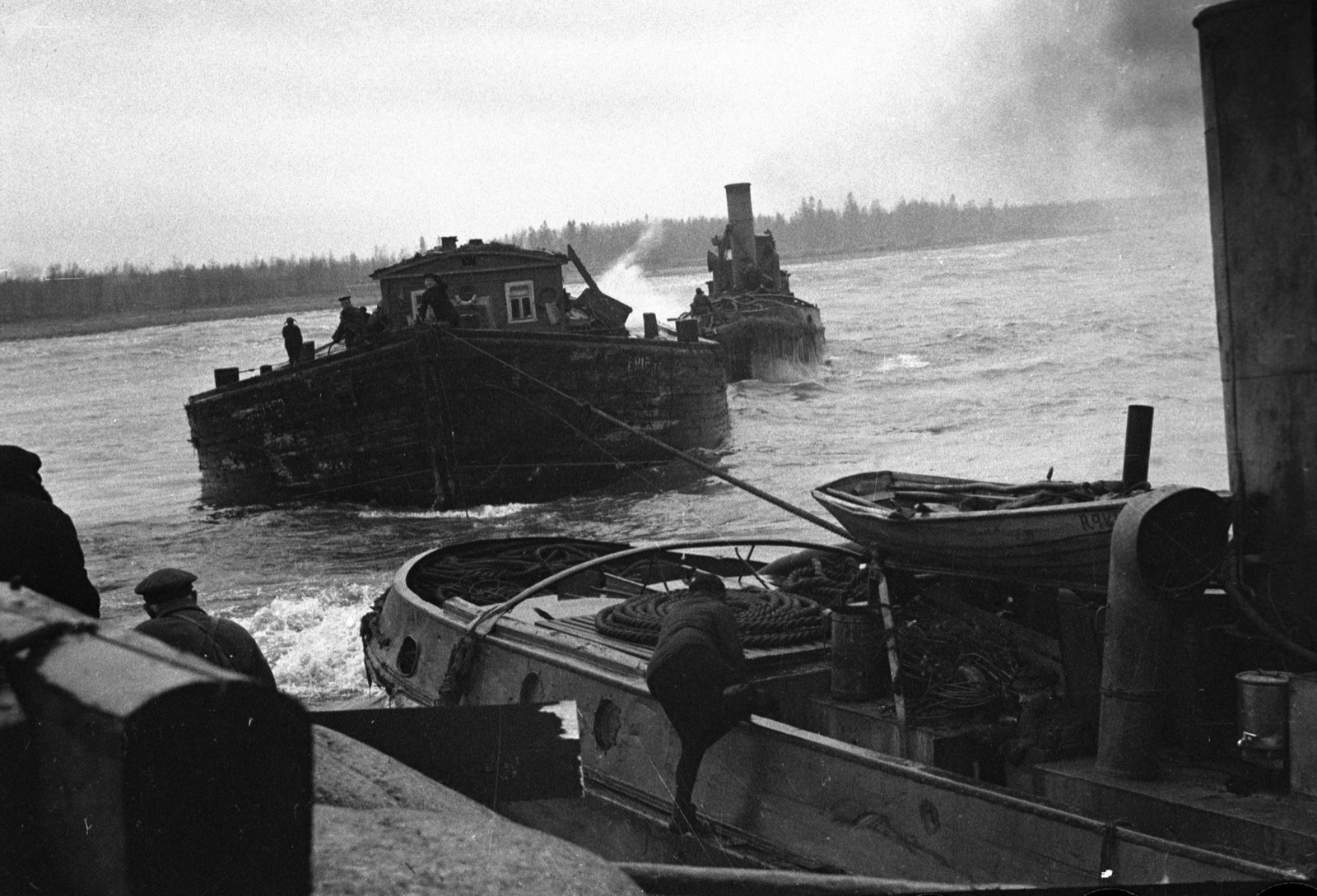
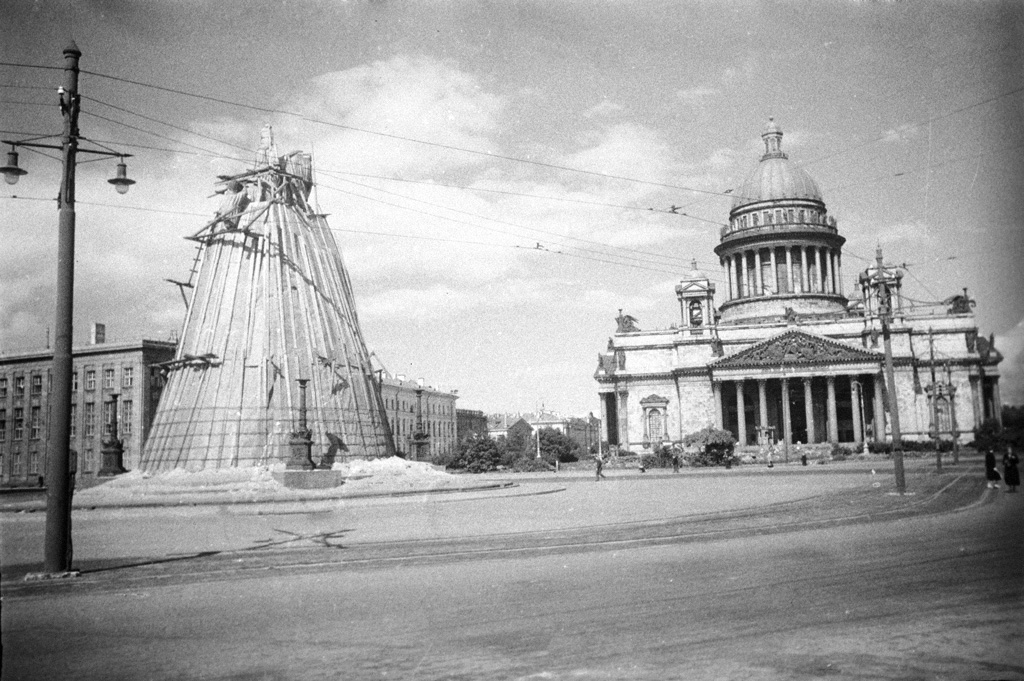
The military situation collapsed fast. German forces closed the ring around Leningrad on 8 September 1941, and every overland route into the city was cut; supplies came by boat across Lake Ladoga and, once the water froze, by an ice road. Rations fell to a floor of 125 grams of bread a day for dependants and children in the winter of 1941. The blockade ran 872 days and was not fully lifted until 27 January 1944. Hundreds of thousands of civilians died, most of them of starvation.
He wrote the first three movements under those conditions before being evacuated with his family to Kuibyshev, now Samara, where he finished the finale and completed the score on 27 December 1941. He first attached programmatic titles to the four movements — War, Reminiscence, Home Expanses, Victory — then withdrew them, leaving nothing but tempo markings. That withdrawal is the most Shostakovich move in the whole piece: give the state its narrative, then remove the labels that would pin the music to it.
He was writing from a specific jeopardy. His opera Lady Macbeth of the Mtsensk District had been attacked in Pravda in 1936 under the headline Muddle Instead of Music, after which he withdrew his Fourth Symphony before its premiere and rebuilt his standing with the Fifth in 1937. The war handed him a subject the state could not object to. What he did inside that subject is the argument that has run ever since.
In public he was careful. Asked what the symphony depicted, he said he had not tried to reproduce the noise of battle: I did not compose so-called battle music.
Solomon Volkov’s memoir Testimony, published in 1979, presents a far more subversive composer who says he had other tyrannies in mind; the authenticity of that book has been disputed for decades, so treat it as contested rather than settled. What is not contested is the double edge: an operetta tune that could pass as German or Russian, driven by a machine that could be either army.
The night Leningrad played it back
The world premiere took place on 5 March 1942 in Kuibyshev, played by the Bolshoi Theatre Orchestra under Samuil Samosud. The score then travelled west on microfilm by way of Tehran and Cairo. Henry Wood conducted the first performance in Britain on 22 June 1942, a BBC broadcast with the London Philharmonic Orchestra, and Arturo Toscanini gave the first American performance on 19 July 1942 in a radio broadcast with the NBC Symphony Orchestra.
The performance everyone remembers, though, is the one inside the siege. The Leningrad Radio Orchestra had roughly forty players before the blockade, and by the time rehearsals began only a handful were still alive and in the city; the score needs about a hundred. Karl Eliasberg filled the gaps with military bandsmen and musicians pulled out of hospitals and off defensive positions. Players collapsed in rehearsal. Three of them died before the concert. The orchestra managed to play the piece through exactly once in advance.
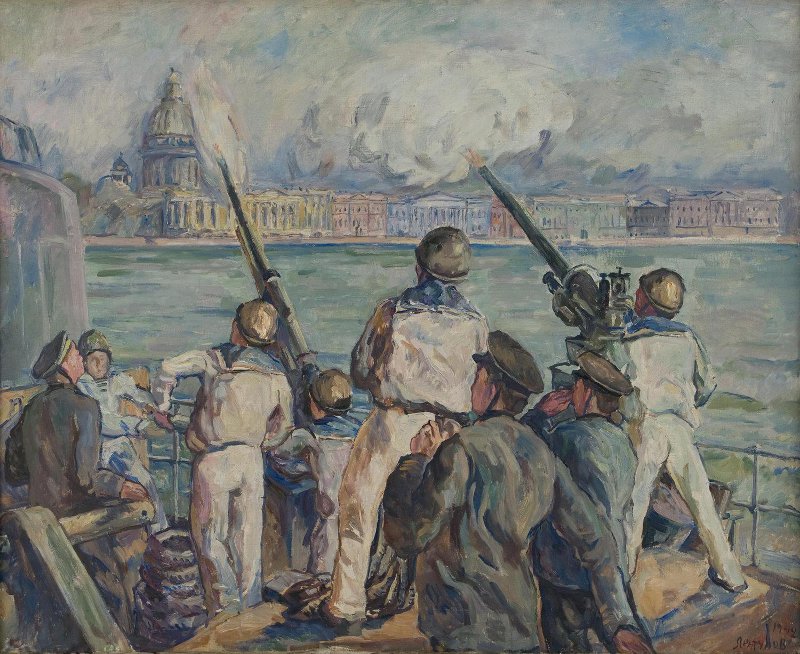
The concert went ahead on 9 August 1942 in the Grand Philharmonia Hall. Soviet artillery ran a bombardment operation code-named Squall to keep German guns quiet, firing some three thousand shells at enemy positions so the hall would not be hit, and the performance was relayed by loudspeaker across the city and out towards the German lines. The applause is reported to have run for an hour. The date was not an accident either: German command had picked 9 August 1942 as the day Leningrad would fall, with a celebration booked at the Hotel Astoria. The symphony went out over the loudspeakers instead.
Nothing about that performance can have been clean. But it is the clearest case I know of music working as something other than an aesthetic object: starving people synchronising their breathing in public, on a schedule, as an act of refusal. Listen with that scene in mind and hear only heroism, and you have taken the propaganda at face value. Hear it as evidence of endurance instead, and the third movement stops being the boring one.
Movement by movement
Eighty minutes is a long sit, and knowing the shape in advance is the difference between a slog and a drama.
I. Allegretto. Daylight theme, then the ostinato march, then the collapse and the requiem. Listen for the moment the brass stop reinforcing the march and start attacking it — the point where the machine meets resistance is the loudest, ugliest bar in the movement. Then listen for the bassoon at the end. It is the same music as the opening with everything warm taken out of it.
II. Moderato (poco allegretto). A scherzo that will not commit to being one. Strings and woodwind sketch something almost pastoral, then a clarinet solo bends it out of shape and a savage central episode kicks the legs out. Material that would be charming if the harmony underneath it were not slightly wrong — and the fastest way to tell a literal conductor from an ironic one.
III. Adagio. The one that decides whether the symphony works for you. Chorale in the winds, then a long declamatory line in the strings, then extended stretches where almost nothing happens except sustained playing. This is where amateur orchestras come apart, by the way — slow, quiet, exposed writing punishes every bow change and every breath, and there is no rhythm to hide behind. Do not skip it. The finale is unearned without it.
IV. Allegro non troppo. It begins uncertainly, in the dark, and works towards C major over a very long span. When the key finally arrives, note that the scoring stays heavy and the tempo stays broad: this is not a bright ending, it is a loud one. Shostakovich writes triumph the way a survivor describes a war, with the weight still in it. Whether a conductor lets that weight show, or files it down into a victory finish, is the single biggest interpretive decision in the piece.
If eighty minutes in one sitting is too much, do this: first pass, movement one plus the last five minutes of the finale. Second pass, movements two and three. Third pass, a different conductor from top to bottom.
Klaus Mäkelä with the Frankfurt Radio Symphony, filmed in concert and free to watch: a clean, well-shot performance where you can actually see the percussion section building the march. Good first exposure if you want the structure legible.
Three recordings, three different pieces
The Seventh is over-recorded and unevenly served; most versions land between grand and generic. These three do not, and they disagree with each other usefully.
Yevgeny Mravinsky / Leningrad Philharmonic Orchestra / 1953 / Melodiya. Start here. Mravinsky worked with Shostakovich for decades, and his invasion march is the least theatrical on record: strict tempo, no swelling, no help. It simply accumulates, and because nobody is dramatising it for you the effect is unpleasant in exactly the way the music intends. The mono sound is rough and the strings turn wiry at volume — not a version to demo your speakers with, but the one that tells you what the piece is.
▶ Listen on YouTube · Apple Music · Spotify
Leonard Bernstein / Chicago Symphony Orchestra / June 1988 / Deutsche Grammophon. The opposite reading, and the best of its kind. Bernstein treats the symphony as an anti-war statement rather than a portrait of a system: extreme dynamics, a finale stretched to the edge of what the tempo will bear, Chicago brass filling the room without cracking. It was taped live in Orchestra Hall. The trade-off is that the second movement’s irony mostly disappears — everything is played for emotional maximum. For someone who does not yet love this repertoire, it is unbeatable.
▶ Listen on YouTube · Apple Music · Spotify
Andris Nelsons / Boston Symphony Orchestra / Deutsche Grammophon, released 2019. The modern choice, from the orchestra’s long Shostakovich series. What it offers that the other two cannot is transparency: the inner woodwind lines during the march build, the harp and piano attacks that give the ostinato its metallic edge, the exact moment each brass section is added. Study this one to understand how the crescendo is engineered. It is also the least dangerous-sounding of the three, which is a real cost.
▶ Listen on YouTube · Apple Music · Spotify
The verdict, plainly: Mravinsky if you want the piece, Bernstein if you want to be moved, Nelsons if you want to see the mechanism. Nobody needs all three, but hearing any two back to back tells you more about conducting than a month of reading will.
Follow the score
The first movement is the rare passage where reading along genuinely helps, because the point is the accumulation of instruments and you can watch them arrive on the page. Teodor Currentzis conducts here; the score scrolls with the audio.
Why it keeps coming back
The Seventh was a propaganda asset for the Soviet state and its wartime allies alike, and Western critics noticed. Virgil Thomson wrote that it seemed written for the slow-witted, the not very musical and the distracted
— a real critique, not a cheap shot, and it lands on the first movement more than anywhere else. Béla Bartók found the march overrated enough to caricature in the Intermezzo interrotto of his Concerto for Orchestra, though the resemblance to Lehár is close enough that it is unclear who he was mocking.
Both things can be true: the symphony is padded in places, and it survives anyway — because the ostinato is genuinely frightening when nobody emphasises it, because the Adagio is one of the best slow movements he wrote, and because the finale refuses to sound happy. It also keeps getting re-pointed. Since Russia’s full-scale invasion of Ukraine, some ensembles have dropped it and others, Ukrainian musicians among them, have claimed it as a piece about resisting invasion, full stop. Both moves are available because Shostakovich never closed the question. He wrote a machine that grinds people down and declined to say permanently whose machine it was.
If the Seventh works on you, the obvious next steps are the two symphonies on either side of it in his war output. The Fifth is the tightrope walk that saved his career, and the Tenth — written after Stalin’s death — is where he finally signs his own name into the music. Our guide to Symphony No. 10 covers that. If it is the sheer scale of the Seventh that hooked you rather than the politics, the Mahler symphonies are the other place where eighty-minute arguments are built this way.
Frequently Asked Questions
Does the invasion theme really quote The Merry Widow?
Yes — the march is a pastiche, and part of it tracks Danilo’s entrance number Da geh’ ich zu Maxim from Lehár’s operetta, which was a favourite of Hitler’s. Knowing the source, the march reads less as a portrait of an army than of something trivial amplified beyond bearing.
Is the Leningrad Symphony only about the Nazi invasion?
Officially, yes. In practice the piece has always been heard more widely than that, partly because the march’s melodic material could pass as Russian or German and partly because Shostakovich withdrew the programmatic movement titles he first attached. Some scholars argue the target was Stalinism as much as fascism, citing Volkov’s Testimony — a source whose authenticity remains disputed. The honest answer is that the score leaves it open.
Which recording of Shostakovich Symphony No. 7 should I hear first?
Mravinsky with the Leningrad Philharmonic for the severest reading, Bernstein with the Chicago Symphony for the emotional one, Nelsons with the Boston Symphony for modern sound and audible inner detail. For a free first listen, use the Frankfurt Radio Symphony concert video embedded above.
How long is the Leningrad Symphony, and can I listen in sections?
About eighty minutes, in four movements. Splitting it up works better than most people expect: the first movement is self-contained enough to stand alone on a first pass, and the Adagio rewards a separate, undistracted listen. What does not work is skipping the third movement and jumping to the finale — the ending only makes sense as the payoff for that long stretch of endurance.