- Composer
- Edvard Grieg (1843–1907)
- Work
- Piano Concerto in A minor, Op. 16
- Key
- A minor
- Composed
- Summer 1868 (Søllerød, Denmark)
- Premiere
- April 3, 1869 — Casino Theatre, Copenhagen
Edmund Neupert (piano) - Movements
- I. Allegro molto moderato (A minor)
II. Adagio (D♭ major)
III. Allegro moderato molto e marcato — Quasi presto — Andante maestoso (A minor → A major) - Instrumentation
- Solo piano, strings, 2 flutes, 2 oboes, 2 clarinets, 2 bassoons, 4 horns, 2 trumpets, 3 trombones, timpani
- Duration
- approx. 30–33 minutes
The Score Liszt Sight-Read in Rome and Couldn’t Put Down
Spring 1870, Rome. A twenty-six-year-old Norwegian composer named Edvard Grieg arrived at Franz Liszt’s door. He carried a manuscript he had completed two years earlier — a piano concerto written during a single summer. At that point, Grieg was effectively unknown outside Scandinavia. Norway barely registered on the European musical map.
Liszt opened the score and began to play. He played it at sight, alone on the piano — solo part and orchestra reductions together — from the first bar to the last. When the famous descending A minor cascade of the first movement opened, Liszt did not stop. He played through all three movements, including the orchestral tuttis, without hesitation. At the end, he stood up and told Grieg: “Keep on. I tell you, you have the gift. Don’t let them intimidate you.”
Grieg later wrote in a letter: “I felt as though I were walking on air.” A provincial composer from the musical margins had just received the blessing of the most celebrated pianist of the nineteenth century. The concerto would go on to remain one of the most beloved works in the entire piano repertoire for the next 150 years.
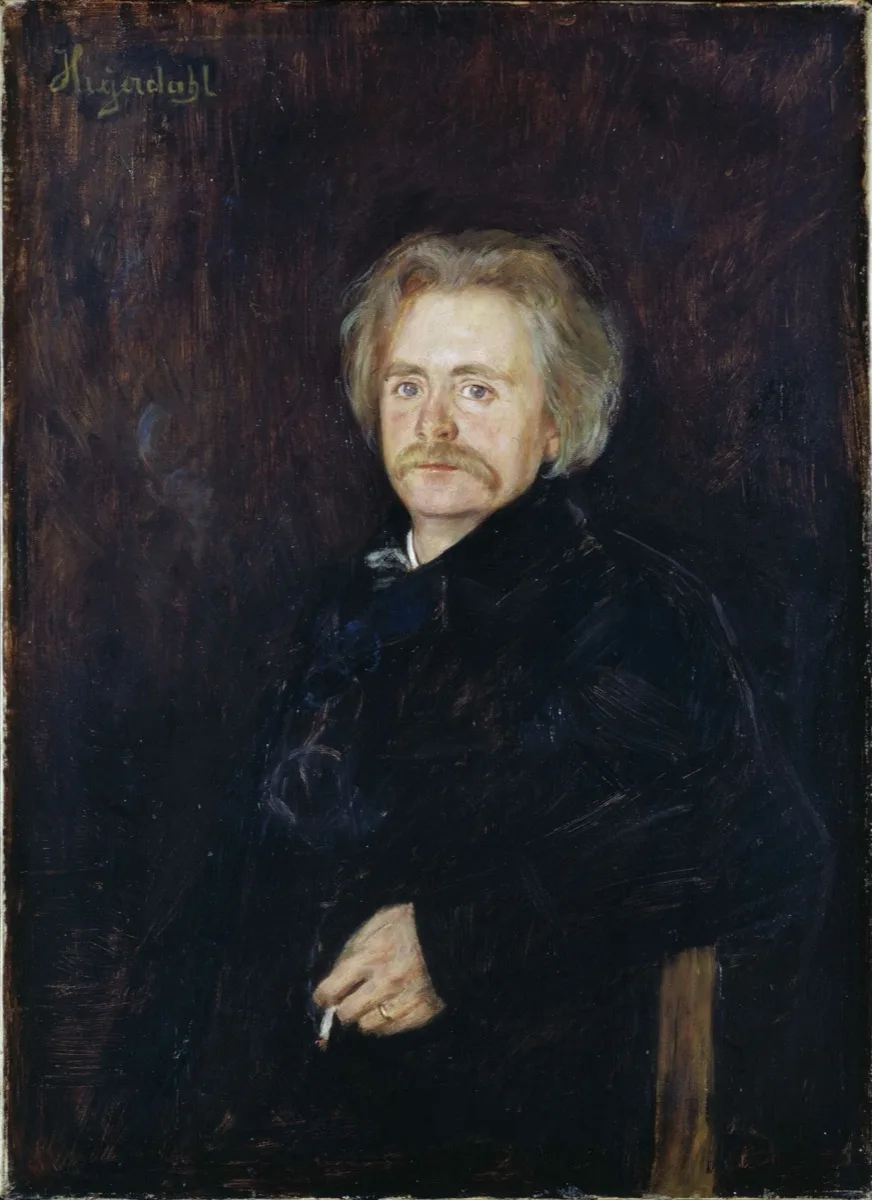
Leipzig Made the Norwegian
Grieg’s starting point was, counterintuitively, not Norway. In 1858, at fifteen, he enrolled at the Leipzig Conservatory — the school Mendelssohn had founded, where Schumann had been a presence. Leipzig was the center of European musical orthodoxy, and for a young Norwegian, it was a complete immersion in German Romantic technique: sonata form, counterpoint, the architecture of the lied.
He emerged technically solid and spiritually restless. Years later, he summed up the experience: “Everything I learned was German music. So what, then, was I supposed to write?”
The answer arrived in stages. After Leipzig, Grieg moved to Copenhagen, where he encountered two pivotal figures. The first was Niels Gade — a towering figure in Scandinavian music and a friend of Mendelssohn — who recognized Grieg’s talent but pushed him toward formal German conventions. Grieg took some of that advice, and set aside the rest.
The second encounter was decisive. In 1864, he met Rikard Nordraak, a fellow Norwegian composer and the man who wrote Norway’s national anthem. Nordraak planted a conviction in Grieg that would never leave him: “There is as much depth in Norwegian folk melody as in any German symphony. Stop borrowing German clothes — make our own.”
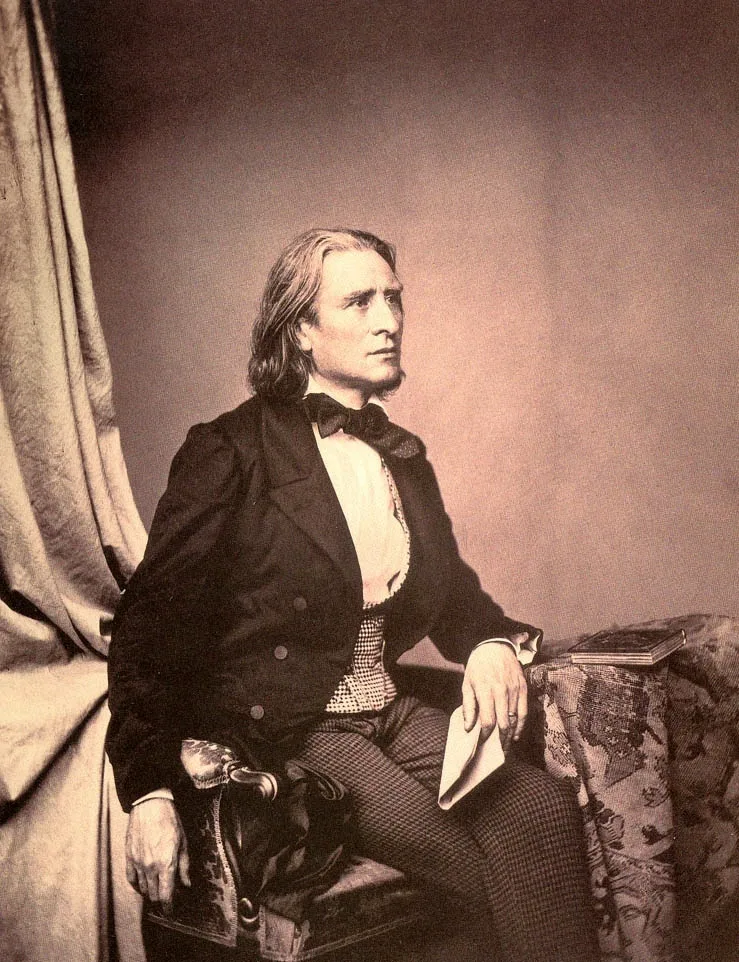
Nordraak died of tuberculosis in 1866, at twenty-three. Grieg made a promise at his friend’s death: he would complete what Nordraak had pointed toward. Two years later, he wrote the Piano Concerto.
Nina Hagerup — Cousin, Partner, Muse
Any account of Grieg’s music that omits his wife is missing a central piece. Nina Hagerup (1845–1935) was Grieg’s first cousin. They reconnected in Copenhagen and married in 1867. Cousin marriages were common enough in Scandinavia at the time, but both families objected — Grieg’s mother worried that “two musicians together will starve,” and Nina’s family wasn’t much more optimistic.
Nina was not merely a companion. She was a distinguished soprano in her own right, and a large portion of Grieg’s art songs were composed specifically with her voice in mind. Grieg himself described his lieder as “music that would not exist without Nina.” During the summer of 1868, while Grieg was pouring out the Piano Concerto in Søllerød, Nina was beside him, caring for their newborn daughter Alexandra.
The happiness was short-lived. In 1869, Alexandra died of meningitis at barely one year old. The Griegs never had another child. The loss cast a long shadow over their marriage — they separated briefly in the 1880s — but they reconciled, and Nina remained at Grieg’s side until his death in 1907. She survived him by nearly three decades, dedicating herself to preserving his musical legacy until her own death in 1935, at the age of ninety.
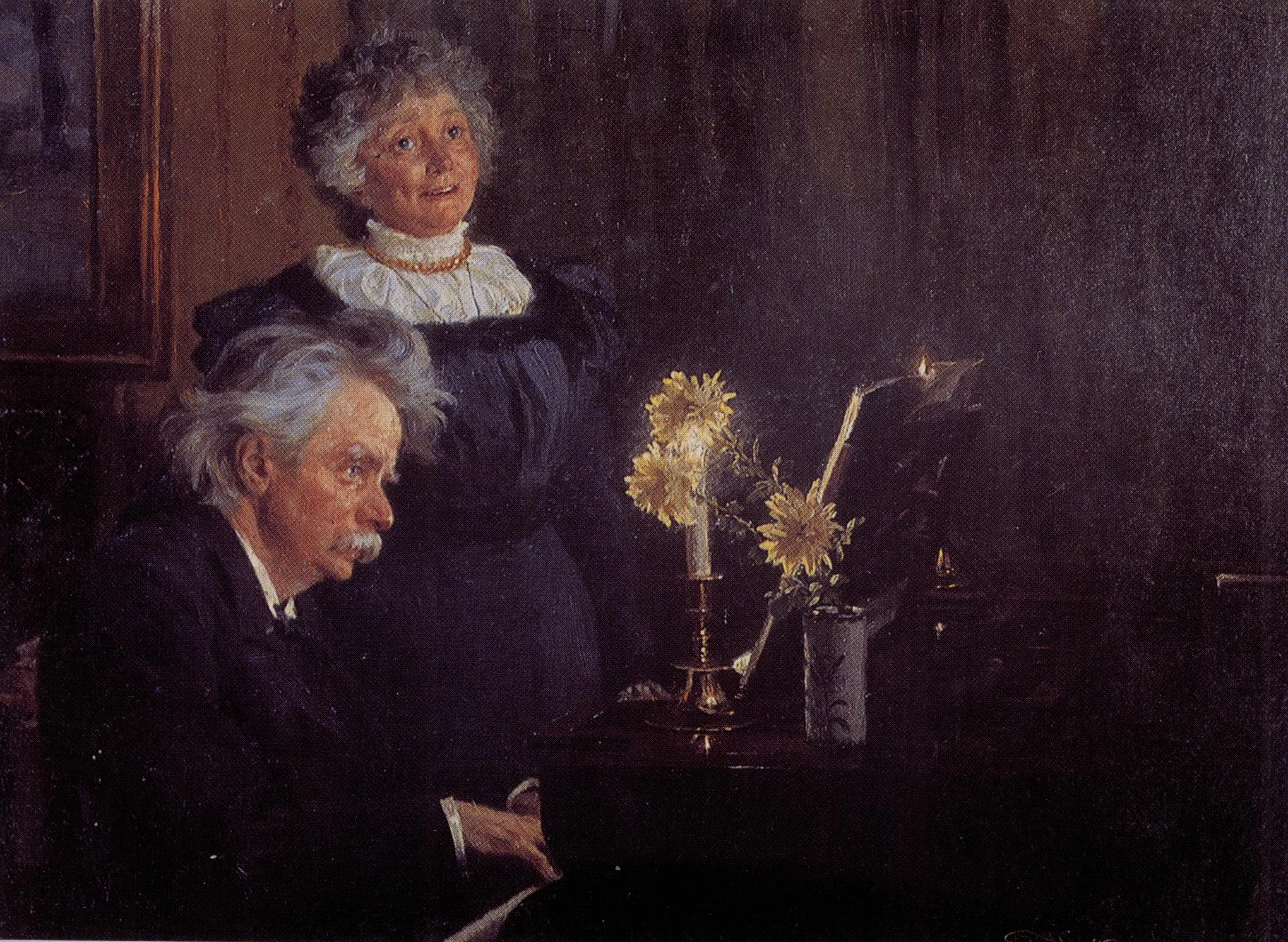
A Summer’s Work at Twenty-Five
In the summer of 1868, Grieg was staying in Søllerød, Denmark, with his wife Nina and their newborn daughter Alexandra. Financially precarious, compositionally promising, unsure of the future — and about to produce, in a matter of weeks, the work that would define his public reputation for the rest of his life.
The speed was notable even to Grieg himself. He had been carrying the musical ideas for some time; the summer brought a concentrated outpouring. The concerto’s framework was essentially complete before autumn.
Anyone who knows Schumann’s Piano Concerto will recognize the opening: A minor, a roll of timpani, then the piano in a sweeping downward cascade. Grieg freely acknowledged the influence. “I studied Schumann’s concerto deeply,” he said, “and I won’t pretend otherwise.”
But the resemblance ends almost immediately after the opening gesture. Schumann’s concerto is intimate, inward-looking — a private language between the composer and Clara. Grieg’s opens outward into landscape: the sweep of a Norwegian fjord, the jagged intervals of folk melody, the tonal ambiguity of a country where the light itself seems uncertain. Same key, similar opening — entirely different world.
Three Movements, Three Landscapes
The first movement opens with what may be the most immediately recognizable piano entry in the concerto repertoire. The timpani builds tension, then the piano enters on a high A and falls through a chromatic scale — four bars that have introduced the piece to millions of listeners who couldn’t name another bar of Grieg. The first theme that follows carries the fingerprints of Norwegian folk melody: the characteristic fifth leaps, the oscillation between major and minor that feels like changing weather rather than formal modulation.
One passage worth singling out in the exposition: the second theme, introduced quietly by the cellos. After the brilliant cascade and the driving first theme, this melody arrives with the stillness of mist lifting from a fjord. Many listeners find themselves exhaling for the first time here. Grieg understood contrast — not as a textbook device, but as something physical, something felt in the body.
The cadenza — the extended solo passage for the pianist alone — was something Grieg revised repeatedly throughout his life. The final version is considered among the finest in the repertoire: technically demanding without being merely decorative, it functions as a compression and re-examination of the entire first movement’s emotional arc.
The second movement arrives as a kind of suspended stillness after the first movement’s energy. D♭ major — a tonality far removed from A minor, approached with deceptive smoothness. Muted strings create a soft, cushioned texture; the piano enters above them with a melody of almost Romantic restraint. What distinguishes this movement is Grieg’s harmonic language: his constant sliding between major and minor, often within a single phrase, produces a quality of shifting emotional light that has been compared to the long Nordic twilight — not quite day, not quite night, the sky neither bright nor dark.
Nina Grieg later recorded that her husband said he was thinking of Norwegian summer nights — the midnattsol, the midnight sun — while writing this movement.
There is a passage midway through the second movement where the orchestra falls completely silent and the piano is left alone. The concert hall suddenly feels like a small room. Grieg knew exactly what he was doing: rather than pitting soloist against orchestra in the German competitive tradition, he carved out a space for private speech within a public form.
The third movement opens with the rhythm of the halling, a Norwegian folk dance performed by male dancers known for acrobatic leaps — kicking a cap hung from the ceiling at the peak of a jump. Translated into piano and orchestra, it produces a driving, percussive energy unlike anything in the German concerto tradition Grieg had trained in. A contrasting pastoral episode for flute evokes something more open and distant — a shepherd’s pipe on a hillside. Then comes the movement’s true surprise: the final coda shifts from A minor to A major, slows from a driving pulse to a broad, ceremonial pace, and builds to a conclusion of genuine grandeur. Liszt reportedly stood and shouted “Bravo!” when he reached this passage in his Rome sight-reading. It’s not hard to understand why.
How to Listen — A Guide for First-Time Listeners
A word of advice for those coming to this concerto for the first time: don’t get so absorbed in the famous opening cascade that you stop listening afterward. The real depth of this work unfolds in what follows.
First, pay attention to the first-movement cadenza. This is where different pianists diverge most dramatically. Andsnes plays it inward and lyrical; Zimerman is structurally precise yet singing; Rubinstein treats it as a broad, expansive narrative. Same notes, entirely different emotional worlds.
Second, give the second movement your full attention. It’s short — about six minutes — and easy to overlook, but it contains the most concentrated expression of Grieg’s harmonic language. The chromatic shifts are frequent, yet they sound completely natural to the ear. That balance is the magic, and it repays conscious listening.
Third, listen for the pivot point in the third movement: the moment the halling rhythm gives way to A major. The orchestral texture transforms completely at this juncture. How convincingly this transition lands is often the measure of a conductor and soloist’s quality. Rush it, and the finale loses its emotional weight. Drag it, and the tension dissipates. Comparing recordings at this exact moment will reveal how much artistry hides inside a single key change.
The Concerto He Rewrote for Forty Years
One of the less widely known facts about this concerto is how long Grieg kept working on it. He completed the initial draft in 1868, but the version performed today is the 1906–1907 revision — nearly forty years of incremental change.
The revisions were not cosmetic. Grieg strengthened the orchestration, refined the cadenza through multiple versions, adjusted dynamics throughout, and sharpened the piano writing. The 1870 version that Liszt sight-read in Rome and the version heard in concert halls today are the same piece wearing different clothes.
A rough timeline of the major revisions: in 1872, the cadenza received its first major overhaul. In the 1880s, Grieg reorganized the wind writing. Through the 1890s, he added subtle ornamental touches to the piano part of the second movement. The final 1906–1907 edition strengthened the orchestration of the third-movement coda, giving the finale greater weight. Forty years of refinement on a single work — even by the standards of perfectionist composers, this is unusual.
Grieg also sketched a second piano concerto in B minor. The sketches survive, but the work was never completed. The conductor Hans Richter once asked him when the concerto would be finished. Grieg’s answer: “When I’m dead.” He died in Bergen on September 4, 1907. The final revision of the A minor concerto was effectively complete. He had kept his word.
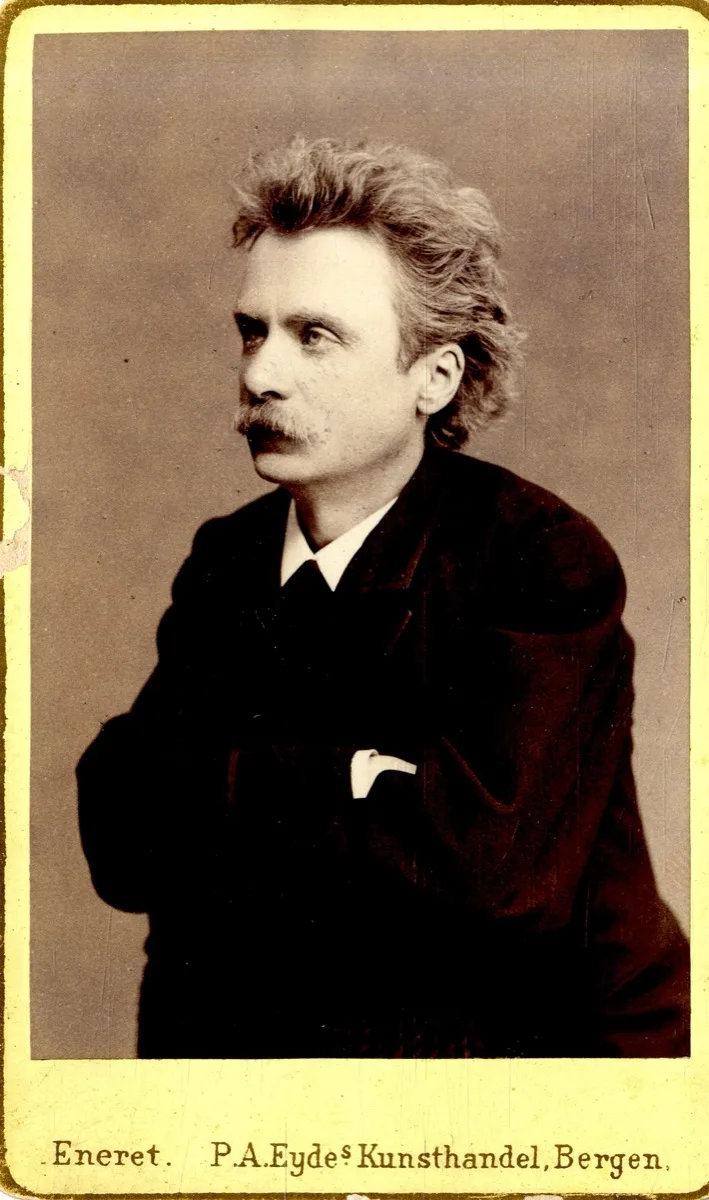
How a Peripheral Masterpiece Conquered the World
The premiere took place in Copenhagen on April 3, 1869. Edmund Neupert was the soloist; Grieg could not attend, being occupied in Christiania (present-day Oslo). Neupert sent a telegram immediately after: “Your concerto was a tremendous success last night.”
Danish audiences were enthusiastic. German and Austrian critics were less so. The complaints were predictable: “formal looseness,” “underdeveloped development section,” “salon music inflated to concerto scale.” By the structural standards of Beethoven or Brahms, these were not entirely wrong. Grieg’s development sections lack the tightly argued intensity of the German tradition. He was not that kind of composer, and he knew it.
What he had instead was melodic immediacy — the ability to state a theme that lodges itself immediately in the listener’s memory — and a distinctive coloristic sense that made the orchestra sound like a landscape rather than an argument. Audiences recognized this before critics did. A similar pattern played out with Tchaikovsky’s Piano Concerto No. 1, which Nikolai Rubinstein declared “unplayable” and which became one of the most performed concertos in history.
By the twentieth century, the concerto had entered the permanent repertoire. Rachmaninoff admired it. Arthur Rubinstein, Sviatoslav Richter, and Krystian Zimerman each left notable recordings. Leif Ove Andsnes — Norwegian, like Grieg — has recorded it with a quality of local authority that reviewers often describe as hearing the actual landscape in the playing.
Dinu Lipatti’s 1947 recording deserves separate mention. Lipatti, a Romanian pianist who died of leukemia at thirty-three, left a Grieg Concerto recording prized for its crystalline transparency. Where other pianists foreground technical brilliance, Lipatti draws out the singing quality buried inside the notes — a different kind of revelation from Andsnes, but no less moving.
The concerto also carries a specific national weight. When Norway achieved independence from Sweden in 1905, Grieg was already a national hero, and this concerto was one of the primary exhibits in the case that Norwegian art had its own distinct voice. The halling rhythms, the folk-derived harmonies, the A major finale’s sweeping affirmation — for Norwegian audiences, these were not merely musical gestures. They were evidence.
The young man from Leipzig who asked himself what he was supposed to write ended up answering the question more definitively than almost anyone else in his generation. The opening descent of the A minor concerto has been playing in concert halls for 150 years, and it shows no sign of stopping.
Follow the Score
The full score is freely available at IMSLP. View the Piano Concerto, Op. 16 score on IMSLP
Frequently Asked Questions
Why does the Grieg concerto sound like the Schumann piano concerto?
Both are in A minor, and both open with the piano entering after a timpani buildup in a sweeping downward figure. Grieg acknowledged the influence openly. The resemblance is limited to the opening gesture; the harmonic world, melodic character, and emotional temperature of the two works are fundamentally different.
Did Grieg write any other piano concertos?
He sketched a second concerto in B minor, but never completed it. The A minor Op.16 is his only finished concerto — a work he continued to revise across four decades, until his death effectively set the final text.
Did Liszt really sight-read the entire concerto, including orchestral reductions?
According to Grieg’s own letters and memoirs, yes. Liszt was considered one of the greatest sight-readers in the history of the piano. He reportedly played the full score — solo and orchestral parts together — from beginning to end, and shouted “Bravo!” when he arrived at the A major finale.
What are the most recommended recordings?
Four recordings are most consistently recommended: Leif Ove Andsnes (for its sense of authentic Norwegian character), Krystian Zimerman (for technical precision and lyrical balance), Arthur Rubinstein (for the warmth and narrative ease of a mid-twentieth-century interpretation), and Dinu Lipatti (for crystalline lyrical transparency). Each offers a distinctly different angle on the same work.
Who was Nina Grieg?
Nina Hagerup was Grieg’s first cousin and a talented soprano. Most of Grieg’s art songs were written with her voice in mind. They married in 1867 and remained together until his death in 1907. Nina spent her remaining years preserving his musical legacy, living until 1935.
When did Grieg compose the Piano Concerto in A minor?
Edvard Grieg composed his only piano concerto, Op. 16, in 1868 at the age of 24 while on holiday in Søllerød, Denmark. The piece premiered in Copenhagen on April 3, 1869, with Edmund Neupert as the soloist. It was an immediate success and has remained one of the most popular piano concertos ever written.
What makes the opening of the Grieg Piano Concerto so famous?
The concerto begins with an iconic and dramatic opening: a timpani roll followed immediately by a powerful, descending piano flourish. This cascade of chords through A minor creates a powerful and instantly recognizable theme that sets a heroic, Nordic tone. This introduction is one of the most famous in the entire classical repertoire.
How many movements are in the Grieg Piano Concerto?
The concerto is in three movements and has a typical duration of about 30 minutes. The first movement is a dramatic “Allegro molto moderato,” the second is a lyrical “Adagio,” and the finale, “Allegro moderato molto e marcato,” is famous for its use of rhythms from the Norwegian folk dance known as the halling.