There’s a stretch late in John Wick: Chapter 3 – Parabellum where the shooting stops and the music turns civilized. Winston opens a case of vintage pistols, John and Charon load magazines, and over the top of it Winston drops the needle on a record — Vivaldi, then Grieg, string music from three centuries ago scoring men who are about to kill a small army in a hotel lobby. It’s the most self-aware musical joke in a series that has always used old European art music as a kind of table manners for violence.
That’s the thing about the John Wick films: they spend a fortune on a pounding electronic score by Tyler Bates and Joel J. Richard, then hand the quietest, most important moments to dead composers. Chapter 3 only borrows three pieces of pre-existing classical music, but each one lands at a hinge point in the story, and each one is doing something more pointed than “fancy music for a fancy world.” Here’s every cue, the exact scene it scores, and where to hear each piece done properly.
Spoiler warning: this article discusses scenes from John Wick: Chapter 3 – Parabellum, including the final act at the Continental.
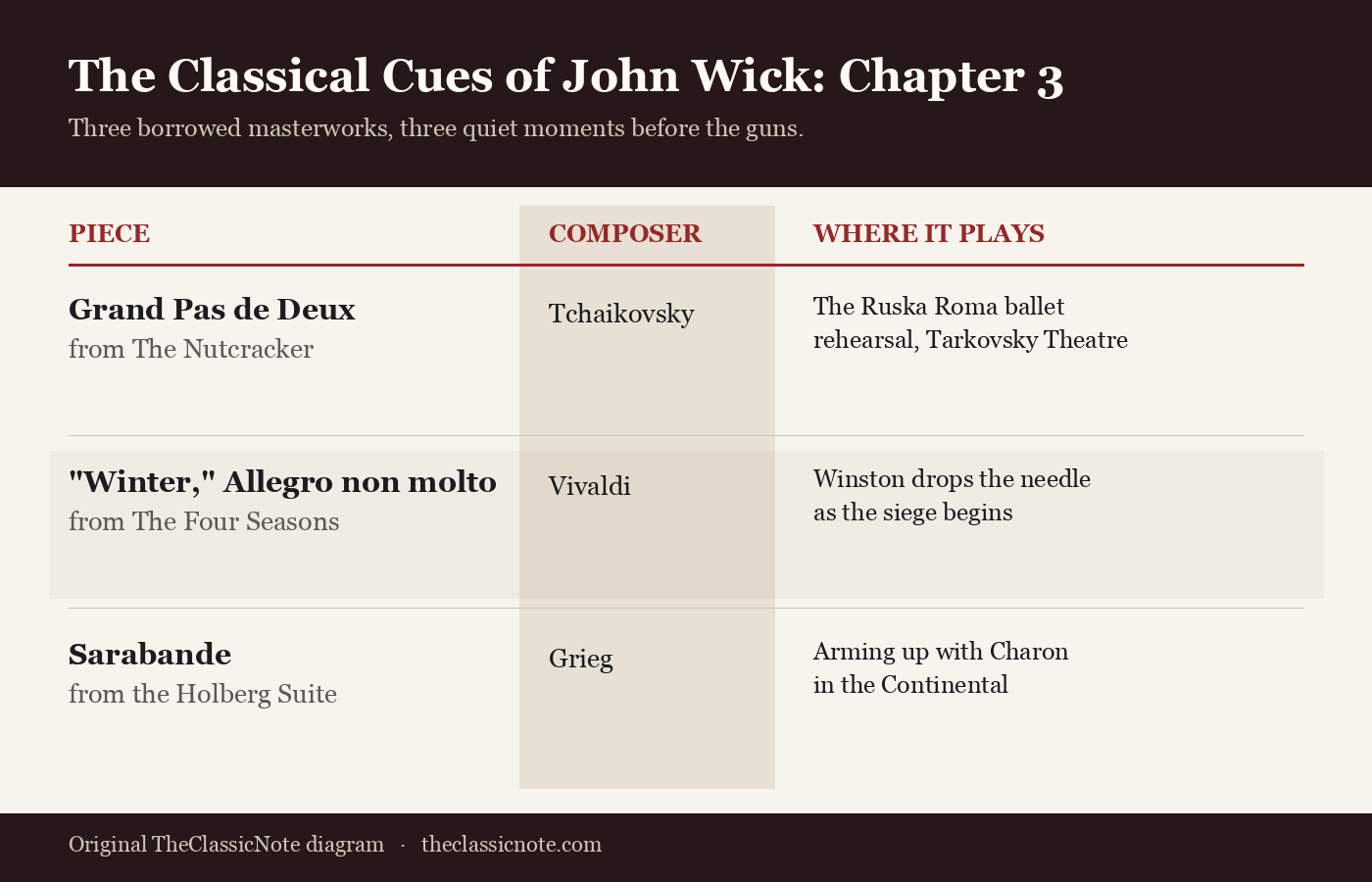
The three classical cues, scene by scene
All three are real concert works, not soundalike knock-offs written for the film. That matters, because part of the effect is recognition — the audience half-knows these tunes, and the movie is counting on the friction between something you’d hear at a wedding and something you’re watching get shot in the throat.
Tchaikovsky — Grand Pas de Deux from The Nutcracker
This is the first classical cue in the film, and the easiest to miss. It scores the ballet sequence at the Tarkovsky Theater, the crumbling New York opera house that fronts for the Ruska Roma crime syndicate. Young dancers rehearse under the eye of the Director (Anjelica Huston) — feet bloodied, bodies pushed past the point of art into something closer to conscription — before John arrives to call in an old favor. The music is the Grand Pas de Deux, the great adagio from Act II that Tchaikovsky wrote for the Sugar Plum Fairy and her Cavalier.
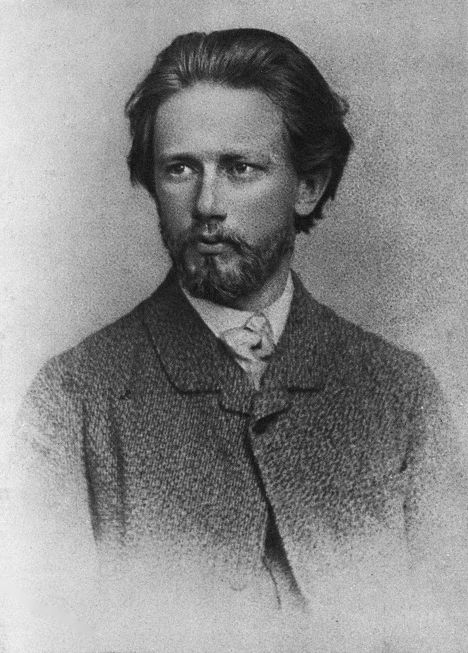
One point of precision, because it’s a common mix-up: this is not the tinkling “Dance of the Sugar Plum Fairy,” the celesta miniature everyone hums at Christmas. That’s a separate number inside the same Act II pas de deux. The cue in the film is the adagio that opens it — slower, heavier, scored for full strings rather than a music-box celesta. If you go hunting for it and land on the celesta tune, you’ve got the wrong piece.
Here’s why it works. The Grand Pas de Deux is one long descending line — the strings step downward in slow, grand octaves, a melody that keeps falling and somehow keeps sounding noble while it does. Tchaikovsky’s ballet premiered on 18 December 1892 at the Mariinsky Theatre in St. Petersburg, on a double bill with his opera Iolanta, and this number was written to be the emotional summit of the whole evening. Placing that music over children being drilled into weapons is the film’s coldest irony: the most beautiful, most “pure” music in the story is the sound of a machine that turns girls into killers. The film never underlines the point — the camera stays on the dancers while the melody keeps falling over them.
Where to hear the real thing: the adagio needs players who can take it slowly without letting the line sag. The Royal Ballet performance below, with Marianela Nuñez and Vadim Muntagirov, gives you both the music and the choreography it was built to carry.
If you want more of Tchaikovsky writing for strings at this level of tenderness, his Serenade for Strings, Op. 48 is the piece to go to next — same melodic generosity, no ballet required.
Vivaldi — “Winter” from The Four Seasons
This is the cue everyone remembers, and rightly so. As the High Table strips the Continental of its protected status and war comes to the hotel, Winston (Ian McShane) walks John into the armory, cracks open a display case of antique firearms, and puts on a record: the opening movement of Vivaldi’s “Winter,” the fourth of The Four Seasons concertos. The marking is Allegro non molto — fast, but not too fast — and the music is all shivering, needling repeated notes in the violins, the sound Vivaldi built to depict standing outside in the cold, teeth chattering.
Vivaldi published The Four Seasons in 1725 in Amsterdam, and “Winter” is the Violin Concerto in F minor, RV 297. What makes the scene sing is the match between the music’s design and John’s situation. That first movement is built on tension without release — the violins keep trembling, the harmony keeps clenching, nothing resolves. It’s the sound of a body braced against something it can’t stop. Winston isn’t playing party music while they load guns; he’s playing the exact emotional weather of the next twenty minutes. The joke and the truth are the same gesture.
Listen for the very opening: before any tune arrives, the violins just vibrate on repeated notes, low and fast, like a shiver you can’t control. Vivaldi even printed a sonnet above the score, describing a figure frozen and shivering in the icy snow. When the solo violin finally cuts across the top, it doesn’t warm the room — it sharpens the cold into something violent. That’s the passage the film leans on, and it’s why the cue feels less like background music than a countdown.
For the recording, skip the smooth, thick modern versions and go period-instrument. The one embedded above — Cynthia Freivogel with the San Francisco early-music group Voices of Music — plays it on gut strings with a hard, biting edge, and that edge is the whole point of “Winter.” You want to feel the cold. A plush, warm reading sands off exactly the thing that makes this music frightening.
Grieg — Sarabande from the Holberg Suite
The Grieg is the sleeper. It comes minutes after the Vivaldi, still inside the Continental, as Charon (Lance Reddick) arrives and the three of them finish arming up for the siege. Where the Vivaldi shivers, the Sarabande stays calm and grave — a slow dance in three, dignified, almost a farewell, the deep breath the sequence takes before the hotel turns into a battlefield.
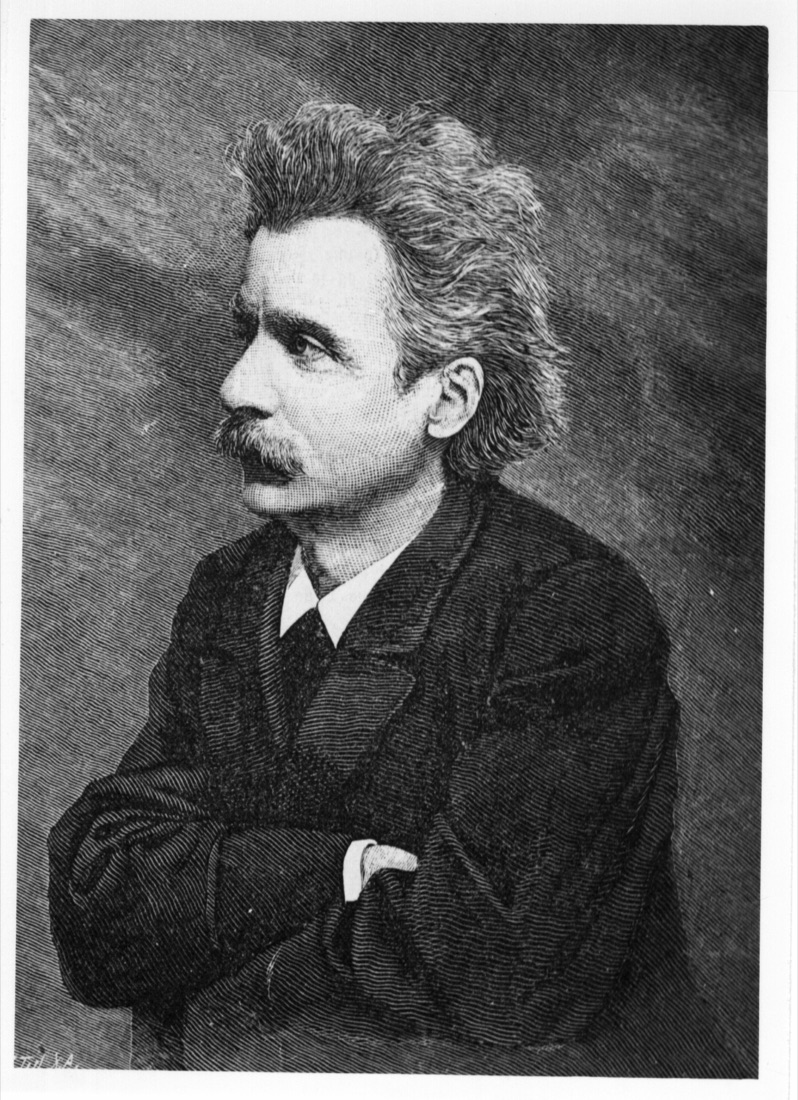
Grieg wrote the Holberg Suite — full title Fra Holbergs tid, “From Holberg’s Time” — in 1884 for the 200th anniversary of the playwright Ludvig Holberg, first for piano and then, in 1885, in the string-orchestra version everyone knows. The whole suite is Grieg looking back at Baroque dance forms through a Romantic lens, and the Sarabande is its still center. Using it here is a smarter choice than it first appears: a sarabande is, historically, a slow and stately dance, and the film drops it into the one genuinely still moment before the violence, so it ends up scoring composure — these men aren’t panicking, they’re getting dressed for work.
If Grieg is new to you and this is where you came in, the natural next step on the site is Grieg’s Peer Gynt Suite No. 1 — the same composer at his most theatrical, and the fastest way to understand why directors keep reaching for his music.
Notice, too, that the Vivaldi and the Grieg arrive back to back on the same record player, within a few minutes of each other. That’s not an accident of playlist — it’s a two-part sequence. First the shiver (Vivaldi), the nerves before a fight; then the composure (Grieg), the steadying breath once the decision is made. Winston is effectively scoring the montage of arming up, moving his men from dread to resolve using nothing but two old records. It’s the most elegant use of source music in the whole trilogy: the character on screen is choosing the soundtrack, and choosing it well.
The standout: Vivaldi does the most work
If you make me pick one, it’s the Vivaldi — and not just because it’s the loudest and best-remembered. It’s the cue where the film’s whole musical strategy clicks into a single image. A man in a suit, in a hotel that runs on manners, calmly setting a needle down on three-hundred-year-old music while he prepares to commit mass violence: that’s the entire John Wick universe in one shot. The Nutcracker cue is colder and the Grieg is more elegant, but the Vivaldi is the one doing the thesis. It says the quiet part out loud without a word of dialogue.
It also rhymes with how the series has always worked. If you go back to the first film, the classical and near-classical choices do the same job — old-world polish stretched over brutality. We broke that down in our guide to the classical music in the original John Wick, and the through-line is clear: in this world, taste is a weapon, and the soundtrack keeps reminding you.
One honest caveat about “the recording in the film”
A quick note on accuracy, because it’s the easiest place to get fooled. We can say with confidence which pieces appear in Chapter 3 — the Tchaikovsky Grand Pas de Deux, Vivaldi’s “Winter,” and Grieg’s Sarabande are all in the film and its music credits. One correction worth making, though: they are not on the official soundtrack album. That release — the Varèse Sarabande album credited to Tyler Bates and Joel J. Richard — carries their original score (its armory cue is even titled “Winter at the Continental,” which is easy to mistake for the Vivaldi), but the three actual classical pieces were left off it and are documented separately as music featured in the film only. What’s much harder to pin down is which specific commercial recording of each the filmmakers used, since that level of detail rarely reaches the public. So the performances recommended above aren’t claims about what’s playing in the movie — they’re the versions I’d send you to if you want to hear each piece at its best. The pieces themselves are verifiable; the exact recording on screen isn’t, so I’d rather leave that gap open than fill it with a guess.