- Composer
- Ludwig van Beethoven
(1770–1827) - Work
- Violin Concerto in D major, Op. 61
- Key
- D major
- Composed
- 1806
- Movements
- 3 movements
I. Allegro ma non troppo (D major)
II. Larghetto (G major)
III. Rondo: Allegro (D major) - Instrumentation
- Solo violin, flutes 2, oboes 2, clarinets 2, bassoons 2, horns 2, trumpets 2, timpani, strings
- Premiere
- December 23, 1806, Theater an der Wien, Vienna
- Dedicated to
- Stephan von Breuning
- Duration
- approx. 40–45 minutes
Knock, knock, knock, knock, knock. The quietest, most revolutionary opening in classical music history begins with these five taps on a timpani. The audience in Vienna in 1806 must have been baffled. Instead of a grand orchestral tutti or a brilliant solo entrance, the concerto is announced by a percussion instrument from the back of the stage, speaking softly but firmly. These five notes were more than just a rhythmic introduction; they were Beethoven’s challenge to the entire concerto form and a declaration of the new lyrical depth the violin could achieve. This work isn’t about showing off; it’s a symphonic exploration of the human soul.
Composition Background
In 1806, Europe was engulfed in the flames of the Napoleonic Wars. That October, Napoleon’s forces decisively crushed the Prussian army at the Battle of Jena-Auerstedt, cementing their control over Central Europe. Vienna, where Beethoven lived, was under French occupation. The sound of soldiers’ boots echoed in the streets, and a shadow of anxiety hung over the city’s citizens. Paradoxically, it was amidst this political chaos and social unrest that Beethoven’s creative furnace burned its hottest. Having already opened a new chapter in music history with his Symphony No. 3, ‘Eroica’, he was channeling his personal suffering—worsening deafness—and the turmoil of the era into what is now known as his “middle period” of masterpieces. Between the bright energy of Symphony No. 4 and the fierce struggle of Symphony No. 5, ‘Fate’, he also produced the intimate lyricism of the Piano Concerto No. 4 and the grand scale of the Razumovsky string quartets. The Violin Concerto in D major, Op. 61, was another brilliant gem forged in this fire of creativity.
The concerto was written for Franz Clement (1780–1842), a star violinist of the Viennese music scene. Clement was more than just a skilled performer. He was the concertmaster and conductor at Vienna’s prestigious Theater an der Wien and was famous for his phenomenal memory, able to recall music he’d heard just once without a single mistake. Beethoven had a close relationship with this talented young musician and held his abilities in high regard. He conceived the concerto with Clement’s lyrical playing style and delicate expression in mind, aiming for a work that would showcase profound musicality rather than empty virtuosity.
But, as was typical for Beethoven, the composition process was a desperate race against the clock. The premiere date, December 23, 1806, was fast approaching, but the solo violin part remained unfinished. According to a story that has become legend, Clement received the final pages of the score at Beethoven’s house on the morning of the concert. He ran to the theater with the ink still wet and had to perform this monumental work essentially at sight. To play a piece over 40 minutes long, filled with Beethoven’s new and complex musical language, without any practice—it was a feat only a virtuoso of Clement’s caliber could have attempted.
The bizarre events of the premiere didn’t stop there. After the first movement, Clement decided to add his own special act to entertain the crowd. He walked back to center stage, flipped his violin upside down, and proceeded to play a set of variations he had composed using only the lowest G-string. The audience roared with applause for his near-miraculous trick. While it wasn’t unheard of for performers to insert such showpieces into concerts, the grand, meditative world Beethoven had built over 25 minutes was completely shattered by this circus-like stunt. A sublime work of art was reduced to background music for an acrobat.
The result was, predictably, a disaster. The audience was more impressed by Clement’s gimmick than by the innovative depth and symphonic structure of Beethoven’s music. A critic for the leading music journal, Allgemeine musikalische Zeitung, dismissed the work, writing that “it contains some beautiful passages, but… the continuity is often completely broken, and the endless repetitions of certain commonplace passages could easily prove wearisome.” The main criticisms were a lack of flashy solo passages and an excessively long first movement. And so, Beethoven’s only violin concerto failed at its premiere and was quickly forgotten by the public and critics alike.
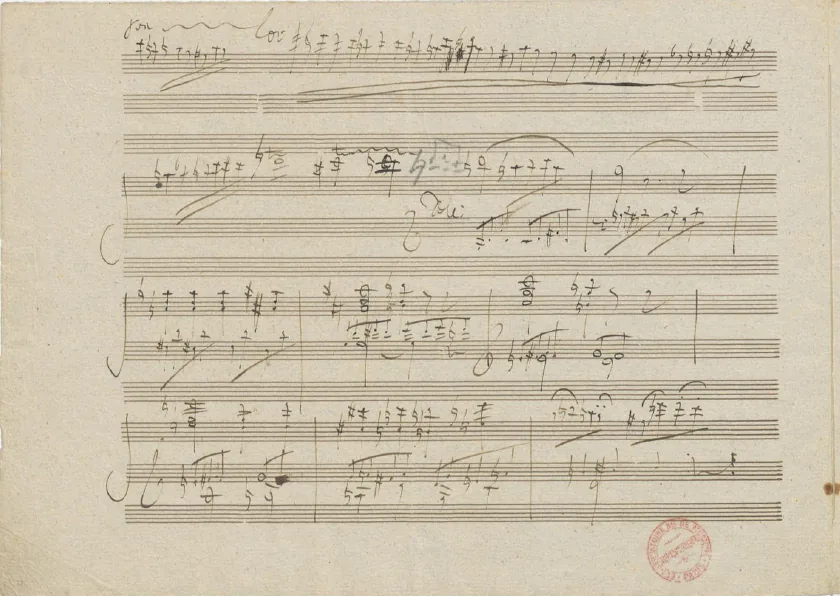
To make matters worse, a dispute over the dedication added personal insult to injury. On the first page of the manuscript, Beethoven had written in Italian, “Concerto par Clemenza pour Clement” (Concerto written with clemency for Clement), a pun clearly indicating his intention to dedicate it to the violinist. However, when the score was published in 1808, the dedication was made not to Clement, but to Beethoven’s longtime friend and patron, Stephan von Breuning. The exact reason is unknown, but it’s likely that Beethoven was deeply disappointed by Clement’s flippant behavior at the premiere or that other practical matters arose during publication. Clement was reportedly deeply hurt by the change. The birth of a work that future generations would call a masterpiece was a messy affair, marked by a grueling creative process, human misunderstanding, and an audience that simply wasn’t ready for it.
Unique Aspects of This Concerto
Beethoven’s Violin Concerto possesses several original features that set it apart from any concerto that came before it. At its heart is Beethoven’s revolutionary spirit, which respected the traditional three-movement structure and double-exposition form of the Classical concerto while boldly breaking its confines to herald the grand narratives of the Romantic era.
The most obvious starting point is the aforementioned timpani introduction. Entrusting the first sounds of a concerto to a percussion instrument, rather than the soloist or the full orchestra, was a radical move. At the time, the timpani was mostly a supporting player, used to reinforce rhythm or add thunder to climaxes. But Beethoven used these five pulsating notes not just as an opening, but as a core motive that governs the entire structure of the first movement. This rhythm, reminiscent of the “fate” motive, reappears in various forms in the woodwinds, strings, and finally the solo violin, acting as the musical DNA that gives the movement its organic unity. This was the embodiment of a truly symphonic idea: breaking down the hierarchy of instruments and allowing even the humblest among them to present and develop the work’s central theme.
The second feature is its overwhelming “symphonic scale.” In the concertos of Mozart or Haydn, the orchestra primarily served as a backdrop or a conversational partner for the soloist. In Beethoven’s concerto, however, the orchestra is a fully equal partner to the solo violin, at times collaborating, at times competing, to drive a massive drama forward. The first movement alone is about 25 minutes long, a length comparable to an entire symphony of the period. Instead of stringing together short, brilliant passages to show off the soloist’s technique, Beethoven chose to have the violin and orchestra build a philosophical narrative together within a grand, architectural structure. This elevates the soloist from a mere virtuoso to the protagonist of a great drama, a philosopher leading the listener into deep contemplation.
Finally, the musical essence of this work is not tied to the characteristics of any single instrument. After the premiere’s failure, Beethoven, hoping to salvage the piece, accepted a proposal from the pianist and publisher Muzio Clementi and arranged it as a piano concerto (Op. 61a) in the same year, 1806. Although the piano version is rarely performed today, its existence proves that the concerto’s sublime melodies, robust structure, and profound spirit are not dependent on the violin’s specific technique but possess a complete musical value of their own. Notably, Beethoven composed a cadenza specifically for the piano version, which cleverly features the timpani alongside the solo piano, re-emphasizing the rhythmic motive that was the core idea of the original. It’s clear evidence of just how important those five drumbeats were to him.
Movement-by-Movement Guide
> 💡 If you’re listening for the first time: Pay attention to how the timpani rhythm from the opening transforms throughout the first movement. Notice the dramatic shift from the quiet meditation of the second movement to the explosive joy of the third. The key to enjoying this piece is to listen to the story the melody tells, rather than focusing on technical fireworks.
Mvt. 1: Allegro ma non troppo
The first movement is a universe unto itself. At nearly 25 minutes, it feels less like a concerto and more like a “symphony with solo violin.” It all begins with those five timpani strokes. As the quiet heartbeat fades, the woodwinds softly sing the first theme, a peaceful, pastoral melody that serves as the prelude to the epic journey ahead. The timpani’s rhythmic motive flows like blood through the movement’s veins, a constant pulse that unifies the whole. The audience in 1806 must have been bewildered by such a long and grand orchestral introduction. A full three minutes pass before the solo violin appears, during which the orchestra presents and develops all the main themes, building a complete world of sound.
Only after the orchestra has laid this vast foundation does the solo violin finally enter. But its arrival is neither explosive nor flashy. It approaches cautiously from a distance, its melody rising gently in high-octave leaps, softly blending into the sonic tapestry woven by the orchestra. Instead of showing off with dazzling technique, the violin acts as a guide, humbly taking the themes presented by the orchestra and leading them into deeper meditation. Just as a powerful fanfare in D major seems to erupt, it quickly shifts to a shadowed melody in G minor, revealing an inner turmoil. The movement writes a grand drama by alternating between lyrical sections reminiscent of wide-open plains and stormy, passionate passages. The listener is left awestruck by the grandeur and intricacy of Beethoven’s sonic architecture. Near the end, there is a place for a cadenza, which Beethoven left blank. Many later violinists have paid homage to this great work by composing their own. Among them, the scholarly cadenza by Joseph Joachim (who revived the piece) and the romantic, brilliant cadenza by the 20th-century master Fritz Kreisler are the most widely performed today.
Mvt. 2: Larghetto
After the vast, philosophical journey of the first movement, a time for deep and quiet introspection arrives. The second movement, in G major, begins with chords played only by the strings, as soft as velvet. Muted strings create a mystical atmosphere, like mist floating over a still lake. This movement is a “theme and variations,” where the solo violin takes a simple, beautiful, hymn-like theme presented by the strings and deepens the meditation by embellishing it in various ways. Here, the solo violin sheds all the dramatic elements of the first movement, exploring the deepest spiritual realms with nothing but pure tone and melodic beauty.
The violin’s soliloquy unfolds over the gentle string accompaniment, sometimes singing, sometimes praying, disarming the listener and leading them into a world of pure emotion. In the first variation, it adorns the theme with delicate ornaments; in the second, it sings more freely over a pizzicato accompaniment; and in the final variation, it delivers a sound of heavenly beauty from its highest register. This movement feels less like a concerto and more like intimate chamber music, a private conversation between the solo violin and the string ensemble. Though brief, the tranquility and sublimity it contains are among the most memorable moments in all of Beethoven’s work. At the very end, as the violin’s slender melody seems to fade into silence, the full orchestra shatters the meditation with a powerful, unexpected chord. Without a moment’s pause (attacca), the music plunges directly into the joyous festival of the third movement. This dramatic transition is a powerful experience, like waking from a deep dream to the brilliant morning of the real world.
Mvt. 3: Rondo. Allegro
The feeling of liberation upon waking from the deep meditation of the second movement—that is the start of the third. Connected seamlessly to the second, the third movement is a delightful festival in a bright and cheerful 6/8 time, structured as a rondo. Following a short orchestral introduction, the solo violin presents the main theme, a lively rhythm reminiscent of a joyful hunting horn. This folk-dance-like melody, seemingly influenced by Hungarian gypsy music, makes you want to tap your feet. The rondo form is characterized by the joyful theme (A) returning repeatedly, interspersed with contrasting episodes (B, C).
Unlike the grandeur of the first movement or the profundity of the second, the third movement wholeheartedly sings of the joy and jubilation of life. The solo violin dances with light steps, engaging in a playful game with the orchestra. Dazzling scales, arpeggios, and double stops showcase the violin’s technique, but the purpose is not to show off, but to express pure delight. A particularly charming moment, revealing Beethoven’s characteristic humor, occurs just before the rondo theme returns: the solo violin plays the theme on its low G-string, and a bassoon comically mimics the melody. After a short cadenza, the music gradually accelerates, rushing towards a powerful and bright coda. Like the triumphal march of a hero who has completed a long spiritual and philosophical journey, the concerto concludes with all instruments singing a song of joy, ending in a grand D-major chord.
Why It’s Still Important Today
For nearly 40 years after its disastrous premiere, Beethoven’s only violin concerto lay dormant, gathering dust on a library shelf. It was stigmatized as a piece that was technically impossible, too long, and too boring to showcase a soloist’s charm. The person who rescued this great work from oblivion and placed it at the pinnacle of the violin repertoire was, remarkably, a twelve-year-old boy. On May 27, 1844, in London, a young boy stood on the stage of a London Philharmonic Society concert, with the great Felix Mendelssohn conducting. His name was Joseph Joachim.
Mendelssohn, the man who had resurrected Bach’s St. Matthew Passion, had a gift for recognizing the value of forgotten masterpieces. He saw the revolutionary worth and deep lyricism of Beethoven’s concerto and entrusted the historic task of its revival to his favorite student, the child prodigy Joachim. The London audience and critics were skeptical. But the moment the first notes flowed from young Joachim’s bow, the atmosphere in the hall changed completely. His performance went beyond technical perfection, which was incredible for his age; he perfectly conveyed the work’s grand structure and deep inner soul. The concert was a monumental success. Critics, stunned, showered him with praise, declaring that he had “revived the great spirit of Beethoven.”
That historic performance changed the fate of the Beethoven Violin Concerto forever. For the rest of his life, Joachim became the concerto’s “apostle” and “evangelist,” dedicating himself to spreading its greatness across Europe. He called it the “Josephine unter den Konzerten” (the Josephine among concertos)—the queen of all concertos—and the cadenza he composed for it remains the most authoritative standard to this day. Without Joachim, we might have lost this masterpiece forever.
Thanks to Joachim’s efforts, this concerto has taken its place alongside the works of Brahms, Bruch, and Tchaikovsky as one of the “four great” violin concertos. It became a mountain that every great violinist of the 20th century had to climb, a touchstone to prove their musical worth. The interpretations of the masters each reveal a distinct personality. Jascha Heifetz, with his razor-sharp and steely interpretation, pushed the work’s structural beauty to its limits. David Oistrakh, with his rich, warm tone, maximized the human warmth and lyricism contained within. Modern performers like Gidon Kremer have shed new light on the work through intellectual exploration. This piece demands more than just nimble fingers; it requires the architectural insight to lead a 45-minute narrative, the poetic sensibility to evoke deep meditation with pure melody, and the conductor-like leadership to commune with the orchestra. It demands that the performer pour their entire philosophy and life experience into the music.

Recommended Recordings
* Jascha Heifetz / Charles Munch / Boston Symphony Orchestra (1955, RCA Red Seal)
This is a classic recording that showcases Heifetz’s signature razor-sharp, fiery interpretation. The flawless technique and fast tempo create a thrilling tension, cutting to the core of the work’s structural beauty.
* David Oistrakh / André Cluytens / Orchestre National de la Radiodiffusion Française (1958, EMI/Warner Classics)
The rich, warm tone of Oistrakh, a leading figure of the Russian school, is simply magnificent. Offering a complete contrast to Heifetz, this recording maximizes the work’s human warmth with an unhurried pace and profound lyricism.
* Isabelle Faust / Daniele Gatti / Vienna Philharmonic (2016, harmonia mundi)
For a more modern recommendation, Faust’s performance stands out for its intellectual and restrained beauty. It’s particularly appreciated by those who enjoy following a score closely, as her interpretation is meticulously detailed and faithful to the text.
Listen with the Score
Following the score can reveal the incredible details of Beethoven’s writing, from the recurring timpani motif to the intricate dialogue between the violin and orchestra. You can view the original score for free on IMSLP.
→ View the score for Beethoven’s Violin Concerto on IMSLP
Frequently Asked Questions
Why did the premiere fail?
The premiere’s failure was caused by a perfect storm of problems. The biggest issue was that Beethoven finished the solo part so late that the violinist, Franz Clement, had almost no time to practice; he essentially had to sight-read it. Another major factor was Clement’s own behavior—between the first and second movements, he performed a showy trick piece with his violin held upside down, which completely undermined the serious mood of the concerto. Finally, the audience of the time found the work’s symphonic scale and 25-minute-long first movement unfamiliar and tedious.
Is this concerto difficult to play?
Yes, it is exceptionally difficult, but not just in terms of technical virtuosity. Unlike a Paganini piece designed for flashy fingerwork, this concerto demands immense stamina to sustain its long, beautiful melodic lines without wavering. It requires a deep musical insight to navigate the vast structure in collaboration with the orchestra. Expressing the profound lyricism and meditative atmosphere of the second movement, in particular, requires an artistic maturity that goes beyond mere technical skill, making it an ultimate challenge for any violinist.
What is a cadenza, and whose are used in this concerto?
A cadenza is a section near the end of a concerto movement where the orchestra stops playing, allowing the soloist to perform alone and showcase their technical and improvisational skills. Beethoven did not write his own cadenzas for this violin concerto. As a result, performers must choose one written by another composer or violinist, or even write their own. The most traditional and frequently performed cadenza is by Joseph Joachim, the violinist who revived the work. The brilliant and romantic cadenza by the early 20th-century virtuoso Fritz Kreisler is also extremely popular.
Why is the opening on the timpani so special?
Until the Classical era, percussion instruments like the timpani were largely relegated to a supporting role, used to emphasize rhythm or add effect at dramatic moments. Beethoven’s decision to begin a concerto with the quietest possible sound from the timpani was a radical departure. More importantly, he used those five drumbeats as a central musical motive that drives the entire first movement. This act elevated the timpani from a simple rhythm instrument to a primary thematic voice, equal to any other instrument in the orchestra—a truly revolutionary step.
What is the piano version (Op. 61a)?
The Piano Concerto, Op. 61a, is an arrangement Beethoven himself made in the same year he composed the original violin concerto (1806). It was commissioned by the famous pianist and publisher Muzio Clementi. While the overall musical structure and melodies are identical to the original, the solo part is adapted to the characteristics of the piano. Although it is not performed nearly as often as the violin version, it holds special value because it includes a unique and extensive piano cadenza composed by Beethoven himself, offering a rare glimpse into his own thoughts on the piece.