- Composer
- Tchaikovsky
(1840–1893) - Work
- Symphony No. 5 in E minor, Op. 64
- Key
- E minor → E major (finale)
- Composed
- May–August 1888
- Movements
- 4 movements
I. Andante — Allegro con anima (E minor)
II. Andante cantabile, con alcuna licenza (D major)
III. Valse: Allegro moderato (A major)
IV. Finale: Andante maestoso — Allegro vivace (E minor → E major) - Instrumentation
- 3 flutes (3rd doubles piccolo), 2 oboes, 2 clarinets, 2 bassoons, 4 horns, 2 trumpets, 3 trombones, 1 tuba, timpani, strings
- Premiere
- November 17, 1888
St. Petersburg
Conductor: Tchaikovsky
In the spring of 1888, Tchaikovsky wrote something remarkable in his diary: “My creative powers are exhausted. All I can do is squeeze something out.”
He was 48 years old. Piano Concerto No. 1, Violin Concerto, Swan Lake, Symphony No. 4 — the world called him Russia’s greatest composer. He felt like a car running on fumes.
The symphony he wrote immediately after that admission is the Fifth.
The Man Who Declared Creative Bankruptcy and Then Wrote a 46-Minute Landmark work
The late 1880s looked like the peak of Tchaikovsky’s career from the outside. Inside, it was a different story.
That slow opening was the fate motif in disguise. What follows is a sonata-form movement built on two contrasting themes: the first theme sharp and agitated, the second theme broad and lyrical. They collide in the development section, and when they return, something odd happens — the second theme reappears in E major instead of the expected E minor. Tchaikovsky shows his hand early. The finale’s transformation is already hinted at in the first movement.
Watch for the moment in the development section where the strings build to a massive crescendo, then suddenly stop. A lone horn plays in the silence. That pause is the bridge to the second movement. The first movement runs about 16–17 minutes.
Second Movement — The Most Beautiful Interruption in Classical Music
Of all the ways to open a slow movement, Tchaikovsky chose a French horn solo over pizzicato strings. It turns out to be one of the smartest decisions he ever made.
The horn plays a long, singing melody in D major — a cantabile (“singing”) line of real aching beauty. This is the horn solo that makes horn players both love and dread this piece. The principal hornist at any major orchestra will tell you this is one of the most exposed and nerve-wracking passages in the symphonic repertoire.
Then the fate motif crashes the party. Twice. Both times at the peak of the movement’s emotional arc. The interruption feels almost rude — deliberately so. The fate motif refuses to let you get lost in the beauty for too long.
How you feel about those interruptions determines a lot about your relationship with this symphony. Some listeners find them unbearably moving — the intrusion of reality into a moment of pure loveliness. Others find them heavy-handed. Both reactions make sense. Tchaikovsky was not trying to be subtle here.
The movement ends with the horn melody returning one last time, quieter now, as if learning to accept the interruption.
Third Movement — Why Tchaikovsky Put a Waltz in His Symphony
In a standard four-movement symphony, the third movement is a scherzo — something quick and playful to provide relief. Tchaikovsky put a waltz here instead.
A waltz in a symphony was considered slightly undignified in the Austro-German tradition. Brahms would never. But Tchaikovsky had already done this in his Third Symphony, and he did it again here without apology. The waltz in A major is genuinely charming — light enough to give your ears a rest after the first two movements’ emotional weight.
Near the end of the waltz, the fate motif briefly reappears and disappears. A shadow crossing the dance floor. The third movement is setting up the explosion to come.
Fourth Movement — The Answer the Symphony Has Been Building Toward
The finale begins slowly, like the first movement’s opening. The fate motif returns — but now in E major. The minor-key gloom brightens immediately. Then the tempo accelerates into Allegro vivace, a relentless sprint.
The development is stormy. Brass and strings drive each other to increasingly high tension. Right before the climax, everything stops. Then Andante maestoso — solemn and grand — brings back the fate motif one final time, now in full E major with horns and trumpets blazing. The whole orchestra piles in for the coda.
This is the moment the symphony has been building toward since those eight quiet clarinet notes in the first measure. Whether you find it genuinely cathartic or slightly theatrical depends on your taste. Tchaikovsky himself had doubts. His diary after the premiere called the finale “overblown” and “insincere.” A year later, after hearing it conducted by Hans von Bülow in Hamburg, he changed his mind: “Not bad at all. I was too hard on it.”
That self-doubt and reversal might be the most honest thing about this symphony.
Why Tchaikovsky Thought His Own Symphony Was Fake
The premiere was November 17, 1888, in St. Petersburg. Tchaikovsky conducted. The reaction was decent — not hostile, not ecstatic.
Tchaikovsky’s reaction to himself was the interesting part. He wrote to von Meck: “I have come to the conclusion that it is a failure. The finale is weak and insincere, and the whole thing is patchy and unpleasant. I dislike it immensely and hope soon to forget about it.”
That’s a brutal self-assessment of a work that hundreds of orchestras now perform every year.
What changed? The Hamburg performance, conducted by Hans von Bülow. Von Bülow was one of the era’s great conductors — also notorious for having lost his first wife to Wagner — and he brought out something in the symphony that Tchaikovsky hadn’t fully heard from the inside. After the Hamburg concert, the composer wrote: “Rather good after all. I was too severe on it previously.”
This story reveals something important about Symphony No. 5: it sounds different from different angles. From inside Tchaikovsky’s anxiety in 1888, the triumphant finale felt manufactured. From the concert hall, conducted by someone who believed in it, it felt earned.
The tension between those two readings — genuine victory or constructed optimism — is still alive in every performance of this piece.
For First-Time Listeners
Three things to hold onto when you first hear Tchaikovsky’s Fifth:
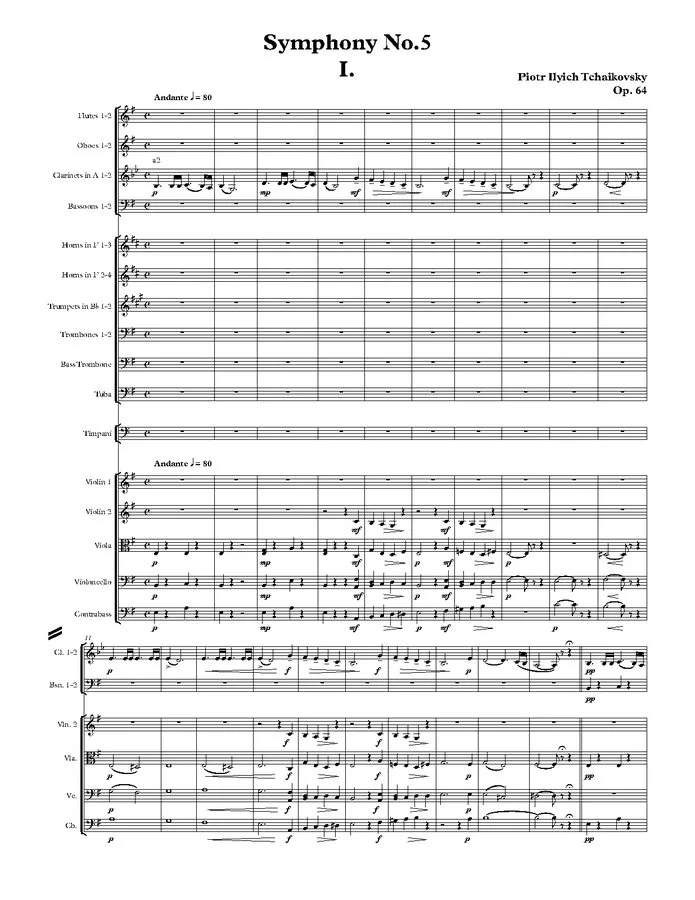
One: Follow the fate motif. Eight notes, played quietly by clarinets at the very start. That’s the anchor. Every time you hear it again — and you will — it’s in a different emotional color.
Two: Don’t miss the second movement horn solo. This is one of the most beautiful passages in the entire symphonic repertoire. Pay attention to the moments it gets interrupted.
Three: Wait for the fourth movement’s pivot. The slow, grand return of the fate motif in E major — that’s the moment the whole symphony has been moving toward. When the brass comes in, you’ll know it.
Listen to it three times if you can. The first time, just let it wash over you. The second time, track the fate motif. The third time, notice how the four movements form a single emotional arc from darkness toward something that feels, however complicated, like light.
No. 5 vs. No. 6 — Which Tchaikovsky Symphony Should You Start With?
Tchaikovsky’s Sixth Symphony, the Pathétique, gets most of the fame. It’s heartbreaking, written just before his death, and ends with one of the most quietly devastating finales in all of music.
But a compelling argument exists for starting with the Fifth.
The Fifth ends triumphantly — or at least it tries to. That matters for first-time listeners. The Sixth ends with the orchestra fading into silence and death. That’s an extraordinary artistic choice, but it can feel baffling before you know the composer’s world. The Fifth gives you the full Tchaikovsky emotional spectrum — anguish, beauty, waltz-hall charm, and a finale that reaches for the light — without requiring you to meet it halfway.
Once you know the Fifth well, the Sixth becomes even more devastating. You hear what he was reaching for in the Fifth and understand what he let go of in the Sixth.
Recommended Recordings
Yevgeny Mravinsky / Leningrad Philharmonic Orchestra (1960, DG)
The reference recording. Mravinsky conducted this symphony with the Leningrad Philharmonic for over forty years. The 1960 account is the definitive statement of his interpretation — steely tension, iron tempo, and not a drop of romantic sentimentality. If you want to hear what Russian orchestral discipline sounds like at its best, start here.
Leonard Bernstein / New York Philharmonic (1988, DG)
The opposite approach. Where Mravinsky is cold and controlled, Bernstein burns hot. The second movement is almost uncomfortably emotional. The finale is explosive. Some find it overwrought; others find it the most honest reading of what Tchaikovsky was actually going through. Worth hearing alongside Mravinsky to understand how far apart two great conductors can be on the same score.
Carlos Kleiber / Vienna Philharmonic (1980, live, Orfeo)
Kleiber’s Fifth is less well-known than his recordings of Beethoven and Brahms, but it’s extraordinary. He finds details in the score that other conductors miss, and the Vienna Philharmonic’s sound gives the whole thing a warmth that neither Mravinsky nor Bernstein quite matches. A discovery for anyone who hasn’t heard it.
Listening with the Score
Following the score while you listen makes it easy to track the fate motif’s transformations across all four movements.
The full score is freely available at IMSLP.
Frequently Asked Questions
What is the fate motif in Tchaikovsky’s Symphony No. 5?
How does Tchaikovsky’s Symphony No. 5 compare to Symphony No. 6 (Pathétique)?
Did Tchaikovsky like Symphony No. 5?
Why did Tchaikovsky put a waltz in the third movement?
What makes the second movement horn solo so famous?
Further Reading
- Beethoven’s Für Elise, WoO 59
- Bach’s Cantata No. 147 ‘Herz und Mund und Tat und Leben’, BWV 147
- Bach’s Cello Suite No. 1 in G major, BWV 1007
- Mozart’s Clarinet Quintet in A major, K. 581
- Chopin’s Piano Sonata No. 3 in B minor, Op. 58