Chopin Isn’t the Delicate One
Chopin gets filed under candlelight: consumptive genius, salon poet, background music for a rainy afternoon. Then look at the pieces he is actually famous for. The Revolutionary etude, where the left hand tears down the keyboard for two and a half minutes without stopping. The Heroic polonaise, built on repeated left-hand octaves that pianists talk about the way runners talk about hills. The funeral march from the Second Sonata, played in an orchestral arrangement at his own funeral service. Three of his biggest hits in a row, and every one of them makes you clench a fist.
He also wrote almost nothing that was not for piano. A cello sonata, a piano trio, a handful of songs, two concertos where the orchestra mostly holds the coat — past that the catalogue is solo keyboard, end to end. One composer, one instrument, and inside it a range running from lullaby to riot. That is why a genre map works for Chopin and would be useless for Mozart: here, the genre is the mood.
What follows is that map — one essential piece per genre, then a three-step route in, then five pianists to use as a compass. New to the wider repertoire? Our classical music beginner’s guide is the general on-ramp.
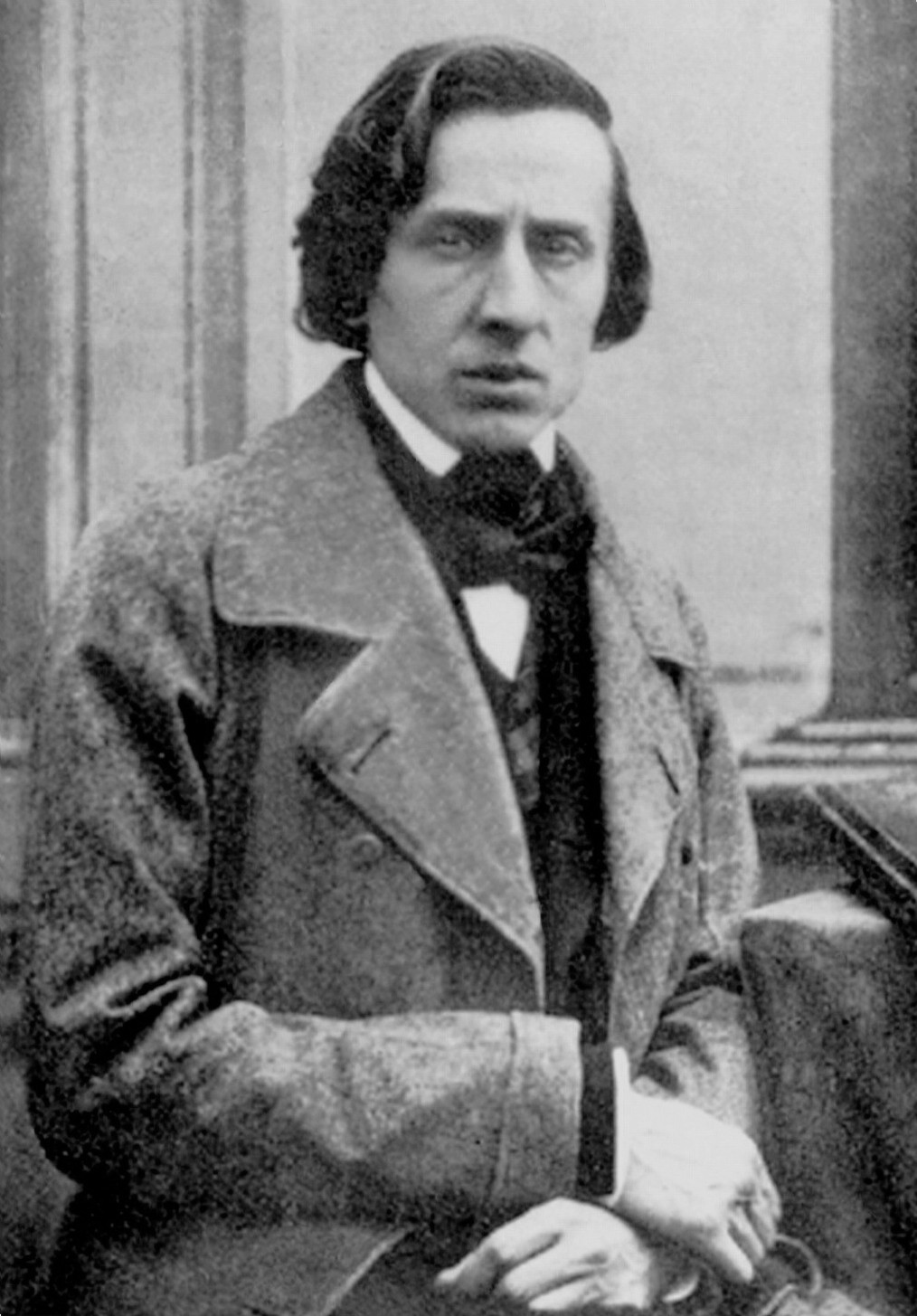
Two dates anchor everything below. Chopin was born near Warsaw in 1810 and died in Paris in 1849, which gives him thirty-nine years. He left Warsaw on 2 November 1830 and never returned to Poland, splitting those years into a Polish youth and a French exile.
The Genres, One Essential Piece Each
Ballades — the ten-minute novels
Chopin wrote four Ballades: Op. 23, Op. 38, Op. 47 and Op. 52. Before him the word meant a sung narrative poem; he took the storytelling shape and handed it to one instrument with no words. Each runs roughly ten minutes and behaves like a plot rather than a form — themes come back changed, not merely repeated.
Start with the Ballade No. 1 in G minor, Op. 23, composed in 1835 and published in 1836. A hesitant opening question, two themes that grow into each other, and a coda that goes off like a demolition charge. The No. 2 in F major, Op. 38 is the strange one — pastoral music repeatedly kicked over by violence — and Chopin dedicated it to Robert Schumann, who had dedicated his Kreisleriana, Op. 16, to Chopin in return. No. 4 in F minor, Op. 52 is the one pianists rank hardest: it runs real counterpoint under the melody and still has to sound like singing.
🎧 Also on: Apple Music · Spotify
Nocturnes — louder than you remember
The nocturne was not Chopin’s invention. The Irish composer John Field is credited with it, and Field’s template — a singing right hand over a wide, pedalled left hand — is what Chopin took over, then loaded with harmonic risk and a far wider dynamic range. Complete sets normally run to 21 nocturnes, and playing them in order is the clearest way to hear a composer age.
The famous one is the Nocturne in E-flat major, Op. 9 No. 2, and it earns the fame. But the set’s reputation for gentleness is a sampling error. In Op. 48 No. 1 in C minor the middle section arrives in full chordal roar, closer to an organ than a lullaby, before the opening theme returns wrecked and doubled in octaves. Op. 55 No. 2 splits the right hand into two voices that sing at once without colliding. Op. 62 No. 2, from his last years, hides its melody under so much ornament you have to lean in.
🎧 Also on: Apple Music · Spotify
Etudes — exercises that escaped the practice room
An etude is a study: one technical problem, drilled. Chopin’s double as concert repertoire, which almost nobody had managed before. The Op. 10 and Op. 25 sets contain twelve each, and adding the Trois nouvelles études of 1839 brings the total to 27.
Op. 10 No. 1 stretches the right hand across arpeggios wider than the hand comfortably opens. No. 4 in C-sharp minor is a speed-and-accuracy test where one missed note collapses the line. No. 12 in C minor is the Revolutionary, and the nickname is worth pausing on: Chopin did not give it that name. The story attaching it to the fall of Warsaw to Russian forces in September 1831, news of which reached Chopin in Stuttgart, is popular and unprovable. The music is furious either way. From Op. 25, No. 11 in A minor — Winter Wind — sends the right hand through four minutes of unbroken descending figuration while the left hand marches underneath.
🎧 Also on: Apple Music · Spotify
Polonaises — the exile’s genre
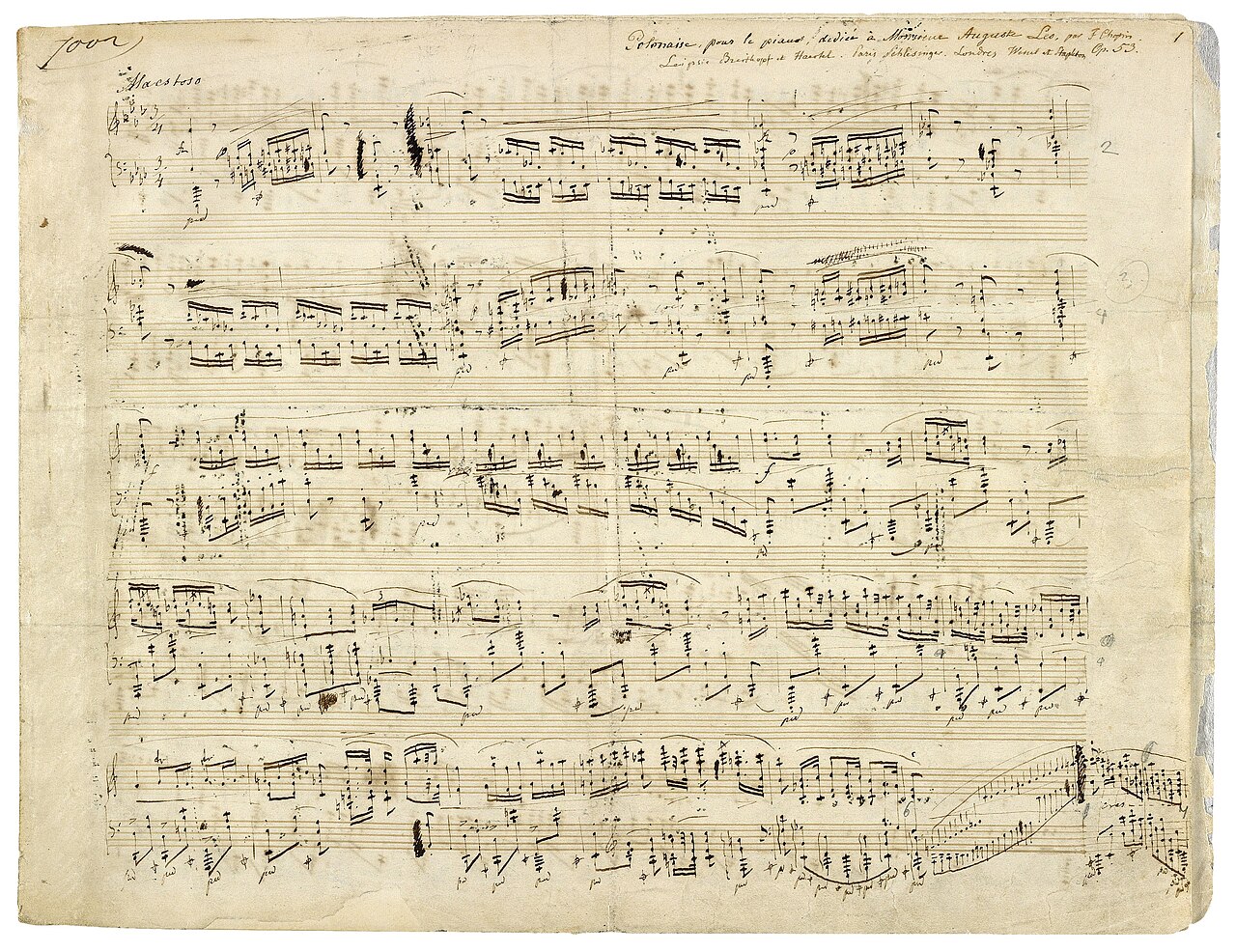
The polonaise is a Polish processional court dance, and Chopin wrote his best ones from Paris, about a country he could not go home to. Op. 53 in A-flat major, the Heroic, is the one everybody knows: the left-hand octave passage before the main theme returns is the most notorious stamina test in the repertoire, and pianists redistribute it more often than they admit.
Op. 44 in F-sharp minor is structurally the odd one — a mazurka sits inside the middle of a polonaise, which he never tried again. The serious payoff is the Polonaise-Fantaisie, Op. 61: a quarter of an hour that keeps dissolving the dance rhythm into something closer to a nocturne, then reassembling it. If you want to hear where late Chopin was heading, that piece is the door.
Preludes — twenty-four keys, forty minutes
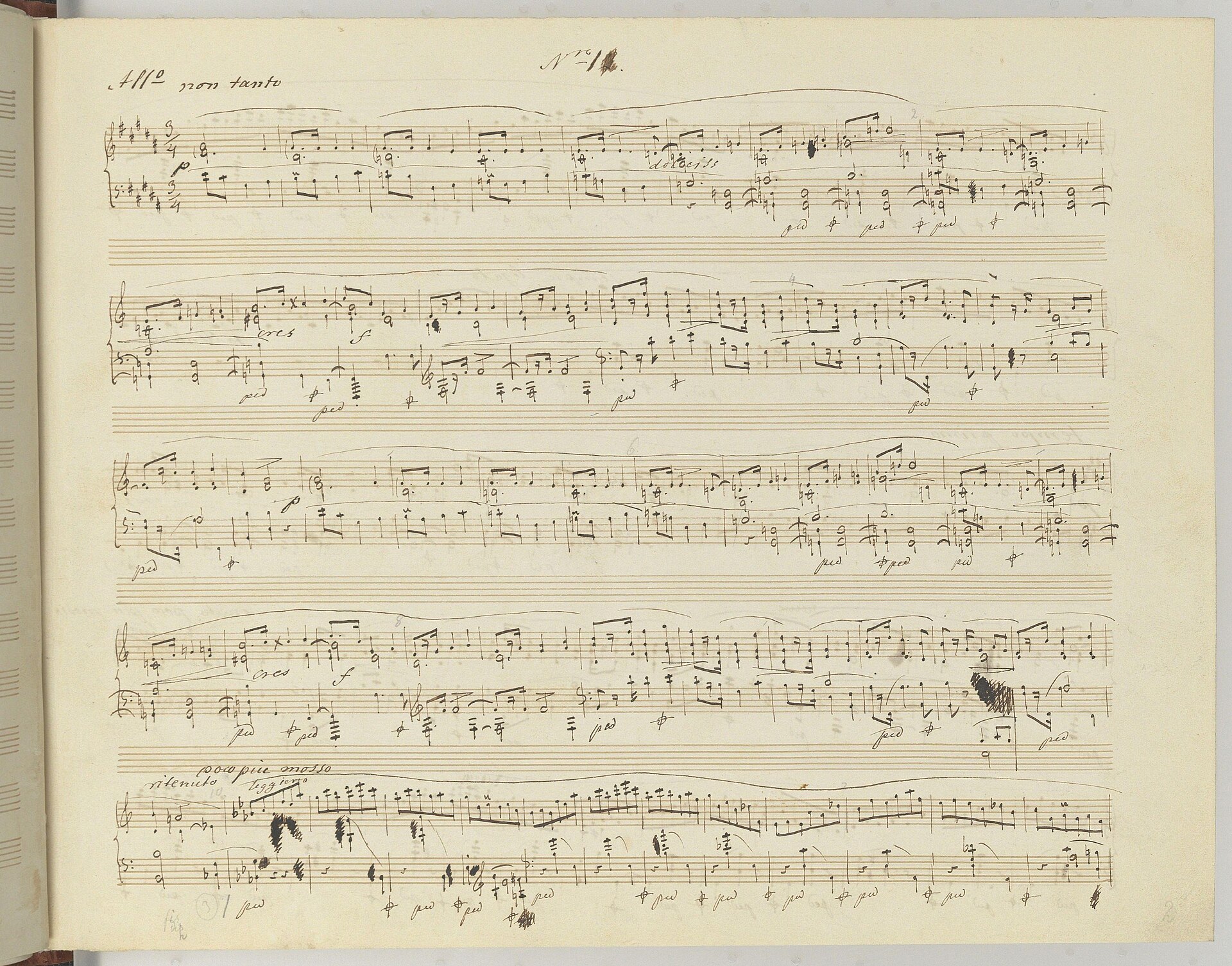
The 24 Preludes, Op. 28 run through every major and minor key, from pieces of half a minute to ones of five. They were commissioned by the piano maker and publisher Camille Pleyel for 2,000 francs, and Chopin finished them partly at Valldemossa on Majorca during the winter of 1838–39, in miserable weather, with George Sand and her children.
That stay produced the set’s best-known story and its best myth-buster. No. 15 in D-flat major, published in 1839, carries a repeated A-flat through its whole length and picked up the nickname Raindrop from Sand’s account of a storm at the monastery. Sand also recorded, in her memoir Histoire de ma vie, that Chopin denied hearing any raindrops and was angry at the suggestion he was imitating sounds at all. Take him at his word and that repeated note stops being weather and starts being a pulse you cannot get away from.
Elsewhere: No. 4 in E minor is one long chromatic sinking in the left hand and gets played at funerals constantly. No. 20 in C minor compresses a funeral march onto a single page. No. 24 in D minor ends the cycle with hammered low Ds that function as a door slamming.
▶ Listen on YouTube · Apple Music · Spotify
Sonatas — three written, two that matter
Chopin wrote three piano sonatas. The First, Op. 4, is student work almost nobody programs. The Second in B-flat minor, Op. 35 contains the funeral march, and the march is so famous that listeners skip the rest — a mistake, because the finale is the strangest ninety seconds he ever wrote: both hands whispering in bare octave unison, no harmony, no melody, no resolution, then stopping.
The Third in B minor, Op. 58 is the better-built piece. Its Largo is one long slow melody that keeps refusing to end, and the finale is a rondo that drives to a conclusion instead of evaporating. Put it beside our Beethoven piano sonata guide and the difference in method is stark: Beethoven builds sonatas out of argument, Chopin out of melody and colour.
Concertos — piano first, orchestra a distant second
There are two, and the numbering lies: the F minor, Op. 21, published as No. 2, was written before the E minor, Op. 11. Both are early, and both take criticism for orchestration that mostly doubles or accompanies. The criticism is fair and beside the point — listen to the piano writing in the E minor’s Romance and the orchestra’s job is obviously to stay out of the way.
Martha Argerich’s account with Claudio Abbado and the London Symphony Orchestra, recorded for Deutsche Grammophon in 1968, is still the reference for forward pressure; she plays the finale like it might get away from her, and it never does. Krystian Zimerman’s version, recorded in 1999 with the Polish Festival Orchestra directed from the keyboard, is the opposite approach and the best-balanced Chopin concerto recording in the catalogue — he assembled and rehearsed that orchestra himself, and the extra attention shows in the wind playing. A dedicated guide to the F minor concerto is on our list to write.
🎧 Also on: Apple Music · Spotify
Waltzes, scherzos, mazurkas and the rest
The waltzes are salon pieces, not ballroom ones — nobody is dancing to the Minute Waltz. Op. 64 No. 2 in C-sharp minor is the pick: a waltz that keeps sliding into melancholy between its own phrases.
The four scherzos have nothing to do with jokes. No. 1 in B minor, Op. 20 opens with screamed dissonant chords and then, in its slow middle section, quotes the Polish Christmas carol Lulajże Jezuniu — a lullaby dropped into the middle of a tantrum, one of the eeriest effects in the repertoire. Two outliers also deserve a listen: the Barcarolle, Op. 60 turns a gondolier’s rhythm into just under nine minutes of the most physically sensuous music he wrote, and the Fantaisie-Impromptu, Op. 66 is his most-played piece by some distance even though he never published it — it appeared posthumously in 1855, against his stated wish that his unpublished manuscripts be destroyed.
Then the mazurkas, close to sixty of them, where the specialists go: folk dance rhythms, private harmonic experiments, several heading toward chromaticism that would not sound out of place fifty years later. Rafał Blechacz and Arthur Rubinstein are the usual entry points.
Where to Start: A Three-Step Route
Step 1 — get hooked on one piece. Play the Nocturne Op. 9 No. 2 once, then again with a different pianist. Five minutes each. The point of the second listen is not the piece; it is discovering how much of what you liked belonged to the performer.
Step 2 — take one genre whole. The 24 Preludes, forty minutes, is the right choice: too many pieces to get bored, short enough durations to notice which ones grab you. Then follow the mood sideways. If No. 4 in E minor landed, go to the Nocturne Op. 48 No. 1. If No. 15 did, go to the Nocturne Op. 27 No. 2.
Step 3 — commit to a big one. Ballade No. 1 or the Second Sonata. By now the vocabulary is familiar enough that the structure holds, and the same Ballade from three pianists is genuinely three different pieces.
Five Pianists to Use as a Compass
Krystian Zimerman — his four Ballades, recorded for Deutsche Grammophon in 1987, is the control sample. Every voice placed deliberately, none of it fussy. Use it as your baseline; other pianists then become easy to describe as departures from it.
Maurizio Pollini — the Op. 10 and Op. 25 etudes, recorded for Deutsche Grammophon in 1972, set the modern standard for accuracy that never sounds clinical. If you find it a touch cold, that is a fair reaction; it is still the set every later one is measured against.
Martha Argerich — the risk-taker. Her live performances beat her studio work almost every time, and her sonatas are ferocious in a way that will not suit everyone. Start here if Pollini bores you.
Arthur Rubinstein — his RCA nocturnes, recorded in 1965 and 1967, remain the default recommendation, and rightly. He refuses to over-sentimentalise: small rubato, warm rather than misty tone. The trade-off is that he can sound plain next to more theatrical players.
Grigory Sokolov — barely any authorised studio Chopin exists, which is why he is a specialist’s name. The live Preludes that circulate are worth the hunt: he takes more time than anyone and the pieces still do not sag — twenty-four separate worlds rather than one suite.
Follow the Score, for Free
Every Chopin score sits on IMSLP as a free PDF, first editions included. Reading along while you listen is the cheapest upgrade available to a non-player, and it does not require you to read music: the density of ink maps onto what you hear, so sparse staves are quiet and clotted black ones are loud and fast.
Go further and the editions themselves disagree, which is the interesting part. The Polish National Edition edited by Jan Ekier is the current scholarly reference; the Cortot edition carries a great pianist’s interpretive commentary. Comparing two on the same page shows that editing is interpretation, not transcription. Our composer map puts Chopin next to Schumann, Mendelssohn and Liszt — same years, same instrument, completely different plans for it.
The Competition That Plays Nothing But Chopin
The International Fryderyk Chopin Piano Competition was founded in 1927 and is held every five years in Warsaw. Competitors play only Chopin, first round to final, which makes the archive an unusually clean experiment: dozens of pianists, the same short list of pieces, side by side.
The winners’ list doubles as a discography. Maurizio Pollini won in 1960, Martha Argerich in 1965 and Krystian Zimerman in 1975. Seong-Jin Cho won in 2015 and brought an enormous new audience with him. Bruce Liu won in 2021. Eric Lu won the nineteenth competition, held in Warsaw from 2 to 23 October 2025, playing the Second Concerto in the final round; that edition drew a record 642 applicants. The Chopin Institute keeps the performances online, and watching four finalists play the same concerto in a row is the fastest interpretation lesson available anywhere.
Frequently Asked Questions
What should I listen to first if I’m new to Chopin?
Why did Chopin only write for piano?
Which Chopin piece is the hardest to play?
Is the Raindrop Prelude really about rain?
Which pianist should I use as a reference for Chopin?
Can I appreciate Chopin without being able to play piano?
Where to Go Next
- Chopin’s Ballade No. 1 in G minor, Op. 23
- Chopin’s Nocturne in E-flat major, Op. 9 No. 2 — the entry-point piece
- Chopin’s Prelude No. 15, the Raindrop — what that repeated note actually does
- The Beethoven piano sonata guide — the opposite method
- The composer map — Chopin among his contemporaries