Search “classical workout playlist” and you get Barber’s Adagio for Strings and Clair de lune, which is how people end up walking on a treadmill at the tempo of a funeral procession. The problem is not that classical music is too calm for the gym. It is that most of it was written for a silent hall, and a gym is the opposite of a silent hall.
These twelve pieces survive that room, sorted by the part of the session they belong in. Three famous picks that do not survive it are at the bottom, with reasons.
The short answer
If you are building the playlist right now and want the list without the argument:
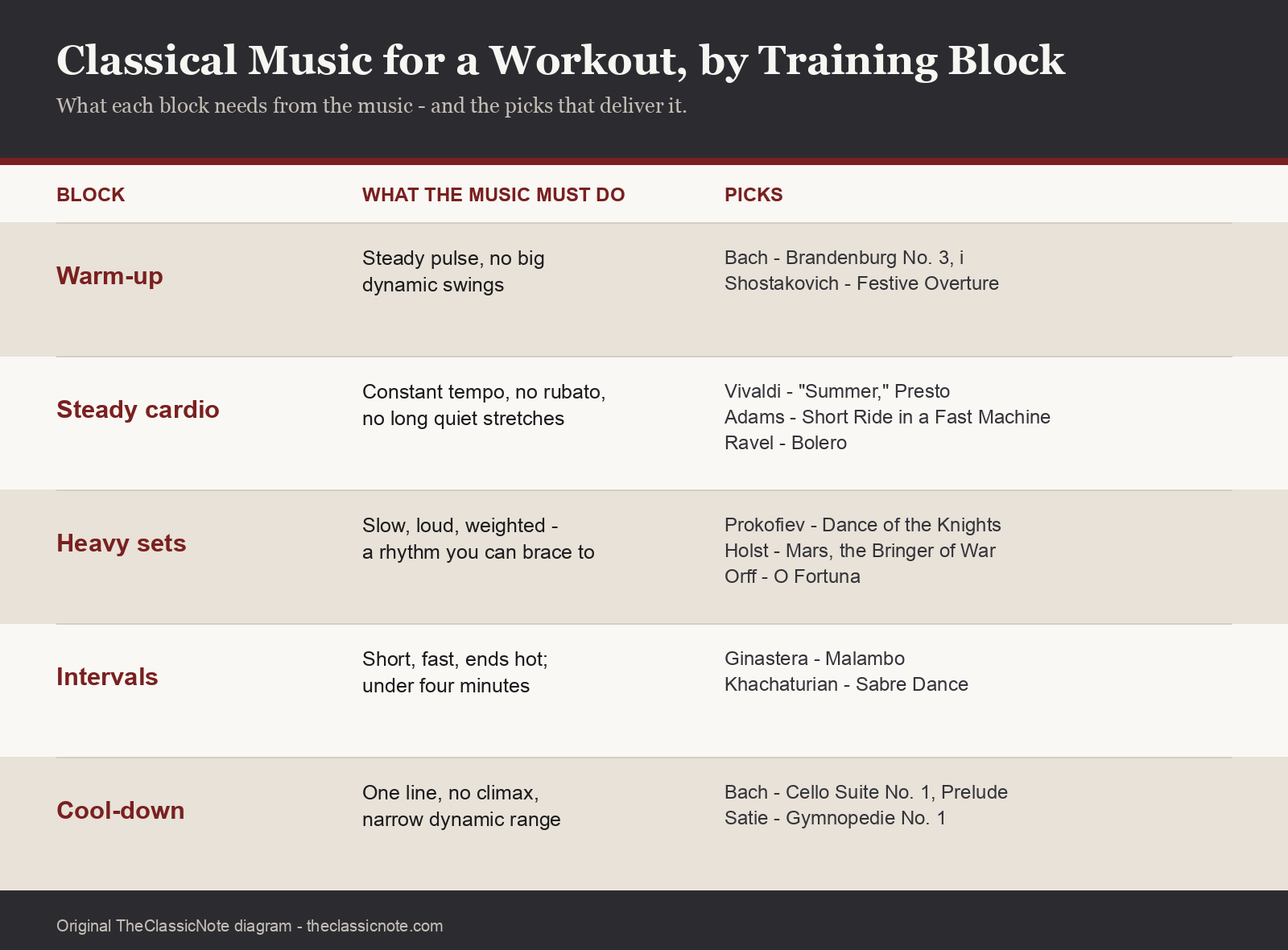
- Warm-up: Bach, Brandenburg Concerto No. 3 (first movement) · Shostakovich, Festive Overture
- Steady cardio: Vivaldi, “Summer” (Presto) · John Adams, Short Ride in a Fast Machine · Ravel, Bolero
- Heavy sets: Prokofiev, Dance of the Knights · Holst, “Mars” · Orff, “O Fortuna”
- Intervals and finishers: Ginastera, Malambo · Khachaturian, Sabre Dance
- Cool-down: Bach, Cello Suite No. 1 Prelude · Satie, Gymnopedie No. 1
Why most classical music dies in a gym
The usual explanation is tempo — classical is slow, dance music is fast. That is wrong, and it sends people looking for the wrong thing. Vivaldi’s “Summer” finale is faster than almost anything on a spin playlist. The real problem is dynamic range.
A heavily compressed pop master can be squashed into as little as four to six decibels of range: the quietest bar and the loudest bar sit close together, so the track stays audible on earbuds next to a squat rack. An orchestral recording keeps twenty or more. That range is the point in a concert hall. In a room with air handling, dropped plates and somebody’s phone on speaker, it means the piece simply vanishes for two minutes at a time and reappears when you no longer need it. You are not bored by the quiet parts. You cannot hear them.
So the filter for gym repertoire is not “exciting.” It is continuously loud with a fixed pulse. That points at three families: Baroque motor rhythm, which never stops moving and never gets much softer; twentieth-century ostinato writing, which repeats a rhythmic cell under everything; and minimalism, which is built out of a constant pulse by design. Romantic music mostly fails, because rubato — the elastic push and pull of the beat that makes Chopin sound human — is poison for anything you are trying to do in time with your feet.
One number worth having: coaching guidance generally puts a productive running cadence somewhere in the 170 to 190 steps-per-minute range. Two steps per beat means the useful musical tempo band is roughly 85 to 95 beats per minute. Most of the picks below sit in or near it.
Warm-up: start the clock, not the fight
Bach — Brandenburg Concerto No. 3 in G, first movement
The best warm-up music in the repertoire, and it is not close. The first movement runs on continuous sixteenth notes that literally never stop, three violins against three violas against three cellos, all of them chewing through the same rhythm. There is no ritardando to trip over and no dynamic hole to fall into — it starts at a working intensity and stays there for five minutes, which is exactly the shape of a good warm-up. Bach sent this concerto, with five others, to Christian Ludwig, Margrave of Brandenburg, under a dedication dated 24 March 1721.
▶ Listen on YouTube · Apple Music · Spotify
Shostakovich — Festive Overture, Op. 96
Six minutes that open with a brass fanfare and then hand the tune to the clarinets over a scampering accompaniment that does not let up. Shostakovich wrote it in three days in 1954 for a Bolshoi concert marking the thirty-seventh anniversary of the October Revolution, and it premiered there on 6 November 1954 under Alexander Melik-Pashayev. Deadline music, and it sounds like it in the best way: no development section to sit through, no introspection, just forward. Use it as track two when the first set is about to start.
▶ Listen on YouTube · Apple Music · Spotify
Steady cardio: the tempo that matches your feet
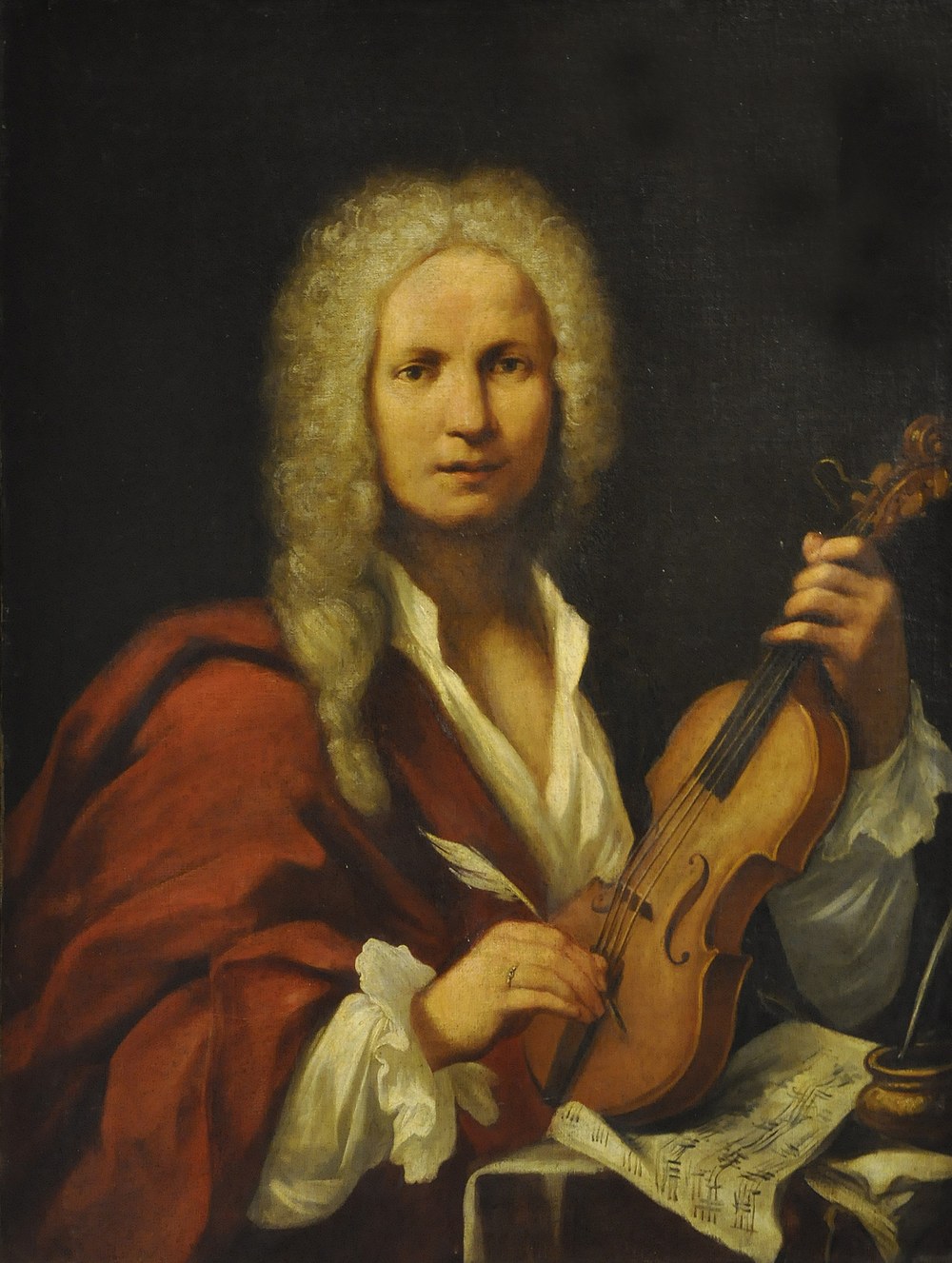
Vivaldi — “Summer” from The Four Seasons, third movement (Presto)
The storm movement, and the single most gym-viable thing Vivaldi wrote. Continuous triplet figures in the strings, a bass line that hammers straight eighths underneath, and a solo violin that behaves like a rhythm instrument rather than a singer. Vivaldi published it in 1725 as part of Op. 8, Il cimento dell’armonia e dell’inventione. Three minutes, no quiet passage longer than a few seconds, and it ends on the beat instead of trailing off.
▶ Listen on YouTube · Apple Music · Spotify
John Adams — Short Ride in a Fast Machine
If you take one recommendation from this article, take this one. A woodblock ticks quarter notes at a fixed rate for four minutes while the rest of the orchestra piles up around it, deliberately not quite lining up, until the brass arrives and settles the argument. The woodblock is the metronome you have been looking for: it does not accelerate, it does not breathe, and it is loud enough to cut through a treadmill belt. Adams called the piece a fanfare for orchestra; the Pittsburgh Symphony premiered it under Michael Tilson Thomas on 13 June 1986 at the Great Woods Festival. Four minutes is a perfect interval block.
🎧 Also on: Apple Music · Spotify
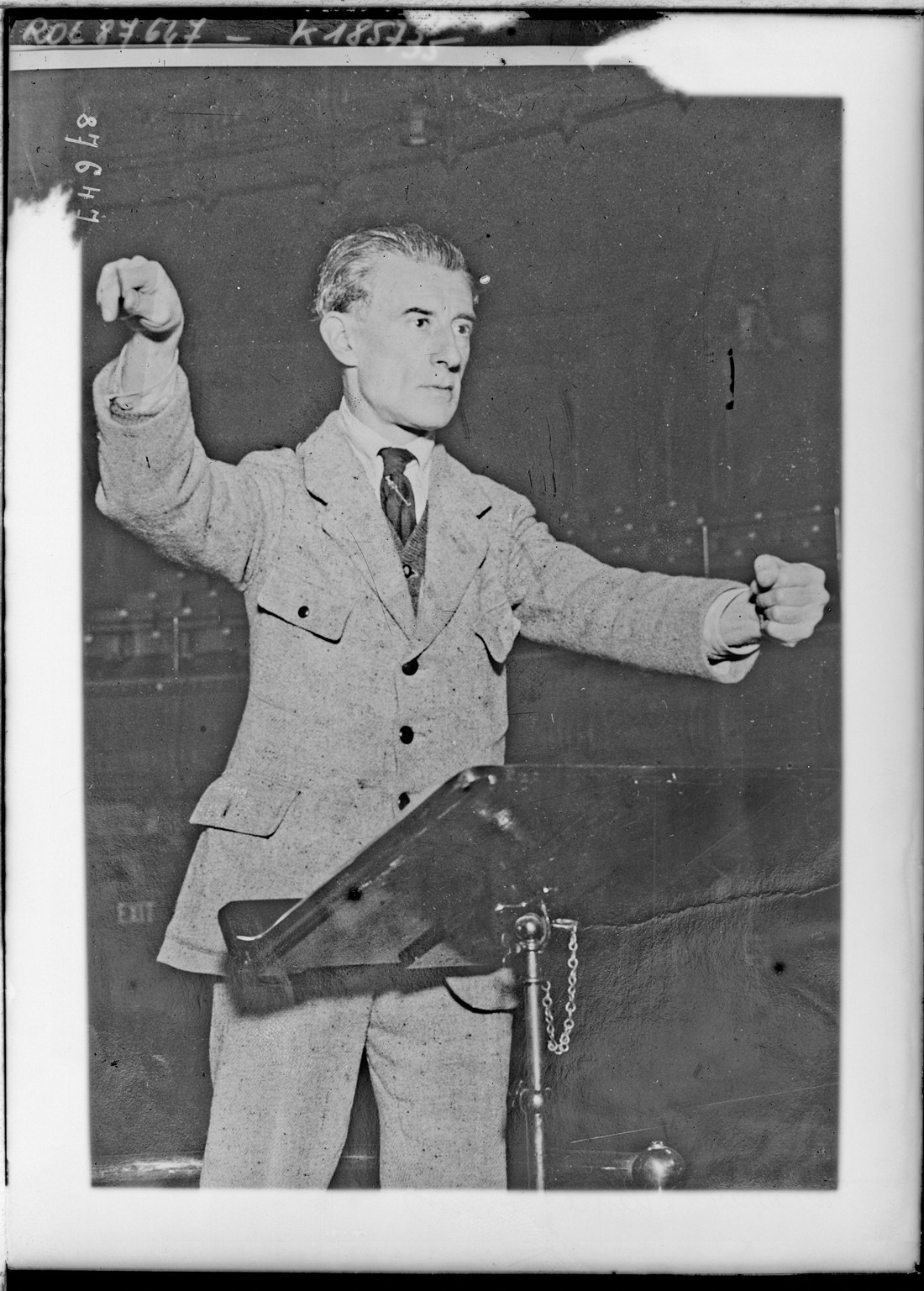
Ravel — Bolero
Fifteen-odd minutes of one snare-drum rhythm and one tune, repeated while the orchestration thickens from a solo flute to the entire ensemble. It is the only piece here that works as a whole training block rather than a track: the crescendo does the job of a progressive effort, so it maps onto a long steady run or a bike ramp. Ravel wrote it for the dancer Ida Rubinstein and it premiered at the Paris Opera on 22 November 1928. Honest caveat: the first four minutes are genuinely quiet, so either start it during your warm-up walk or skip ahead to the point where the horns enter.
▶ Listen on YouTube · Apple Music · Spotify
Heavy sets: slow, loud, and weighted
Lifting wants the opposite of running. You are not matching a cadence; you are bracing against something. The music needs weight and a slow, implacable pulse you can time a breath to.
Prokofiev — Dance of the Knights
The “Montagues and Capulets” music from the 1935 ballet Romeo and Juliet, also published in the Second Suite, Op. 64ter. Low brass and strings stamping out a dotted rhythm at a tempo you could walk to, with a texture so thick it stays audible even at gym volume. This is the closest classical music gets to a deadlift anthem, and the reason it turns up in football stadiums and boxing walk-ins is not a mystery: the pulse is slow enough to be felt in the body rather than counted.
🎧 Also on: Apple Music · Spotify
Holst — “Mars, the Bringer of War” from The Planets
Seven minutes built on a five-beat ostinato that repeats without mercy from the first bar. Five beats to a bar is the detail that makes it work here: your body keeps trying to hear it as a march in four, fails, and stays alert. The strings play the opening with the wood of the bow, so the rhythm arrives as a dry clatter rather than a tone, which is why it cuts through background noise better than almost any orchestral texture. Best used for the set you are dreading. If you want to go deeper on the piece, we compared the major recordings in our guide to the best recordings of The Planets.
▶ Listen on YouTube · Apple Music · Spotify
Orff — “O Fortuna” from Carmina Burana
Everybody’s first thought, and it half deserves the reputation. Orff’s cantata premiered at the Frankfurt Opera on 8 June 1937, and the opening chorus has been advertising’s sound of impending doom ever since. Here is the honest verdict: the famous part is the first forty seconds and the last forty seconds. Between them sits a long stretch of hushed choral muttering that disappears completely under gym noise, and the whole thing is under three minutes. Use it as the track you cue for one specific heavy single, not as playlist filler. Our comparison of Carmina Burana recordings covers which versions keep the bite.
▶ Listen on YouTube · Apple Music · Spotify
Intervals and the last set: short, fast, ends hot
Ginastera — Danza final (Malambo) from Estancia
The pick nobody puts on these lists, and the best interval track in the repertoire. A malambo is a competitive Argentine dance for men, and Ginastera writes it as an accelerating machine: a stamping rhythm that starts at a manageable clip and keeps adding instruments and speed until the last thirty seconds are barely controlled. It runs about three and a half minutes and finishes at maximum, which is the whole point — the piece ends when you are supposed to stop. Ginastera composed Estancia in 1941 on a commission from Lincoln Kirstein’s American Ballet Caravan. Put it on your last interval and try not to go faster than you planned.
🎧 Also on: Apple Music · Spotify
Khachaturian — Sabre Dance from Gayane
Two and a half minutes of xylophone, screaming brass and a rhythm that never lets go. It comes from the final act of Gayane, premiered on 9 December 1942 at the Perm Opera and Ballet Theatre, and was added late, after the rest of the ballet was written. The one weakness is the slower middle section with a saxophone tune — about forty seconds where the energy drops. Everything on either side of it is perfect sprint music.
▶ Listen on YouTube · Apple Music · Spotify
Cool-down: bring the heart rate down on purpose
Bach — Cello Suite No. 1 in G, Prelude
One instrument, one unbroken line of broken chords, and a dynamic range narrow enough that you can actually hear all of it while you stretch. It is also short — under three minutes — so it will not strand you on the mat. The reason it works better than the usual slow-movement choices is that it keeps moving: the pulse is steady, so your breathing has something to lock onto instead of drifting. We wrote a full listening guide to the Bach cello suites if you want to keep going after the workout.
▶ Listen on YouTube · Apple Music · Spotify
Satie — Gymnopedie No. 1
The obvious cool-down, and for once the obvious answer is right. A slow waltz bass under a melody that refuses to build to anything: no climax, no key change that demands attention, no surprise. That flatness is a defect in a concert and an asset at the end of a session, where you want the music to stop asking things of you. Three minutes, and the title is a joke about Greek athletic festivals, which makes it the only piece on this list that is technically about exercise.
▶ Listen on YouTube · Apple Music · Spotify
Three famous picks that don’t survive the gym
Wagner, “Ride of the Valkyries.” The tune everyone wants arrives about ninety seconds in, after a build that is mostly tremolo strings at low volume. In a quiet room that build is the best part. On a rowing machine it is ninety seconds of nothing followed by eight seconds of payoff, repeated. If you must use it, find a version that starts at the brass entry.
Barber, Adagio for Strings. It appears on workout lists constantly, presumably because it is intense, and intense reads as motivating. It is a piece about grief that spends eight minutes climbing to one shattering chord and then goes almost silent. It will not make you run faster. It will make you think about your grandmother.
Tchaikovsky, Festival Overture, Op. 49. Fifteen minutes for roughly two of usable material, and the famous cannon fire is at the very end. The long hymn opening and the folk-tune middle are lovely and completely inaudible under a fan. Save it for the drive home.
How to actually build the playlist
Sequence by block, not by mood. Warm-up, work, finisher, cool-down — the diagram above is the running order. The most common mistake is front-loading the biggest tracks, which leaves you with nothing for the set that actually hurts.
Watch the lengths. Most of these run three to seven minutes, which is longer than a pop track and shorter than a full symphonic movement. That is convenient: one piece is roughly one interval or two working sets. Bolero is the exception at around fifteen minutes and should be treated as a block of its own.
Turn off loudness normalization, then add compression if you can. Streaming services normalize the average level, which does nothing for the gap between the loud and quiet parts of an orchestral track. If your app or headphones offer a compression or “night mode” setting, that is the one that actually helps: it lifts the quiet passages instead of just raising the whole thing.
Skip anything with a famous silence. Any piece known for a dramatic pause, a long diminuendo or a whispered ending will feel like your headphones broke. That rules out most late Romantic slow movements, which is where the “classical is boring at the gym” idea comes from in the first place.
If this list works for you, the natural next step is our roundup of classical music that sounds like heavy metal — same instinct, more distortion. And if you want music for the other end of the day, Beethoven for studying applies the same test in reverse: what stays out of your way.