- Composer
- Johannes Brahms
(1833–1897) - Work
- Double Concerto for Violin and Cello in A minor, Op. 102
(Konzert für Violine und Violoncello a-Moll op. 102) - Key
- A minor
- Composed
- Summer of 1887
- First performance
- 18 October 1887, Gürzenich, Cologne
Joseph Joachim (violin)
Robert Hausmann (cello)
Brahms conducting - Instrumentation
- Solo violin, solo cello
2 flutes, 2 oboes, 2 clarinets, 2 bassoons
4 horns, 2 trumpets
timpani, strings - Movements
- Three movements
I. Allegro (A minor)
II. Andante (D major)
III. Vivace non troppo (A minor → A major) - Duration
- About 33 minutes
An apology Brahms could not say out loud
Most composers write concertos because someone commissions one, or because they want to hear a particular player do a particular thing. Brahms wrote this one because he had lost a friend and could not figure out how to get him back with words.
Brahms composed the Double Concerto in the summer of 1887, and it turned out to be the last work for orchestra he ever wrote. The friend was the violinist Joseph Joachim, and the two men had not been on speaking terms for years. The concerto was, in part, a gesture of reconciliation aimed directly at him. What makes the piece worth an hour of your attention is that you can hear the intention in the writing itself — not as a program, not as a story bolted on afterwards, but as a structural decision. Brahms built a concerto in which neither soloist is allowed to win.
That decision is also why the piece confused its first listeners, and why it still gets described as difficult, austere, or — the recurring complaint — not showy enough. All of that is true, and none of it is a flaw. This is a concerto that behaves like chamber music at symphonic scale, and once you stop waiting for the fireworks, it becomes one of the most emotionally direct things Brahms ever put on paper.
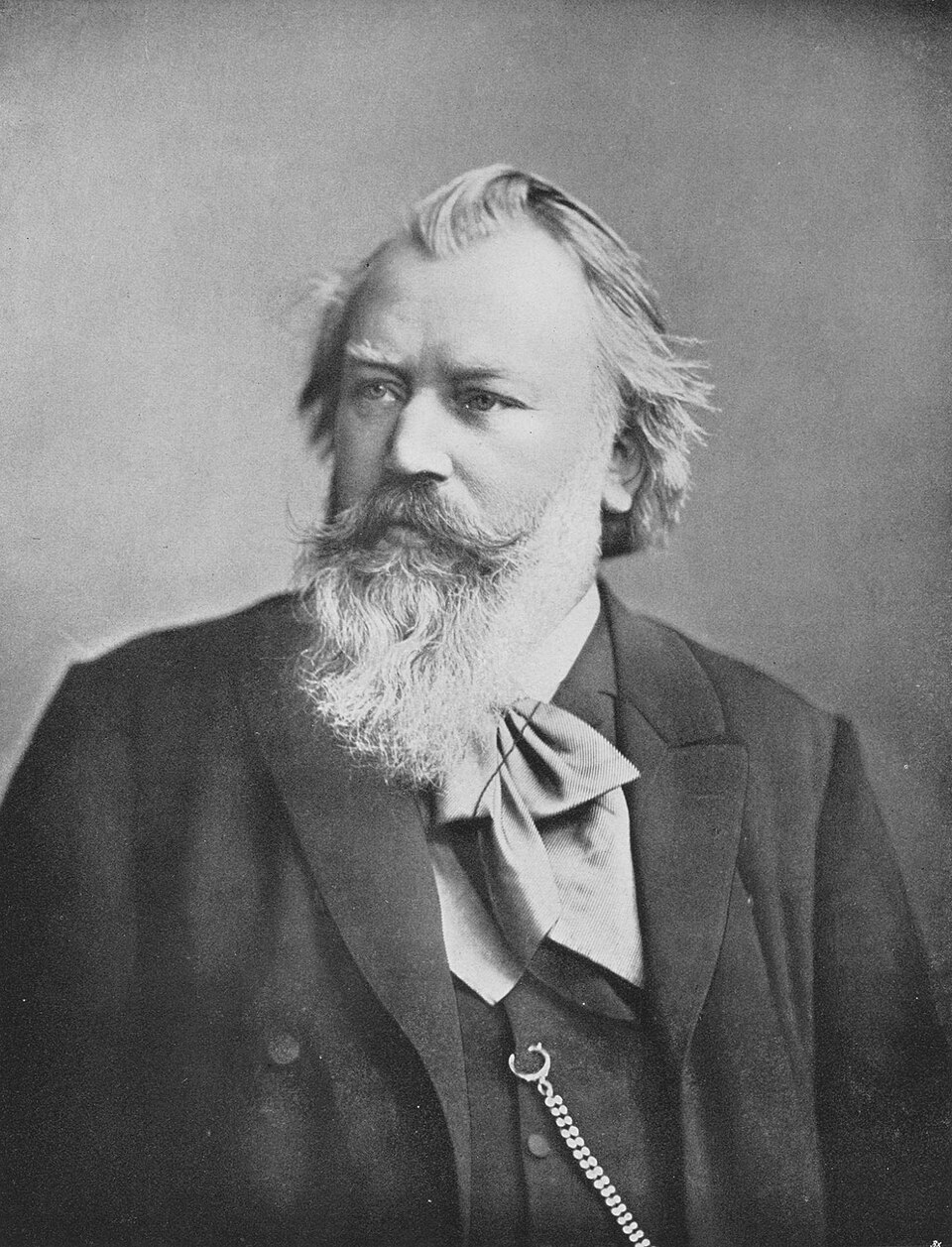
What actually broke: a divorce, a letter, and a very long silence
Brahms and Joachim met in 1853, when Brahms was still an unknown from Hamburg. Joachim was already one of the most admired violinists in Europe, and he did two things that changed Brahms’s life: he took the young man’s music seriously, and he sent him to the Schumanns in Düsseldorf. From there the two became each other’s default first reader. Brahms mailed Joachim scores; Joachim mailed back blunt corrections. Joachim gave the first performance of the Violin Concerto in D major, Op. 77, in Leipzig on 1 January 1879, and the playability of that solo part owes a good deal to his notes in the margins.
Then the friendship hit something neither of them could argue their way out of. Joachim became convinced that his wife, the contralto Amalie Weiss, was having an affair with the publisher Fritz Simrock. Joachim filed for divorce in 1883, and the marriage was formally dissolved in 1884. Brahms did not believe the accusation, and he wrote Amalie a sympathetic letter saying so. Amalie’s side produced that letter in court.
You can see the problem from Joachim’s chair. His oldest musical ally had, in writing, taken the other side, and the document ended up in the record of his own divorce. Correspondence stopped. When the two crossed paths professionally, they were polite and nothing more.
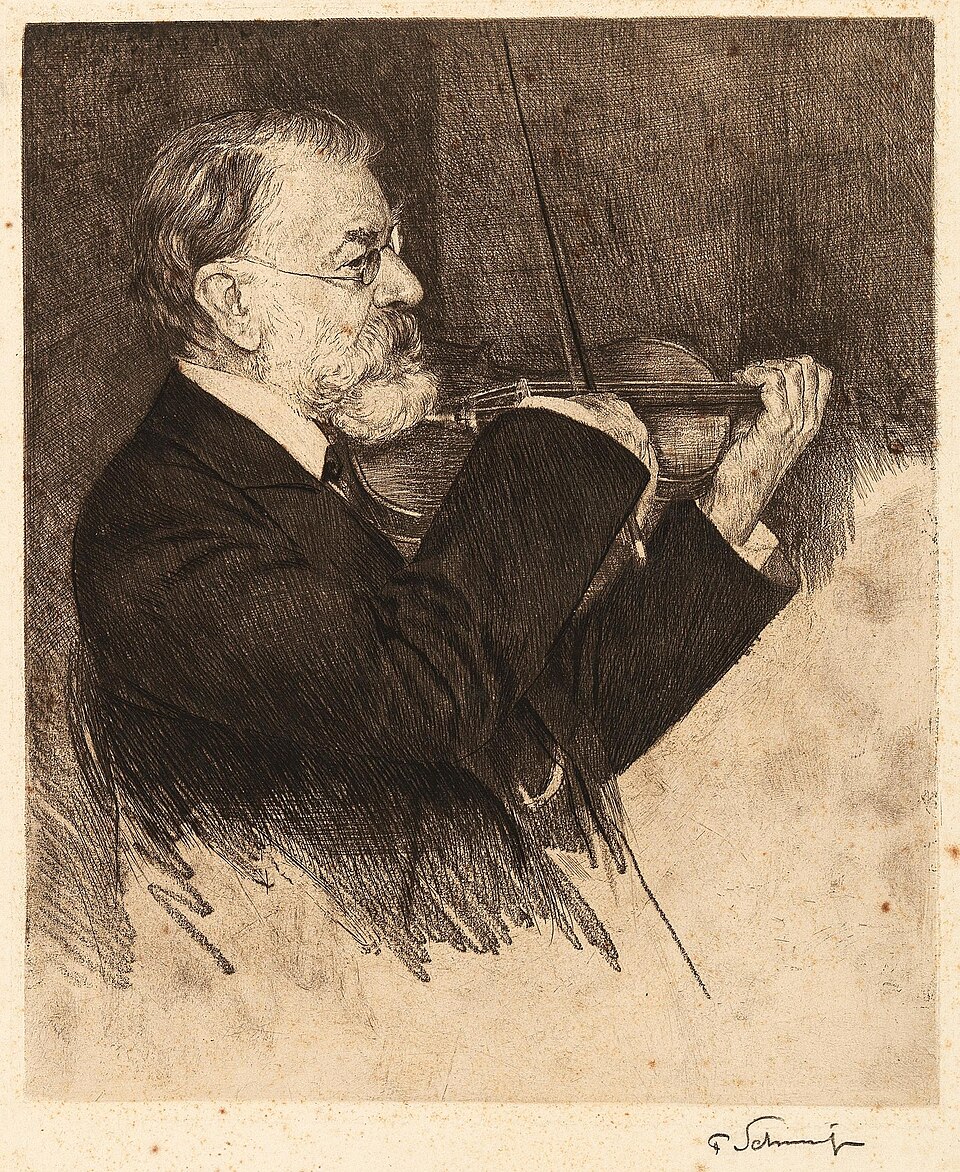
Why two soloists, and why a cello
Brahms had already written Joachim a violin concerto. Writing a second one would have been a gift with a receipt attached — here, have another of the same thing. Adding a second soloist changed the terms entirely.
The cellist was Robert Hausmann, cellist of the Joachim Quartet, and a musician on good terms with both men. Brahms had written the Cello Sonata No. 2 in F major, Op. 99, for Hausmann in 1886, so the relationship was fresh. Putting Hausmann on stage next to Joachim meant Joachim would be sharing the platform with a colleague he saw constantly, in a piece whose entire argument is that two players have to listen to each other.
Brahms also sent Joachim sections of the score while he was writing, asking for technical advice — the exact ritual the two had performed for thirty years before the silence. Whatever else the concerto did, that request restarted the conversation.
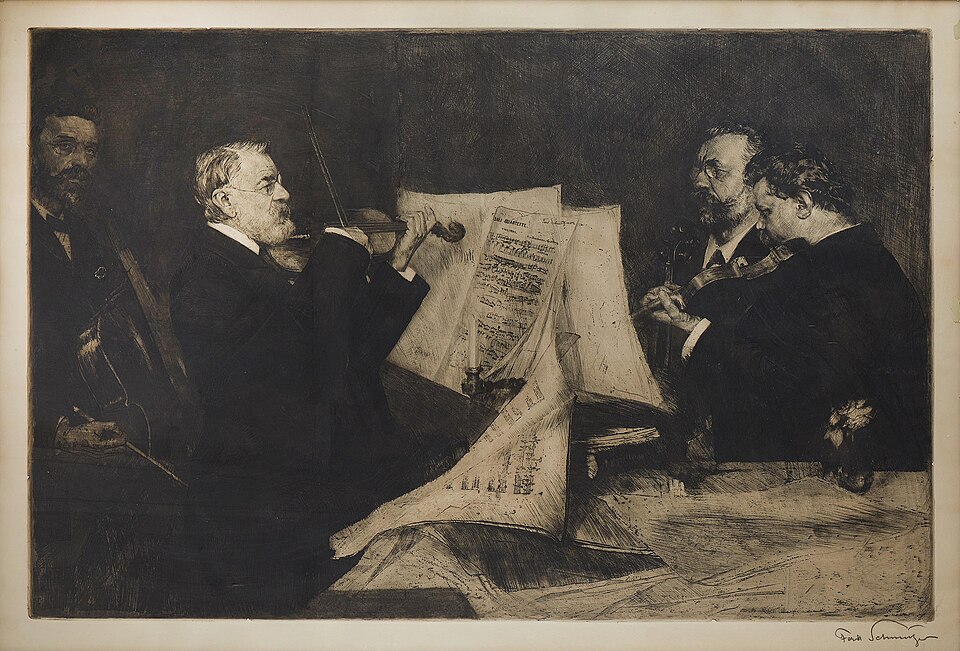
What to listen for
Four concrete things. If you catch these, you have the piece.
The soloists never accompany each other. This is the structural signature and it is audible within the first three minutes. In a normal double concerto, one instrument carries the tune while the other fills in harmony underneath. Brahms almost never does that. His default texture is the two solo lines running in parallel thirds and sixths — locked together, same rhythm, different pitch — or trading a phrase back and forth in imitation. The effect is one four-string instrument with an impossible range rather than two competing personalities.
The opening refuses to be an opening. The orchestra starts, then stops almost immediately, and the cello walks in with an unaccompanied recitative. Then the winds interject. Then the violin gets its own unaccompanied entry. Only after both soloists have spoken alone does the orchestra get to lay out the exposition properly. Brahms has inverted the standard concerto order — introductions first, argument second.
The A–E–F cell. Commentators frequently point out that the concerto leans on the pitch sequence A–E–F, a rearrangement of F–A–E, Joachim’s personal motto standing for Frei aber einsam, or free but lonely. Whether Brahms meant it as a private message is not something you can prove from the score, but the three notes are genuinely there in the thematic material, and once you know them you will hear them.
Where the orchestra sits. The scoring is deliberately lean — no trombones, no piccolo, no extra percussion beyond timpani. Compare it to the brass weight in the Fourth Symphony and the difference is obvious. Brahms is protecting the middle register so a cello can be heard without shouting.
Movement by movement
I. Allegro — two entrances, then a real argument
The cello’s opening recitative is the passage that decides whether you like a given performance. It is marked to sound improvised, and it can go two ways: grand and declamatory, or searching and quiet. Neither is wrong, but they produce completely different concertos downstairs. Rostropovich plays it as an oration; more recent cellists tend to play it as thinking out loud.
Once the sonata form gets going, the movement is dense — this is late Brahms, with themes that fragment and recombine rather than repeat cleanly. The second subject is the relief: a broad, sighing melody the two soloists hand over to each other. The development is where the parallel-thirds writing gets genuinely strenuous, and where a duo that has not rehearsed enough starts to smear. Intonation between two soloists playing in thirds is unforgiving; you can hear immediately whether a recording was made by partners or by two stars flown in.
II. Andante — the reason people love this piece
D major, and the temperature changes completely. Horns and winds sing the theme first, in bare octaves, with almost no harmonic decoration. Then the soloists take it — and here Brahms does the thing that makes the movement famous: violin and cello play the melody together, two octaves apart, in unison rhythm. Not a duet with a lead. The same line, twice, at different heights.
It lasts around eight minutes and it is the shortest movement, but it carries the emotional weight of the whole concerto. Listen for the middle section, where the key darkens and the woodwinds take over while the soloists drop to a murmur underneath. Then the return of the opening theme, which Brahms scores more warmly the second time. If you only have ten minutes for this concerto, spend them here.
III. Vivace non troppo — Hungarian dance rhythms, and a way out of A minor
A rondo, and the most immediately likeable movement. The main theme has the dotted, foot-stamping profile of the Hungarian style Brahms had been mining since the Hungarian Dances — a shared vocabulary between him and Joachim, who was born in what was then the Hungarian half of the empire and wrote his own concerto in Hungarian style.
Two things to track. First, the rondo theme comes back altered every time, never as a straight copy. Second, the episodes hand rapid figuration between the two soloists at close range, and the ensemble has to be exact — half a beat of drift and the energy collapses. Then the coda swings from A minor to A major, and the piece ends in the light. Brahms used that minor-to-major turn often; here it lands with unusual force because of everything the first movement put you through.
The premiere, and the reviews that did not get it
The first performance took place on 18 October 1887 at the Gürzenich in Cologne, with Joseph Joachim on violin, Robert Hausmann on cello, and Brahms conducting. More performances followed before the year ended.
Clara Schumann was unconvinced. She judged the concerto to be, in her words, “not brilliant for the instruments” — a fair description of what Brahms had done, and a complaint that misses the point. Audiences in 1887 came to a concerto expecting a soloist to dominate. Brahms had written a piece where domination is structurally impossible.
The reconciliation, on the other hand, worked. Clara Schumann noted after a rehearsal in Baden-Baden in September 1887 that Brahms and Joachim had spoken to each other again for the first time in years. The friendship held until Brahms died in 1897, and Joachim kept the concerto in his repertoire long afterwards.
Recordings: what to actually put on
David Oistrakh, Mstislav Rostropovich / George Szell, The Cleveland Orchestra (1969, EMI) — start here. This is the reference, and the reason is Szell as much as the soloists. The Cleveland strings are so precise that the orchestral counterpoint stays audible under two very large personalities, which almost never happens in this piece. Rostropovich’s opening recitative is enormous — closer to Boris Godunov than to chamber music — and Oistrakh answers with a tone that is warm rather than competitive. The second movement is the payoff: their unison melody genuinely sounds like one instrument. The sound is 1960s analogue, a little close and dry, and the soloists are spotlit forward of the orchestra. Live with it.
David Oistrakh (violin) and Mstislav Rostropovich (cello) — complete.
Itzhak Perlman, Mstislav Rostropovich / Bernard Haitink, Concertgebouw Orchestra (1979, EMI) — the better-sounding alternative. Rostropovich again, older, with a very different partner. Perlman’s violin is sweeter and more forward than Oistrakh’s, and Haitink lets the Concertgebouw breathe where Szell drills. The finale has more swing and less snap. The trade-off is real: you gain warmth and a far more natural orchestral balance, you lose some of the Cleveland precision in the first-movement development. If you find the Szell recording too hard-edged, this is your version.
Itzhak Perlman, Mstislav Rostropovich, Bernard Haitink and the Concertgebouw Orchestra.
Julia Fischer, Daniel Müller-Schott / NDR Elbphilharmonie Orchester (live video) — watch this one. The best argument for video in this repertoire. Fischer and Müller-Schott have played together for years and it shows in the parallel passages, where their bow speed and vibrato match closely enough that the two lines fuse. More usefully, you can watch them cue each other. The moment in the second movement where they look up before the unison entry explains the whole piece in two seconds — something no audio recording can do for you.
Julia Fischer and Daniel Müller-Schott with the NDR Elbphilharmonie Orchester.
Anne-Sophie Mutter, Pablo Ferrández / Manfred Honeck, Czech Philharmonic (Sony Classical, 2022) — the modern pick. Fast, transparent, and recorded with far more air around the orchestra than the older versions. Honeck keeps the textures light enough that the woodwind writing in the Andante actually registers. Mutter’s phrasing is highly characterised — she stretches lines noticeably — and whether that reads as expressive or mannered will depend on your tolerance. Worth hearing for the engineering alone if the vintage EMI sound puts you off. ▶ Listen on YouTube
Verdict. Oistrakh and Rostropovich under Szell is the one to own. Perlman and Rostropovich under Haitink if you want it to sound beautiful rather than urgent. Fischer and Müller-Schott if you have never heard the piece and want to understand why the two-soloist idea matters — the video does the teaching for you.
Follow the score
The complete concerto with the score on screen — the fastest way to see the parallel-thirds writing.
The full score is free at IMSLP: Double Concerto, Op. 102 on IMSLP. Even if you do not read music fluently, watching the two solo staves move in locked parallel motion makes the central idea obvious in about thirty seconds.
Where to go next
The obvious companion is Brahms’s Violin Concerto, written for the same violinist. Comparing how Brahms treats the solo line in the two works shows how far he had moved from display toward conversation.
For the orchestral Brahms that immediately precedes this piece, the Fourth Symphony is the one to hear — Brahms conducted its first performance in 1885, two years before the concerto, and its passacaglia finale shows the same instinct for tight formal control. Going backwards, the Third Symphony has a similar habit of ending quietly rather than triumphantly, and the Second Piano Concerto is the other place where Brahms treats a concerto as a giant chamber piece — its slow movement hands the tune to the principal cello and lets the soloist accompany.
If you want the earlier model for what a concerto argument sounds like when the soloist really is the centre of gravity, try Beethoven’s Violin Concerto alongside it. Beethoven’s soloist leads; Brahms’s two soloists negotiate. Hearing them back to back makes the Double Concerto’s strangeness feel deliberate rather than awkward.