Four minutes into Up, an entire marriage goes by without a line of dialogue, and a lot of people walk out of that scene trying to find the classical piece that played under it. There isn’t one. Every note in the film is original music by Michael Giacchino, recorded by the Hollywood Studio Symphony under orchestrator and conductor Tim Simonec. No Chopin, no Satie, no borrowed Tchaikovsky. What you heard was a brand-new waltz doing a very old job.
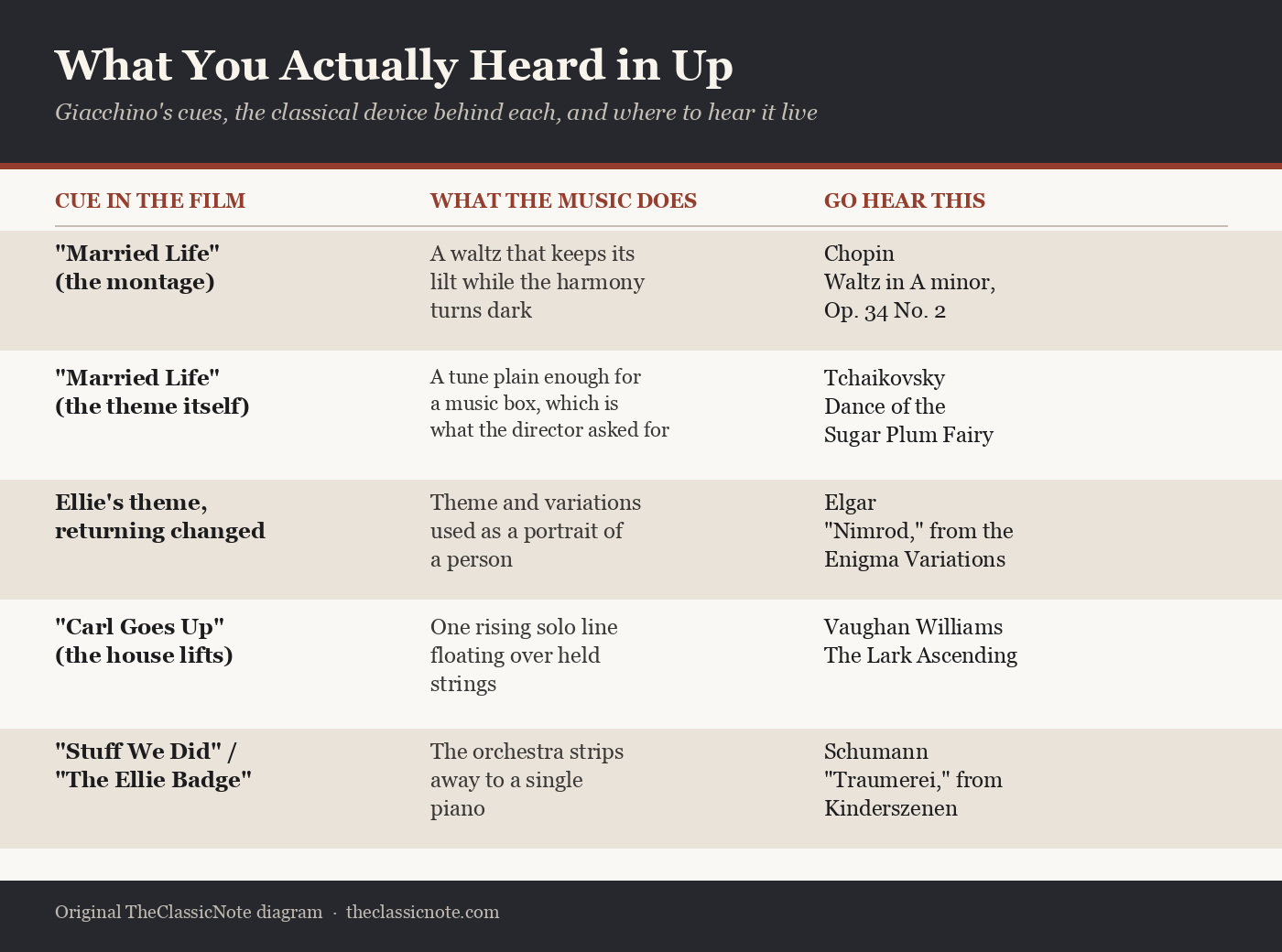
So why does the search feel so reasonable? Because the instinct behind it is correct. Giacchino built that montage out of concert-hall machinery: a waltz, a theme with variations, a tune stripped down to one piano at the moment it hurts most. The film has no classical cues, but it has classical method all over it. This article maps each cue you remember to the device it borrows, then hands you the repertoire piece that does the same thing at full length, with one recording to start from.
Spoiler warning: this article discusses scenes from Up, including Ellie’s death in the opening montage and the film’s closing moments.
What Up actually has: 26 tracks, all of them new
The soundtrack album runs 26 tracks and 53 minutes. Walt Disney Records released it digitally on 26 May 2009; Intrada put out a limited CD in 2011. Everything on it is Giacchino’s, apart from the last three tracks, which are sound effects from Skywalker Sound. There is no licensing credit for a dead European composer anywhere in it, because there was nothing to license.
That includes the music you might assume was a needle-drop. When Carl and Russell sit down to dinner aboard Muntz’s airship, the tinny period music in the room has the boxy, narrow sound of an old record. Same with the newsreel that opens the film: the brassy 1930s march behind The Spirit of Adventure footage is pastiche, written for the film to imitate a style, and imitation is exactly why your ear files it under “old music.”
The score swept its awards year: the Academy Award for Best Original Score at the 82nd ceremony in 2010, a Golden Globe, a BAFTA, and two Grammys at the 52nd ceremony — Best Score Soundtrack Album, plus Best Instrumental Composition for “Married Life” itself.
Why a 2009 cartoon score feels like the concert hall
Three things do most of the work.
The first is the waltz. “Married Life” is in three, and three is a form loaded with meaning before a single note arrives: it is the meter of the ballroom, of the music box, of the nineteenth century. Pete Docter’s brief to Giacchino was music that sounded “as if from one’s grandmother’s music box,” and the composer has said they tackled the montage first because everyone knew it was the hardest scene in the picture. A waltz was the shortest route to “a life that already happened.”
From inside a string section, a waltz lives or dies on beats two and three, not on the tune. The second beat has to arrive slightly early and slightly light or the whole thing turns into a march, and every amateur orchestra in the world flattens it. Listen to what’s under Giacchino’s melody in the first minute: the accompaniment keeps that lift even after the harmony has gone dark. That gap — cheerful engine, sad harmony — is the entire emotional trick of the montage.
The second is variation. Ellie’s theme is not one cue; it’s a single tune that keeps returning wearing different clothes. It’s giddy in “We’re in the Club Now,” settled in the middle of “Married Life,” and hollowed out by the time it comes back near the end. That is theme-and-variations used the way Romantic composers used it: as a portrait of a person changing over time.
The third is restraint. At the peak moments Giacchino subtracts instead of adding. The montage ends with almost nothing left but a piano. Film composers who reach for a choir at that point get a trailer; Giacchino gets a room going quiet.
Cue by cue: what you heard, and what to play next
“Married Life” — the montage, from the wedding to the empty chair
The scene runs from Carl and Ellie’s wedding through the house they fix up, the picnic on the hill, the jar of savings broken open for one emergency after another, the doctor’s office, and finally the funeral and the chair beside an empty one. The music is continuous and the dialogue is nonexistent.
The reason it works is that the waltz never stops being a waltz. Most scores signal grief by changing genre — the strings swell, the meter loosens, the audience is told what to feel. This one keeps the same dance going while the harmony sours underneath it, which is a far crueller idea: life keeps its rhythm whether or not you’re ready. Giacchino has described preferring simple writing at the biggest emotional moments, and you can hear that decision here as the orchestration thins out rather than thickening.
🎧 Also on: Apple Music · Spotify
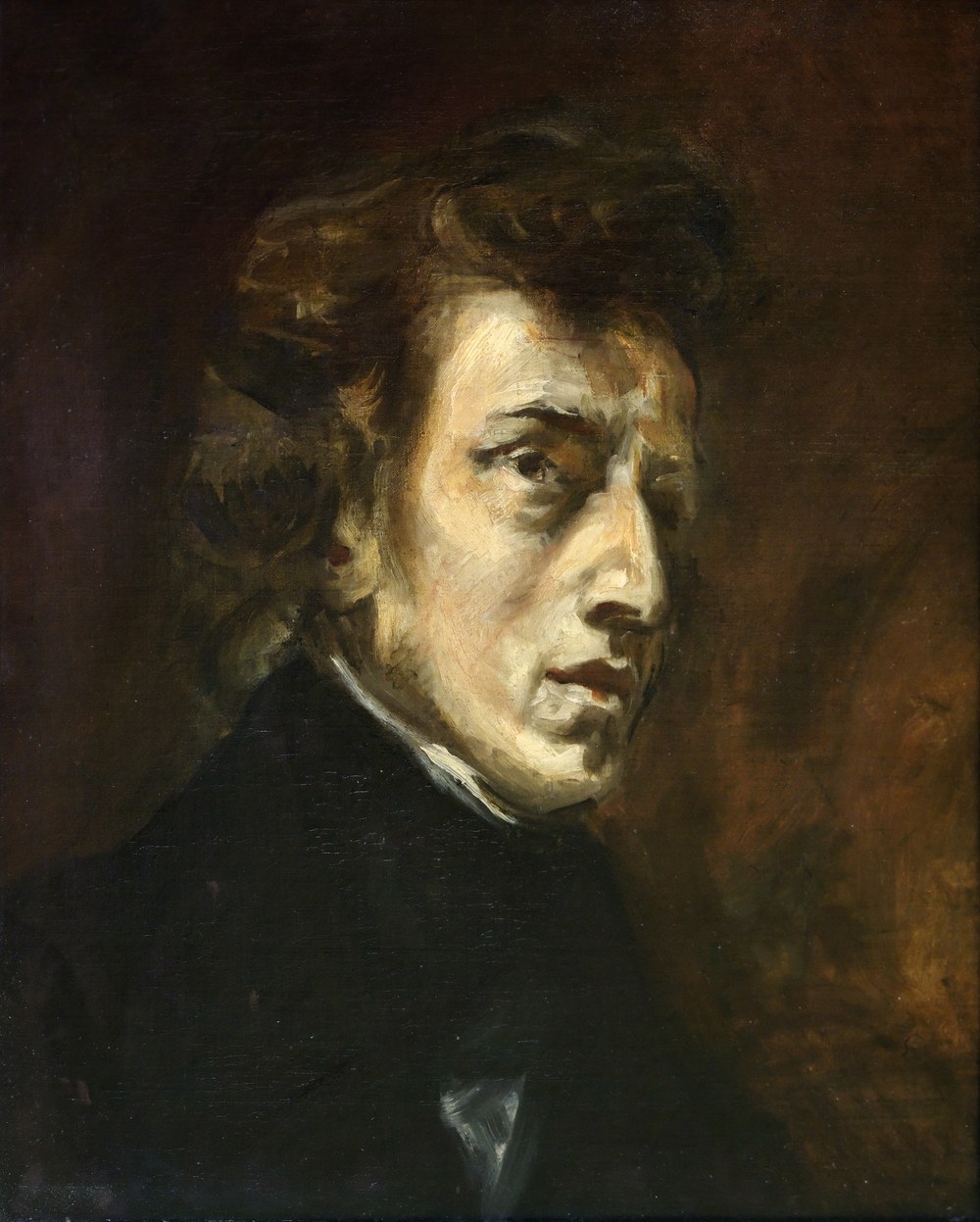
Chopin — Waltz in A minor, Op. 34 No. 2 is the concert-hall version of that exact trick, and it predates the film by 171 years. Chopin published it in 1838 inside a set titled Grandes valses brillantes, which is a small joke on the listener: the second of the three brilliant waltzes is marked Lento and is the saddest thing in the group. Stephen Heller recalled that Chopin named it his own favourite. The left hand keeps a plain waltz pulse for five minutes while the right hand refuses to cheer up, and that tension is precisely what “Married Life” is built on.
Start with Arthur Rubinstein / RCA / 1963, the stereo waltz cycle he set down in June of that year. Rubinstein plays this one straight — no wallowing, no rubato applied like frosting — and that plainness is why it lands. Pianists who try to make it tragic ruin it.
🎧 Also on: Apple Music · Spotify
The tune itself — the music-box brief
Strip the orchestration away and Ellie’s theme is nearly nothing: a short phrase, mostly stepwise, that a child could pick out. That is the “grandmother’s music box” instruction taken literally. A music box has no dynamics, no vibrato and no rubato, so a melody written for one has to survive on shape alone. Giacchino’s does, which is why every piano cover on the internet still works.
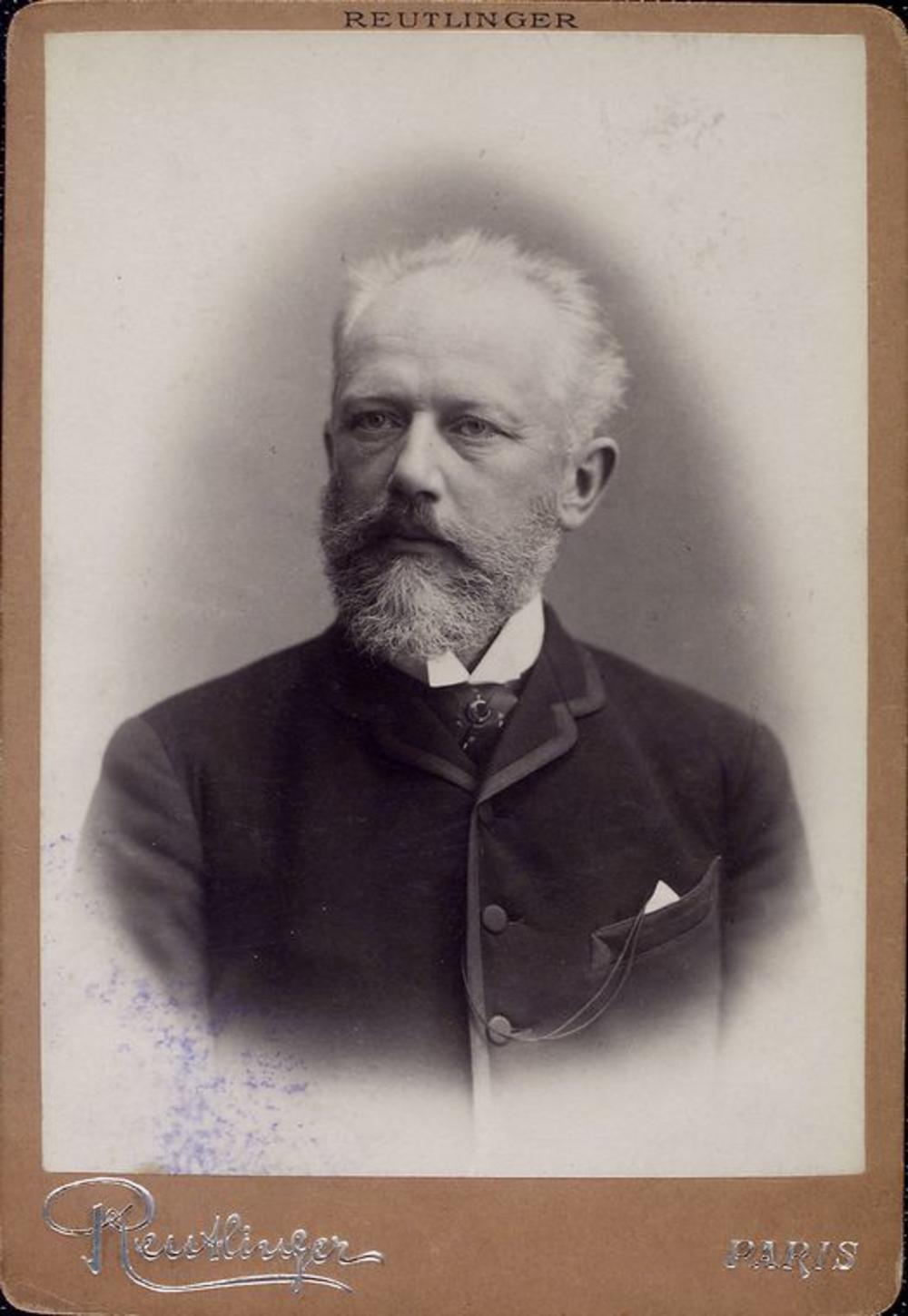
Tchaikovsky — “Dance of the Sugar Plum Fairy,” from The Nutcracker is where the orchestra went looking for that same sound and had to invent an instrument to get it. Tchaikovsky wrote the solo for the celesta, a keyboard that strikes metal bars and comes out somewhere between a bell and a toy. Nothing else in the repertoire is so nakedly a music box, and nothing else has kept its magic through a century of Christmas overuse.
My pick: Simon Rattle / Berliner Philharmoniker / 2009 / EMI Classics, from their complete Nutcracker taped around live concerts at the Philharmonie that December. It’s a cooler reading than the Russian tradition — some find it under-dramatised, a fair complaint in the big ballet numbers — but for this movement the Berlin transparency is the point. You can hear the celesta as a separate object in the room rather than a glaze over the strings.
▶ Listen on YouTube · Apple Music · Spotify
Ellie’s theme, coming back changed
Track the same eight bars across the film and you get the plot. In “We’re in the Club Now” it’s bright and rushed, a kid’s tune for a kid. In the montage it broadens into something domestic. By the last act it returns slowed and thinned, and the difference between the two versions is the distance Carl has travelled. The music is the explanation.
Elgar — “Nimrod,” from the Enigma Variations is the piece to hear if you want that idea at full strength. Elgar wrote fourteen variations, each a portrait of a friend, and the ninth is the one everybody knows from British state occasions. The relevant thing for a Up listener isn’t its solemnity, it’s the method: a plain theme becomes a person, and then becomes a different person each time it returns.
Get Sir John Barbirolli / Philharmonia Orchestra / 1962 / EMI, recorded at Kingsway Hall. Barbirolli had played as an orchestral cellist under Elgar himself, and his reading is warm without dragging — “Nimrod” here breathes at a tempo that still moves, which is rarer than it should be now that conductors treat the variation as a memorial rather than a portrait. If you only know the slow-motion funeral version of this music, this one will surprise you.
▶ Listen on YouTube · Apple Music · Spotify
“Carl Goes Up” — the house leaves the ground
The balloons come out of the chimney, the neighbours stare, and the house pulls free of its foundations. Giacchino’s cue for it does something specific: the melody climbs while the accompaniment holds still. Fanfares push from underneath; this one floats, because the harmony barely moves and the ear reads a stationary background as air.
Vaughan Williams — The Lark Ascending is the same effect stretched to a quarter of an hour. A solo violin drifts upward over held string chords in a rhythm loose enough that barlines stop registering, and the orchestra spends the whole piece refusing to pull it back down. If the shot of the house rising is your favourite image in the film, this is your piece, and it will ruin you for movie music that tries the same thing in ninety seconds.
The recording to own is Hugh Bean / New Philharmonia Orchestra / Sir Adrian Boult / 1967 / EMI, taped at Abbey Road. Bean plays it as English chamber music rather than as a violin showpiece, and Boult keeps the orchestra so quiet underneath that you notice the silence between phrases. Later recordings are more beautiful in the hi-fi sense; none of them makes the ascent feel as unforced.
▶ Listen on YouTube · Apple Music · Spotify
“Stuff We Did” — the orchestra leaves the room
Carl finally opens Ellie’s adventure book past the pages he assumed were blank, and finds she filled it with their ordinary life. The cue is barely two minutes long and it is mostly one piano. Everything the score has accumulated over ninety minutes gets spent by taking things away.
▶ Listen on YouTube · Apple Music · Spotify
Schumann — “Träumerei,” from Kinderszenen, Op. 15 is the ancestor of that move. It lasts under three minutes, it never raises its voice, and it is the most famous thing Schumann wrote precisely because it declines to be impressive. Adult music about childhood, played at a whisper: that is the same emotional address as a widower reading his wife’s scrapbook.
Hear it as Vladimir Horowitz played it at the Great Hall of the Moscow Conservatory on 20 April 1986, released by Deutsche Grammophon. He was 82 and had not played in Russia in six decades, and he offered this as an encore. It is not a tidy performance. It is, however, the one where you can hear an audience trying not to cry, which is the correct response to both this piece and that scrapbook.
▶ Listen on YouTube · Apple Music · Spotify
The standout, and it isn’t close
“Married Life” carries the film. Not because it’s the prettiest cue — “Carl Goes Up” is prettier — but because the rest of Up is structurally impossible without it. The story asks an audience to spend an hour and a half with a rude, closed-off old man who yells at children, and it buys that goodwill in four wordless minutes at the start. If the montage fails, the film is about an unpleasant stranger. The Grammy for Best Instrumental Composition went to this cue rather than to the score as a whole, and for once an award named the right thing.
Watching a montage get scored teaches you something you don’t get from listening: picture and music are cut against each other until the joins disappear, and the version that feels inevitable is the one that took the most work. The reason nobody notices the music in that sequence is that somebody spent a long time making sure of it.
What people get wrong about the music in Up
The most common assumption is that “Married Life” is an old European waltz that Pixar licensed, which is why searches for classical music in the film keep coming up empty. Streaming makes this worse: the tune has been recorded by countless pianists and light-orchestra groups, and those covers land in playlists filed under classical piano or relaxing classical, so the algorithm confirms a mistake the ear made honestly.
The second assumption is that a Pixar film with an orchestral score must be borrowing from the canon the way Fantasia did. Up works the other way round. It borrows techniques, not tunes, and it does so well enough that the seam is invisible.
Worth separating two claims, because they get blurred constantly in film-music coverage: the claim that a piece appears in the film is checkable against a soundtrack listing, while the claim that one specific recording appears in the film needs a cue sheet or a credits page. In this case both are simple. Nothing pre-existing appears in Up at all, so any article telling you which Chopin recording Pixar used is inventing it. For films that genuinely do drop needles on old records, see our guide to classical music in modern movies, and the case of a whole film series built on one Brahms record.
Sources and how this was checked
Track titles, durations and personnel come from the published soundtrack listing, which credits all music to Michael Giacchino except three Skywalker Sound effects tracks, with Tim Simonec as orchestrator and conductor and the Hollywood Studio Symphony as the ensemble. Awards are from the same source and from the Academy and Grammy records for the 82nd Academy Awards and the 52nd Grammy Awards. Docter’s music-box brief and Giacchino’s account of scoring the montage first come from documentation of the film’s opening sequence.
Recording metadata was checked individually: Rubinstein’s waltz cycle (RCA, Rome, 1963), Barbirolli’s Elgar with the Philharmonia (EMI, Kingsway Hall, 1962), Bean and Boult’s Lark Ascending (EMI, Abbey Road, 1967), Rattle’s Nutcracker (EMI Classics, Berlin, December 2009) and Horowitz’s Moscow recital (Deutsche Grammophon, 20 April 1986). Where scholarship is anecdotal rather than documentary — Chopin naming Op. 34 No. 2 his favourite rests on Stephen Heller’s recollection — it is flagged as such above. The scene descriptions are from the film; the readings of what the music is doing are mine.
Two neighbours on this site if you want more: why Tchaikovsky’s Pathétique ends in silence takes the “subtract everything” idea to its extreme, and classical music for a wedding is where the waltz question usually leads next.