Over the opening titles of Ridley Scott’s Hannibal, a crowd of pigeons shuffles across a Florence pavement and, for about two seconds, arranges itself into Anthony Hopkins’s face. Bach is playing underneath. That shot is the entire film in miniature: something exquisite laid carefully over something appalling, with the music doing the laying.
This is the Lecter film that leans hardest on borrowed and borrowed-sounding music. The Silence of the Lambs belonged to Howard Shore’s score — low, patient, almost odourless. Hannibal instead hands whole scenes to Bach, to Johann Strauss II, and to a brand-new aria written in the style of a Renaissance-poem setting. Hans Zimmer’s score sits around them, sometimes imitating them. The result is a film where refinement is the horror, not the relief from it.
Spoiler warning: this article discusses scenes from Hannibal (2001), including late-film moments and how two characters die.
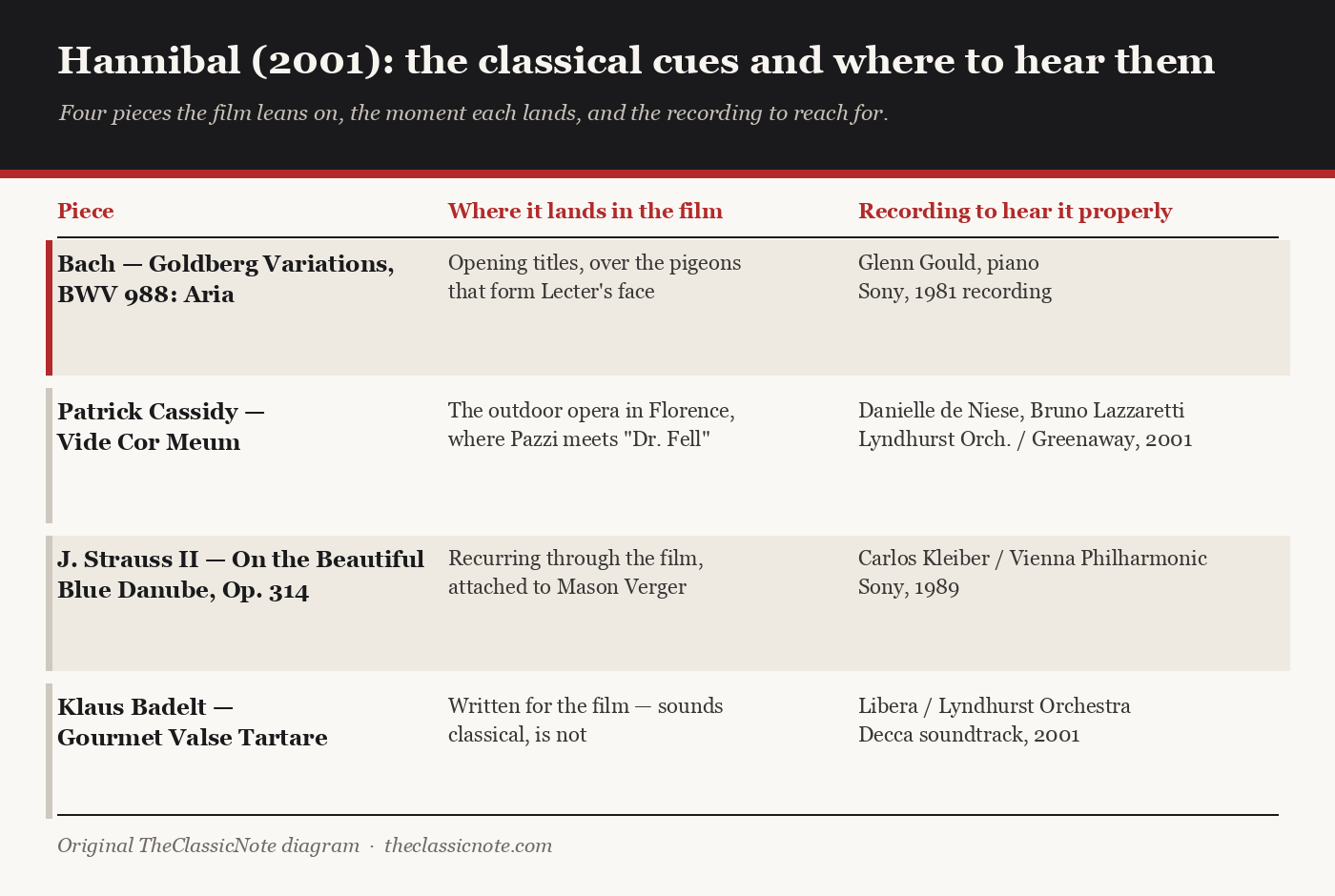
Bach — Goldberg Variations, BWV 988: Aria
The exact scene: the opening title sequence, over the pigeons in the piazza. It is the first sound the film gives you, before a single line of dialogue, and the soundtrack album lists it as track two — “Aria da capo” from the Goldberg Variations, credited to Glenn Gould.
Why it works there: because you have heard it before, in this exact company. In The Silence of the Lambs, the Aria plays on a cassette in Lecter’s Memphis cage in the minutes before he kills two guards. Putting it under the titles of the sequel is not a fresh idea — it is a receipt. Scott is telling you the man is unchanged and still choosing his own soundtrack. The Aria is a good choice for that job because it refuses to escalate: a sarabande-like tune in G major, thirty-two bars, an ornamented melody over a bass line that walks calmly down and back up. It has no crisis in it. It just proceeds, elegantly, no matter what you put on top of it. That is exactly Lecter’s manner.
My reading, not the film’s stated intent: the Aria also solves a problem the sequel has. Lecter spent 1991 behind glass, so his taste was a rumour. In Hannibal he is free, wealthy and curating a library in Florence, and the Bach is the first evidence that the rumour was true.
Where to hear the real thing: Gould recorded the Goldberg Variations twice, in 1955 and again in 1981, and the two are almost different pieces. The 1955 is fast, bright and slightly reckless — a 22-year-old showing you what a piano can do. The 1981 is slower, drier and much sadder, and it is the one I would put on after this film, because the Aria there sounds like someone who knows how the story ends. Start with the closing statement of the Aria, where the same tune returns after thirty variations:
If that reading feels too funereal, the ▶ 1955 Aria is here — same pianist, twenty-six years earlier, and about twice as awake. And if you want to hear the piece on the instrument Bach actually specified, a two-manual harpsichord, go to Pierre Hantaï (Opus 111, 1993): ▶ Listen on YouTube. The harpsichord makes the ornaments crackle instead of sing, and the whole set stops sounding like a lullaby. We go deeper into the choices in our guide to Bach’s Goldberg Variations, BWV 988.
🎧 Also on: Apple Music · Spotify
Patrick Cassidy — Vide Cor Meum
The exact scene: the outdoor opera performance in Florence, where Inspector Rinaldo Pazzi and his wife Allegra sit a few seats from the man they know as Dr. Fell. Pazzi watches Allegra watching Lecter; Lecter watches Allegra. Nobody says anything important. The music does all of it. The piece returns later in the film, so it is not a one-off set-dressing cue.
Why it works there: this is the film’s cleverest move, and it is worth being precise about what it is. Vide Cor Meum is not a repertoire opera. Patrick Cassidy wrote it for this film, setting Dante’s sonnet “A ciascun’alma presa” from Chapter 3 of the Vita Nuova — the passage where the poet dreams that Love appears holding his burning heart and makes Beatrice eat it. So the scene is not “characters attend an opera.” It is: Lecter sits in a Florentine courtyard listening to a soprano and tenor sing, in Italian, about a man who offers his heart to a woman to consume. Then he goes home and cooks.
Cassidy’s writing is deliberately plain — a rising modal line, thin string accompaniment, long-held vowels, no big cadenza — which is why it reads as fifteenth-century rather than 2001. Whether Scott intended the cannibal joke to land that hard is not something I can source, but the text choice is not ambiguous, and the film later has Lecter lecture on Dante’s punishments and then apply them.
Where to hear the real thing: the soundtrack performance is the definitive one and it is also the original — soprano Danielle de Niese and tenor Bruno Lazzaretti with the boys’ choir Libera and the Lyndhurst Orchestra, conducted by Gavin Greenaway, on the Decca album. De Niese was a teenager at the time and the thinness of her tone is the point; a big Verdi soprano would ruin it.
One detail that makes the scene better once you know it: the opera was staged for filming in the courtyard of the Pazzi Chapel, beside the monastery of Santa Croce. The detective being manipulated in that courtyard is a Pazzi, from the family whose ancestors were hanged from the Palazzo Vecchio — which is exactly how Lecter kills him later. Cassidy also expanded the piece afterwards; a if you want it longer.
▶ Listen on YouTube · Apple Music · Spotify
Johann Strauss II — On the Beautiful Blue Danube, Op. 314
Where it appears: recurring through the film, attached to Mason Verger — the disfigured millionaire financing the hunt for Lecter. Documentation of the film’s music notes the waltz turning up at several points; it is not on the Zimmer album, so it is easy to miss if you only own the soundtrack.
Why it works there: the waltz is the most socially secure music ever written. It is what plays when nothing is wrong — New Year’s Day in Vienna, champagne, a room full of people who are fine. Handing it to Verger is a straight-faced insult. He has the money, the estate, the manners and the taste, and he is using all of it to have a man eaten by pigs. Where Bach flatters Lecter, Strauss exposes Verger: the same cultural furniture, none of the self-control. Zimmer’s own score never comments on Verger. It doesn’t need to; the waltz already has.
Where to hear the real thing: Carlos Kleiber with the Vienna Philharmonic, from the 1989 New Year’s Concert (Sony Classical). Most Blue Danube recordings sit back and beam. Kleiber pushes and pulls the second beat until the thing actually dances, and the introduction — those tremolo strings and the horn call rising out of them — takes its time in a way that later conductors rarely dare..
▶ Listen on YouTube · Apple Music · Spotify
Klaus Badelt — Gourmet Valse Tartare (the one that isn’t classical)
Search for the “classical waltz in Hannibal” and you will find people looking for a piece that does not exist. “Gourmet Valse Tartare” was written for the film by Klaus Badelt and released on the Decca soundtrack, performed by Libera with the Lyndhurst Orchestra under Gavin Greenaway. It sounds nineteenth-century on purpose. Boys’ voices, a lilting three-beat pattern, harmony that stays polite — it is the sound of a very good restaurant, which is the joke, given what is being served.
The same trick runs through Zimmer’s cues. Titles like “Avarice,” “Virtue” and “To Every Captive Soul” are lifted from Dante’s vocabulary, and several are scored for boys’ choir and strings in a way that reads as sacred music rather than film score. If you want to hear how far he pushed it, try “To Every Captive Soul”: ▶ Listen on YouTube, or the waltz itself: ▶ Listen on YouTube. This blurring is deliberate and it works on audiences — which is also why so many “classical music in Hannibal” lists are wrong. Two of the most-quoted pieces in the film were written for it, not borrowed from the concert repertoire.
🎧 Also on: Apple Music · Spotify
The standout: Vide Cor Meum, not the Bach
The Bach is the famous one, and it is the weaker choice. It arrives with all its meaning pre-installed from 1991; the sequel is spending equity it did not earn. Take the Aria out of the opening titles and you lose a nod, not a scene.
Vide Cor Meum is the cue that actually does work. It carries the one thing the film struggles to say out loud — that Lecter’s interest in Clarice Starling is romantic, and that he understands romance as consumption. It does that without a line of dialogue, in a language most of the audience doesn’t speak, in a piece nobody in the cinema had heard before. And it did something almost no film cue does: it left the film. Vide Cor Meum is now programmed in concerts and used in other productions, which is a strange fate for four minutes of music written to make a cannibal look thoughtful.
If you only chase one thing from this film, chase that. If you want the wider version of this argument — which film cues earn their reputation and which coast — we make the case in Classical Music in Famous Movies.
What the credits actually prove (and what they don’t)
Two different claims get mixed up constantly in writing about this film, so here is the split.
Verifiable: which pieces are in the film. The soundtrack album, released in February 2001, carries the Bach Aria, Cassidy’s Vide Cor Meum, Badelt’s waltz and Zimmer’s cues; the album’s Bach track is credited to Glenn Gould. Documentation of the film’s music also records Strauss’s Blue Danube appearing at several points even though it is absent from the album.
Harder to verify: exactly which take of a given recording ends up on screen, and where. Album credits and on-screen cues are not the same document, and licensing choices can differ between them. A cautionary example from the previous film: the Goldberg Aria heard in The Silence of the Lambs is widely assumed to be Gould’s, but that film’s music credits name a version performed by pianist Jerry Zimmerman. So “the Bach in the Lecter films is Gould” is half right at best — it is right for the 2001 sequel’s album, and not for 1991.
Where I could not stand up a scene-to-cue match — the specific placements of the Blue Danube, and which Gould take runs under the titles — I have said the piece appears rather than invented a moment for it. Sources used: the soundtrack album’s published track and performer credits, Wikipedia’s soundtrack article for the release date and the Strauss note, Patrick Cassidy’s own catalogue for the Vita Nuova text, a Florence filming-locations survey for the Pazzi Chapel staging, and label discographies for the Gould, Kleiber and Hantaï recordings.
Where to go next
If Hannibal is your entry point, the useful next step is not more Bach — it is more film music that uses classical repertoire as a character trait rather than a mood. The John Wick films do the same thing with a very different accent, and we broke down every cue in Classical Music in John Wick.
And if you take only one recommendation from this piece: put on Gould’s 1981 Aria, sit through the full three minutes, and notice that nothing in it is frightening. That is why the film could use it.