There’s a specific kind of evening where your body decides something is wrong before your brain agrees to it. Heart going, jaw tight, thoughts running the same lap. Reaching for music is a good instinct — but most “relaxing classical” playlists are built by an algorithm that thinks slow equals safe, which is how you end up with Barber’s Adagio for Strings at 1am and feel considerably worse.
This is a curated list, not a mood tag. Twelve pieces grouped by what you need from them — breaking a spiral, sitting under two hours of work, ending the day — with the recordings I’d use and three widely recommended pieces you should skip.
The short answer
If you close this page after the table, you’re still served. These five do the most work:
| Piece | Use it when | Listen |
|---|---|---|
| Satie — Gymnopédie No. 1 | You need something in the room in the next 30 seconds | ▶ Ciccolini |
| Bach — Aria, Goldberg Variations | Your thoughts are looping and you want structure, not sedation | ▶ Gould, 1981 |
| Pärt — Spiegel im Spiegel | Sitting still is the hard part | ▶ Duo Gazzana |
| Marcello — Adagio, Oboe Concerto in D minor | Background for two hours of work you’re dreading | ▶ Holliger |
| Debussy — Clair de lune | Last thing before lights out | ▶ Gieseking, 1953 |
What all of these have in common (and why “slow” isn’t the point)
What makes music useful when you’re anxious isn’t tempo. It’s predictability — a piece that never ambushes you lets your attention stop bracing. Every entry below shares three properties: dynamics stay inside a narrow band, so nothing suddenly gets loud; the harmony moves slowly and lands where your ear expects; and the texture is thin, one line or two, rarely more. Barber’s Adagio is slow and fails all three, which is exactly the point.
Is there evidence behind any of this? Some, and it’s narrower than the wellness industry suggests. A 2013 Cochrane review of music interventions for preoperative anxiety pooled 26 trials with 2,051 participants and found that patients who listened to music reported anxiety on average 5.72 units lower on a standardised scale than those receiving standard care — while noting that most of the trials had methodological weaknesses. That’s a real effect in a specific setting, not a treatment. Music is a tool for managing a bad hour. If your anxiety is persistent or disabling, it belongs in front of a clinician, not a playlist.
Group 1 — When your heart is already going
These are the emergency picks: low information, slow-moving, nothing to track. You want music that asks nothing of you.
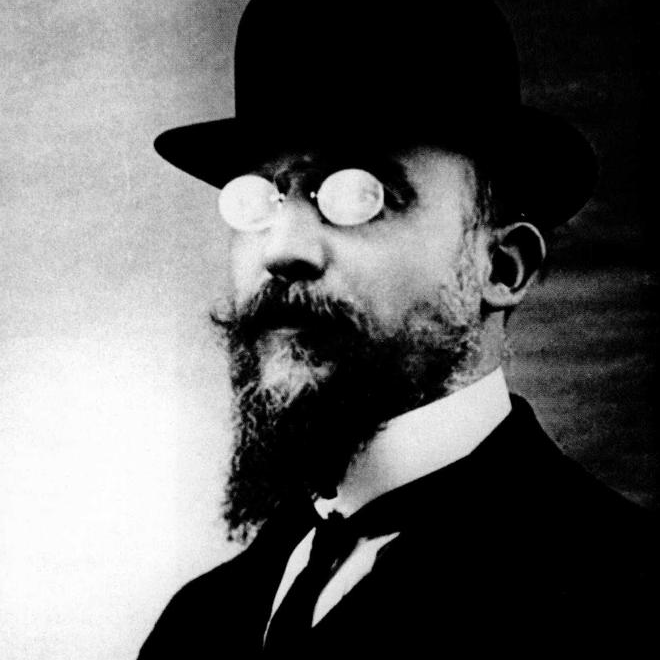
Satie — Gymnopédie No. 1
Satie published the three Gymnopédies in 1888, and the first has been doing this job ever since. The left hand alternates between two chords for the entire piece — a bass note, then a chord, over and over, like something breathing in the next room — while the right-hand melody drifts across without developing into anything. There is no climax to wait for. That’s the design, and it’s why the piece works when almost nothing else does.
Aldo Ciccolini plays it slower than most and refuses the rubato a lesser pianist would reach for. It stays flat and steady, which is what you want. If you’re new to Satie, we wrote about the strange, solitary life behind the music separately.
Bach — Aria from the Goldberg Variations, BWV 988
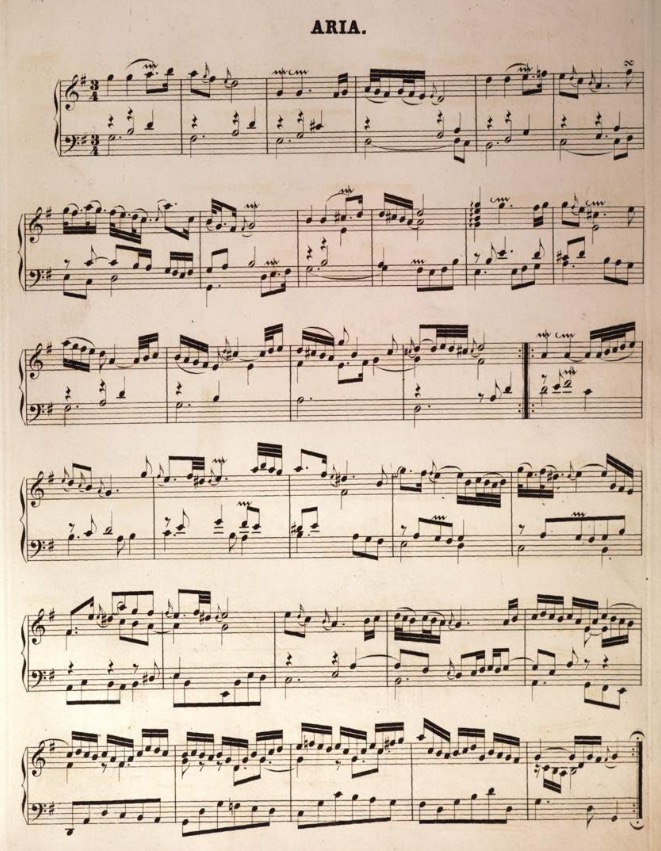
Published in 1741 as the fourth part of Bach’s Clavier-Übung, the Goldbergs open with a sarabande that lasts about four minutes and goes exactly where it says it will. The famous story — that a Count Kaiserling commissioned the set to help him through sleepless nights — comes from Forkel’s 1802 biography of Bach and has been questioned by scholars ever since; treat it as a good anecdote rather than documented fact.
What matters for our purposes is the bass line. It’s a steady, descending pattern that the ear latches onto within about eight seconds, and once you’ve got it, nothing in the piece can surprise you. Glenn Gould’s 1981 remake is much slower than his famous 1955 debut, and here the slowness is the feature — he lets the ornaments sit rather than flicking them off. Our full guide to the Goldberg Variations covers the other thirty variations, most of which are far too busy for tonight.
▶ Listen on YouTube — Glenn Gould, 1981.
Arvo Pärt — Spiegel im Spiegel
Written in 1978, this is a violin and piano piece built from almost nothing: the piano plays rising triads, three notes at a time, in an unbroken pulse for ten minutes, while the violin plays long tones that step away from a centre and return to it. Because the pattern never varies, you stop counting — which is a large part of why sitting still becomes possible.
Duo Gazzana’s ECM recording keeps the piano quiet enough that the violin doesn’t have to push. Some performances of this piece get sentimental; this one doesn’t.
▶ Listen on YouTube — Duo Gazzana, ECM Records.
Hildegard of Bingen — O virtus sapientiae
Here’s the pick nobody puts on these lists. Hildegard (1098–1179) wrote unaccompanied plainchant: a single vocal line, no harmony underneath, no bar lines, no regular beat. That last part is why it belongs here. Almost all the music you hear in a day runs on a grid, and part of you is tracking that grid whether you notice or not. Chant has none. The line moves at the speed of a breath and stops when the text stops.
Sequentia’s Canticles of Ecstasy, recorded in June 1993 in the church of St. Pantaleon in Cologne and released by Deutsche Harmonia Mundi in 1994, is the version to start with — the acoustic is generous but the voices stay close and human rather than turning into wash.
▶ Listen on YouTube — Sequentia.
Group 2 — For the long middle: work, waiting rooms, the hours you have to get through
Different job. Here you need music that stays interesting enough not to become wallpaper, but never demands the foreground.
Bach — Prelude from Cello Suite No. 1, BWV 1007
One instrument, one continuous stream of broken chords, no repeats, no pauses. The Prelude runs about two and a half minutes and loops better than almost anything else here: the harmonic movement is slow and utterly clear, so you can follow it with a fraction of your attention and use the rest for whatever you’re supposed to be doing. Yo-Yo Ma has recorded the suites three times and has never sounded rushed in this movement. If it grabs you, the other five are a rabbit hole — we mapped them in our guide to Bach’s Cello Suites.
▶ Listen on YouTube — Yo-Yo Ma.
Marcello — Adagio from the Oboe Concerto in D minor
My favourite pick here, and the one most people haven’t heard. Alessandro Marcello’s concerto was printed in a 1717 Amsterdam anthology under a pseudonym, then spent two centuries misattributed to Vivaldi and to Marcello’s own brother. Bach transcribed it for solo keyboard as BWV 974.
The Adagio is three and a half minutes of a single oboe line over a plucked, walking bass. The bass never stops and never changes character — the musical equivalent of someone walking beside you at a steady pace. The oboe is a human breath sustained longer than you could sustain one, and following that line lengthens your own breathing without your deciding to. Heinz Holliger’s account is unhurried and doesn’t over-vibrate the long notes.
Mozart — Adagio from the Clarinet Concerto, K. 622
Written in the last year of Mozart’s life, the slow movement is one long clarinet melody with the orchestra holding a cushion underneath. No development, no drama, no second theme fighting the first — the tune states itself, wanders, and comes back. It’s warmer than the Bach and the Marcello, so it’s the right choice when what you need isn’t neutrality but something kind. Sabine Meyer with Claudio Abbado plays it quietly, without the swooning this movement invites. Our full guide to the Clarinet Concerto covers the basset clarinet it was actually written for.
▶ Listen on YouTube — Sabine Meyer, Claudio Abbado.
Chopin — Nocturne in E-flat major, Op. 9 No. 2
The obvious one, and it earns its place. The left hand keeps a rocking accompaniment going without interruption while the right hand sings a tune that returns three times, ornamented differently each time. You know where you are at every moment. One caution: Chopin wrote a big flourish near the end, and on some recordings it lands loud enough to pull you back out. Maria João Pires keeps it inside the dynamic of the rest — that’s why hers is the version I’d use rather than a more theatrical reading. More in our Nocturne Op. 9 No. 2 guide.
▶ Listen on YouTube — Maria João Pires.
Group 3 — Winding down, and ending the day
These are longer and more emotionally open. Use them when the acute part is over and you’re trying to land.
Debussy — Clair de lune
From the Suite bergamasque, published in 1905. Everyone knows it, which is a reason to include it rather than a reason to skip it — a piece you’ve heard a hundred times can’t surprise you. The middle section does swell, but in a slow arc you can see coming from a long way off.
Walter Gieseking’s 1953 recording is dry and unsentimental — no pedal fog, no slowing down for effect. Modern recordings tend to be plusher; this one lets the piece stay a quiet thing rather than a grand one.
▶ Listen on YouTube — Walter Gieseking, 1953.
Rachmaninoff — Vocalise, Op. 34 No. 14
A song with no words — the singer holds a single vowel for six minutes. With no text there’s nothing to interpret and no story being told at you, which is a real relief when your head is already full of language.
Anna Moffo’s recording with Leopold Stokowski and the American Symphony Orchestra is the famous one, and deservedly: she takes it slower than anyone and the tone never thins at the top. It is sad music, though — worth knowing before you press play. If that’s the wrong flavour tonight, go back to the Marcello. We’ve written a full piece on the Vocalise and why it kept being rewritten.
▶ Listen on YouTube — Anna Moffo, Leopold Stokowski.
Vaughan Williams — The Lark Ascending
Fourteen minutes, and the violin spends most of them playing free, unmeasured passages with no accompaniment at all — the notated equivalent of birdsong circling above a field. The violin-and-piano version was first performed on 15 December 1920 at Shirehampton Public Hall by Marie Hall, who then gave the orchestral premiere in London on 14 June 1921 with Adrian Boult conducting.
This is the one to use when you want to be somewhere else. Hilary Hahn plays the free passages with an almost conversational looseness rather than treating them as a showpiece. Fair warning: fourteen minutes of sustained gentleness can tip into wistfulness if you’re already there.
▶ Listen on YouTube — Hilary Hahn.
Sibelius — Andante Festivo
The last pick, and the one I’d defend hardest. Sibelius wrote it for string quartet in 1922 and rescored it for string orchestra with timpani in 1938; he conducted it himself in a radio broadcast on 1 January 1939, which is the only known surviving recording of Sibelius conducting his own music.
It runs about four minutes and it is not sad — that’s the point. Everything else in this section is tinged with melancholy, and sometimes an anxious evening needs something upright rather than more tenderness. The strings move in solemn, hymn-like blocks; the timpani roll at the end is the only real swell, and it feels like a door closing rather than an alarm. I put it at the end of every wind-down sequence I make.
Three pieces to skip, even though every list recommends them
Barber — Adagio for Strings. It appears on every “calming classical” playlist and it is the worst choice available. The whole piece is a single line climbing chromatically toward a held, screaming fortissimo, followed by silence — a designed emotional ambush, and it works. Magnificent music, as our piece on the Adagio argues. But it is grief music, not calm music.
Górecki — Symphony No. 3. The slow movements are hypnotic and the soprano line is gorgeous — and the texts are a mother mourning her son and a message scratched on a Gestapo cell wall. It sells enormously as ambient sadness to people who never read the words. Our Symphony of Sorrowful Songs guide covers what you’d actually be sitting with.
Beethoven — “Moonlight” Sonata, whole album. The first movement is genuinely excellent for this — quiet, repetitive triplets, almost no dynamic range. The problem is structural: the Adagio sostenuto runs about six minutes and the brief Allegretto barely two, so leave the recording playing and around eight minutes in the third movement arrives marked Presto agitato and detonates. Play the first movement on repeat, not the sonata.
How to actually use these
Pick a length before you press play. Open-ended listening turns into scrolling for the next track. Two hours of background: loop the Marcello, the Bach Prelude and the Mozart. Twenty minutes to land before sleep: Satie, then Clair de lune, then the Sibelius as a full stop.
Turn it down further than feels right. Quieter playback flattens the gap between loud and soft passages, which is most of what makes music startling. Everything here works at a volume you could talk over.
Speakers over headphones when you can. Headphones put the sound inside your head, which is where the problem already is.
Never shuffle, and repeat rather than explore. A shuffled classical playlist will hit a scherzo eventually. Build a fixed order, then keep reusing it instead of hunting for new calm pieces — a piece you know cold is a piece your nervous system has already filed as safe.
The same principle — predictable structure, narrow dynamics — drives our sleep list for children. And if the Bach or the Mozart left you wanting more, where to start with classical music is the next stop.