Most bedtime classical playlists were assembled by an algorithm that has never met a four-year-old. They open with the Moonlight Sonata, which is correct for about six minutes, and then let the album keep playing straight into the third movement — seven minutes of hammered arpeggios at full volume. Now you have a wide-awake child at 9:40 p.m. and a grudge against Beethoven.
Getting a child to sleep with music is a narrow engineering problem, not a mood board. The piece needs a slow, regular pulse; no sudden dynamic jumps; no dramatic arrival point; and ideally it ends quieter than it began. Plenty of gorgeous music fails all four tests. What follows are twelve pieces that pass, arranged as an actual bedtime arc — the wind-down while teeth are being brushed, the lights-out stretch, and the long pieces you leave running after you shut the door. At the end I’ve listed the famous “sleep” picks that sabotage you, and the one lullaby almost everybody credits to the wrong composer.
The short answer
Standing in a dark hallway with a phone in your hand? Take these six. They cover the whole arc, and none has a moment that will make a half-asleep child open one eye.
| Piece | Use it for | Listen |
|---|---|---|
| Fauré — Berceuse (Dolly Suite) | Pyjamas, teeth, the last book | ▶ Listen on YouTube |
| Ravel — Pavane of Sleeping Beauty | The 90-second transition into bed | ▶ Listen on YouTube |
| Brahms — Wiegenlied, Op. 49 No. 4 | Lights out, sung or played | ▶ Listen on YouTube |
| Satie — Gymnopédie No. 1 | Toddlers who fight sleep | ▶ Listen on YouTube |
| Bach — Aria (Goldberg Variations) | Leaving something on at low volume | ▶ Listen on YouTube |
| Pärt — Spiegel im Spiegel | Older kids who overthink at night | ▶ Listen on YouTube |
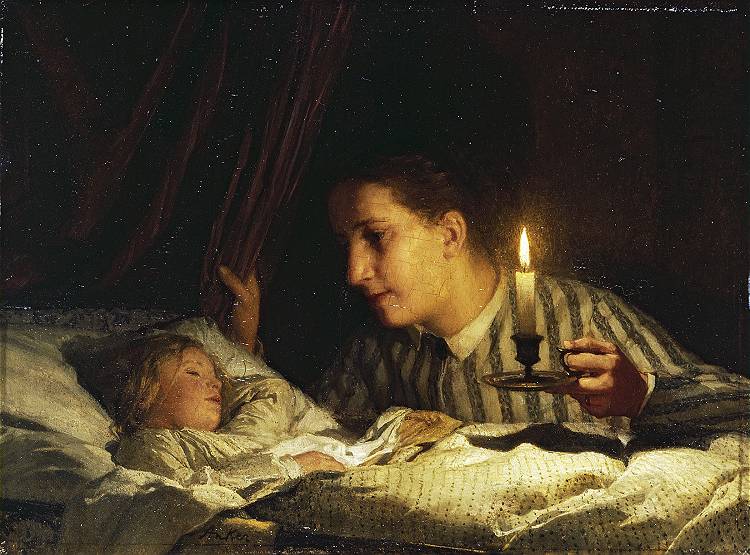
Stage 1 — The wind-down (lights still on)
This is not sleep music yet. It is a signal that the loud part of the day is over. You want a visible pulse a child can rock to — the body settles before the brain does.
Berceuse from the Dolly Suite, Op. 56 — Gabriel Fauré
The best opening piece there is, and it is not close. The Dolly Suite is six short pieces for piano four hands, written or revised between 1893 and 1896 to mark birthdays and milestones in the life of Hélène “Dolly” Bardac, the daughter of the singer Emma Bardac. The Berceuse opens it: a rocking left hand under a tune that never climbs more than a step or two at a time, and a middle section that briefly gets curious before settling right back.
The reason it works on children specifically is that it was aimed at one. There is no adult melancholy in it — compare it to any Chopin nocturne and you’ll hear the difference immediately. Britain figured this out early: the Berceuse was played at the close of every broadcast of the BBC radio programme Listen with Mother, which ran from 1950 to 1982, and two generations of British children learned that this exact piano duet meant it was time to be quiet.
Träumerei from Kinderszenen, Op. 15 — Robert Schumann
Two and a half minutes, and the whole thing is one phrase reaching up and letting go. Schumann wrote the thirteen pieces of Kinderszenen in 1838; Träumerei is No. 7. These are less pieces about children than about remembering being one, which is why this one tends to affect the parent more than the child.
Use it anyway. Its practical virtue is the shape — the melody rises, hesitates, and comes down, four times, with nothing in between. A child who is still talking will usually stop talking by the second rise. Horowitz played it as an encore for decades and slowed it almost to a stop; that recording is the one to know. ▶ Listen on YouTube
Pavane de la Belle au bois dormant from Ma mère l’Oye — Maurice Ravel
Ninety seconds. That is the entire piece, and the brevity is the point: it fits exactly in the gap between putting the book down and turning off the lamp. Ravel wrote Ma mère l’Oye as a piano duet for children and it was premiered on 20 April 1910 at the first concert of the Société Musicale Indépendante by two young pianists, Jeanne Leleu, then eleven, and Geneviève Durony, fourteen.
In the orchestral version the flute carries the tune over almost nothing — a few muted strings, a clarinet. It is the thinnest texture here, and thin is good: nothing for a restless brain to grab onto. For the whole suite and the story behind it, see our guide to Ravel’s Ma mère l’Oye. ▶ Listen on YouTube
The Swan from The Carnival of the Animals — Camille Saint-Saëns
Saint-Saëns composed The Carnival of the Animals in February 1886 and refused to publish it in his lifetime, worried it would damage his standing as a serious composer. He made exactly one exception: The Swan, released in 1887 in his own arrangement for cello and piano. The rest of the suite only appeared in 1922, the year after he died.
So the one movement he judged worth showing the world is the slow one, and children respond to it for a reason that has nothing to do with taste: the cello sits roughly in the range of a calm adult speaking voice. It reads as someone talking gently in the next room. Skip the versions with a full orchestra behind the soloist; you want cello and piano, nothing else. ▶ Listen on YouTube
Stage 2 — Lights out
Now the rules tighten. From here on, no piece may have a climax, a key change that feels like an event, or a texture that suddenly thickens.
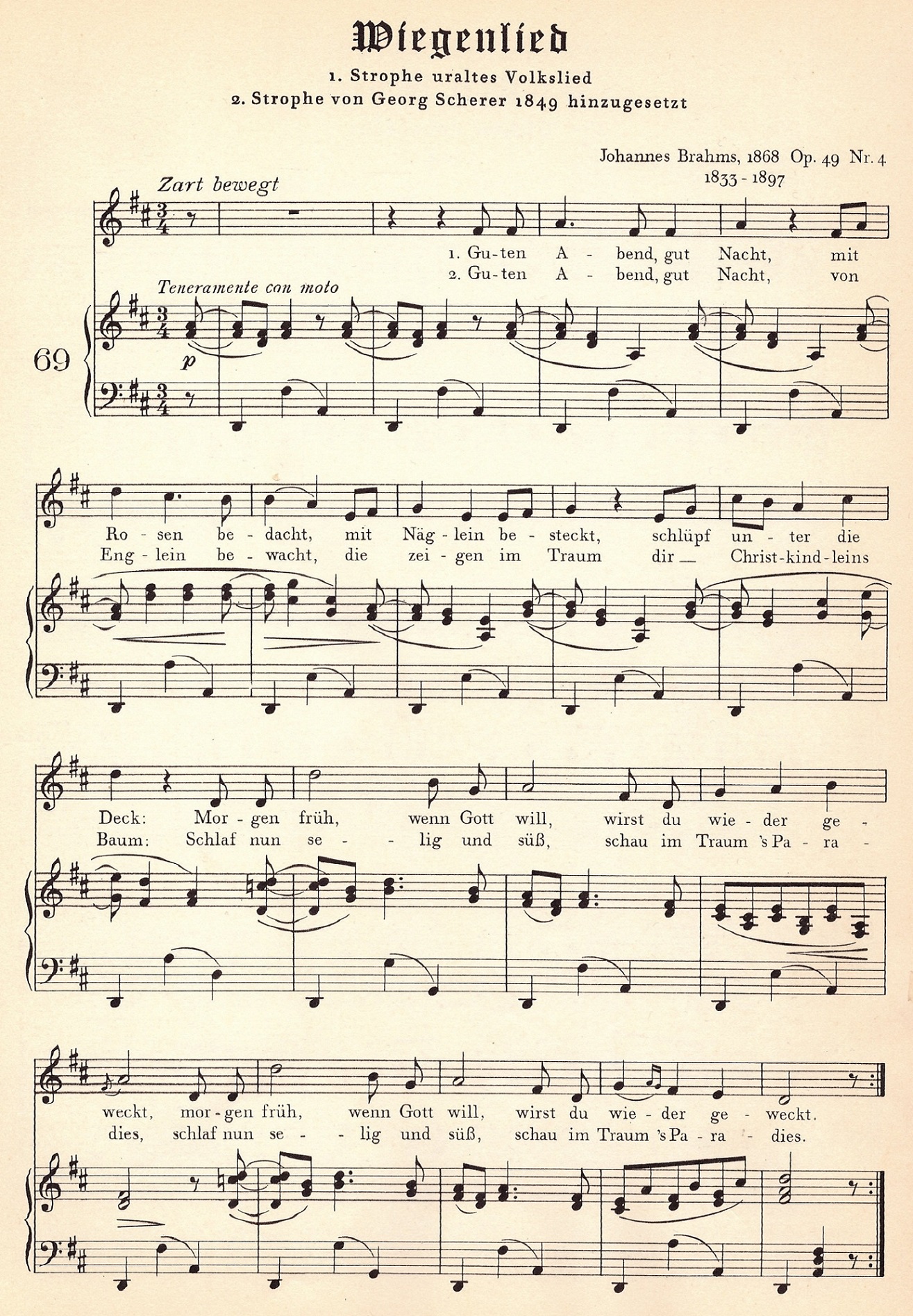
Wiegenlied, Op. 49 No. 4 — Johannes Brahms
The most famous lullaby ever written, and the version in your head is probably a music box, which is a shame. Brahms published it in 1868 as a song for voice and piano, written for his friend Bertha Faber on the birth of her second son. The melody sits on a gently swaying accompaniment that never once resolves into anything emphatic.
My advice: play a sung version, not an instrumental one, and play an old one. A voice doing this at conversational volume, with the words, does something a solo piano cannot — it sounds like a person rather than a device. Elisabeth Schumann’s recording with George Reeves at the piano is the model: no vibrato showing off, no swelling, just the tune delivered like speech.
Berceuse in D-flat major, Op. 57 — Frédéric Chopin
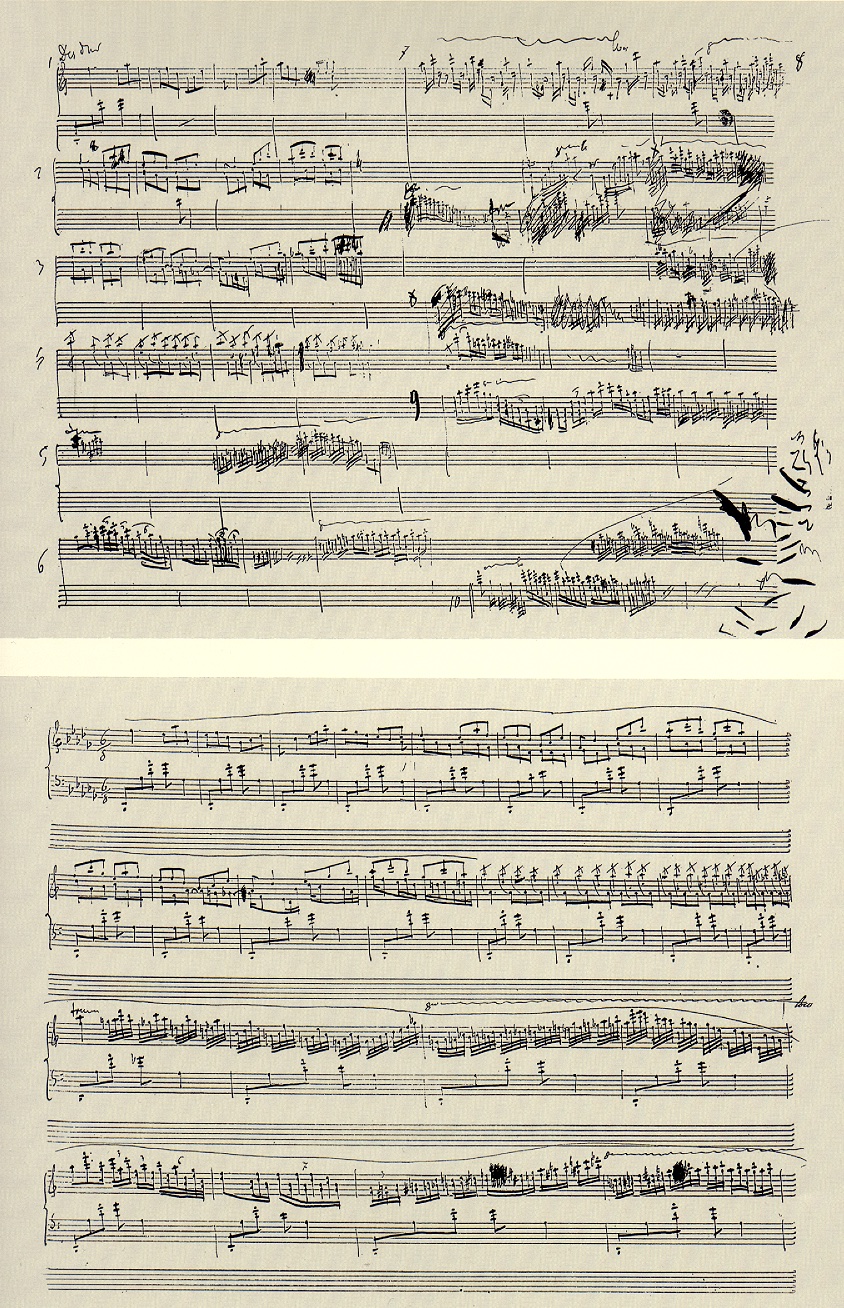
Chopin wrote this in 1843–44 and published it in 1844, and structurally it is the most literal sleep machine in the repertoire: the left hand plays the same rocking figure over and over, essentially unchanged, for four and a half minutes, while the right hand spins increasingly ornate variations above it. The ground never moves. That is the whole design.
The honest caveat, because most lists won’t give you one: the right-hand decoration gets busy in the later variations, with fast runs and stacked trills. A baby will not care; a seven-year-old on the edge of sleep might. Use Rubinstein, who plays the filigree quietly rather than brilliantly. ▶ Listen on YouTube
Gymnopédie No. 1 — Erik Satie
Published in 1888 and marked Lent et douloureux — slow and sorrowful. Ignore the marking; children hear none of the sorrow. What they hear is the most patient music on this list: a left hand alternating two chords in an unbroken three-beat pattern, and a melody that moves so slowly it barely counts as a melody.
This is my pick for the child who fights sleep — the one who talks, negotiates, asks for water. Satie gives them nothing to argue with. Aldo Ciccolini’s reading is unhurried without dragging, which matters: slower than this and it turns eerie. Satie himself is a strange, funny story, told in our piece on his solitary life. ▶ Listen on YouTube
Rêverie — Claude Debussy
I am putting Rêverie here instead of Clair de lune on purpose, and this is the one recommendation on the list I expect pushback on. Clair de lune is the piece everyone reaches for, and its middle section builds to a genuinely loud, rolling climax with the pedal down. It is beautiful and it is wrong for this job.
Rêverie does the same thing — the same drifting harmony, the same soft focus — and stays flat the whole way through. Nothing swells. If your child already loves Clair de lune, use it, but fade it before the middle. If you are building your own listening from scratch, our beginner’s guide is a better starting point than any playlist. ▶ Listen on YouTube
Stage 3 — The ones you leave running
For after you close the door: long, even, safe to leave playing. The rule here is that the last five minutes must sound like the first five.
Aria from the Goldberg Variations, BWV 988 — Johann Sebastian Bach
There is a famous story, told by Bach’s biographer Forkel in 1802, that the Goldberg Variations were commissioned by a Count who suffered from sleepless nights and wanted music to fill them. The story is disputed — Forkel wrote more than sixty years after the fact, the published score carries no dedication, and some scholars regard the whole account as unreliable. So do not tell your child this is bedtime music because Bach said so. Nobody can prove he did.
What is true is that the Aria works: a slow sarabande with an ornamented tune over a bass that walks steadily downward. Leave the full set running and you will hit the fast variations, so play the Aria and stop, or loop it. There is a full walkthrough in our guide to the Goldberg Variations. Gould’s 1981 Aria is much slower than his 1955 one, which for once makes the famous eccentric the practical choice. ▶ Listen on YouTube
Spiegel im Spiegel — Arvo Pärt
The unexpected pick, and for children over about six it is the most effective thing on this page. Pärt wrote it in 1978 for violin and piano, in the style he calls tintinnabuli: the piano plays rising three-note figures, the violin plays long notes that step up and down by one degree at a time, and the two never collide. There is no rhythm to speak of and no harmonic tension anywhere in ten minutes.
Why it beats the standard lullabies for older kids: a child who lies awake replaying the day needs music with no narrative, and this one refuses to tell one. Adults often find it sad. Children mostly find it empty, in the good sense.
Venus, the Bringer of Peace from The Planets — Gustav Holst
Yes, an orchestral movement, and yes, it comes immediately after Mars, which is one of the loudest seven minutes in the repertoire. Play it as a standalone track and never let the album run, in either direction. On its own, Venus is eight minutes of solo horn, flutes, harp and a solo violin, with the strings held so quietly they sound like breathing.
It is the best pick here for a child who has started asking about space: this is the planet named after the goddess of peace, written as the answer to the war music. We ranked the recordings in our guide to the best recordings of The Planets. ▶ Listen on YouTube
The Lark Ascending — Ralph Vaughan Williams
Vaughan Williams composed it in 1914 and revised it in 1920; the first performance, with piano, was given by the violinist Marie Hall on 15 December 1920, and the orchestral premiere followed on 14 June 1921, again with Hall. Fifteen minutes, and it opens and closes with the solo violin playing alone, unmeasured — no beat at all, just a line curling upward.
One warning: the middle has a faster folk-dance section with the full orchestra — not loud, but busier. For a child on the edge of sleep, use the first four minutes and stop. That opening, a violin with no pulse under it, is the most sleep-inducing thing I know of in English music. ▶ Listen on YouTube
The famous ones that don’t work
Every other list includes these. Here is why mine doesn’t.
Beethoven, Moonlight Sonata. The first movement is perfect for this. The problem is what follows it on every album, and autoplay does not know your child is asleep. Use the single track and set a timer.
Mozart, Eine kleine Nachtmusik. The title translates as a little night music, which has convinced a lot of people it is bedtime material. It is a brisk serenade with a snapping rhythm in the first bar. It is party music for a summer evening.
Barber, Adagio for Strings. Slow, yes. It also builds to one of the most devastating climaxes in twentieth-century music and then goes silent for several seconds. Wonderful piece, catastrophic bedtime choice.
And the myth worth knowing: the lullaby sung across the German-speaking world as “Schlafe, mein Prinzchen, schlaf ein” is usually credited to Mozart and was once catalogued as K. 350. It has since been moved to the Köchel appendix of doubtful and spurious works as K. Anh. C 8.48, with the melody generally credited to Bernhard Flies. It is still a lovely tune. It is almost certainly not Mozart’s.
How to sequence it
Four practical things, learned the hard way.
Build a fixed order and never change it. The point is the repetition, not the music: after two weeks the first four bars start doing the work by themselves. Fauré, then Ravel, then Brahms is a complete twelve-minute arc.
Set the volume before you start, and set it low. Low enough that a whisper is louder than the music. Most of these recordings have a wide dynamic range, which means the quiet parts vanish and the busy parts jump out if you get this wrong.
Turn autoplay off. This is the single biggest failure mode. Every piece here is safe; the track that follows it on the album is often not.
Prefer solo and chamber recordings to orchestral ones. A piano, or a cello and piano, stays within a narrow band of volume. Orchestras do not, even in slow music.
On the nights this works you get a small bonus: the child falls asleep to Fauré and Ravel, and years later hears one of them somewhere else and cannot explain why it feels like home.