There are more than a hundred recordings of Vivaldi’s Four Seasons in print, and they do not sound like variations on a theme. They sound like arguments. Put the 1959 I Musici version next to Il Giardino Armonico’s 1994 one and you would struggle to prove they are playing the same notes: one is warm, round, unhurried, roughly the tempo of a pleasant afternoon; the other snarls, scrapes and detonates. Same score. Completely different piece.
That gap exists because of what happened to Baroque performance between those two dates. Gut strings replaced steel. Vibrato went from constant to occasional. Continuo players started improvising instead of politely comping. And a generation of Italian ensembles decided that Vivaldi’s storm music should actually sound frightening. So the choice of recording is not a fussy question here — it decides whether you hear a pastoral wallpaper record or one of the most violent pieces of program music written before Berlioz. Below: six recordings that matter, what each one actually does, and the one I would hand to a friend.

What you’re actually listening for
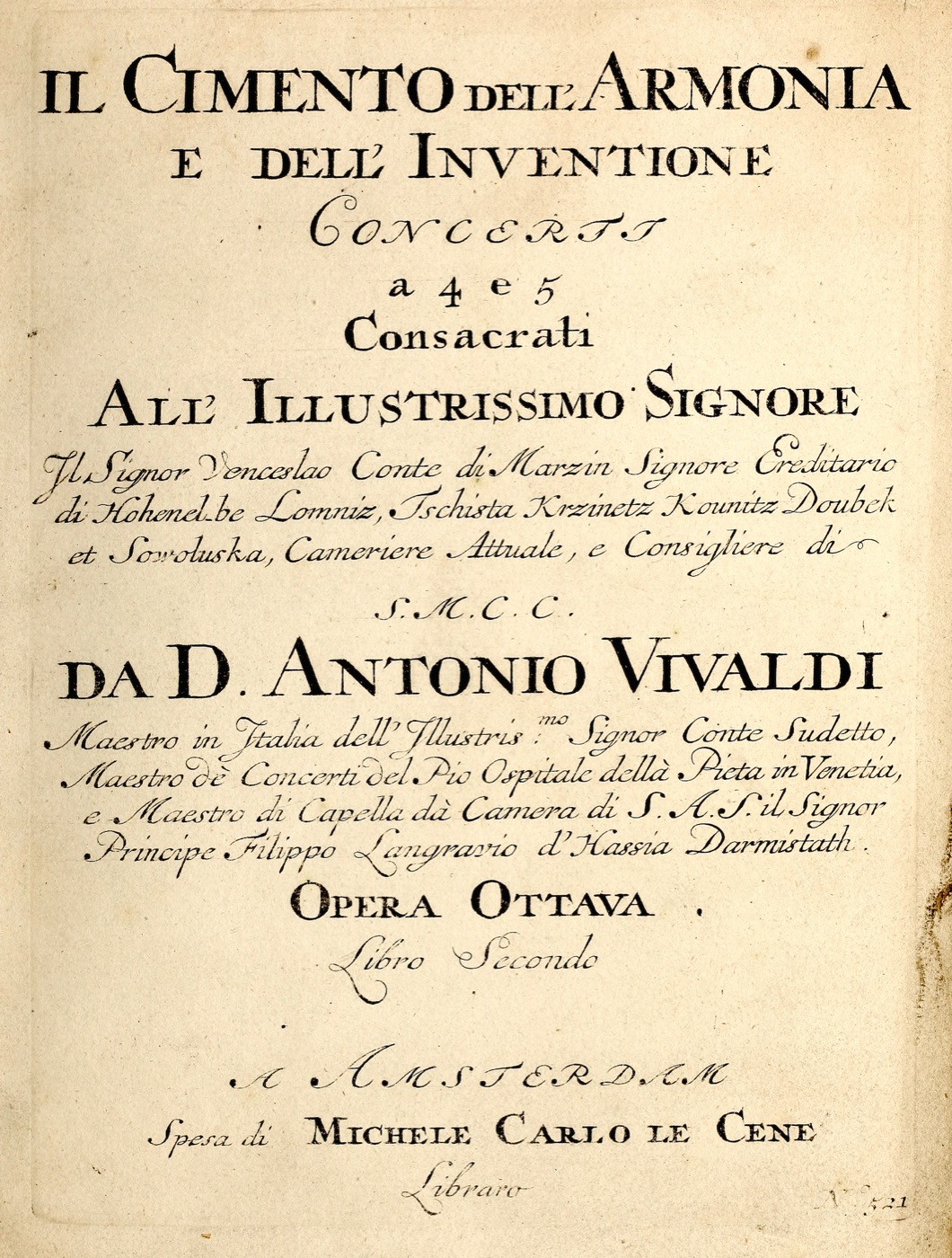
The Four Seasons are the first four concertos of a set of twelve that Vivaldi published in Amsterdam in 1725 under the title Il cimento dell’armonia e dell’inventione — “the contest between harmony and invention.” The individual concertos date from roughly 1718–1723. Each of the four is a standard three-movement violin concerto: fast, slow, fast, with a solo violin trading material against a string band and continuo.
The unusual part is the poetry. Vivaldi printed a sonnet alongside each concerto, and the lines are keyed to specific points in the score — the birds, the barking dog, the drunken harvesters, the storm. Vivaldi may well have written the sonnets himself, though that is not settled. Either way, this is program music with the program printed in the part, which is rare enough for the 1720s that it changes how you judge a performance: a recording either delivers the picture or it doesn’t.
Three moments do most of the work. In Spring, the first movement’s bird calls — three violins chirping over a held chord — tell you immediately whether the ensemble is willing to be silly. In Summer, the final Presto is the storm, and the question is whether the bass line drives it like weather or trots along like an accompaniment. And in Winter, the Largo has the violin sing a long lyrical line while the other strings play pizzicato raindrops on the roof — the single most-copied texture in all of Vivaldi. If a recording gets those three right, the rest usually follows.
The contenders
Rachel Podger, Brecon Baroque — 2018, Channel Classics
Eight players, one to a part. That is the whole idea, and it changes everything: with no section to hide inside, every inner line becomes audible and every player has to make a decision. The result is the most conversational Four Seasons on record. In Autumn‘s first movement the harvesters don’t sound like a crowd, they sound like five specific people, and you can hear the continuo (harpsichord, organ, theorbo, cello and violone) changing colour from movement to movement rather than laying down uniform padding.
Podger plays as first among equals instead of as a soloist with backing. Some listeners will want more weight in the storms — this is not the loudest Summer you can buy. But Winter‘s Largo is the best I know: the pizzicato is genuinely light, like rain rather than plucking, and the violin line above it is unforced, almost spoken. Presto Music made it their Recording of the Week when it appeared. My pick of the six.
🎧 Also on: Apple Music · Spotify
Il Giardino Armonico, Enrico Onofri (violin), Giovanni Antonini — 1994, Teldec
The most extreme Four Seasons that is also a serious one. Recorded in Lugano in September 1993 and released the following year, this is where the Italian period-instrument scene stopped being tasteful. The dynamic range is enormous, the articulation is percussive, and the continuo behaves like a rhythm section — you’ll hear plucked strings, keyboard and what sounds like deliberate roughness where other groups smooth things out.
Summer is the reference point. Onofri’s solo in the third movement is played with a snap and a bite that makes most rival versions sound like they’re describing a storm rather than being caught in one. The trade-off is real: the mannerisms are loud, the rubato is aggressive, and if you dislike this style you will dislike it within thirty seconds. Get it second, after you own a version you can just live with.
🎧 Also on: Apple Music · Spotify
Fabio Biondi, Europa Galante — 1991, Opus 111
The one that broke the dam. Biondi and his young Italian ensemble recorded this in Graz in 1991, and it arrived like a provocation: fast, sharply accented, full of ornament that other groups had left on the page. Everything Il Giardino Armonico did three years later starts here.
What still holds up is the sheer forward drive — the tempi in the outer movements of Spring and Summer feel like they were chosen by someone who reads the sonnets as action scenes. What has aged less well, to my ear, is the ensemble precision; there are moments where the excitement outruns the tuning. Historically it’s the most important recording on this list. As a daily listen, Podger and Il Giardino Armonico both do it better now.
Summer from the 1991 Opus 111 recording.
▶ Listen on YouTube · Apple Music · Spotify
Trevor Pinnock, Simon Standage (violin), The English Concert — 1982, Archiv Produktion
Recorded at Henry Wood Hall in London in October 1981 and issued by Archiv the following year, this was the version that made period instruments respectable in this repertoire for a mainstream audience. It is noticeably more restrained than anything the Italians did a decade later — Standage’s tone is clean and slightly cool, the tempi are brisk without being confrontational, and the recorded sound is spacious in the way early-1980s Archiv always was.
That restraint is exactly why I still recommend it. If the Italian recordings feel like too much on a first hearing, this one gives you gut strings, transparent textures and clear inner parts without the theatrics. Spring‘s bird calls are precise rather than comic; Winter‘s opening shivers instead of shrieking. It is also cheap and permanently available, which matters.
▶ Listen on YouTube · Apple Music · Spotify
I Musici, Felix Ayo (violin) — 1959, Philips
The historical anchor. I Musici recorded the Four Seasons with Ayo in 1955 and again in 1959, and the 1959 version is generally identified as the first stereo recording of the work. It sold enormously and it is, for a couple of generations of listeners, simply what the piece sounds like: modern instruments, continuous warm vibrato, a big round string sound, tempi that never rush.
I like it more than the period-instrument orthodoxy says I should. Ayo’s tone in Winter‘s Largo is beautiful in a way that no gut-string version quite matches, and the ensemble’s blend is genuinely luxurious. But the storms are polite, the harpsichord is nearly inaudible, and the whole thing sits at one emotional temperature. Buy it as a document and for the slow movements — not as your only copy.
▶ Listen on YouTube · Apple Music · Spotify
Nigel Kennedy, English Chamber Orchestra — 1989, EMI
The commercial phenomenon. Released in September 1989, Kennedy’s version became one of the best-selling classical albums ever made, with sales reported at over three million copies worldwide — a number no Four Seasons recording before or since has come close to.
It deserves some of that. Kennedy plays with real personality, the slow movements are shaped with a pop musician’s instinct for a hook, and the whole record has an energy that the safe modern-instrument versions of the era lacked. But it is also the version whose interpretive decisions I’d argue with most: the phrasing is heavily applied from outside rather than growing out of the harmony, the ECO is thickly recorded, and the storm in Summer is loud without being fast. If you already own it, fine. If you’re buying your first, this is the one I’d skip.
▶ Listen on YouTube · Apple Music · Spotify
The verdict
Best overall: Rachel Podger and Brecon Baroque (2018, Channel Classics). The one-per-part scoring makes the counterpoint legible in a way no larger ensemble manages, the continuo is genuinely inventive, and it never trades musical sense for effect. It is also excellently engineered, which matters more in this piece than people admit — half the drama lives in the bass line, and most recordings bury it.
Budget and streaming pick: Pinnock, Standage and The English Concert (1982, Archiv). It is on every streaming service, it costs almost nothing physically, and it does the historically-informed basics cleanly without asking you to sign up for a manifesto. If you want one Four Seasons and no opinions about it, take this.
If you want the storm to actually scare you, get Il Giardino Armonico (1994, Teldec). Nothing else on this list treats Summer‘s Presto as an emergency. Just don’t make it your only copy — it’s a performance you react to, not one you live with.
If you want the pre-period sound at its best, get I Musici with Ayo (1959, Philips) — for the slow movements, which are still gorgeous, and for a clear picture of what this music meant before 1980.
Where to hear them
All six are on the major streaming services in some form, though catalogue availability shifts: the Channel Classics, Archiv and Warner/EMI titles are stable, while the Opus 111 Biondi has moved between reissue labels over the years and can be listed under different catalogue numbers. Podger’s recording was made in DSD and is worth hearing in a high-resolution format if you have the option — the pizzicato in Winter is exactly the kind of detail that lossy compression flattens. For physical copies, the Pinnock and I Musici discs are permanent budget-line fixtures; the Il Giardino Armonico has been reissued repeatedly by Warner and is easy to find.
Sources and recording notes
Recording metadata here — conductor, soloist, ensemble, year and label — was checked against release listings on Discogs, label and distributor pages (Warner Classics for the Kennedy, Deutsche Grammophon for the Pinnock/Standage Archiv issue, Channel Classics and Presto Music for the Podger), and the publication and sales details on the work’s Wikipedia entry, which cites the three-million-copy figure for Kennedy and identifies the 1959 I Musici/Ayo disc as the first stereo recording. Session details for Il Giardino Armonico (Lugano, September 1993) and Pinnock (Henry Wood Hall, October 1981) come from the respective release listings. The judgments about how each recording sounds are mine, not received consensus. Two things I could not independently confirm and have therefore not asserted as fact: the precise edition or manuscript source each ensemble used, and whether the Op. 8 sonnets are Vivaldi’s own work — the attribution to him is plausible and widely repeated but remains an open question.
Related reading
If you want the piece itself explained movement by movement rather than compared across recordings, start with our guide to Vivaldi’s Four Seasons, Op. 8. For how the Baroque solo concerto works and where Vivaldi sits in its development, see our complete guide to the violin concerto. And if this is your entry point into the repertoire generally, our classical music for beginners piece is the place to go next.