- Composer
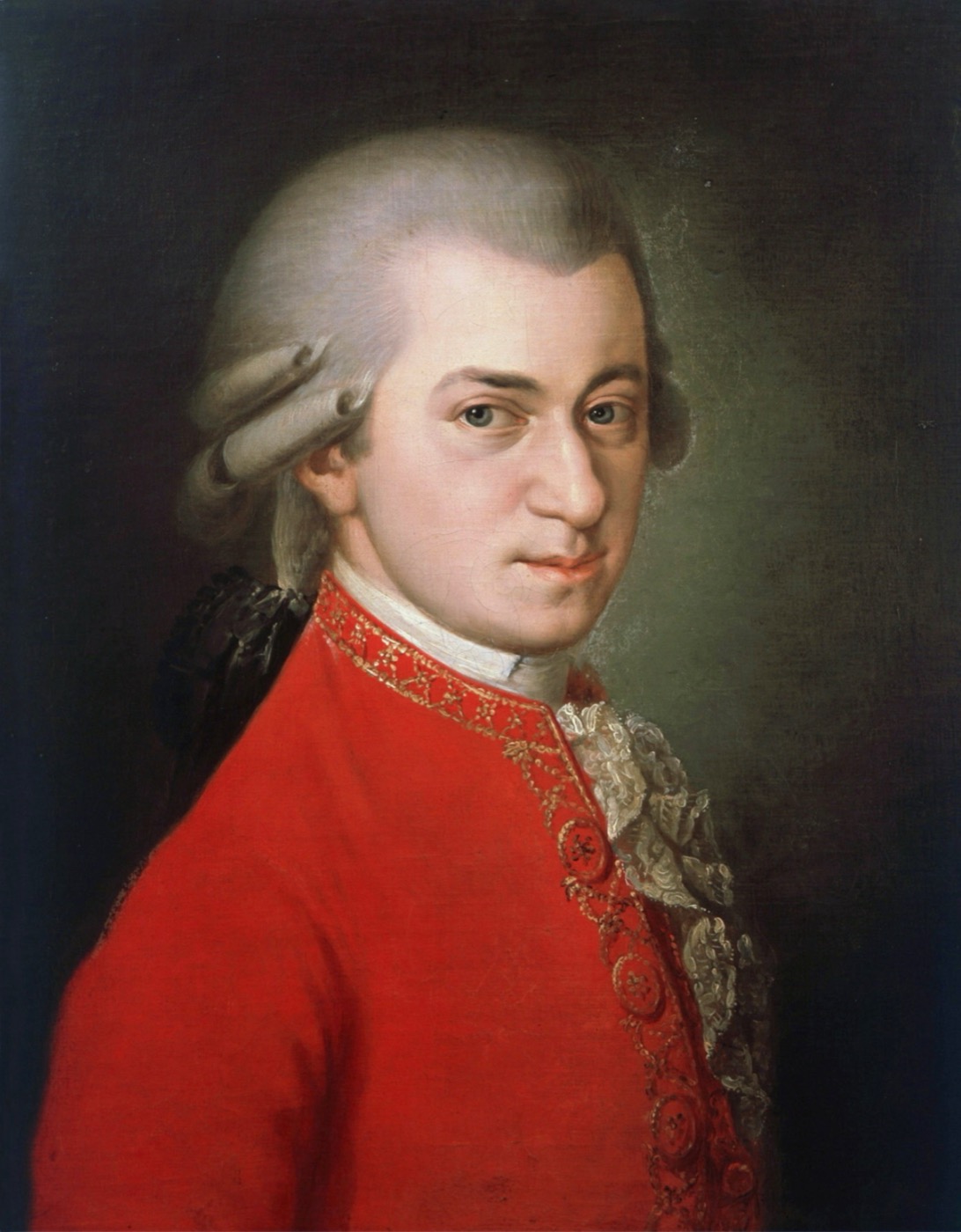
- Wolfgang Amadeus Mozart
(1756–1791) - Work
- Twelve Variations on Ah vous dirai-je, Maman, K.265/300e
- Key
- C major
- Composed
- 1781–1782, Vienna
- Structure
- Theme and twelve variations
- Instrumentation
- Solo Piano
- Duration
- Approx. 13 minutes
Most piano students meet this piece twice. The first time it is a tune you can pick out with one finger before you can read music. The second time, usually somewhere around a conservatory audition, it is a set of variations with fast parallel writing, a hand swap, a slow movement in all but name, and a meter change at the finish. Same melody. Completely different job.
Mozart’s Twelve Variations on Ah vous dirai-je, Maman, K.265, usually gets filed under charming and left there. Here is the narrower claim I want to make, because it changes how you hear the whole thing: the set becomes a real piece at Variation 8, and everything around it exists to make that one moment land. Everything before is Mozart laying flat ground. Everything after is the recovery. If you listen for one thing, listen for the moment the lights go out.
The tune came with a love song attached
The melody was first published in France in 1761, without words. Nobody knows who wrote it. It circulated as a light air, the kind of thing printed in collections for amateurs to play at garden parties, and it had no particular association with children at all.
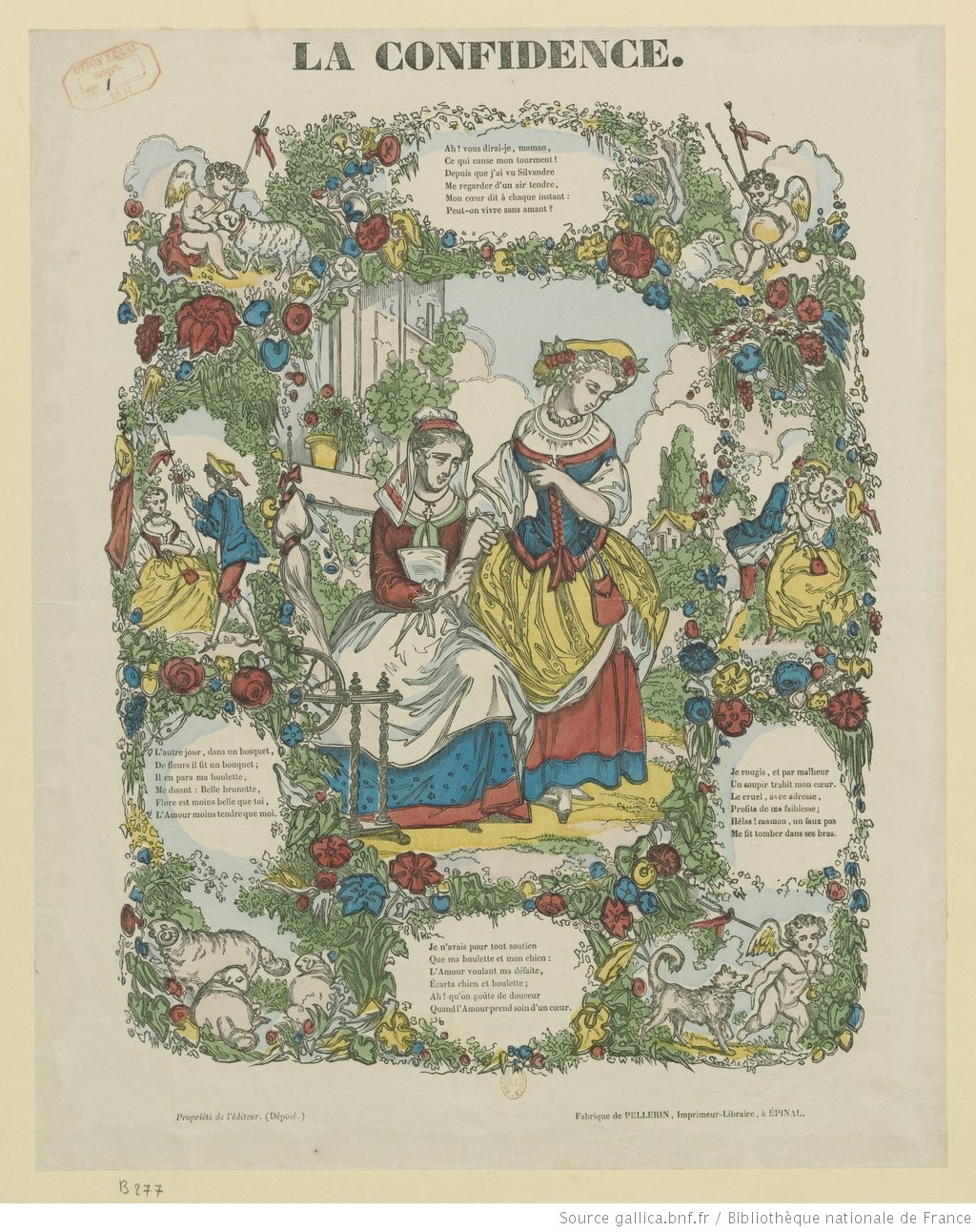
The words came later, and they are not for children either. In 1774, the earliest known printed publication of the lyrics together with the music appeared in volume two of Recueil de Romances by Charles de Lusse, published in Brussels, under the title La Confidence naive. The narrator is a shepherdess. She meets a young man named Silvandre in the woods, he gives her flowers, and by the end of the verses she has stopped resisting. The whole song is her telling her mother about it. Later versions swap the man’s name around — Sylvandre, Lysandre, Clitandre — which tells you how widely the thing travelled and how little anyone treated it as fixed.
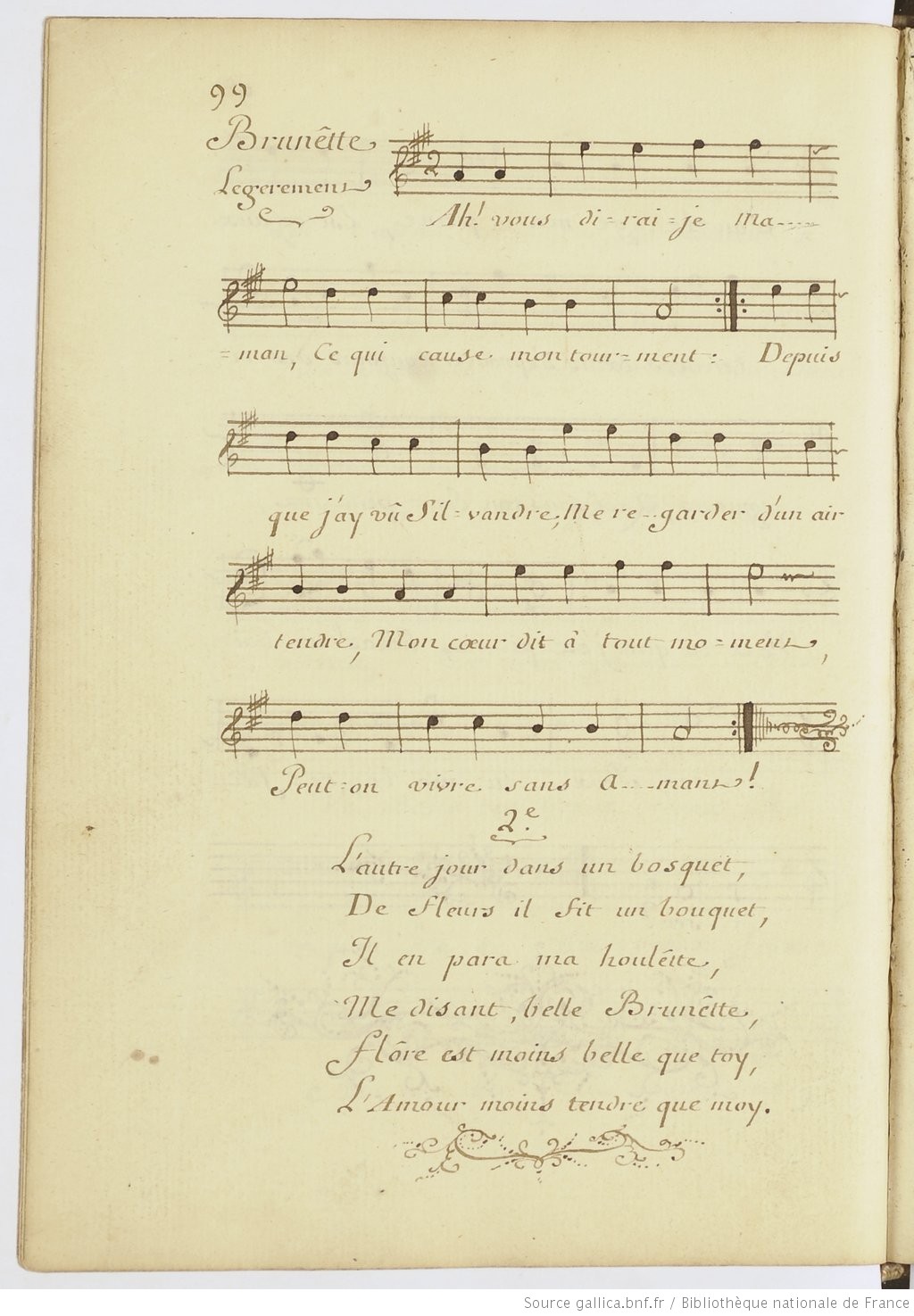
That history changes what the piece is doing. A Viennese audience in the early 1780s heard a tune they could already hum, attached to words about a girl, a boy and a walk in the woods; the nursery association arrived decades later and in another language. The joke lands differently when the room knows the words.
The Paris theory, and why it fell apart
For a long time the piece was assigned to 1778, the year Mozart spent several months in Paris, and it was renumbered from K.265 to K.300e to reflect that. The logic was thin but tempting: French tune, French city, done. Wolfgang Plath’s later analysis of Mozart’s manuscript pointed instead to 1781 or 1782, and that dating is now the standard one, though it rests on handwriting evidence rather than a document, so treat it as strongly supported rather than settled beyond argument.
The revised date moves the piece into a much more interesting year. In 1781 Mozart’s relationship with his Salzburg employer, Prince-Archbishop Hieronymus Colloredo, collapsed, and he was dismissed with a kick from the archbishop’s steward, Count Arco. He was out of a salaried job and starting over in Vienna as a freelance.
What a freelance needed in Vienna was pupils and salon invitations, and French was the language of the salons. A set of variations on a French air that everyone in the room could hum is, read that way, a piece of extremely shrewd product design: playable enough that a good amateur could aspire to it, difficult enough that the composer could demolish it himself when asked. No document records Mozart’s motive — he left no note explaining why he chose this tune — so read that as circumstantial, not established.
The variations were first published by Christoph Torricella in Vienna in 1785, as part of a collection of Mozart’s keyboard music. That year sat in the middle of his strongest run as a Viennese concert pianist. The first performance of his Piano Concerto No. 20 in D minor, K.466, took place at the Mehlgrube in Vienna on 11 February 1785, with Mozart as soloist, and the C major concerto that followed it, Piano Concerto No. 21, K.467, came out of the same run of concerts. A set of variations on a popular air reached print in the middle of all that. Mozart evidently thought it belonged there.
What to actually listen for
The theme is laid out in A–B–A form in eight-bar sections, followed by twelve variations. The whole set stays in C major apart from Variation 8, which is in C minor, and the time signature is 2/4 throughout except for the twelfth variation, which moves to 3/4. Only the final two variations carry tempo indications, Adagio and Allegro. Those facts are most of the architecture, and once you have them you can follow the piece without a score.
The mechanisms Mozart uses are worth naming, because they are the same ones he uses everywhere and this is the clearest place to hear them isolated. Surface decoration: the tune stays put and the note values get smaller. Registral swap: the same tune, moved to a different hand and a different part of the keyboard, changes character without changing a pitch. Modal darkening: one flip to minor, used once. Rhythmic dislocation: accents pushed off the beat so the pulse stops feeling safe. Metric reframing: the same melody re-barred in three, so your body wants to move differently. That is the toolkit, and Mozart uses all of it without padding.
Variations 1 to 7: Mozart building flat ground
In Variation 1 the right hand breaks the theme into running sixteenth notes; in Variation 2 the left hand does the same thing underneath. Variations 3 and 4 repeat that swap in triplets. It is deliberately symmetrical, and the symmetry has a job. Mozart is establishing a rule — what one hand does, the other will do — so that breaking the rule later actually registers.
The difficulty curve is steeper than it sounds. The sixteenth-note pairs are manageable because only one hand is busy. The triplets are where amateur performances come apart, because triplets against a duple pulse demand an internal clock rather than finger speed, and the ear catches every wobble against that famous melody. There is no covering it up when the audience already knows the tune.
Variation 5 sets the hands against each other in imitation, and Variation 6 runs them in parallel thirds and sixths — elegant on the page, unforgiving at tempo, because unevenness between the hands turns clean intervals into smear. Then Variation 7 breaks the rule Mozart spent the first half establishing: the melody moves into the left hand. Every pitch stays exactly where it was; the theme simply arrives with weight underneath it now instead of light above it. This is the first moment in the set where a listener with no training says out loud that something is different.
Variation 8: the only minor-key variation, and the reason the piece exists
C minor arrives, and it arrives once. Out of twelve variations, exactly one leaves the major, and Mozart never returns to it. The left hand pushes the accents off the beat, the harmony thickens, and the tune small children everywhere can sing turns into something you would not sing to a small child.
The economy is the point. One minor variation in twelve is a ratio, and the ratio is what does the emotional work: light, light, light, light, light, light, light, shadow, light, light, light, light. Give the set three minor variations and it becomes a moody piece with cheerful bits. Give it one and the whole thing acquires a floor it did not have before. Mozart pulls the same trick at larger scale in Symphony No. 40, where the minor mode is the whole environment rather than a single window — hearing the two side by side is the fastest way to understand what he could do with mode as a structural device rather than a mood setting.
Variations 9 to 12: the recovery and the release
Variation 9 returns to C major, and it sounds brighter than the opening did. It is the same key; your ear has simply been recalibrated by the shadow it just walked through. Variation 10 opens out across the keyboard in octaves and wide leaps, gathering momentum toward the end.
Then Mozart stops. Variation 11, marked Adagio, slows the theme into an ornamented aria, the melody stretched out and decorated until it breathes like a vocal line. Placing the slowest music immediately before the finale is a structural choice, and it is the one that separates this set from the hundreds of disposable variation sets published in the same decades. Without those minutes of stillness, the ending would be merely fast.
Variation 12, marked Allegro, changes the meter to 3/4. Everything that has been marching now dances, and Mozart empties the toolbox into it: scales, crossings, trills, the lot. The twelfth variation ends with an eleven-bar concluding section in which the original melody comes back plainly, one last time. After twelve transformations you hear the tune you started with, and it does not sound the same, because you no longer do.
Follow it with the score
If you want the structure to become obvious rather than described, watch the notation move. Watch for the key signature change into Variation 8, and for the bar lines reorganising into three at Variation 12.
Who actually owns this melody
Search engines will happily tell you that Mozart wrote Twinkle, Twinkle, Little Star. What he wrote is a set of variations on a French air whose composer nobody has identified, and the English words did not exist in his lifetime.
Jane Taylor’s poem The Star was first published in 1806, in Rhymes for the Nursery, fifteen years after Mozart died in 1791. Someone later fitted it to the French tune, and the pairing stuck so hard that the melody’s actual history vanished behind it. The same melody also carries Baa, Baa, Black Sheep and the alphabet song — The ABC Song was first copyrighted in 1835 by the Boston music publisher Charles Bradlee. One anonymous French air ended up teaching literacy, putting children to sleep, and counting sheep, in a language its original audience did not speak.
Mozart’s set is the reason the melody has a foothold in concert programmes at all, and he had plenty of company. Johann Christoph Friedrich Bach wrote variations on the tune in G major around 1785 to 1790. Christian Heinrich Rinck published an organ set on it as his Op. 90 in 1828. Adolphe Adam turned it into bravura variations for his opera Le toreador in 1849, and Erno Dohnanyi built a whole piano-and-orchestra showpiece out of it in 1914, the Variations on a Nursery Tune, Op. 25.
Saint-Saens belongs on that list only with an asterisk, and it is worth being exact about what he did. What he contributes is a quotation rather than a variation set: a brief nod to the tune in Fossils, the twelfth movement of The Carnival of the Animals from 1886, sitting alongside Au clair de la lune and a snatch of Rossini. The standard reading of that movement is that everything it quotes was already a musical antique by Saint-Saens’s day, this tune included. A wink, then, and a short one.
Mozart’s remains the version pianists actually programme, and my reading of why is structural rather than sentimental: his set has a shape — one darkening at Variation 8, one slow movement parked deliberately before the finale — where most of the others have a sequence.
The recordings worth your time
Lang Lang — Piano Book (Deutsche Grammophon, 2019)
Lang Lang recorded the complete set, theme and all twelve variations, for his album Piano Book, a collection of the pieces he learned as a child. It is the brightest and most immediately enjoyable version here: clean articulation, a forward tone, and real delight in the fast writing. Its weak spot is Variation 8: the minor variation passes as a colour change rather than a floor dropping out. For a first listen, or for playing to someone who thinks classical piano is homework, that is the right trade. If you want to hear why the piece is built the way it is, go to Schiff instead.
▶ Listen on YouTube · Apple Music · Spotify
Andras Schiff — Decca
Schiff’s Decca account of K.265 appeared on a 1988 album that also carries the K.455 variations, the Rondo in A minor, K.511, and the Adagio in B minor. This is the one I would hand to someone who wants to hear the architecture. Schiff keeps ornamentation lean and lets the differences between variations do the arguing, which means the early pairings register as pairings, the hand swap in Variation 7 registers as an event, and Variation 8 gets the weight it needs without any pedal-and-rubato theatre. My pick, and it is not close.
🎧 Also on: Apple Music · Spotify
Kristian Bezuidenhout — fortepiano (harmonia mundi)
Bezuidenhout plays it on fortepiano on harmonia mundi’s Keyboard Music vols. 5 and 6, released in 2014; his K.265 runs 13 minutes 19 seconds. The instrument changes the argument. On a modern grand the parallel writing in Variation 6 sounds smooth; on a fortepiano you hear every attack, and the texture becomes granular rather than glossy. The minor variation is the payoff: without a big modern sustain to blur it, the syncopations land like knocks. The trade is that the fast variations have less carrying power and the top register can sound brittle if you are used to Steinway sound. Go here second, not first — it is far more rewarding once you already know what the piece does.
▶ Listen on YouTube · Apple Music · Spotify
The verdict. Schiff for the piece, Lang Lang for the pleasure, Bezuidenhout for the sound Mozart actually had under his hands. If you only play one, play Schiff, and start it at Variation 7 if you are impatient — the swap into the left hand and the minor variation that follows are the stretch that justifies the rest.