- Subject
- Niccolò Paganini (1782–1840)
- Key Works
- 24 Caprices Op. 1, Violin Concertos Nos. 1–6
- Active
- Born in Genoa, Italy; toured across Europe
- Epithet
- “The Devil’s Violinist”
Paganini is the most myth-shrouded violinist in history. This article traces the real reasons behind the rumours of a deal with the devil, the violin techniques that made his playing possible, and the Marfan syndrome hypothesis — all written for newcomers and connoisseurs alike.
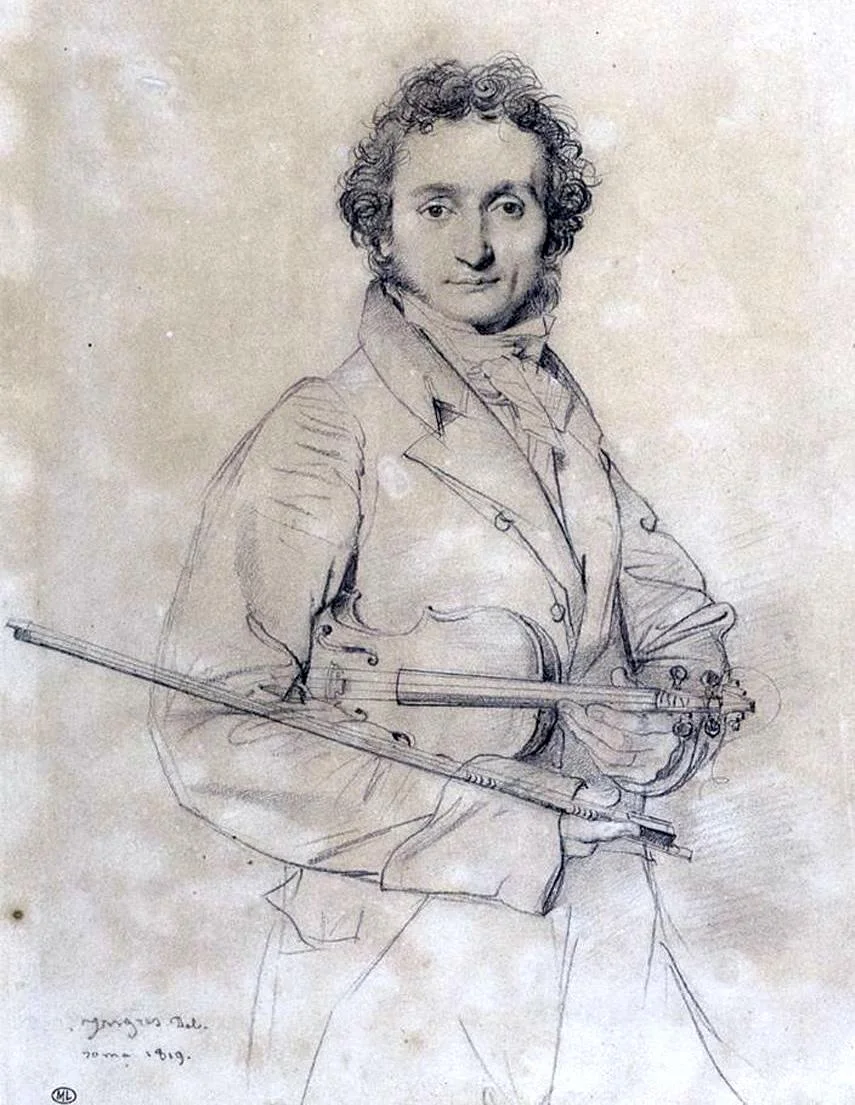
1. The Devil Takes the Stage
March 1828, a concert hall in Vienna. A skeletal figure stepped onto the platform. Black coat, deathly pale skin, fingers of unnatural length. As he raised his bow, someone in the audience whispered:
“That man sold his soul to the devil.”
Niccolò Paganini. The greatest violinist who ever lived — and the musician most plagued by satanic rumour. Everyone who heard him play said the same thing: “No human being can play like that.” So people reached the obvious conclusion: he wasn’t human.
The real story, though, is more dramatic than any deal with the devil.
2. A Ship Chandler’s Son Picks Up the Violin
27 October 1782, Genoa. Paganini was born the third son of a ship chandler. His father Antonio supplemented a faltering trade by playing the mandolin for small change. Music was a sideline; poverty was the main occupation.
Mandolin at five, violin at seven. He burned through a couple of local teachers before his ability outstripped them all. His father took the boy to Parma to find Alessandro Rolla, the leading pedagogue of the day.
Rolla listened to the boy play, then announced: “I cannot teach this child.” He sent him on to his own teacher, Ferdinando Paer, who in turn passed the boy to his teacher, Gasparo Ghiretti. The pupil was so advanced that he had to be referred up three generations of masters.
By fifteen, Paganini was practising more than ten hours a day. He had already mastered every existing technique. Now he began inventing ones that didn’t exist.
3. A Prodigy’s Downfall — Gambling, Women, and Squandered Gifts
In 1799, the seventeen-year-old Paganini toured northern Italy to rapturous acclaim. Fame and money arrived simultaneously. He did exactly what you’d expect.
He gambled it away.
Debauchery and the gaming table wrecked his health and left him in serious debt. He even lost his violin. Being a genius, it turns out, is no guarantee of self-discipline.
Between 1801 and 1804 he vanished from public life altogether, living in seclusion with an aristocratic lover at her estate in Tuscany. Without any concerts to report, the rumour mill obliged: word went round that he had murdered a mistress and been thrown in prison.
The truth was different. During those three years Paganini was developing harmonics, multiple stopping, and left-hand pizzicato — techniques no one had ever attempted. It was not a collapse. It was a metamorphosis.
4. ‘Il Cannone’ — Paganini’s Cannon-Like Stradivari
When Paganini returned to Genoa in 1804, his playing was more overwhelming than ever. But the encounter with his legendary instrument happened a little earlier, in Livorno.
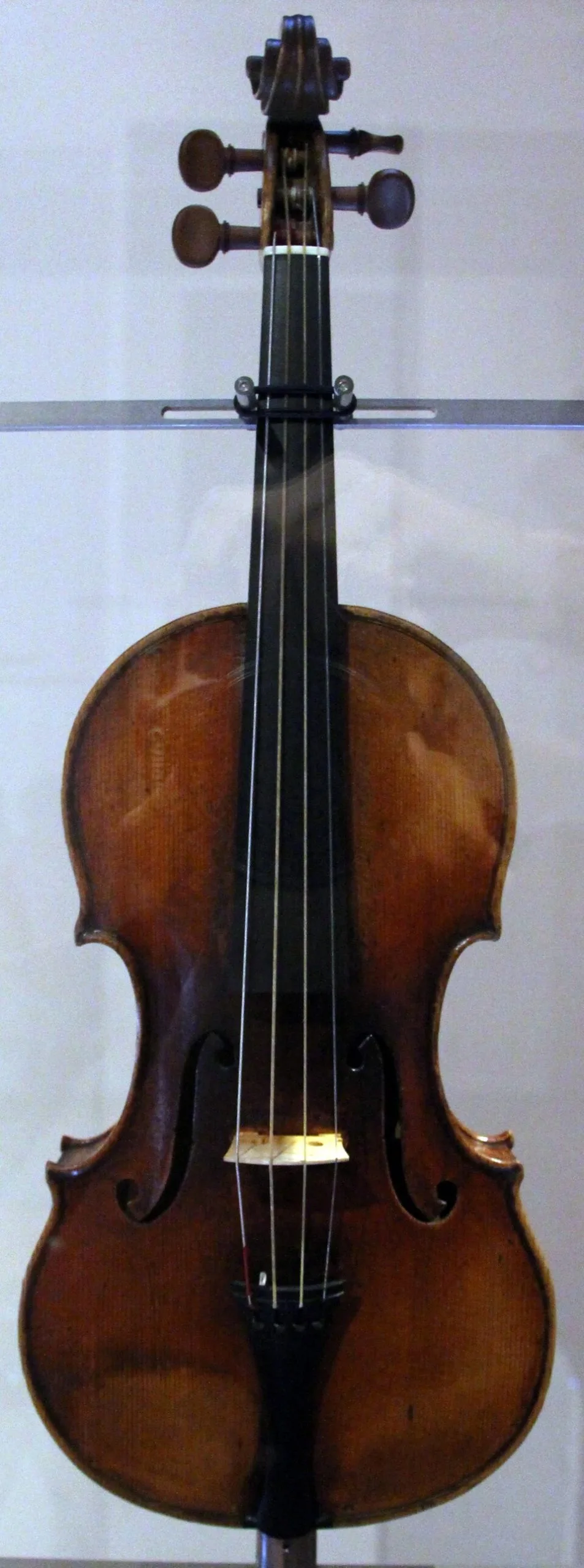
A wealthy merchant named Livron lent the young Paganini his violin — a 1743 instrument by the legendary Cremonese maker Giuseppe Guarneri del Gesù. After the performance, Livron refused to take it back. “This instrument must be yours.”
Paganini called it ‘Il Cannone’ — the Cannon — for its explosive volume and cavernous resonance. He played it for the rest of his life and bequeathed it to the city of Genoa. It is still on display at the Palazzo Doria-Tursi, where a custodian plays it once a month. An instrument must be played to survive.
Here’s a curious footnote. The great luthier Jean-Baptiste Vuillaume built an exact copy of Il Cannone — so exact that Paganini himself couldn’t tell them apart at first. Only after detecting a subtle difference in timbre could he identify the original. The replica passed to Paganini’s only pupil, Camillo Sivori.
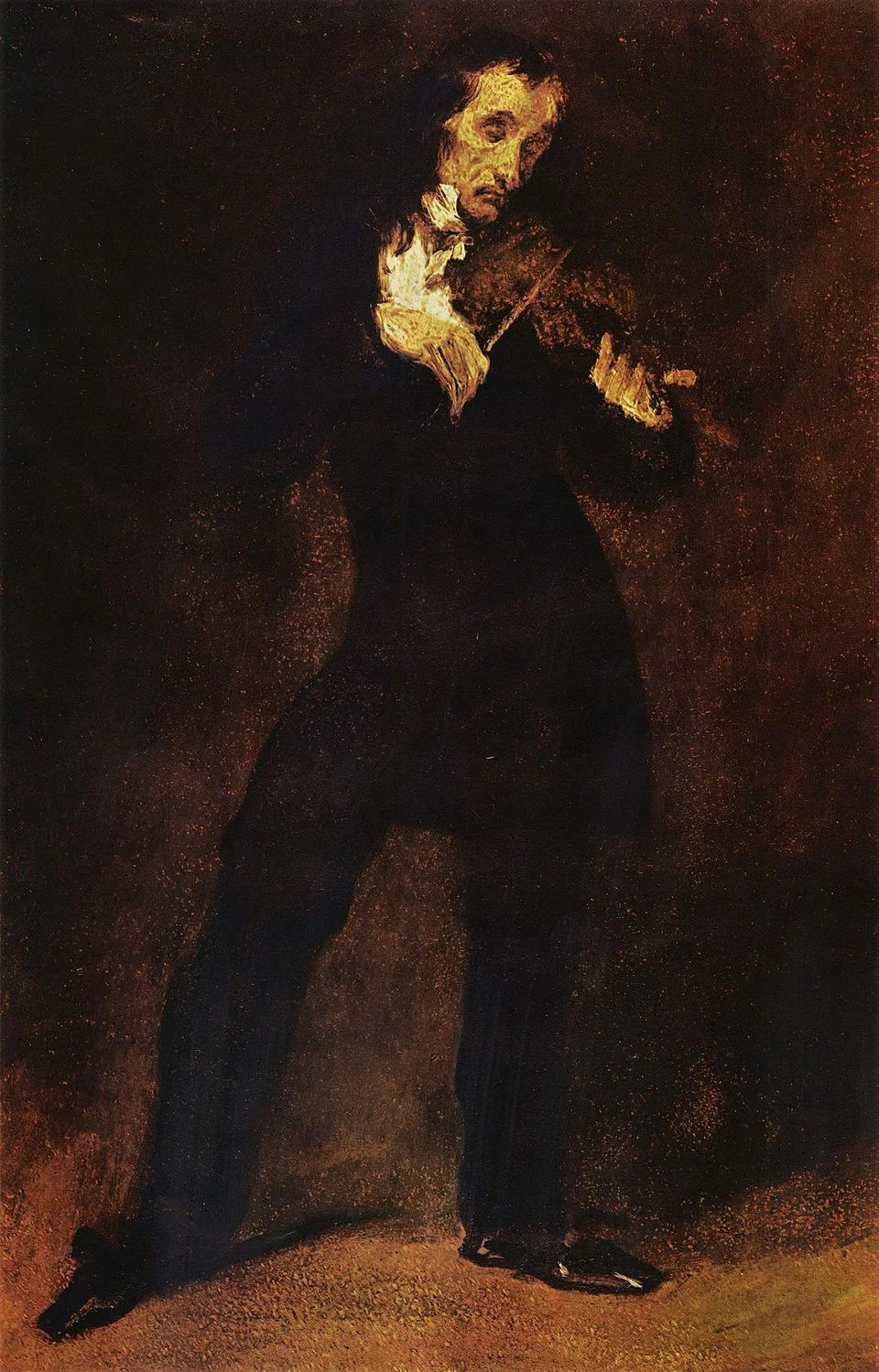
5. The Secret Behind the Devil Rumours — Marfan Syndrome?
Why was Paganini’s playing deemed ‘beyond human limits’? He commanded a range of four octaves with impunity, sometimes performing an entire work on a single string. Double-handed pizzicato, natural and artificial harmonics, double trills — two centuries on, the number of violinists who can play his Caprices flawlessly can be counted on one hand.
The secret may lie in an unexpected place. Modern medical researchers have suggested that Paganini suffered from Marfan syndrome or Ehlers-Danlos syndrome — conditions characterised by abnormally long fingers and hypermobile joints. The contemporary descriptions of his appearance — cadaverous pallor, emaciated frame, grotesquely elongated fingers — match the clinical profile precisely.
Disease didn’t create talent. But if ten hours a day of obsessive practice were combined with a physical advantage of that order, the result was something audiences in the early nineteenth century could explain only as a pact with Satan.
6. The 24 Caprices — The Old Testament of the Violin
Between 1802 and 1817, Paganini completed the 24 Caprices for Solo Violin, Op. 1. The set is sometimes called the Old Testament of violin literature. Each caprice explores a single technique pushed to its limit: arpeggios, double trills, extreme position shifts, ricochet bowing.
Caprice No. 24 in particular has had an influence on music history that is almost impossible to overstate.
Franz Liszt heard Paganini play and was electrified. “If there is a Paganini of the violin, then I shall be the Paganini of the piano.” He wrote the Grandes études de Paganini. Johannes Brahms composed the Variations on a Theme of Paganini, Op. 35. Sergei Rachmaninoff created the Rhapsody on a Theme of Paganini, Op. 43. A single theme from Caprice No. 24 has fuelled composers’ imaginations for two hundred years.
Paganini dedicated the collection “alli artisti” — to artists. Not to a patron or a prince, but to artists in general. In a later annotation, however, he named the dedicatee of No. 24: “Niccolò Paganini, sepolto pur troppo” — “alas, buried.” He dedicated it to himself.
7. The Rock Star Who Set Europe Ablaze
In 1828, Paganini ventured outside Italy for the first time. A late debut, at forty-six. The response was explosive.
Vienna was an unprecedented triumph. Shops filled overnight with ‘Paganini-style’ suits, hats, gloves and shoes — nineteenth-century merchandise. The fan mania went further still: devotees were seen wearing brooches containing the stubs of his cigars around their necks.
Berlin in 1829, Paris in 1831, then London. The same scenes repeated wherever he went. Pope Leo XII awarded him the Order of the Golden Spur. Paganini was the rock star of the nineteenth century — with a violin instead of a guitar.
8. Berlioz and a Rejected Viola
In 1833 in Paris, Paganini met the young composer Hector Berlioz. (For more on Berlioz’s masterpiece, see our guide to the Symphonie fantastique.) Paganini called Berlioz “the resurrection of Beethoven” — the highest compliment he could pay.
He then commissioned Berlioz to write a viola concerto, intending to perform it himself. Berlioz produced Harold en Italie.
Paganini looked at the score and refused to play it.
His reason is priceless: the viola part wasn’t showy enough. The piece was a dialogue between viola and orchestra, not a showcase for the soloist. For Paganini, monopolising every eye in the hall was simply a given.
Ironically, Harold en Italie became one of the greatest works in the viola repertoire. The piece Paganini turned down is the one that survived in history. The two men remained close friends nevertheless; in later years Paganini sent Berlioz a substantial sum of money. And a guitar signed by both of them has come down to us.
9. A Corpse the Devil Wouldn’t Take
Paganini’s final years were wretched. Mercury and opium prescribed for syphilis ravaged his body; tuberculosis compounded the ruin. In 1836 he staked everything on a casino venture in Paris and went bankrupt. His instruments and personal effects were auctioned off.
In May 1840, in Nice, a priest sent by the bishop arrived to administer last rites. Paganini refused. He believed it was not yet his time.
A week later, on 27 May 1840, he died of internal haemorrhage — before the priest could return.
What happened next is genuinely macabre. The Catholic Church denied Paganini a consecrated burial. The reason? He had refused last rites, and the old rumour about a pact with the devil sealed the decision. The very legend that had made him famous in life now denied him a grave in death.
His body was returned to Genoa but left unburied. An appeal to the Pope secured permission for the coffin to be moved, but formal interment was still refused. Paganini’s remains were not buried until 1876 — thirty-six years after his death.
In 1893, the Czech violinist František Ondříček persuaded Paganini’s grandson to open the coffin. What fifty-three years had done to the body is best left to the imagination.
Composers with Equally Dramatic Stories
- The audience threw punches on opening night — Stravinsky’s The Rite of Spring
- Three years without writing a single note — Rachmaninoff’s Piano Concerto No. 2
- A suicide note in symphonic form — Tchaikovsky’s Symphony No. 6 ‘Pathétique’
10. There Was No Devil — But the Legend Lives On
There was no devil. What there was: abnormally flexible joints, ten hours a day of fanatical practice, the desperation of a man who had gambled away his own violin, and a set of unprecedented techniques forged during three years of solitary retreat.
Count the things he left behind. The 24 Caprices became the bible of violin technique. Liszt, Brahms, Rachmaninoff, Robert Schumann and Witold Lutosławski all borrowed his melodies to build masterpieces of their own. The phrase “the Paganini of the twenty-first century” is still the highest accolade a violinist can receive.
And in Genoa, Il Cannone endures. A violin built in 1743, still played once a month, 283 years later. Winners of the Paganini Competition earn the right to perform on it. It is not the devil’s violin. It is a violin made by a human being, played by human beings, and kept alive by human beings.
When Paganini dedicated Caprice No. 24 to himself, he wrote: “Alas, buried — Niccolò Paganini.” Self-deprecation or prophecy? Given that his body went unburied for thirty-six years, it may have been prophecy after all.
But the music was never buried.
Tonight, try listening to Caprice No. 24. Not as the devil’s violin, but as five minutes of proof of how far human determination can go.
Frequently Asked Questions
Did Paganini really make a pact with the devil?
No. His superhuman playing was the product of more than ten hours’ daily practice, a physical condition — probably Marfan syndrome — that gave him abnormally long, flexible fingers, and a set of revolutionary techniques developed during three years of self-imposed seclusion.
Where is Paganini’s violin ‘Il Cannone’ today?
It is preserved at the Palazzo Doria-Tursi in Genoa, Italy. Built in 1743 by Guarneri del Gesù, the instrument was bequeathed to the city after Paganini’s death. A custodian plays it monthly, and winners of the Paganini International Violin Competition are given the privilege of performing on it.
Why was Paganini’s body left unburied for thirty-six years?
Paganini refused last rites on his deathbed, and the old ‘deal with the devil’ rumour prompted the Catholic Church to deny him a consecrated burial. After repeated petitions, his remains were finally interred in Parma in 1876.
You Might Also Enjoy
- Vivaldi’s The Four Seasons
- The Classic Note Composer & Works Map
Why did people believe Paganini sold his soul to the devil?
The rumor that Paganini made a pact with the devil arose from his revolutionary violin skills, which seemed supernatural to audiences in the early 19th century. His gaunt appearance, intense performances, and use of unheard-of techniques like ricochet bowing and left-hand pizzicato fueled this myth. The legend was cemented by the otherworldly difficulty of his compositions, such as the 24 Caprices for Solo Violin.
Did Paganini have a medical condition that helped him play the violin?
It is widely believed Paganini had a connective tissue disorder like Marfan syndrome or Ehlers-Danlos syndrome, which resulted in hypermobile joints and exceptionally long, flexible fingers. This physical anomaly would have given him a unique advantage in playing large intervals and complex passages that were impossible for other violinists. Though never formally diagnosed, contemporary accounts from physicians like Dr. Francesco Bennati support this theory.
What was special about Paganini’s violin, “Il Cannone”?
Paganini’s primary violin, a 1743 Guarneri ‘del Gesù’ he nicknamed “Il Cannone” (The Cannon), was special for its immense power and resonance. Crafted by Bartolomeo Giuseppe Guarneri, its robust construction allowed it to produce a darker, more forceful tone than the sweeter-sounding Stradivari violins. This powerful voice was essential for Paganini’s dynamic and dramatic solo performances in large concert halls.
What specific techniques made Paganini’s playing so revolutionary?
Paganini’s technique was groundbreaking because he mastered and popularized many difficult skills, creating entirely new sounds. He was a master of scordatura (intentionally altering the tuning of the strings), playing entire passages on a single string (the G-string), and generating high, flute-like notes using artificial harmonics. He also famously combined bowed notes with plucking the strings with his left hand (left-hand pizzicato), a technique featured prominently in his Caprice No. 24.
How did Paganini’s 24 Caprices change violin playing?
Published in 1819, Paganini’s 24 Caprices for Solo Violin, Op. 1, created a new technical standard for the instrument. Each caprice is a study focusing on a specific virtuosic skill, such as wide leaps, fast arpeggios, or double-stop trills. They were so advanced that they codified a new vocabulary of violin technique and remain a pinnacle of achievement for all serious violinists today.
Further Reading
🎼 Browse the score — Download Paganini’s 24 Caprices Op. 1 free on IMSLP