- Composer
- Beethoven
- Work
- Violin Sonata No. 5 in F major ‘Spring’, Op. 24
- Key
- F major
- Composed
- 1800–1801
- Movements
- 4 movements
I. Allegro (F major)
II. Adagio molto espressivo (B♭ major)
III. Scherzo: Allegro molto (F major)
IV. Rondo: Allegro ma non troppo (F major) - Instrumentation
- Violin and piano
- Premiere
- c. 1801, Vienna
Beethoven didn’t actually name it ‘Spring’. That nickname was attached by someone else long after he was gone. But it’s hard to imagine a more perfect fit. The moment you hear the first few bars of the first movement, you can’t help but think of spring. It’s like a ray of sunshine has found its way into the room, carried on the melody of the violin.
But here’s the thing: in 1800, when this piece was born, Beethoven was in no position to be enjoying the season. His hearing was beginning to fail, a slow-motion catastrophe that had started two years prior. He confessed his torment to only a few close friends. A letter to his doctor from that time reveals his anguish: “For more than two years my ears have been getting steadily weaker… I am still plunged in deep sorrow.”
Out of that profound despair, one of a brightest and warmest violin sonatas in the repertoire was created.
Count Moritz von Fries and Beethoven in 1801
What was Beethoven’s life like around 1800? He was steadily making a name for himself in Vienna. His reputation was growing and his compositions were selling, but the life of a freelance musician was as precarious then as it is now. To create with any stability, he needed patrons. One of his most important supporters was Count Moritz von Fries, one of the wealthiest men in the Austrian Empire. In 1801 alone, the Count was the dedicatee of three major works: the String Quintet, Op. 29, the Violin Sonata No. 4, and this ‘Spring’ Sonata.
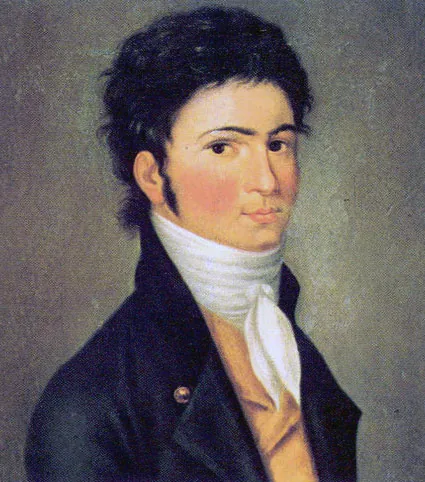
Receiving three dedications in a single year points to a close relationship. It also shows just how ferociously productive Beethoven was during this period.
Originally, Beethoven planned to publish the ‘Spring’ Sonata as a set with his Violin Sonata No. 4, Op. 23. The two works were designed to complement each other: the 4th is a turbulent and dark work in A minor, while the ‘Spring’ is a radiant and relaxed piece in F major. For reasons that remain unclear, the publisher split them into separate opuses. We still don’t know exactly why the plan changed; one of those minor mysteries of music history.
Published in 1801, the sonata was an immediate success. There are clear reasons why this piece, out of Beethoven’s ten violin sonatas, has remained so popular. The first is its four-movement structure. Most of his violin sonatas have three movements; only three have four, and the ‘Spring’ was the first. It was a bold move to give a chamber piece the substantial, symphonic-like structure typically reserved for larger works.
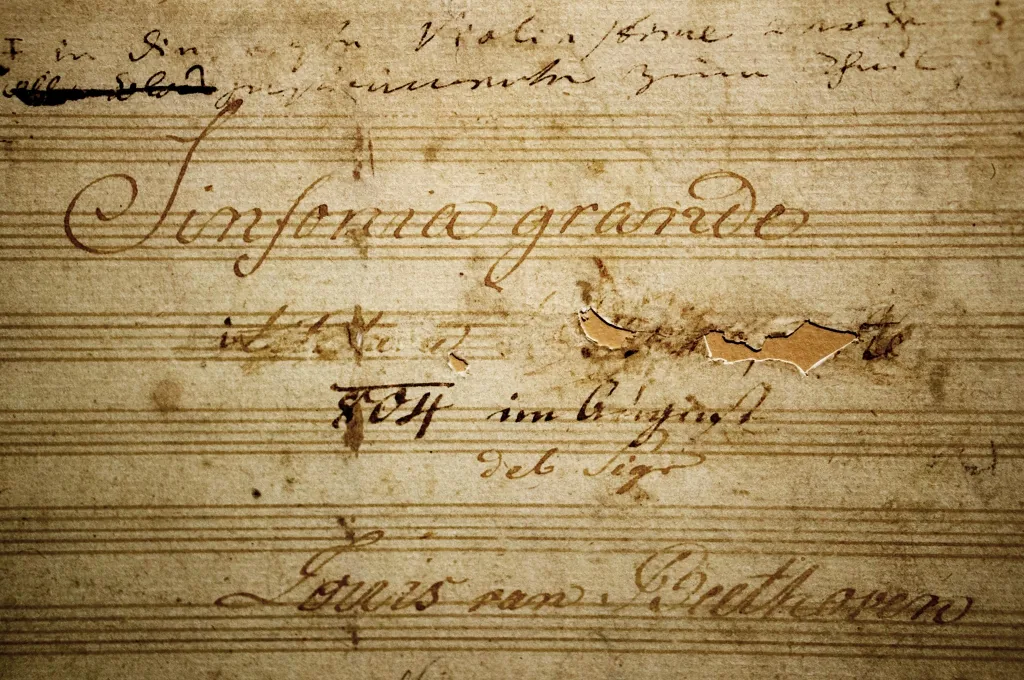
The original manuscript is now preserved in the Austrian National Library. One can only imagine what the composer was feeling as he wrote down these notes, his hearing slowly fading. That context makes the “spring” he wrote with his own hands feel all the more extraordinary.
The Arrival of Spring: The First 8 Bars
It’s rare for a violin sonata to begin this way. The violin enters completely alone, without any piano accompaniment, to present the opening melody. It’s quiet, simple, and unfolds over an F-major chord with such natural ease that it feels like a cloudless morning.
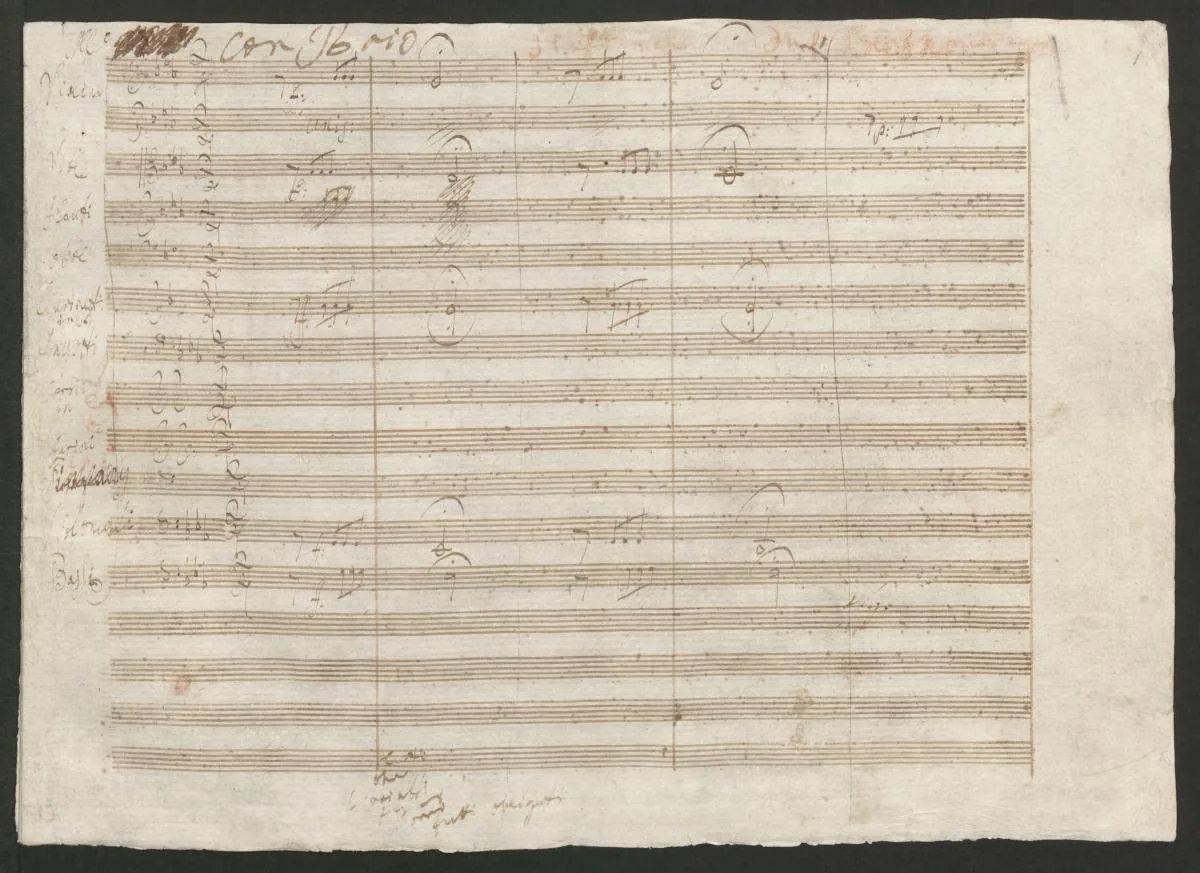
And here’s something interesting: the melody itself is constructed with utter simplicity. It’s essentially an ascending arpeggio, but its directness gives it immense power. Because it isn’t overly complicated, even a first-time listener can follow it instantly. This simplicity is what aligns so perfectly with the intuitive feeling of spring.
When the piano takes over the theme, the melody is the same, but the volume increases and the texture becomes richer. In that moment, the violin’s solo whisper transforms into a conversation between two equal partners.
The entire first movement is in sonata form: a structure that presents themes, develops them, and then brings them back. Think of it like a three-act play: setup, conflict, and resolution. The most striking part of the ‘Spring’ Sonata’s first movement is the development section. The bright F-major tonality suddenly darkens into a stormy F minor. It’s the same melody, but the shift to a minor key gives it a completely different color. You might wonder, “I thought this was about spring, what’s with the sudden drama?” This is precisely the kind of dramatic contrast Beethoven intended. A moment of shadow is necessary to make the return of light feel even more powerful.
After this development section, when the main theme returns in the recapitulation, the listener has been waiting for it. Like the sun breaking through after a cloudy spell, the brightness of the major key, having passed through the shadow of the minor, sounds even more vivid. Beethoven embedded this kind of foreshadowing and reversal into a seemingly simple movement.
A Movement-by-Movement Guide
> 💡 First time listener? In the first movement, focus on the opening eight bars where the violin plays alone. Listen for the moment the piano joins in and how the melody transforms; you’ll immediately understand that this piece is a dialogue. For the second movement, slow down and let the violin’s song-like melody wash over you. In the fourth movement, try to catch the moment the main Rondo theme returns—it feels like a happy “Ah, there’s that spring feeling again!”
Mvt. 1: Allegro — The Violin Leads the Morning
The first movement, to repeat, begins with the solo violin. No piano introduction, no accompaniment. In the Classical era, this was a highly unusual way to start a violin sonata. Convention dictated that the piano would introduce the main theme, with the violin following. Beethoven boldly flipped that tradition on its head.
After the first theme is gently established in F major, the music moves to a second theme in C major. The change in key also brings a change in character. If the first theme is like clear, crisp air, the second has a more gracefully flowing, rotating quality. These two themes alternate, creating a cycle of tension and release.
In the development section, Beethoven experiments with both themes, but the shift to F minor is the most memorable moment. The bright theme is instantly cloaked in darkness, and the contrast feels surprisingly intense. This is why the return of the first theme in the recapitulation feels so much deeper and more earned.
Among performers, setting the right tempo for this movement is a key point of interpretation. Too fast, and the leisurely feel of spring is lost. Too slow, and the “Allegro” loses its vitality. Comparing different recordings reveals a wide range of choices. David Oistrakh and Lev Oborin take a more spacious approach, while Itzhak Perlman and Vladimir Ashkenazy play with more vibrant energy. It’s the same movement, but each performance offers a different vision of spring.
The movement concludes with a coda—a short but energetic finishing touch that provides a sense of complete satisfaction without a bombastic finale. It’s a perfect example of Beethoven’s masterful sense of balance.
Mvt. 2: Adagio molto espressivo — The Violin Sings
This is often the movement people talk about most when they discuss the ‘Spring’ Sonata. The marking “Adagio molto espressivo” means “very slow, very expressively.” The piano lays down a bed of quiet chords, and over this, the violin spins out a long, singing melody.
The reason this movement stands apart isn’t just its slow beauty. The melodic phrases are exceptionally long and flow seamlessly one into the next, like a piece of prose poetry. It’s hard to predict where a phrase will end, which makes its conclusion feel both natural and poignant.
When you compare recordings of classical violin sonatas, the performers’ individual personalities often shine through most clearly in the slow movement. The delicate balance—how softly the piano supports, how long the violinist holds a breath—can completely change the impression of the music. If the piano is too loud or forward, it can overwhelm the violin’s song.
This question of balance is also tied to historical instruments. On a fortepiano, the instrument of Beethoven’s time, the volume is naturally softer than a modern grand piano, making the balance between the two instruments easier to achieve. On a modern piano, the pianist must consciously restrain their volume. More than anything, this is a movement about balance.
Mvt. 3: Scherzo: Allegro molto — A Short, Sharp Interlude
This is the shortest movement in the sonata, but its brevity is highly effective. After the long, lyrical atmosphere of the second movement, the sudden appearance of a fast, sharp rhythm is a jolt to the senses. “Scherzo” means “joke,” and this movement acts like a playful interruption.
The structure is simple, but the way the instruments toss rhythmic fragments back and forth is incredibly precise. The thrill comes from the moments when the violin and piano, after trading jabs, suddenly take off in a unified sprint. It’s over so quickly you might think, “Is that it?” but it serves its purpose perfectly as a bridge to the final movement.
Why did Beethoven include such a short Scherzo? It was likely a strategy to build anticipation for the finale. After the relaxation of the second movement, the third movement ramps up the energy, which then flows directly into the fourth.
Mvt. 4: Rondo: Allegro ma non troppo — Spring Returns
The final movement is a Rondo, a form where a main theme (A) returns repeatedly between contrasting episodes (B, C), creating a pattern like A-B-A-C-A. The Rondo theme of the ‘Spring’ Sonata brings back the brightness of the first movement, but from a different angle. It prompts a feeling of welcome recognition: “Ah, spring is back!”
The Rondo was a form Beethoven often used for finales, but here it feels particularly light-hearted. It avoids excessive drama or an abrupt ending, providing a natural conclusion to the vernal mood that has been building since the first movement.
Each time the theme returns, it’s slightly varied—never exactly the same. It’s like how spring arrives every year, but the scenery is always a little different. The theme makes one final appearance before the piece closes with a clean, satisfying flourish.
The division of labor between the two instruments in the finale is worth noting. The role of introducing the theme constantly shifts. At first, the violin opens with the Rondo theme, then the piano takes over. On later returns, they might present it together. It’s hard to imagine a more natural way to conclude a 25-minute sonata.
The Paradox of a Nickname
There’s a deep irony here. The name ‘Spring’ was given posthumously, yet it’s rare to find a nickname that so perfectly captures the essence of a piece. The composer himself, however, was in no state to feel the joys of spring.
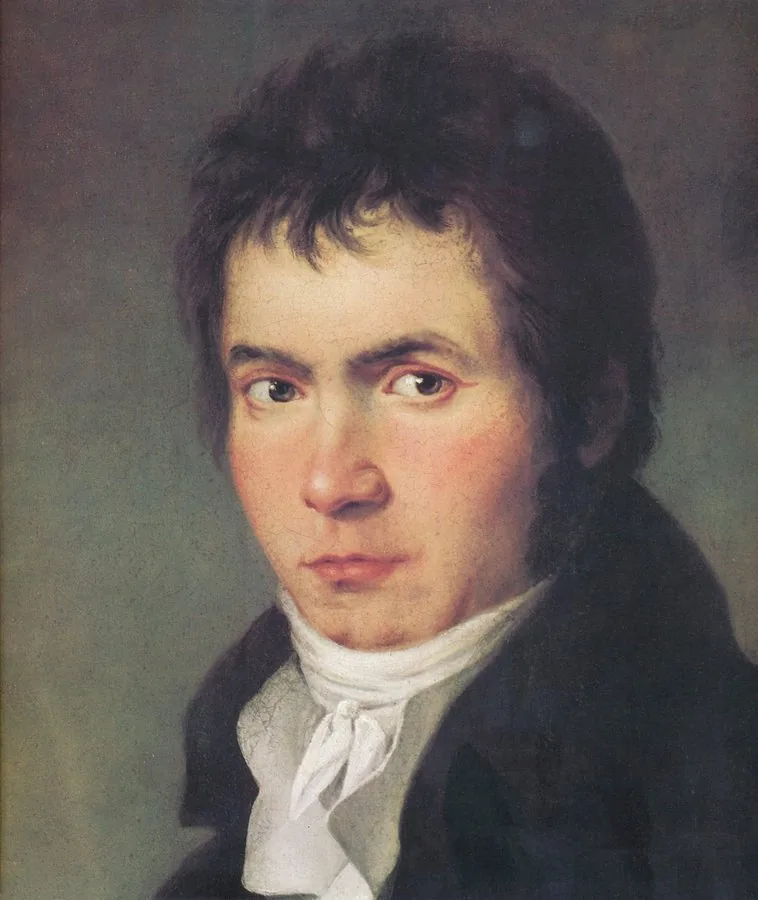
His hearing problems would culminate in the 1802 “Heiligenstadt Testament,” a letter in which he confessed his suicidal despair. In the period just before that, from 1800 to 1801, while writing this sonata, Beethoven was already anticipating this fate and desperately trying to hide it. For a musician, losing one’s hearing was a death sentence.
From the heart of that anxiety and despair, this dazzlingly bright sonata was born. Some scholars suggest that Beethoven’s works from this period became more open and cheerful as a psychological reaction—an attempt to suppress his anxiety. Or perhaps it was born of a desperate conviction that composing was the only thing that could save him. Either way, the result was one of a most beloved sonatas.
Another reason modern audiences connect so deeply with this work is the equal partnership between the violin and piano. In many Classical sonatas, the piano often feels like the star, with the violin playing a supporting role. Not here. In the ‘Spring’ Sonata, the two instruments trade themes, lead together, and sometimes run in parallel, like two people on a leisurely walk.
This sonata also serves as a crucial bridge between Beethoven’s early violin sonatas and later masterpieces like the ‘Kreutzer’ Sonata (Op. 47). The structural integrity and instrumental balance achieved here would profoundly influence his later chamber music.
If You’re Listening for the First Time
If this is your first encounter with the piece, just remember three things.
First, the violin starts alone. The first eight bars of the first movement. The violin unfolds the melody without any piano. The moment the piano joins in defines the character of the entire work: this is music as a conversation.
Second, cherish the second movement. Many fans of the ‘Spring’ Sonata consider the second movement their favorite. It’s slow and long, but not a second is wasted. Just listen to how the violin’s melody sings over the piano.
Third, remember the Rondo theme in the fourth movement. The bright energy of the first movement returns in a new way. You’ll have a moment of recognition, a feeling of “Ah, there it is again.” That’s the Rondo theme.
The entire performance takes about 25 minutes. It’s not short, but by the end, you’ll understand why the ‘Spring’ Sonata is the most frequently performed of all Beethoven’s violin sonatas.
Recommended Recordings
* David Oistrakh (violin) / Lev Oborin (piano) (1962, Philips)
This recording represents an ideal balance between violin and piano. Oistrakh’s tone is rich and warm, a perfect match for the sonata. Oborin’s piano is a true partner, supporting without ever trying to steal the spotlight.
* Itzhak Perlman (violin) / Vladimir Ashkenazy (piano) (1978, Decca)
A bright and fluid interpretation. This recording is full of youthful energy that suits the fresh character of the music. It’s an excellent choice for first-time listeners and a version that holds up to repeated listening.
* Arthur Grumiaux (violin) / Clara Haskil (piano) (1957, Philips)
A meeting of two legends. Grumiaux’s violin is noble and clear, while Haskil’s piano is a model of tasteful restraint. The true genius of this pairing is revealed in the second movement.
Listen with the Score
You can download the score for Beethoven’s Violin Sonata No. 5 ‘Spring’ for free from the International Music Score Library Project (IMSLP). Following along with the score makes it even clearer how the two instruments trade themes and motifs.
Frequently Asked Questions
Why is Beethoven’s Violin Sonata No. 5 ‘Spring’ so famous?
Who gave the ‘Spring’ Sonata its nickname?
When did Beethoven compose the ‘Spring’ Sonata?
What is the movement structure of the ‘Spring’ Sonata?
What are the best recordings of Beethoven’s ‘Spring’ Sonata?
Further Reading
- Beethoven’s Für Elise, WoO 59
- Beethoven’s Egmont Overture, Op. 84
- Beethoven’s Piano Concerto No. 3 in C minor, Op. 37
- Bach’s Cantata No. 147 ‘Herz und Mund und Tat und Leben’, BWV 147
- Bach’s Cello Suite No. 1 in G major, BWV 1007