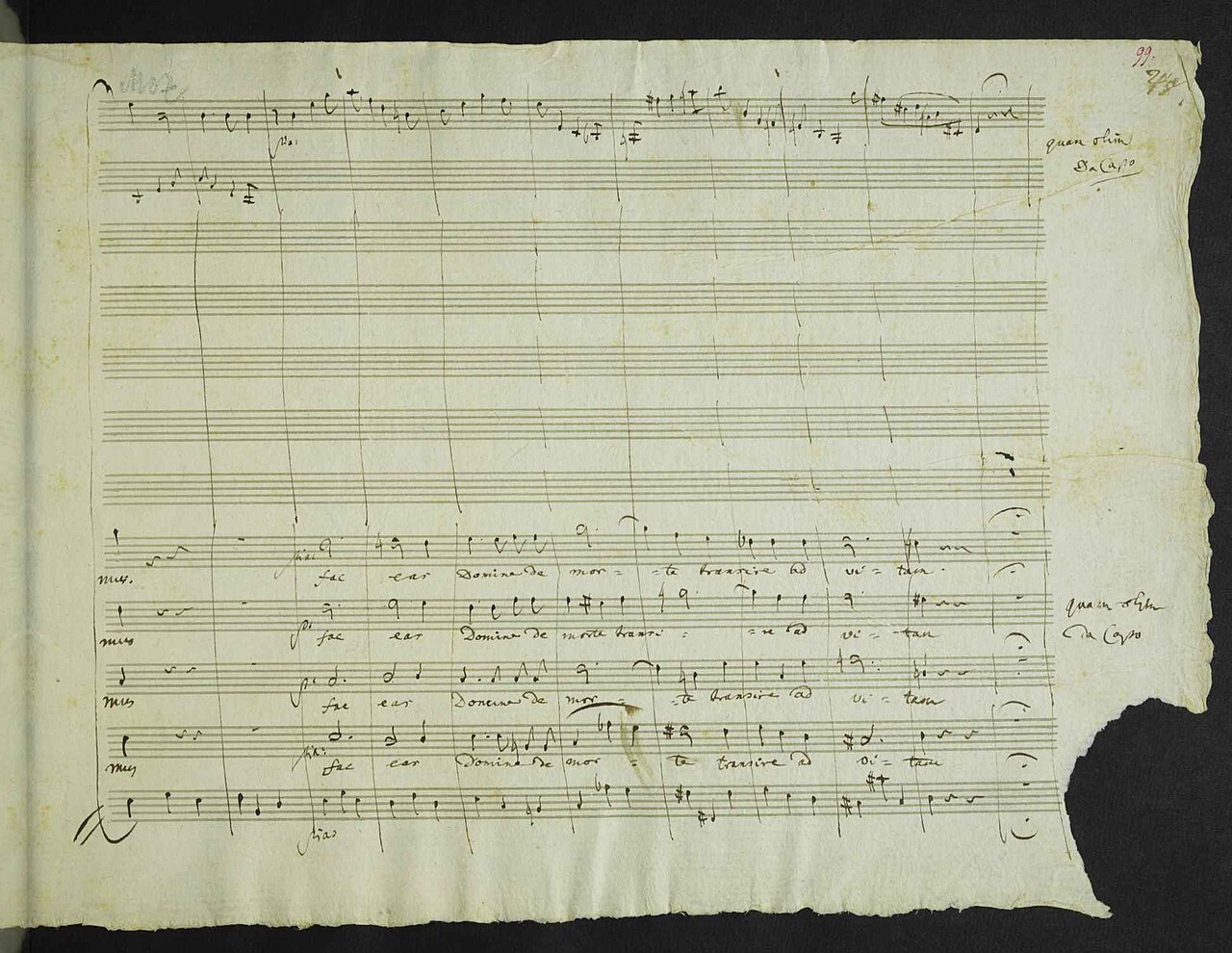
The last thing Mozart wrote into the Requiem score is a three-word instruction rather than music. At the foot of a page of the Hostias he scrawled “Quam olim da Capo” — go back and repeat the fugue — and after that the staves are empty.
That detail is stranger and better than the mysterious-stranger legend that grew up around this piece. A composer who could not finish left behind a document precise enough that other people could finish it for him, and the version the world sings is the one a young assistant assembled out of those instructions within weeks of the funeral. Every performance you have ever heard is a negotiation between two hands.
This guide is about hearing those two hands apart, knowing which pages are which, and choosing a recording that suits what you actually want out of the piece.
- Composer
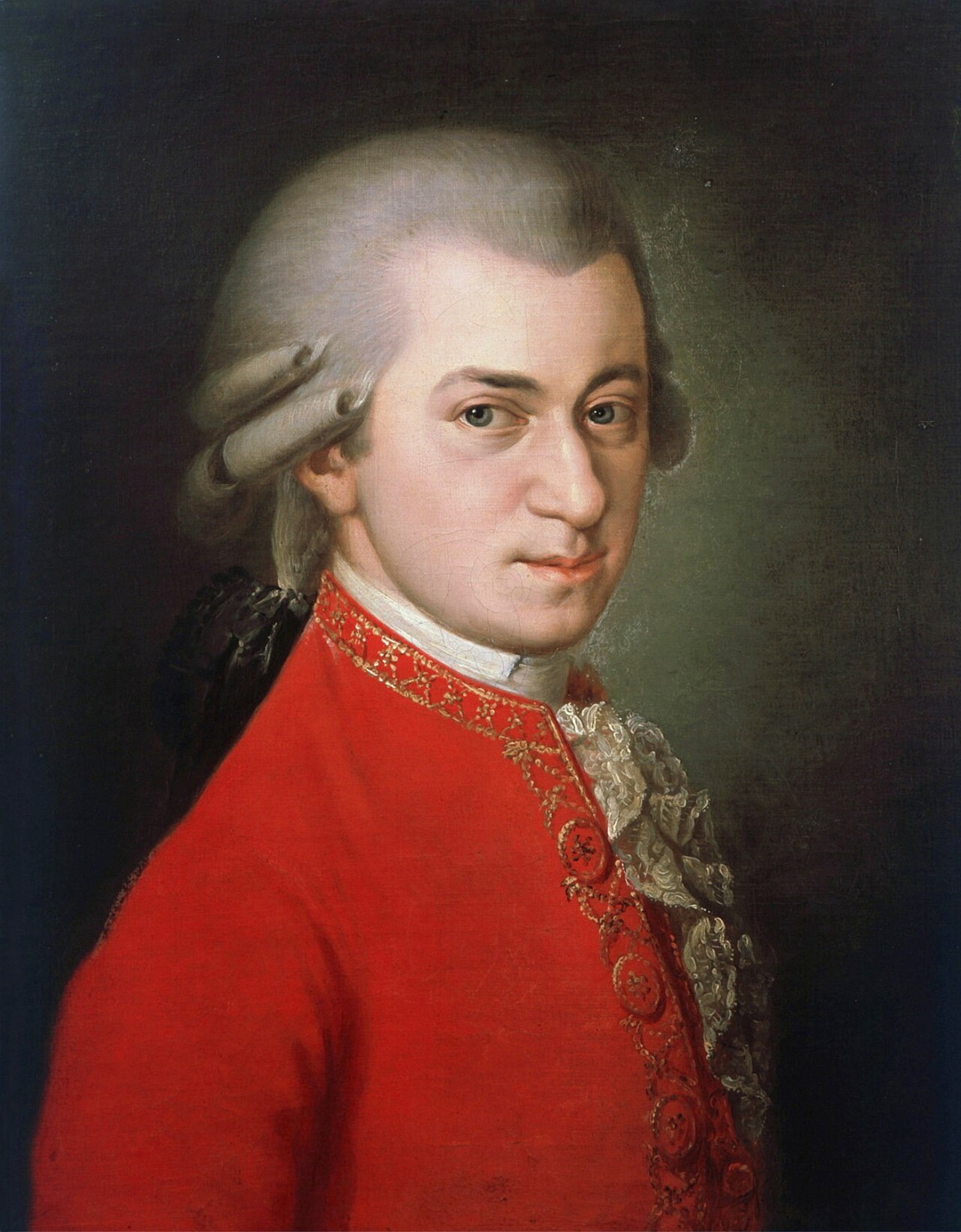
- Wolfgang Amadeus Mozart (1756–1791)
- Work
- Requiem in D minor, K. 626
- Composed
- 1791, left unfinished; standard performing version completed by Franz Xaver Süssmayr
- First complete performance
- 2 January 1793, Vienna, at a benefit concert arranged by Baron Gottfried van Swieten
- Scoring
- Two basset horns, two bassoons, two trumpets, three trombones, timpani, strings and organ continuo, with four vocal soloists and SATB chorus
- Duration
- Around 50 minutes
The commission that was supposed to stay anonymous
Count Franz von Walsegg lost his wife Anna on 14 February 1791; she was twenty years old. He wanted a Requiem Mass for the memorial service on 14 February 1792, the first anniversary of her death, and he sent an intermediary rather than his own name, because Walsegg had a hobby: he bought music from working composers and then presented it in his own house as his own work.
That is vanity, and expensive vanity, and it happens to have produced the single most famous commission in music. The anonymity was a contract term, the kind a vanity buyer insists on. What turned it into an omen was that the composer taking the money was ill, working simultaneously on The Magic Flute and the Clarinet Concerto, and dead before the anniversary service ever happened.
Mozart died on 5 December 1791. He was 35. The Requiem sat on his desk in pieces.
What Mozart actually finished
This is the part most program notes blur, and it is worth getting exactly right, because it changes what you listen for.
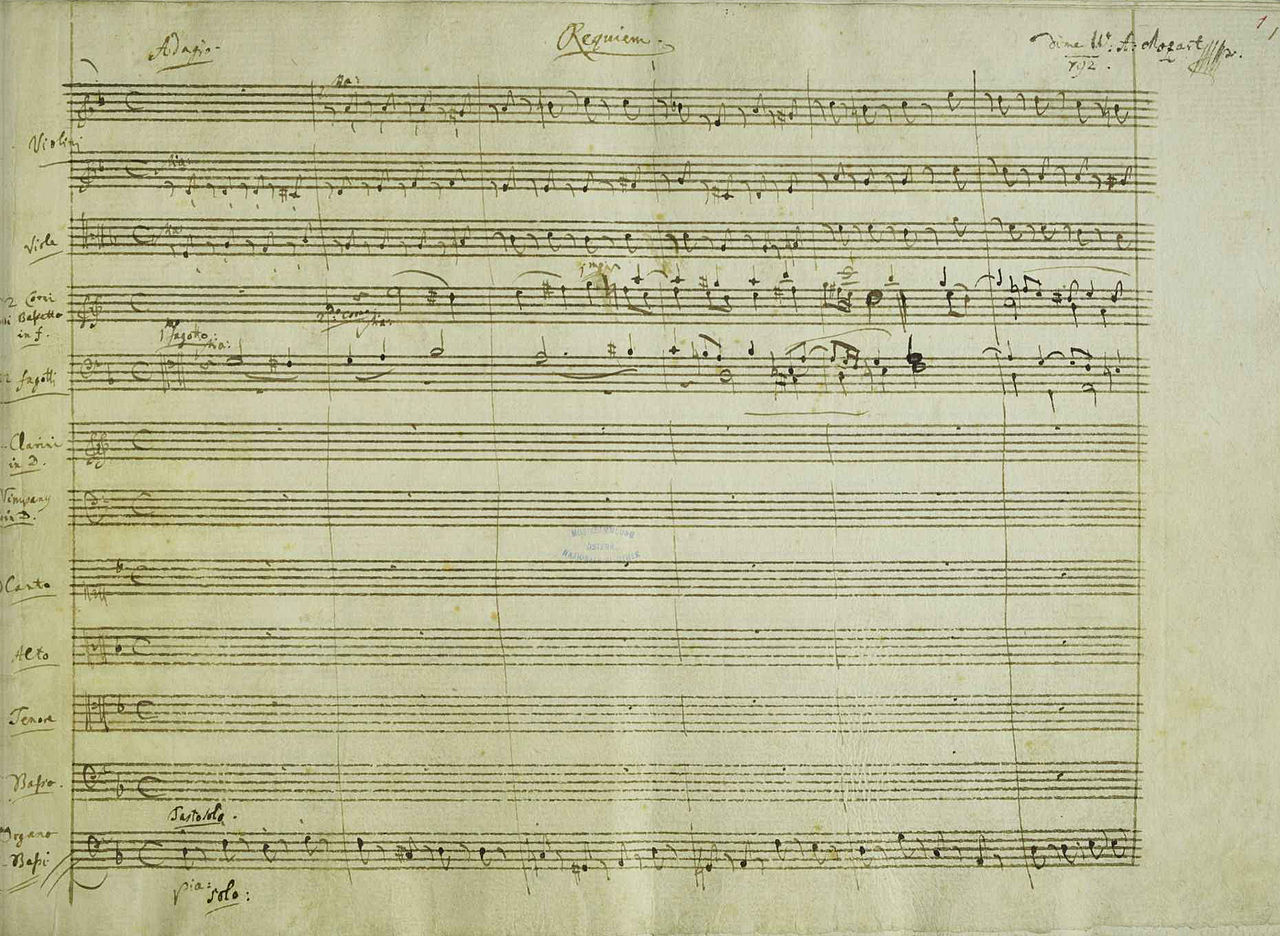
- Introitus (Requiem aeternam): complete. Every vocal line, every instrumental part, fully scored in Mozart’s hand.
- Kyrie, Sequentia, Offertorium: a skeleton. All the vocal parts and the figured bass are there, with some of the most important orchestral lines sketched in — the string figuration in the Dies irae, the trombone solo in the Tuba mirum. The rest of the orchestration was not written down.
- Lacrimosa: the first eight bars, and then nothing.
- Sanctus, Benedictus, Agnus Dei: no autograph survives. Whether Mozart left sketches or verbal instructions for them is disputed, and always has been.
So the standard performance is roughly: one movement entirely by Mozart, a large stretch where Mozart supplies the bones and someone else supplies the muscle, eight famous bars, and then a final third with no Mozart manuscript behind it at all.
What to listen for
The missing top of the orchestra. There are no flutes, no oboes, no horns in this score. The woodwind color comes from two basset horns — low, reedy clarinets with an extended bottom range — doubled by bassoons, with trumpets, three trombones and timpani above the strings. Take away the bright wind register and the whole ensemble sits in a lower, darker band than a Mozart symphony does. That veiled, slightly clotted sound is written into the instrument list; the performers inherit it.
One viola line holding the middle. From inside a string section, this scoring is unusual in a way audiences never notice: the violas are the only inner voice between the violins and the bass, and Mozart makes them work almost continuously. In the Introitus and the Kyrie they carry the harmonic filler that would normally be shared between second violins and horns. When a performance sounds thin or muddy in the middle, that is usually where it is going wrong.
The Kyrie fugue. Two subjects at once — a jagged leaping line for the Kyrie eleison against a scurrying sixteenth-note line for the Christe eleison — hammered through every voice. Listeners often note the resemblance between the first subject and a chorus from Handel’s Messiah; whether Mozart had that chorus in mind is a matter of interpretation, but the family resemblance tells you what idiom he was reaching for. Baroque, deliberately old-fashioned, and relentless.
The Confutatis split. Men in bare octaves over churning strings, then women answering in a hushed high register, twice, and then the ground drops out under both of them in a chromatic sinking sequence. It is short, and it is the most theatrical writing in the score.
The eight bars. The Lacrimosa opens with rocking strings and a vocal line that climbs a rising chromatic scale to a suspended peak. That climb is Mozart. Everything after the eighth bar is someone else building outward from it, which is why the movement can sound like it stops arguing partway through.
Movement by movement
Introitus — A slow processional over a walking bass, basset horns first, the chorus entering in imitation. The soprano solo at Te decet hymnus is the one patch of major-key light before the Kyrie slams the door.
Kyrie — The double fugue described above, ending on a bare unharmonized chord that sounds like a mistake the first time you hear it and like a door slamming the second.
Dies irae — A short burst of panic. Off-beat string figures, shrieking chorus, timpani. Conductors who take it too fast turn it into noise; too slow and it becomes stately, which is worse.
Tuba mirum — A solo tenor trombone announces the Last Judgment before the bass soloist sings a note. Trombonists build careers on this brief solo and dread it accordingly.
Rex tremendae — Dotted rhythms borrowed from French overture style, so that the chorus sounds like it is addressing a monarch. Which it is.
Recordare — The longest movement and the one people skip. Don’t. Four soloists in constantly shifting pairs over basset horns; it is chamber music smuggled into a Mass.
Confutatis — The damned and the saved, alternating, then dissolving.
Lacrimosa — Eight bars of Mozart and then the argument continues without him.
Domine Jesu and Hostias — Two Offertory movements ending in the same fugue, the Quam olim Abrahae music, which is where Mozart’s handwriting finally stops.
Sanctus, Benedictus, Agnus Dei — The disputed third. The Benedictus is a lovely, oddly gentle quartet; the Sanctus fugue is the section critics have complained about ever since for its short-winded subject.
Communio (Lux aeterna) — The Introitus and Kyrie music returns with new words, closing the circle. Whether that recycling was Mozart’s instruction or a practical solution by his assistant is not settled.
The bedside sing-through, and what to do with it
You have heard the story: on his last day, Mozart had the Requiem brought to his bed, friends sang the parts around him — the singer Benedikt Schack among them — and when they reached the Lacrimosa he wept and put the score aside.
The story is not contemporary evidence. It surfaced in an anonymous obituary of Schack published in 1827, thirty-six years after the event it describes, and there is no way to test it against anything written down at the time. It may well be true. But a memory written down that late by someone with a stake in it belongs in a different category of evidence from a dated letter.
Treat it as you would any good anecdote about a famous death: enjoyable, plausible, unverifiable. The Requiem attracts this material, and the poisoning rumor is the same phenomenon — we took that one apart in Did Salieri Really Kill Mozart?.
Constanze’s salvage operation
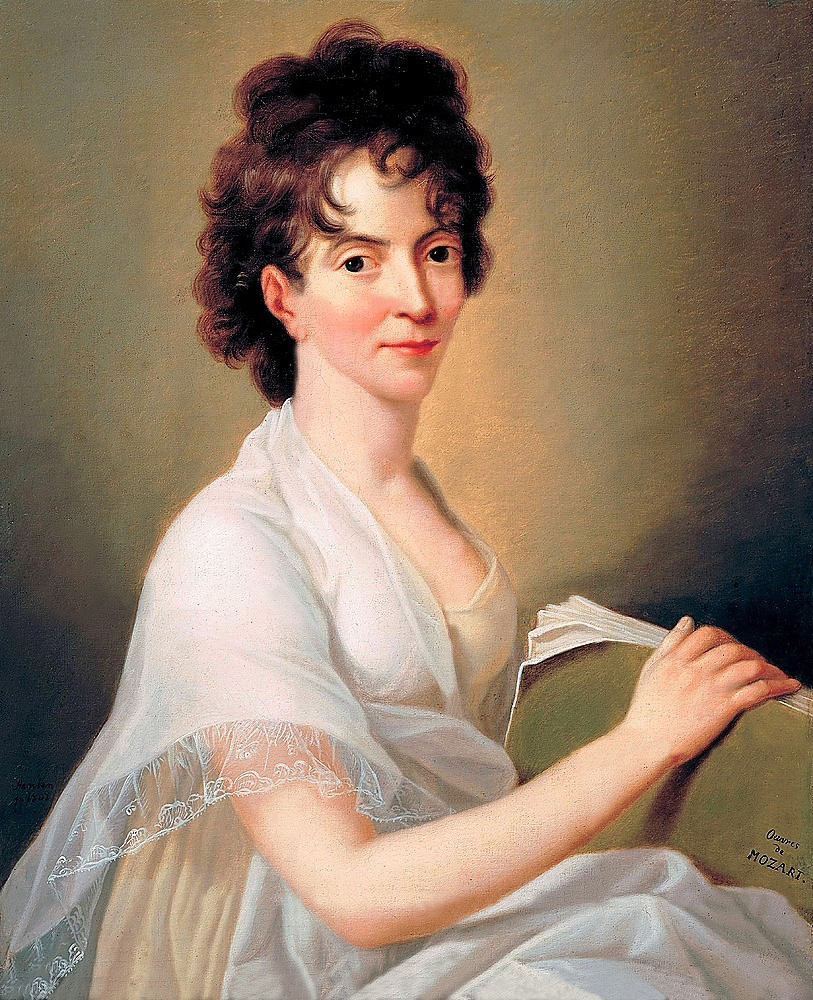
The commission fee had been partly paid and partly spent. Constanze Mozart needed a finished score or she would have to hand the money back, and she went about getting one with more competence than she is usually credited with.
Joseph Eybler took the score first and orchestrated the movements from the Kyrie through the Lacrimosa before withdrawing from the job. Franz Xaver Süssmayr, born in 1766 and therefore in his mid-twenties, then finished the orchestration, completed the Lacrimosa, and supplied the Sanctus, Benedictus and Agnus Dei. His copy is the score Walsegg received and the score the world still performs.
Meanwhile the piece was already being heard. On 10 December 1791, five days after Mozart died, a memorial service at St. Michael’s Church in Vienna included what existed of the Requiem — most likely just the Introitus and Kyrie. The first complete performance came on 2 January 1793 at a benefit concert for Constanze arranged by Baron Gottfried van Swieten. Count Walsegg finally got his memorial on 14 December 1793, in the Cistercian Neukloster abbey church at Wiener Neustadt, and by then everyone in Vienna already knew whose music it was.
Süssmayr, Levin, Dutron: does the completion matter?
Musicians have rewritten the ending ever since, and the modern attempts fall into two camps. Some rebuild what Süssmayr did using better scholarship and better counterpoint while keeping his material. Robert Levin’s version, first performed in August 1991 at the European Music Festival in Stuttgart under Helmuth Rilling, is the best known of these: it tightens the Sanctus fugue and adds an Amen fugue after the Lacrimosa, based on a Mozart sketch. Others go further and re-orchestrate wholesale, like Pierre-Henri Dutron’s 2016 revision, recorded by René Jacobs.
My honest verdict: learn the piece in Süssmayr first, and treat the alternatives as a second listen. The Süssmayr text is the one every chorus knows, the one every other recording uses, and the one whose flaws are part of the work’s reception history. Hearing Levin’s Amen fugue is fascinating once you know what it is replacing. Hearing it first just means you have learned a version nobody around you is singing.
Four recordings, and where to start
John Eliot Gardiner / Monteverdi Choir / English Baroque Soloists (released in 1987) — Start here. Period instruments, a small chorus that can actually articulate the Kyrie fugue at speed, and a bass line you can follow all the way through. The Confutatis is genuinely frightening because the men are singing text rather than sound. If you grew up on big-choir Mozart the Dies irae may sound underweight for a minute, until you notice you can hear the inner parts.
🎧 Also on: Apple Music · Spotify
Karl Böhm / Vienna Philharmonic / Vienna State Opera Chorus (released by Deutsche Grammophon in 1971) — The opposite argument, made about as well as it can be. Slow, dark, enormous, with the Vienna strings giving the Introitus a weight no period band will ever match, and a solo quartet of Edith Mathis, Julia Hamari, Wiesław Ochman and Karl Ridderbusch singing it like opera. The fugues are the cost: at these tempos the Kyrie sounds monumental rather than agitated. Get this one second, for what it does to the slow music.
▶ Listen on YouTube · Apple Music · Spotify
Teodor Currentzis / MusicAeterna / The New Siberian Singers (recorded in 2010 in Novosibirsk, released on Alpha in 2011) — The provocation. Whispered pianissimos that force you to lean in, sudden violent accents, consonants spat rather than sung. Simone Kermes leads the solo quartet and sounds nothing like a standard Mozart soprano. I would not hand this to someone hearing the Requiem for the first time, because the effects are so strong they become the subject. As a third or fourth listen, once you know the shape of the piece, it is the most alive performance on record.
🎧 Also on: Apple Music · Spotify
René Jacobs / RIAS Kammerchor / Freiburger Barockorchester (released on harmonia mundi in 2017) — The one to hear if the completion question interests you, because it uses Dutron’s 2016 revision of Süssmayr rather than Süssmayr plain. Textures are rebalanced, the brass writing is reworked, and passages you thought you knew arrive wearing different clothes. The choral singing is the finest of the four. Hear Gardiner first, then this one, or the differences will register as errors instead of decisions.
▶ Listen on YouTube · Apple Music · Spotify
Where to go next
If the Kyrie fugue is what grabbed you, the place to go is the choral writing that Mozart was studying when he wrote it — our guide to Bach’s Mass in B Minor, BWV 232 covers the mountain range this piece is standing on. If it was the minor-key drama, Mozart’s Symphony No. 40 in G minor is where he does the same thing without a text to lean on.
The score is free to read while you listen: Requiem in D minor, K. 626 on IMSLP. Follow the Introitus with the page in front of you and you can see the basset horn writing doing the work your ear is registering as gloom.
Frequently Asked Questions
How much of Mozart’s Requiem did Mozart actually write?
Who was the mysterious stranger who commissioned the Requiem?
Which recording of Mozart’s Requiem should a beginner start with?
Is there a version of the Requiem without Sussmayr’s additions?
Why does the Requiem sound darker than other Mozart works?
One last thing
Chopin asked for this Requiem at his own funeral. It was sung at the Madeleine in Paris on 30 October 1849, and it nearly did not happen: women were barred from singing in the city’s parish churches, and the performance went ahead only after a special dispensation, with the female singers hidden behind a black velvet curtain.
That is the piece in one image. Music written for a service nobody was supposed to attribute, finished by somebody else, sung from behind a curtain, and still the thing a dying composer asks for. Put on the Introitus and let the basset horns start.