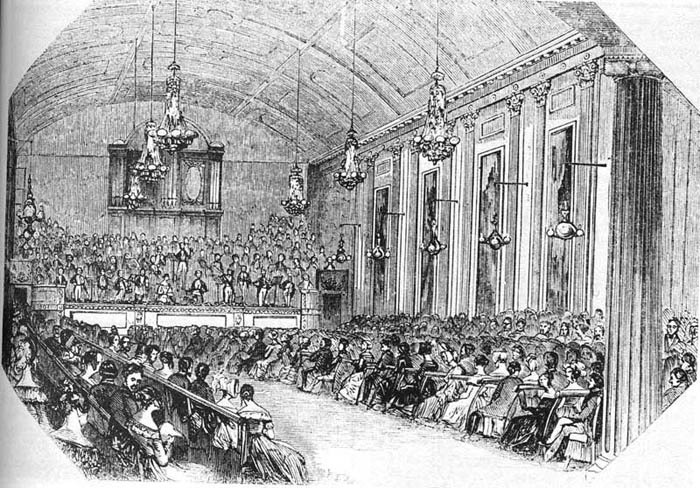
March 23, 1792. The Hanover Square Rooms in London’s West End were packed to capacity — fashionable society, music devotees, and plenty of people who came primarily to be seen. The hall held perhaps four or five hundred, and on that Monday evening every seat was taken. A sixty-year-old Austrian composer with a pockmarked face and an unpretentious manner sat somewhere in the room, watching his orchestra take their places. His name was already famous across Europe, though he had spent most of his career in a provincial Hungarian palace, composing on demand for a single aristocratic patron. This was his second London season, and the city had embraced him with a fervor that surprised even him. The Morning Chronicle would later call him the greatest composer in the world.
What happened that evening — specifically what happened in the second movement — is one of those musical moments that people have been arguing about, laughing about, and getting wrong ever since.
- Composer
- Franz Joseph Haydn (1732–1809)
- Work
- Symphony No. 94 in G major, Hob.I:94 ‘Surprise’
- Key
- G major
- Composed
- 1791
- Movements
- 4 movements
I. Adagio cantabile – Vivace assai (G major)
II. Andante (C major)
III. Menuetto. Allegro molto (G major)
IV. Finale. Allegro di molto (G major) - Instrumentation
- Flute, 2 oboes, 2 bassoons, 2 horns, 2 trumpets, timpani, strings
- Premiere
- 23 March 1792, Hanover Square Rooms, London
Haydn in London: The Late Arrival Who Owned the Room
The architecture of Symphony No. 94 makes sense only when viewed through the lens of Haydn’s London years. The city transformed the composer. In return, he conquered the city.
For nearly three decades, Franz Joseph Haydn served the Esterházy family, a Hungarian aristocratic dynasty of staggering wealth. His primary domain was Esterháza. This isolated palace in the marshes was magnificent, yet suffocatingly remote. He composed prodigiously there. He managed an orchestra and an opera company, enjoying comfortable treatment, but remained, by his own admission, “cut off from the world.” Pirated copies of his scores crossed borders he had never seen. When the death of Prince Nikolaus finally released him from service in 1790, Haydn was Europe’s most famous living composer. He had barely set foot outside Habsburg lands.
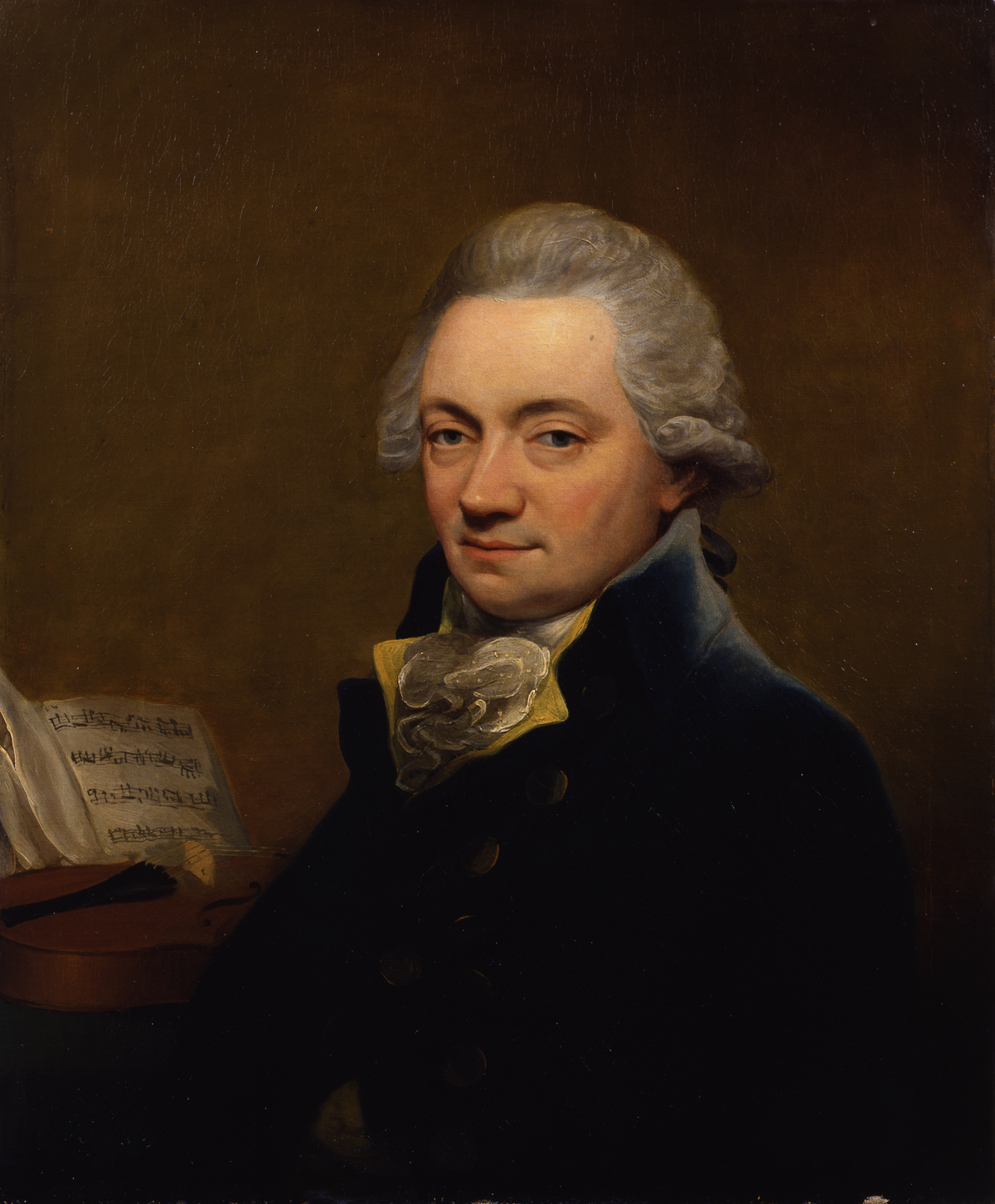
Enter Johann Peter Salomon. A German-born impresario operating out of London, Salomon reportedly arrived at Haydn’s Vienna door in December 1790 with a blunt directive: “I am Salomon of London. I have come to fetch you.” The money was excellent. The adventure was impossible to refuse. Crossing the Channel in January 1791, the fifty-eight-year-old composer finally met a metropolis scaled to his ambition.
Late-eighteenth-century London operated as a commercial leviathan. Concert life here was ruthlessly competitive. Audiences were not captive aristocratic retainers listening out of duty; they were ticket-buying citizens demanding entertainment. Haydn had never faced a public market. The friction sharpened his pen.
That initial residency (1791–92) yielded six symphonies, cataloged as Nos. 93 through 98. A subsequent tour (1794–95) generated Nos. 99 through 104. Grouped together as the London Symphonies (Hob.I:93–104), this dozen reveals a musician accelerating into his sixties, writing with a muscularity that eclipsed his earlier work.
Premiered in March 1792 to close out the first season, Symphony No. 94 emerged from a year of intense sociological observation. Haydn had studied the English public. He mapped their tastes, gauged their attention spans, and anticipated their fatigue. The ‘Surprise’ did not materialize by chance. It was a calculated theatrical strike by a master who knew precisely how to manipulate a crowded room.
Movement I: Adagio cantabile – Vivace assai
Delaying the main action, the symphony opens with a slow introduction. Marked Adagio cantabile in G major, the music hovers in a quiet, suspended stillness. Haydn understood the psychological utility of these preludes. They exist not merely to establish key and tempo, but to recalibrate the listener’s ear. Over the course of two minutes, this opening gathers tension so effectively that the ensuing Vivace assai registers less as a shift in speed than as a physical release.
That fast section arrives with a jolt of compressed energy. Tight and rhythmically precise, the principal subject relies on quick stepwise motion punctuated by sudden leaps. It is an inherently modular theme, designed to be dismantled and reassembled. Haydn navigates the exposition with unhurried efficiency. He lays out his material, secures the dominant, and pivots to the development with the cold confidence of a composer who has already written ninety-odd symphonies and knows exactly how to spring a structural trap.
Here, the composer’s reputation for motivic obsession takes center stage. Rather than lazily cycling the exposition through new keys, Haydn isolates fragments—sometimes nothing more than a two-note cell—and subjects them to rigorous, almost neurotic transformation. The harmony wanders far afield. By the time the music finally reaches the recapitulation, the first theme’s return feels less like a formal requirement than a hard-won arrival.
Conventional Classical sonata form dictates a relaxation at the second theme, a moment of lyrical contrast before the final drive toward the double bar. Haydn refuses to yield. His secondary material possesses a certain lyricism, yet the underlying rhythmic motor never stops running. The friction between these two subjects maintains an active, unyielding forward pressure from the first measure to the last.
To close the movement, Haydn supplies a brisk, purposeful coda. There is no extended peroration, no lingering theatricality. The argument is settled, the cadence strikes, and the music simply vanishes.
Movement II: Andante — The One Everyone Came For
Most listeners know this symphony for exactly one reason. Yet the second movement offers far more than its namesake gimmick.
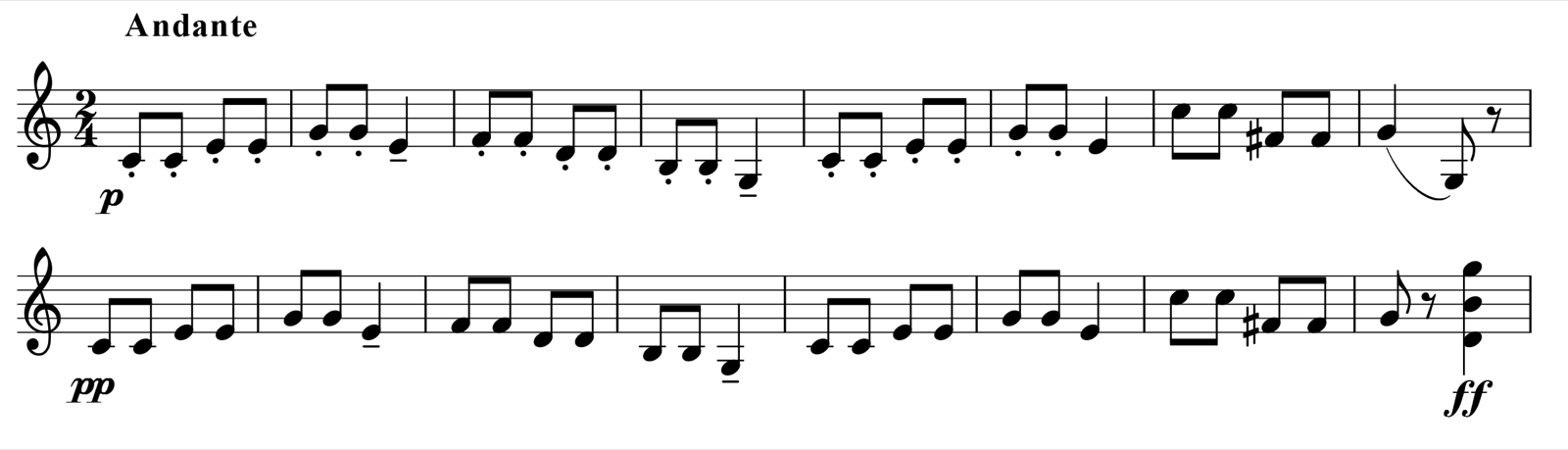
Cast in C major and marked Andante, the structure unfolds as a theme and variations. Before any disruption occurs, the primary melody emerges with nursery-rhyme simplicity. Strings alone play it pianissimo. It is aggressively unassuming. Eight bars sound, followed by an eight-bar repeat, forming a perfectly symmetrical musical object. Haydn presents the plainest possible material by design, laying a pristine foundation solely so he can fracture it.
During the repetition, the trap is set. The strings trace the exact same melody at the exact same dynamic. Then, at the cadence—the most stable, predictable juncture of the phrase—the full orchestra delivers a fortissimo C-major chord, heavily reinforced by timpani. No crescendo warns of its approach. The ensemble simply vaults from a whisper to maximum volume in a fraction of a second.
Silence follows. The theme then resumes its polite amble as if nothing had happened.
To understand the humor, one must look at the context. The joke relies on structural subversion, striking exactly where the ear demands quiet closure. Even in a modern concert hall, where audiences brace for the impact, the chord lands with a physical jolt. For a London audience encountering it in 1792, the rupture would have been entirely disorienting.
While music history clings to the myth that Haydn wanted to wake sleeping concertgoers, the reality involves shrewd professional rivalry. Georg August Griesinger’s 1799 biography quotes the composer claiming a simpler motive: he wanted to shock the public with something novel. Ignaz Pleyel was running a competing subscription series in London that same season, forcing both men to vie for the public’s notoriously fickle attention. The sudden dynamic shift was a calculated theatrical gambit. Haydn needed a talking point—a sonic event that attendees would describe to their friends the next morning. He got one.
Fixating on the punchline, however, obscures the real architectural work of the movement. Once Haydn shatters his fragile theme, he subjects it to four variations of escalating sophistication.
Rather than abandoning his melody, Haydn trades it between the oboe and flute over an active, ornamental string line. A sharp pivot to C minor defines the second variation. Here, the previously smooth tune turns jagged with syncopation, revealing a darker, restless character. This sudden descent into agitation arrives unannounced.
When the key reverts to C major for the third iteration, the tempo broadens, and the orchestration dresses the theme in ceremonial grandeur. What began as a naked, thin line is now dense and textured. Rushing string figures propel the fourth variation. They churn beneath a treble melody, generating a breathless momentum entirely absent from the opening bars.
A brief coda recalls the famous chord one last time. Now, however, it sounds quieter and distinctly wry. The joke has been told, the laughter has subsided, and the composer is already looking ahead.
Beyond the theatricality of a single loud noise lies a work of rigorous musical invention. The harmonic searching of the C-minor episode carries real emotional weight, and the overall architecture builds from manufactured innocence to genuine complexity. The loud chord guarantees the audience’s attention. The ensuing variations reward it.
Movement III: Menuetto. Allegro molto
Arriving at a brisk Allegro molto, the third movement wastes no time. By the latter half of his career, Haydn’s minuets had largely shed their powdered-wig gentility, accelerating into something altogether more robust. Here, the music trades the ballroom for the village green. Sturdy rhythmic figures drive the main theme, giving the section a rustic, stomping directness.
For the trio, the composer thins the texture and lowers the volume. Oboes and bassoons step forward, carving out an acoustic illusion of open air and distance. When the initial dance inevitably returns, its heavy-footed vigor lands differently—tempered, however briefly, by the memory of that rural expanse.
Placement dictates function. Following the sophisticated gamesmanship of the preceding Andante, the minuet acts as a necessary palate cleanser. It grounds the ear. Rather than demanding intense intellectual engagement, the music offers sheer kinetic pleasure—a rhythmic reset before the finale demands our full attention.
Such pragmatism reveals a composer with flawless theatrical instincts. A lesser musician might have packed every section with dense counterpoint or harmonic trickery. Haydn understood the arc of an evening’s entertainment. He delivers a movement that knows exactly what it is, executing its mechanics with absolute conviction.
Movement IV: Finale. Allegro di molto
Cast in G major and marked Allegro di molto, the finale adopts a rondo-sonata form—a hybrid architecture Haydn favored in his late symphonies. The main theme is headlong, bordering on impetuous. Its rhythmic profile generates a relentless forward thrust. Once set in motion, the music threatens to outpace itself.
At its most basic, a rondo relies on a recurring refrain interspersed with contrasting episodes. Haydn refuses to leave the formula alone. He subjects these episodes to the rigorous logic of a development section, fracturing and recombining the contrasting material rather than merely stating it. What emerges is a structural sleight of hand: a movement driven by the propulsive engine of a rondo, yet anchored by the intellectual weight of sonata form.
Strategic wit defines much of the composer’s late period, operating here as a central organizing principle. Haydn builds momentum toward an apparent conclusion, only to execute a sudden diversion. A harmonic detour. A rhythmic displacement. A sudden drop in dynamics that instantly deflates the drive. Then the engine restarts. A lesser musician might use these tactics to manipulate the gallery; Haydn uses them to converse, trusting his listeners enough to tease them.
Because he spends the preceding minutes maneuvering and redirecting rather than simply throwing his weight around, Haydn earns the right to an emphatic close. The ending strikes with proportionate force. He has tested the limits of the material without exhausting it. Those final cadences satisfy not because they are loud, but because they are inevitable.
Why Symphony No. 94 Matters More Than Its Nickname Suggests
For over two centuries, the “Surprise” moniker has served as both this symphony’s greatest asset and its heaviest anchor. Every piano student encounters the anecdote about the loud chord designed to jolt a slumbering audience. Most never look past the punchline.
To stop at the joke is to miss a document of a specific cultural collision. Europe’s most celebrated living composer had met the world’s most sophisticated commercial public. Haydn did not pander to London. He sized it up. The resulting symphonies—No. 94 in particular—reveal a veteran artist writing for listeners who paid attention, possessed distinct tastes, and demanded provocation.
Consider the sheer structural guile at work. The opening movement does not merely transition from a slow introduction to a brisk Vivace assai; it builds a psychological frame, lending the ensuing allegro an air of sudden consequence. Then comes the famous Andante. Stripped of its shock value, the theme-and-variations format operates as a vehicle for severe emotional pivots, moving from naked simplicity into minor-key agitation, and finally arriving at a variation of heavy, ceremonial tread. A rustic minuet and a kinetic rondo finale close the arc. The symphony traverses vast expressive territory, yet the architecture holds fast.
Instrumentation offered another avenue for reinvention. By 1791, Haydn commanded a London ensemble larger and more technically secure than his isolated band at Esterháza. His scoring responds to this newfound muscle with startling transparency. The woodwinds step out of the shadows. Rather than merely doubling the strings, the flute, oboes, and bassoons assert distinct personalities. During the trio section of the minuet, they retreat into a chamber-music intimacy, carving out a quiet, private space within the orchestral mass.
Salomon’s subscription series guaranteed repeat performances, a fact that fundamentally alters how we should read the “Surprise” chord. It was never meant to be a disposable gag. On a second hearing, an audience anticipates the jolt. The silence preceding it becomes charged. Haydn understood this theatrical calculus perfectly, designing the Andante’s variations so that the initial shock dissolves into a deeper structural game, rewarding the listener long after the punchline has landed.
We too often reduce Haydn to a mere architect. He becomes the man who drafted the blueprints that Mozart and Beethoven later built upon. The London Symphonies dismantle that condescension. When Beethoven premiered his first symphony in 1800, he was acutely aware of the shadow stretching across his desk. Symphony No. 94 is no stepping stone. It is a terminal point of classical style—a work of absolute confidence, written by a composer who knew exactly what his audience wanted, and gave them exactly what they needed instead.
The Sleeping Audience: Myth, Half-Truth, and the Real Story
Every account of this symphony eventually confronts the sleeping-audience anecdote. The tale is too entrenched to ignore, yet too neat to swallow whole.
As the legend goes, Haydn deployed his sudden fortissimo chord for a single, punitive purpose: to jolt dozing concertgoers out of their post-dinner stupor. The narrative possesses the frictionless quality of a perfect anecdote. It is vivid, slightly comic, and entirely fabricated.
Georg August Griesinger’s 1809 biography offers a more pragmatic motive. Haydn simply wanted to surprise the public with something new. The composer was locked in a fierce, well-documented rivalry with Ignaz Pleyel, and he needed a theatrical gesture to dominate the London season. He engineered a musical talking point designed to hijack the city’s gossip. The gambit worked.
Stripped of its mythology, the anecdote reveals itself as a piece of promotional wit that eventually calcified into historical fact. It bears all the hallmarks of a tall tale, compressing a complex commercial reality into a flattering vignette of a clever maestro outsmarting a lazy public. Musical history runs on commerce rather than charm.
Yet the fable survives because it captures a fundamental truth about the music’s original impact. London audiences in 1792 were highly sophisticated listeners. They simply had never encountered a violent dynamic rupture at the exact moment a phrase was supposed to sleep. Haydn weaponized the era’s formal expectations, turning a polite cadence into an ambush. The score itself supplies all the necessary violence; no snoring dowagers are required to justify the uproar.
Comparing No. 94 to Its Siblings: The London Symphonies in Context
Among the twelve London Symphonies, No. 94 occupies a curious chronological slot. It arrived early in the sequence, part of the initial batch (Nos. 93–98) composed for Haydn’s first English sojourn before the final six (Nos. 99–104) followed on his return. Yet chronology here is merely trivia. Haydn was not building a prescribed emotional arc, the way Beethoven soon would. He was writing discrete entertainments. Each operates as a sovereign state.
Pairing the “Surprise” with Symphony No. 100, the “Military,” has long been a reflex for programmers. Both carry catchy nicknames; both weaponize percussion. But the mechanisms differ entirely. When the “Military” deploys its triangle, cymbals, and bass drum in the second movement, the effect is explicitly programmatic—a direct evocation of Turkish Janissary bands. The “Surprise” relies on no such external scaffolding. Its famous jolt is a purely structural joke, an internal disruption of expectation rather than a costume change. One offers a vivid theatrical tableau. The other demands we listen to the architecture.
Look elsewhere in the cycle, and Haydn’s varied strategies come into sharper focus. The final entry, No. 104 (“London”), pushes formal ambition to its limit, building a massive, intricate edifice. No. 103 (“Drumroll”) opts for pure theater, opening with an unaccompanied timpani solo that rivals No. 94 for sheer audacity. Even No. 96—saddled with the “Miracle” moniker, though the famous falling chandelier actually crashed at the premiere of No. 102—matches the “Surprise” in its rigorous craftsmanship. Haydn was testing different methods of holding a restless public’s attention.
What sets No. 94 apart is its ruthless efficiency in balancing populism with high craft. Anyone can understand a sudden loud chord. It requires no musical training to get the joke. Yet the surrounding variations—and the symphony as a whole—refuse to coast on that single gag. Haydn weaves the disruption into a tightly argued musical fabric that repays intense scrutiny. This duality explains why the work remains the default gateway to classical form. The nickname sells the ticket. The counterpoint secures the legacy.
Placed side by side, the contrast between the “Surprise” and the “Military” reveals two distinct modes of eighteenth-century public art. The latter looks outward. It capitalizes on the anxieties of 1794 London, tapping directly into the martial zeitgeist of the French Revolutionary Wars. No. 94 looks inward. Its tensions are entirely self-contained, relying on the manipulation of diatonic harmony and phrasing rather than the mimicry of a battlefield. They are twin peaks of the same era, built from entirely different stone.
Recommended Recordings
From a vast and uneven discography, four interpretations emerge as essential.
Frans Brüggen / Orchestra of the 18th Century Period instruments provide the strictest benchmark for No. 94, and Brüggen’s reading remains the standard. Gut strings, natural horns, and classical-era oboes yield a transparency that modern symphonic forces simply cannot replicate. The famous chord itself takes on a different sonic profile here. It is less a sustained roar than a percussive snap. Brüggen paces the work with absolute security. In the Andante, his variations possess an improvisatory looseness, leaning into the era’s performance practices without sounding academic. This is the closest the modern ear can get to the raw, unvarnished shock of that 1792 Hanover Square premiere.
Nikolaus Harnoncourt / Concentus Musicus Wien To hear Haydn as pure theater, one must turn to Harnoncourt. He treated the symphonies not merely as formal compositions but as physical events. Conductors of a more polite disposition tend to smooth over the composer’s rougher edges; Harnoncourt sharpens them. He takes the Andante at a slower, more deliberate tread than Brüggen. The variations gain a sudden, heavy gravity. Consequently, the joke arrives with a grim inevitability. Backed by the exacting precision of the Concentus Musicus Wien, this is a willful, highly idiosyncratic reading that forces us to confront the inherent strangeness of the music.
Leonard Bernstein / New York Philharmonic There is still a compelling case to be made for the modern symphony orchestra, provided the conductor understands the idiom. Bernstein’s approach to the London Symphonies radiates physical generosity. He believed music was an act of direct communication, demanding total presence from the podium. Here, the ‘Surprise’ chord lands with massive, unapologetic weight. The timpani strike hard; the brass flares brightly. Yet Bernstein never treats the Andante as a mere setup for a punchline. He mines the movement for genuine emotional substance, shaping the finale with a muscular, driving wit that reminds us how large Haydn’s symphonic canvas truly was.
Antal Doráti / Philharmonia Hungarica Captured over the course of the 1970s, Doráti’s traversal of all 107 Haydn symphonies remains a vital reference text. His No. 94 may lack the fierce idiosyncrasy of Harnoncourt or the sheer scale of Bernstein. Instead, it offers something equally valuable: honesty. Doráti lets the score speak. He refuses to impose a heavy interpretive hand, delivering a clean, accurate, and deeply illuminating performance. For those seeking to understand the symphony not as an isolated spectacle but as a single, logical step in Haydn’s lifelong architectural project, this recording is indispensable.
Follow the Score
To see the mechanics of Haydn’s wit in real time, follow the notation as the performance unfolds.
Those inclined to dissect the orchestration at their own pace will find the complete manuscript archived online.
Frequently Asked Questions
Why is Haydn Symphony No. 94 called the ‘Surprise’ symphony?
The moniker stems from a single, jarring moment in the second movement. A sudden fortissimo chord—struck by the full orchestra and timpani—detonates at the end of a hushed, nursery-rhyme theme. Even when anticipated, the dynamic jolt registers. Audiences seized on the nickname immediately after the 1792 premiere, though the composer himself preferred to let the music speak without a title. German-speaking listeners adopted a more literal label: Mit dem Paukenschlag, or “with the kettledrum stroke.”
What happens in the second movement of Haydn’s Surprise symphony?
Deceptive simplicity defines the opening of the Andante (C major). Strings alone trace a soft, two-phrase melody. It repeats. Then, at the precise moment the ear settles into complacency, the entire orchestra delivers a massive fortissimo strike. Order immediately resumes as if nothing happened. From there, Haydn spins four distinct variations: one highly ornamented, a second plunging into minor-key agitation, a stately third, and a final sprint driven by rapid string figures. A quiet coda eventually arrives, offering a sly, parting glance at the joke that made the movement famous.
When did Haydn compose Symphony No. 94 and what was the occasion?
Economics, rather than pure inspiration, drove the commission. In 1791, the impresario Johann Peter Salomon brought the composer to England for a lucrative series of subscription concerts at the Hanover Square Rooms. The symphony premiered there on 23 March 1792, closing out the first season. At sixty, Haydn found himself navigating a radically new reality. He was no longer a cloistered servant to the Esterházy court; he was a free agent, writing directly for a ticket-buying public eager to be entertained.
How many movements does Haydn Symphony 94 have and what are they?
Spanning roughly half an hour, the architecture follows a standard four-movement classical design. An Adagio cantabile introduction gives way to a kinetic Vivace assai (G major) to launch the work. Next comes the celebrated Andante (C major) and its variations. The third movement, a Menuetto. Allegro molto (G major), pushes the traditional court dance into a decidedly brisk, rustic gear. Finally, a rondo-sonata Finale. Allegro di molto (G major) closes the symphony with breathless, virtuosic momentum.
Did Haydn really write the loud chord to wake up sleeping audience members?
Biographers love the image of a loud chord jolting overfed aristocrats awake, but the truth is far more calculating. Haydn faced steep competition in London from his former pupil, Ignaz Pleyel, who was running a rival concert series across town. To win the season, Haydn needed a talking point. The sudden dynamic explosion was a brilliant piece of marketing designed to ensure his audience left the hall buzzing. The sleeping-dowager myth makes for charming folklore, yet the reality reveals a shrewd professional outmaneuvering his competition.
How does Haydn Symphony 94 compare to his other London symphonies?
Among the twelve London Symphonies (Nos. 93–104), this score occupies a unique pedagogical space. It serves as the default entry point for novices, largely due to its easily digestible central joke. Yet it concedes nothing in structural rigor. Where No. 103 (‘Drumroll’) experiments with form and No. 104 (‘London’) builds massive architectural weight, No. 94 balances immediate surface appeal with deep motivic sophistication. The gimmick gets listeners through the door; the underlying craftsmanship keeps them in the room.
What orchestra and conductor recordings of the Surprise symphony are recommended?
Navigating the discography requires choosing between distinct interpretive philosophies. Frans Brüggen and the Orchestra of the 18th Century provide an essential period-instrument reading, exposing the gut-string grit and transparent textures of the 1790s. Nikolaus Harnoncourt, conducting Concentus Musicus Wien, treats the score like theater, leaning hard into its sudden contrasts. For modern-instrument warmth, Leonard Bernstein’s New York Philharmonic account remains physically imposing and emotionally direct. Finally, Antal Doráti’s cycle with the Philharmonia Hungarica offers the definitive baseline—a clear, unmannered view of the work within the context of Haydn’s total output.
How does Haydn Symphony No. 94 differ from Symphony No. 100 ‘Military’?
Percussion drives the reputation of both works, yet they employ it to entirely different ends. In Symphony No. 100 (composed 1793–94), Haydn imports the triangle, cymbals, and bass drum of Turkish Janissary bands to evoke the encroaching dread of the French Revolutionary Wars. It is literal, programmatic scene-painting. The jolt in No. 94, conversely, refers to nothing outside the concert hall. It is an inside joke about musical form, subverting the listener’s expectation of phrasing and dynamics. The ‘Military’ captures a specific historical anxiety; the ‘Surprise’ plays a permanent game of structural cat-and-mouse.