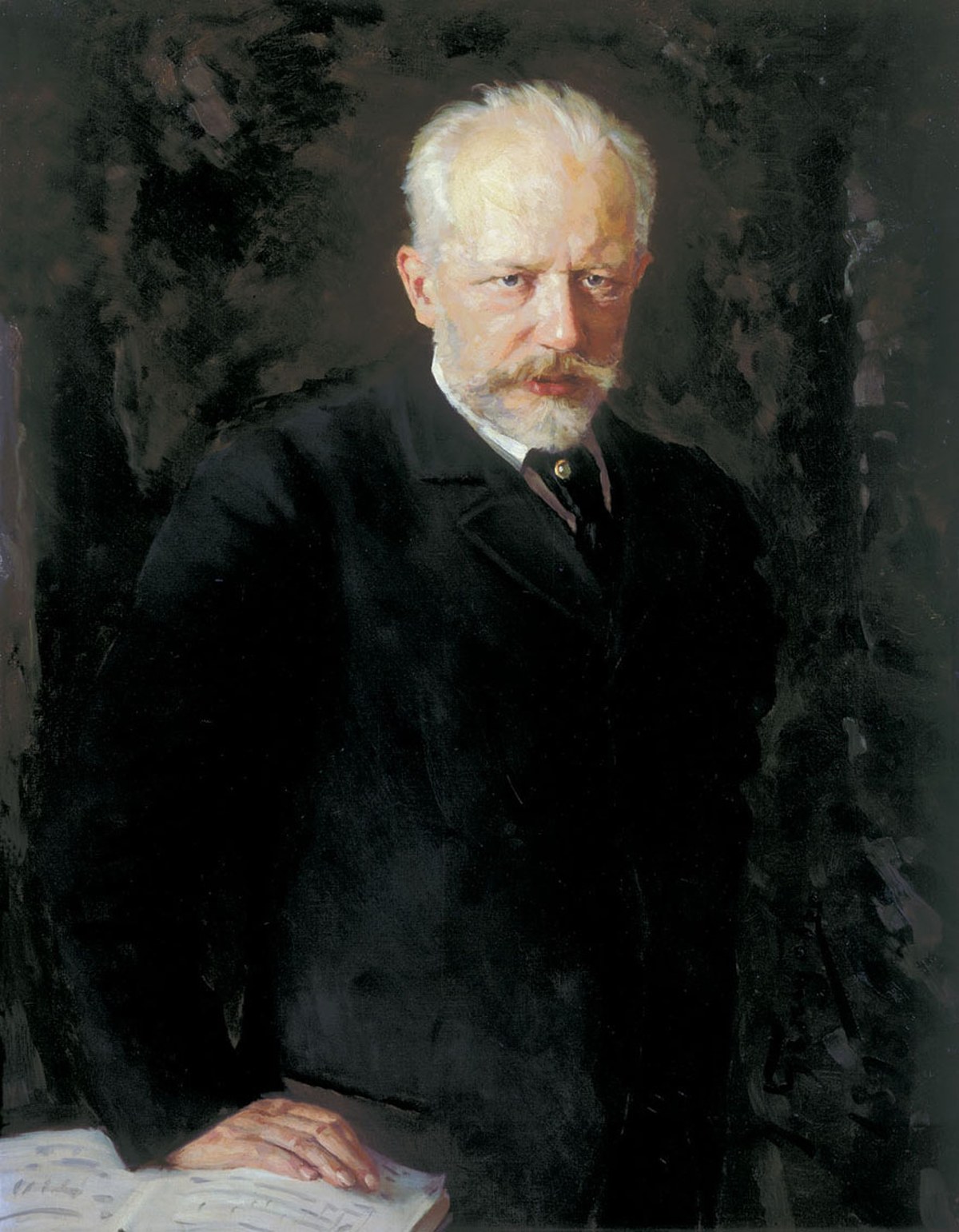
Because Tchaikovsky designed it that way from the very beginning. In February 1893, months before a note of it was public, he told his nephew Vladimir “Bob” Davydov what the new symphony would do: “the finale is not to be a loud allegro but the slowest adagio.” The Pathétique ends in silence because its composer deliberately reversed the most basic promise a nineteenth-century symphony made — that it would end in triumph — and put a dying slow movement where the victory lap belongs.
That one fact — the letter, written nine months before his death — is the key to this whole question, because it rules out the explanation most people reach for first. We’ll get to that. But start with what the ending actually does.
The rule the Pathétique breaks
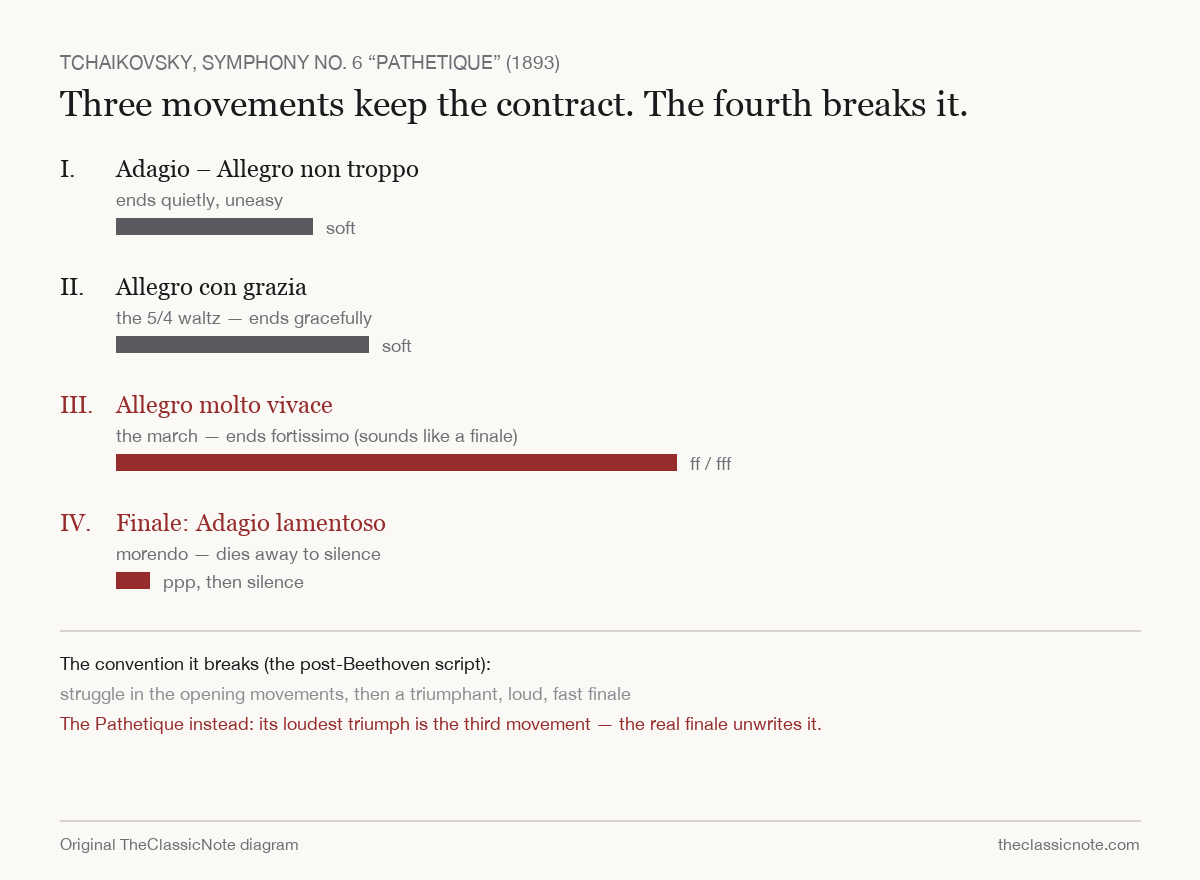
By 1893, the symphony had a script, and it was Beethoven who wrote it: through struggle to victory. The Fifth Symphony fights its way from C minor darkness to a C major blaze; the Ninth ends in a choral explosion of joy. For seventy years afterward, whatever storms a symphony’s middle movements raised, the finale resolved them — faster, louder, usually in the major key, sending the audience out convinced the battle had been won. The script was strong enough that Tchaikovsky himself had followed it twice in a row: his Fourth and Fifth symphonies both close with blazing, affirmative finales — the Fifth even converts its brooding motto theme into a major-key victory march. An audience walking into the Hall of Nobility in Saint Petersburg on 28 October 1893 had every reason to expect the same arc.
The Pathétique honors the script for three movements — then tears it up at the exact moment it matters most. The third movement is a huge, brilliant march that accelerates to a roaring close; it sounds so much like a finale that audiences have been applauding after it for a hundred and thirty years. We’ve written a whole piece about that applause trap, and our full guide to the Sixth walks the whole symphony movement by movement — this article stays on the single question of the ending, and what it sets up. After the march’s false triumph, the real finale opens with a cry: Adagio lamentoso, a lamenting adagio, back in B minor. The symphony spends its last ten minutes not building but draining — winding down through descending string lines until the cellos and basses are pulsing alone, marked morendo, “dying away,” and the music doesn’t so much end as stop being audible.
There is even a hidden trick in how the finale’s famous opening theme is built: neither the first violins nor the seconds actually play the melody you hear. Each section plays an angular, incomplete line, and the tune only exists as the composite of the two interlocking parts. The most openly emotional theme Tchaikovsky ever wrote is, on the page, an illusion — grief engineered with a watchmaker’s precision. Keep that in mind the next time someone tells you this music is uncontrolled confession.
The misconception: a suicide note in B minor
The explanation you will hear most often is that the quiet ending is autobiographical — that Tchaikovsky, who died nine days after the premiere, knew he was finished and wrote his own requiem. It is an irresistible story. The trouble is the calendar.
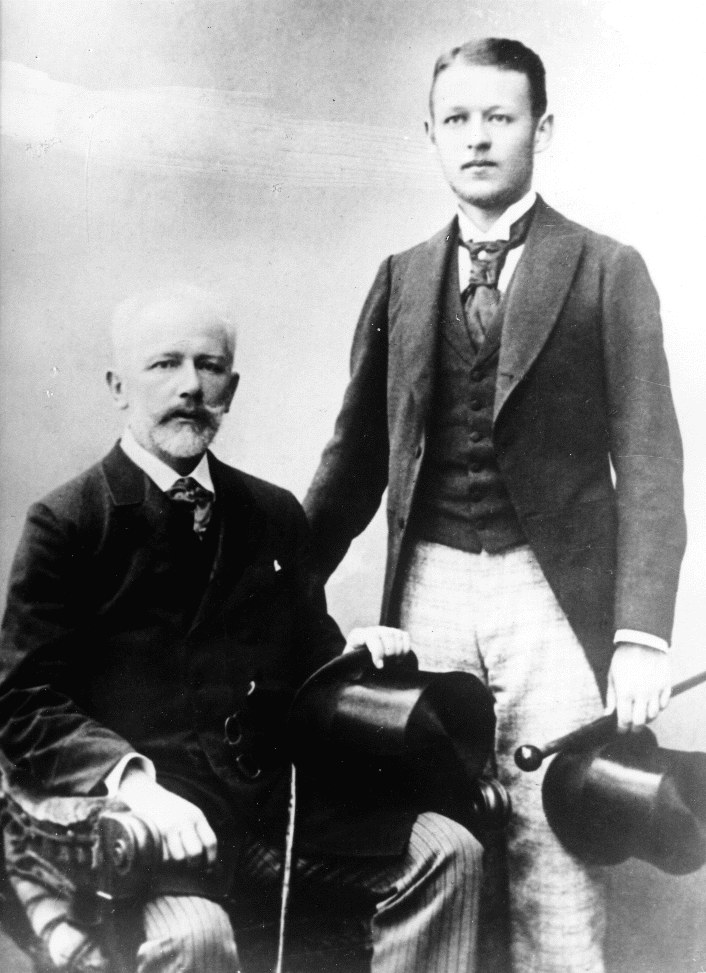
The symphony was composed between February and August 1893. The letter to Bob Davydov announcing the slow finale — and teasing that the work had “a program, but a program that will be a riddle to everyone” — dates from February, when Tchaikovsky was healthy, productive, and by his own account delighted with the piece. He conducted the premiere himself on 28 October. He died on 6 November, with the mainstream account pointing to cholera from unboiled water; the darker theories exist, and we’ve examined them separately, but none of them changes the composition dates. A man who plans a “slowest adagio” ending in winter, finishes it in summer, and premieres it proudly in autumn was writing a work of art about mortality — not a note left on the desk. The Pathétique is about dying the way King Lear is about madness: as a subject mastered, not a symptom displayed.
What the calendar does allow is this: the premiere audience heard the ending without the death attached, and reacted with polite bewilderment — the reception was modest, puzzled applause. Three weeks later, on 18 November, Eduard Nápravník conducted the second performance for listeners who now knew the composer was gone, and the same ending devastated the room. The notes hadn’t changed. The silence had become legible. That is the real story of this ending: Tchaikovsky wrote a question mark, and his death — by pure, brutal timing — taught everyone to read it as an epitaph.
Hear the ending do its work
This is one of the rare cases where following the score genuinely changes what you hear — you can watch the dynamics collapse from the screaming climax to morendo:
🎧 Also on: Apple Music · Spotify
Jump to the last five minutes of the finale. Listen for the moment the gong sounds — once, quietly — and the brass intone a chorale like a funeral procession passing. Then the descending string figure begins repeating, each time lower, each time softer, over a dying pulse in the basses. Notice what your body does with the last thirty seconds: you stop being sure whether the music is still sounding. That uncertainty is composed. If you want to compare how differently conductors handle it — how long they hold the room after the last pitch — our recordings guide for the Pathétique goes through the great options.
One more thing worth hearing on the way down: the finale doesn’t only lament. Its second theme, in D major, is warm — a consolation the movement offers twice, and both times fails to keep. The first time, it builds to the symphony’s most desperate climax and collapses; the second time, after the gong, it returns drained of its major-key color, absorbed back into B minor for the descent to silence. This is why the ending feels like a verdict rather than a mood: the music proposes comfort, tests it, and audibly decides against it. A loud finale asserts an answer. This one shows you the argument and lets it lose.
Was it the first symphony to end this way?
Not quite — and the exception proves the rule. In 1772, Haydn ended his “Farewell” Symphony with a slow section in which the players stop one by one, snuff their candles, and walk out, until two violins are left. But that ending was a labor negotiation in costume — a witty hint to Prince Esterházy that the musicians wanted to go home, understood and granted the next day. It ends quietly as a joke with a purpose.
The Pathétique ends quietly as a worldview, and that made it a door. Fifteen years later Mahler wrote a Ninth Symphony whose finale is likewise a vast adagio, its last page marked ersterbend — “dying away” — fragmenting into six minutes of near-silence. The triumphant-finale script never recovered its monopoly: after 1893, a symphony was allowed to end by asking instead of answering. Whether Mahler consciously took the model from Tchaikovsky is for the scholars; what’s audible is that the Pathétique got there first, in front of the largest audience, and paid for it with three weeks of baffled applause.
What the ending asks of performers
From inside the orchestra, the last page is an exercise in control at the edge of audibility. The final bars sit in the cellos and basses, which must keep a repeating pulse steady while getting softer — and playing very quietly is, mechanically, one of the hardest things a string section does, because a bow moving too slowly stops speaking at all. The conductor’s real instrument in the closing bars is the silence after them: the baton stays up, nobody moves, and the performance isn’t over until the conductor decides the room may breathe. With no final chord to cue applause, every audience hesitates — which means the piece ends, every single time, with a few seconds in which two thousand people are listening to nothing. No loud finale can do that.
Sources and notes
The February 1893 letter to Vladimir Davydov — the finale “not to be a loud allegro but the slowest adagio” plan and the “riddle” program remark — the February–August composition dates, the 28 October premiere under the composer’s baton, his death on 6 November, the modest first reception, and the successful 18 November second performance under Nápravník are all standard in the reference literature on the Sixth Symphony. So are the finale’s Adagio lamentoso marking, the morendo ending, and the divided-violins construction of the finale’s opening theme. The Haydn “Farewell” story and its 1772 date, and Mahler’s Ninth (1908–09) with its ersterbend close, come from the standard literature on those works; the trajectories of Beethoven’s Fifth and Ninth and of Tchaikovsky’s own Fourth and Fifth are standard descriptions. The finale’s D major second theme and its returns are standard analysis; the reading of those returns as consolation proposed and withdrawn is my listening judgment, offered as such. The claim that the ending was read differently after Tchaikovsky’s death is a judgment about reception supported by the contrast between the two 1893 performances; the descriptions of what performers do with the final page are craft observations, marked as such.