Rimsky-Korsakov spent nearly three years at sea before he wrote a note of Scheherazade, and the first movement gives it away. It does not describe waves. It moves like them: one rocking figure handed from violas to cellos to violins until the whole string section is breathing on the same swell.
The sea is not what holds the suite together, though. A solo violin is. It arrives in the first minute, returns at the head of every movement, and gets the last word after the shipwreck. Learn that before you press play and the forty-five minutes stop feeling like a sequence of exotic postcards. The violin is the narrator; everything else is a story she is telling to survive until sunrise.
- Composer
- Nikolai Rimsky-Korsakov (1844–1908)
- Work
- Symphonic suite Scheherazade, Op. 35
- Key
- E minor
- Movements
- I. The Sea and Sinbad’s Ship — Largo e maestoso
II. The Story of the Kalendar Prince — Lento
III. The Young Prince and the Young Princess — Andantino quasi allegretto
IV. Festival at Baghdad. The Sea. The Ship Breaks against a Cliff Surmounted by a Bronze Horseman — Allegro molto - Scored for
- Piccolo, 2 flutes, 2 oboes (2nd doubling cor anglais), 2 clarinets, 2 bassoons, 4 horns, 2 trumpets, 3 trombones, tuba, timpani, percussion (bass drum, cymbals, snare drum, tambourine, triangle), harp, strings, solo violin
- Duration
- About 45 minutes
- Written
- 4 June to 7 August 1888, at Nyezhgovitsy near Luga
- First performance
- 28 October 1888, St Petersburg, conducted by the composer
Nine Weeks in a Rented House
The suite came out of one summer, and a fairly grim year before it. Borodin died in 1887, and Rimsky-Korsakov gave months to sorting, completing and orchestrating the wreckage of his friend’s opera Prince Igor. Editing another man’s manuscript is unglamorous work, and it keeps your own ideas queued up behind a door.
The door opened at a rented country house at Nyezhgovitsy, near Luga. The autograph carries its own dates: begun 4 June 1888, finished 7 August 1888. Nine weeks. In the same stretch of that summer he also drafted the Russian Easter Festival Overture, which tells you the tap was fully open. The first performance of Scheherazade followed on 28 October 1888 in St Petersburg, with the composer conducting.
Nine weeks matters for how the piece sounds. Nothing in it is laboured. The themes are short, memorable and reused rather than developed, and the scoring has the confidence of a man writing fast because he already knew exactly what each instrument would do. That is the opposite of, say, the four-year grind behind Schubert’s Great C major Symphony — and you can hear the difference in the surface finish.
The Shore Job That Taught Him to Orchestrate
Every programme note mentions that Rimsky-Korsakov was a naval officer, then files it under biography and moves on. The naval years are where the sound of this suite comes from, and the posting that does the most work is the shore job nobody quotes: Inspector of Naval Bands.
He entered the naval school in St Petersburg in 1856, at twelve, pushed toward the sea by an older brother who was a working navigator. He met Mily Balakirev in 1861, and Balakirev started teaching him composition almost immediately. Then the navy sent him away: he sailed on the clipper Almaz from late 1862 until May 1865, across the Atlantic to New York and back through the Mediterranean, doing his composition lessons by post.
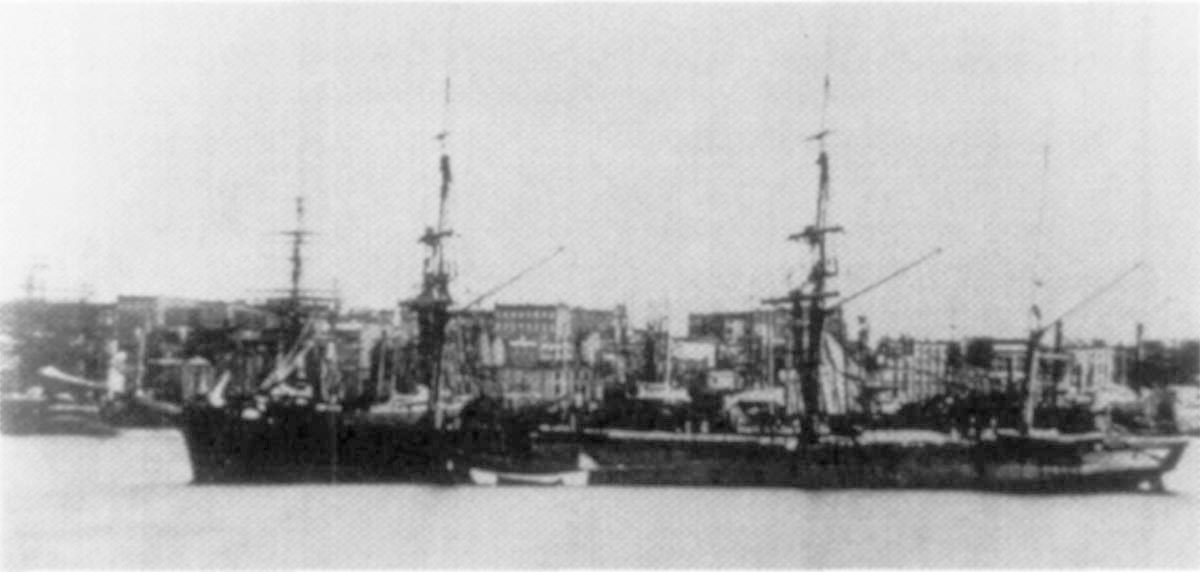
Back on land he joined the circle the critic Vladimir Stasov christened the Mighty Handful in 1867 — Balakirev, Mussorgsky, Borodin, Cui and Rimsky-Korsakov, four of them amateurs with day jobs. He was hired as a professor at the St Petersburg Conservatory in 1871 while, by his own account in his memoirs, knowing less harmony than the students he was teaching, and spent years secretly catching up. In 1873 the navy created a civilian post for him as Inspector of Naval Bands.
That last job is the one that shows in Scheherazade. Inspecting bands means standing in front of clarinets, cornets and bassoons for years, at close range, hearing which register sings and which one goes woolly. His treatise Principles of Orchestration was left unfinished at his death and completed by his son-in-law Maximilian Steinberg in 1912; the suite is that book’s working demonstration, written a generation earlier. When the trombones enter in the second movement, they enter at the one dynamic and register where trombones sound like an announcement rather than a smear.
What to Listen For: Two Themes and a Frame
Almost everything in the suite grows out of two ideas, and they are deliberately opposite in every measurable way.
The Sultan. Low brass and low strings in bare unison, no harmony underneath, a heavy stepwise descent. It is loud, square, and rhythmically rigid. Because there is no accompaniment, it has no context and no warmth — it just states itself and stops.
Scheherazade. A solo violin, unaccompanied except for rolled harp chords, moving in curling ornamental figures with almost no fixed pulse. It is written like a cadenza: the bar lines are there, but the player is expected to bend them. Where the Sultan is a block, she is a line.
The frame is the trick. That violin recitative returns at or near the start of each movement, so the suite behaves like a set of tales inside a telling. And the Sultan’s unison motif does not stay the Sultan: slowed down and re-harmonised, the same descending shape becomes the sea in the first movement, then the crowd at the Baghdad festival in the finale. Rimsky-Korsakov is recycling, not developing. The themes barely change internally; what changes is the light he shines on them — tempo, key, scoring.
The oriental colour comes from a small, repeatable toolkit, and it is worth naming so you stop hearing it as vague atmosphere. Melodies lean on the augmented second, the gapped interval that instantly reads as non-Western. Woodwinds curl around a held note in the manner of a reed pipe rather than stating a tune. Harmony often sits on a drone or a repeating ostinato instead of moving in functional progressions, so the music can hover. Percussion is used sparingly, then decisively: tambourine and snare drum arrive to mark a scene change, not to keep time.
🎧 Also on: Apple Music · Spotify
Alain Altinoglu and the Frankfurt Radio Symphony are my pick for a first watch rather than a first listen: the camera sits close enough that you can see the solo violin start and stop the narrative, which makes the frame obvious in a way audio alone does not.
Four Nights, Movement by Movement
I. The Sea and Sinbad’s Ship
The Sultan barks, the violin answers, and then the sea arrives — and it is the Sultan’s own motif, stretched out and given harmony. From inside a string section, this movement is not really about the tune. It is about the rock: an inner-voice figure that keeps shifting between desks, so no single player is producing the swell and the whole section is. Violas spend long stretches on that figure with nothing to hide behind, holding the motion steady while the cellos take the line. If a performance feels seasick rather than oceanic, that is where it went wrong.
Listen for the flute cutting across the top of the texture, and for how little brass there is once the storm settles. Rimsky-Korsakov keeps his loudest colours in reserve for two movements’ time.
II. The Story of the Kalendar Prince
A bassoon solo over a drone opens the tale, and it is one of the great character entrances in the repertoire — wandering, slightly comic, unmistakably a storyteller warming up. The movement is episodic on purpose: the tempo lurches, the narration stops mid-thought and restarts.
Then the brass. Trombones and trumpets erupt into what everyone hears as a battle, and this is the passage where the Inspector of Naval Bands shows his hand. The writing is exposed rather than thick, which is why it cuts instead of booming. Note also the cadenzas scattered through this movement for clarinet, bassoon and horn: soloists step out of the orchestra as if each one is taking a turn at the story.
III. The Young Prince and the Young Princess
The easiest movement to love and the one I would hand a newcomer first. Strings sing a broad, unhurried theme for the prince; a clarinet answers with a lighter, more decorated one for the princess, over a snare-drum rhythm that keeps it dancing rather than swooning. The two ideas circle, overlap and eventually share the same bar.
It is also the movement that exposes an orchestra’s legato. There is nowhere to hide in that opening string theme — it is slow, high, and scored so thinly that any unevenness in the section is audible immediately.
🎧 Also on: Apple Music · Spotify
Leif Segerstam and the Sinfónica de Galicia take the third movement broadly, which suits it: the string theme gets room to phrase instead of being pushed along.
IV. Festival at Baghdad. The Sea. Shipwreck.
The finale is a collision. Themes from all three previous movements pile into a festival scene, the metre keeps flipping, and the percussion finally gets to work. Then the sea comes back, and this time the ship is destroyed on a cliff topped by a bronze horseman — a single shattering tutti with the brass at full stretch.
What happens next is why the piece endures. The noise stops. The solo violin comes back alone, exhausted. The Sultan’s motif returns too, but quiet and harmonised for the first time, and it dissolves into the violin’s highest note, held. Read it as the tyrant relenting, or read it as a storyteller finishing her last night. Either way, the ending is dramatically earned rather than decorative, which is not something you can say about most nineteenth-century showpieces.
He Took the Titles Off. Should You Put Them Back?
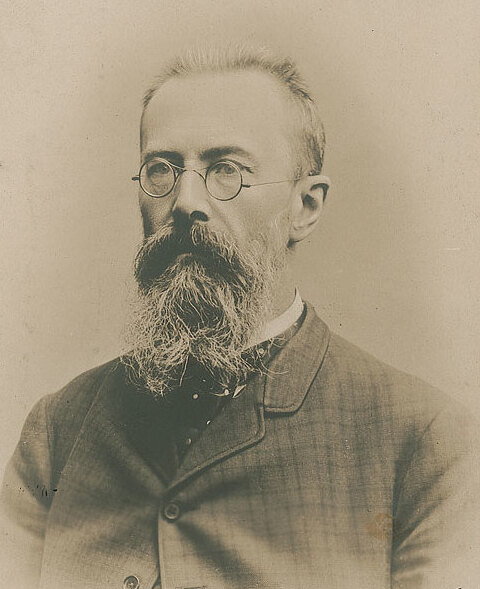
Rimsky-Korsakov gave the four movements descriptive titles and then removed them from a later edition of the score. In his memoirs he wrote:
“All I had desired was that the hearer, if he liked my piece as symphonic music, should carry away the impression that it is beyond doubt an oriental narrative of some numerous and varied fairy-tale wonders and not merely four pieces played one after the other and composed on the basis of themes common to all the four movements.”
He added that the hints were meant to nudge the listener’s fancy “but slightly”, not to fix a plot.
So: is the story a crutch? My view, after living with the piece, is that he was protecting the music from a reading it cannot support — there is no plot here, no narrative causality between movements, and if you hunt for one you will spend the second movement wondering which Kalendar prince is which. What the titles do give you is a set of moods and a reason for the frame. Take them as scene headings, not as a libretto, and ignore the movement-by-movement blow-by-blow that concert programmes love to print. The recurring violin tells you everything structural you actually need.
Three Recordings, and What Each One Is For
Kirill Kondrashin / Royal Concertgebouw Orchestra / 1979 / Philips — my first recommendation, and the one to buy if you are only buying one. Herman Krebbers, the orchestra’s own leader, plays the solo, and that matters: he phrases it like a section principal shaping a line for colleagues rather than like a guest virtuoso taking a bow. Kondrashin drives the finale harder than almost anyone without letting the ensemble smear, and the Concertgebouw acoustic gives the low strings the weight the sea music needs. If you want a criticism: the woodwind detail in the second movement sits further back than on the American recordings.
▶ Listen on YouTube · Apple Music · Spotify
Fritz Reiner / Chicago Symphony Orchestra / 1960 / RCA — the choice if you care about hearing the orchestration rather than the atmosphere. Reiner runs the piece leaner and faster, and RCA’s Orchestra Hall engineering separates the winds so cleanly that you can follow the clarinet cadenza in the second movement as a line rather than a texture. Sidney Harth takes the violin solo with a cooler tone than Krebbers, which some listeners find under-narrated. I think it fits Reiner’s reading: this is Scheherazade as a machine you can see through.
▶ Listen on YouTube · Apple Music · Spotify
Thomas Beecham / Royal Philharmonic Orchestra / 1957 / EMI — the one for the third movement. Beecham indulges the love music more than anyone since, with rubato that would sound mannered from a lesser hand and instead sounds like speech, and Steven Staryk’s solo is the most openly lyrical of the three. The trade-off is real: the finale is less ferocious, and the late-1950s Kingsway Hall sound is warm rather than detailed. Get it second, not first.
▶ Listen on YouTube · Apple Music · Spotify
Recording metadata above was checked against label and discography listings rather than reconstructed from memory; the verdicts are mine. If you want a comparable exercise on a work where the recording gap is even wider, our guide to Saint-Saëns’s Organ Symphony deals with the same problem of a spectacular score that rewards clarity over volume.
The Ballet That Made It Famous in Paris
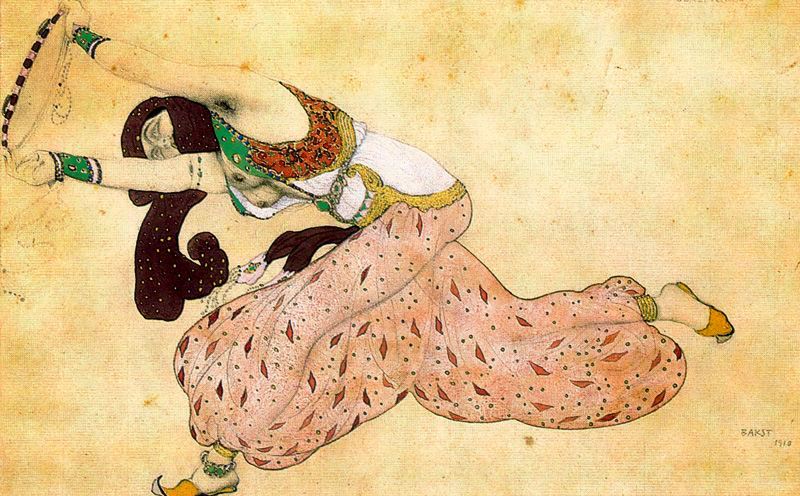
Rimsky-Korsakov never saw the production that turned his suite into a cultural event. Sergei Diaghilev’s Ballets Russes staged Schéhérazade at the Palais Garnier in Paris in 1910, choreographed by Michel Fokine with designs by Léon Bakst, two years after the composer’s death in 1908. Bakst’s saturated colour and Fokine’s loose, non-academic movement made it notorious, and the orientalist look bled straight into Parisian fashion and interior design.
It is worth knowing because it explains the piece’s afterlife. The score was written for a concert hall and it works there, but the ballet is why Scheherazade became shorthand for a whole visual style. His widow, Nadezhda Rimskaya-Korsakova, protested against the production in open letters to Diaghilev — a reminder that the composer’s intentions and the work’s reception parted company early.