The Goldberg Variations comes with a bedtime story attached: a sleepless count, a teenage harpsichordist, music ordered up to make the long nights pass. It is a charming story. It is also thin, and it has done real damage — two centuries of listeners treating the most physically exhilarating keyboard music Bach ever put into print as a lullaby with a pedigree.
What you actually get is an aria, thirty variations built on that aria’s bass line rather than its tune, and a return to the aria at the end that lands completely differently the second time around. This guide covers where the legend came from and why it does not hold up, what the architecture is doing while you listen, the moments that repay attention most, and which recordings are worth your money — with a verdict, not a shrug.
The Bedtime Story, and Why It Falls Apart
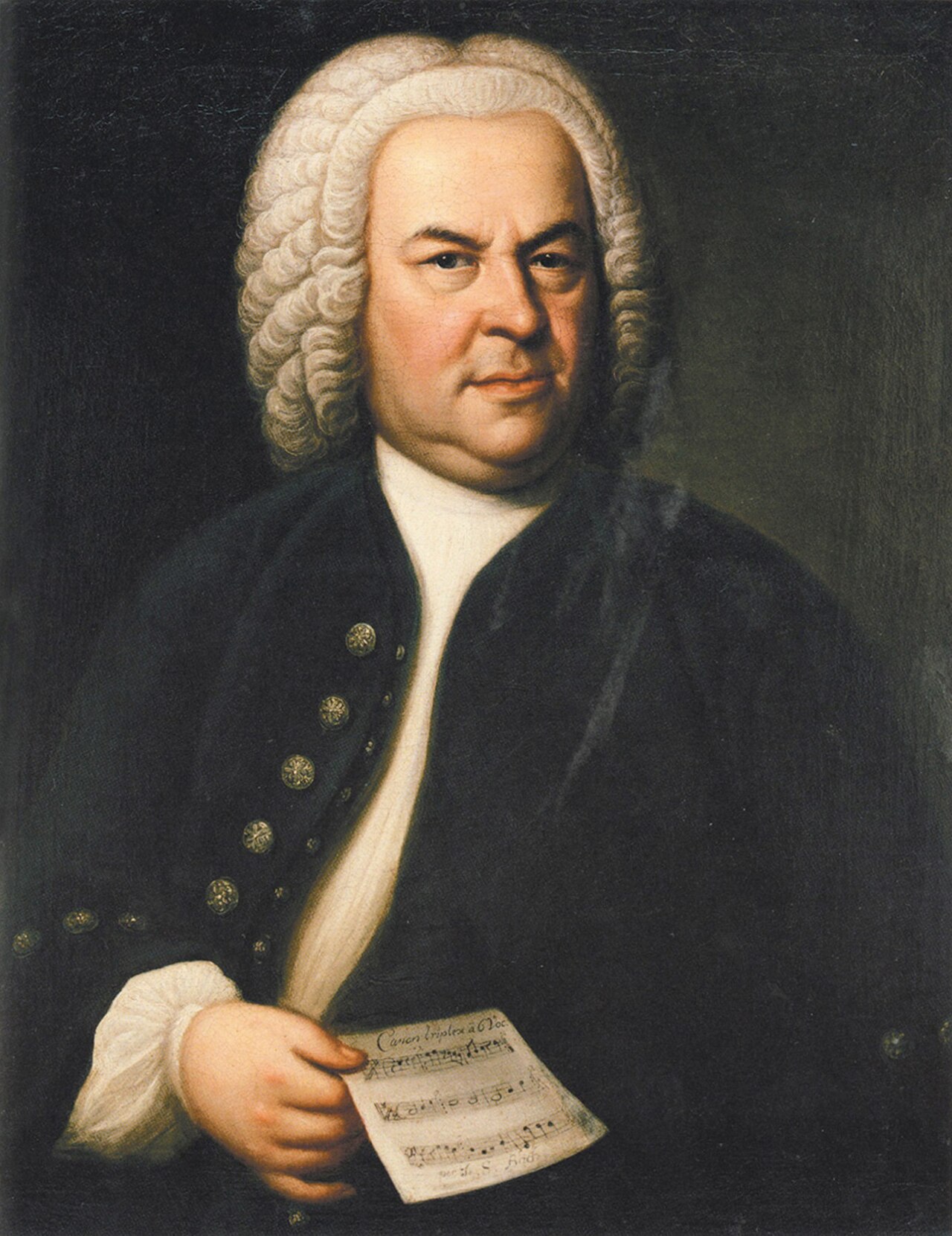
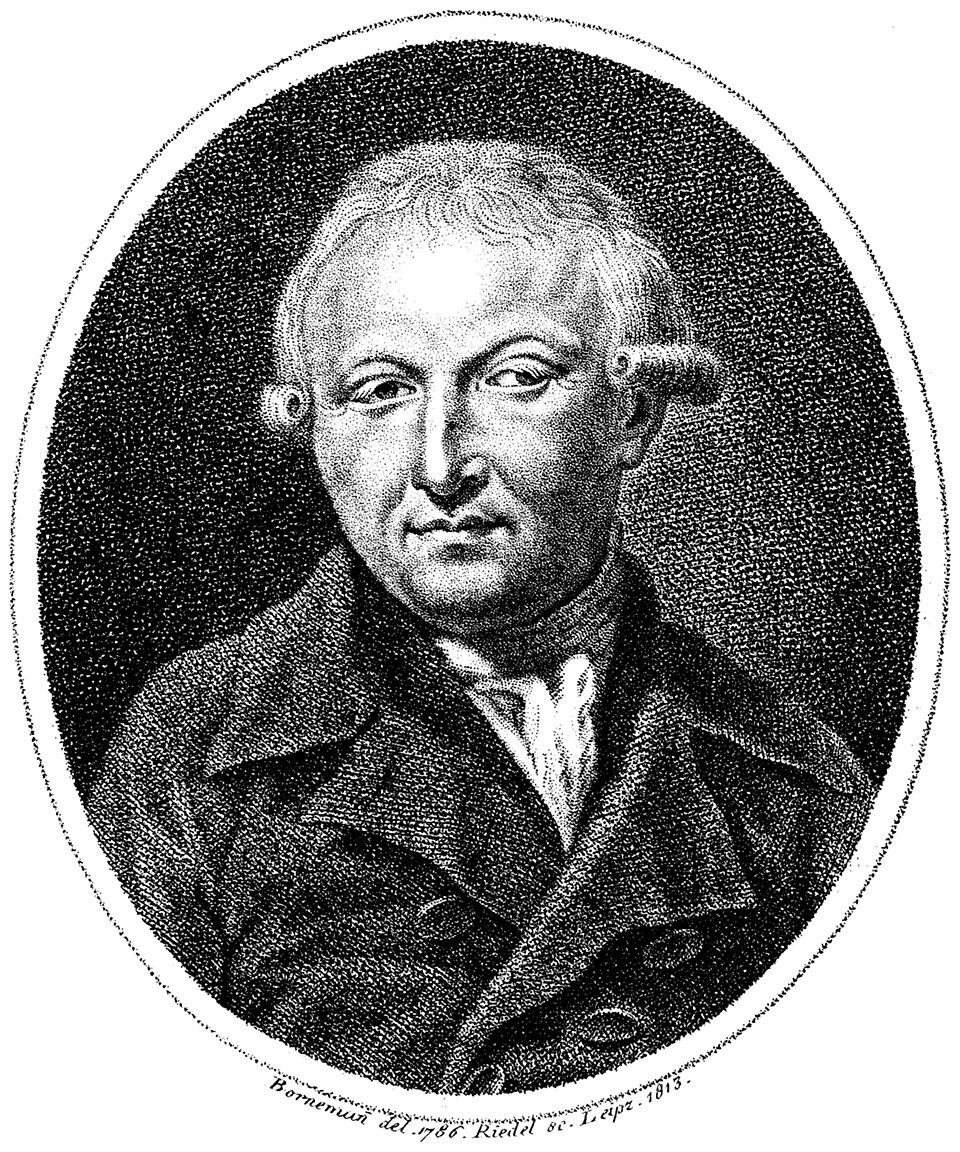
The tale comes from Johann Nikolaus Forkel, whose Bach biography appeared in 1802, more than sixty years after the music was printed. Forkel’s account has Count Hermann Karl von Keyserlingk, a Russian envoy posted to Dresden, asking Bach for keyboard pieces that his resident harpsichordist could play through the count’s sleepless nights. The harpsichordist was Johann Gottlieb Goldberg, and the work has carried his name ever since — not the patron’s, not the composer’s dedication, just the kid at the keyboard.
Two things puncture it. Johann Gottlieb Goldberg was born in 1727, which would have made him around fourteen years old when the music appeared, and this is not fourteen-year-old repertoire — several variations demand two keyboards and the kind of hand independence that takes decades. More decisively, the first edition carries no dedication to the count at all, and Bach supervised that print himself. Scholars have argued the point in both directions for a long time; the honest summary is that the story is unverified and the print contradicts its most checkable detail.
I would keep the story anyway, but hold it at arm’s length. It survives because it flatters a real quality in the music — this set genuinely does soothe, in stretches — while completely misdescribing the rest of it. Variation 5 is a hand-crossing sprint. Variation 29 is a slab of hammered chords. Nobody is falling asleep to those.
What Bach Actually Published
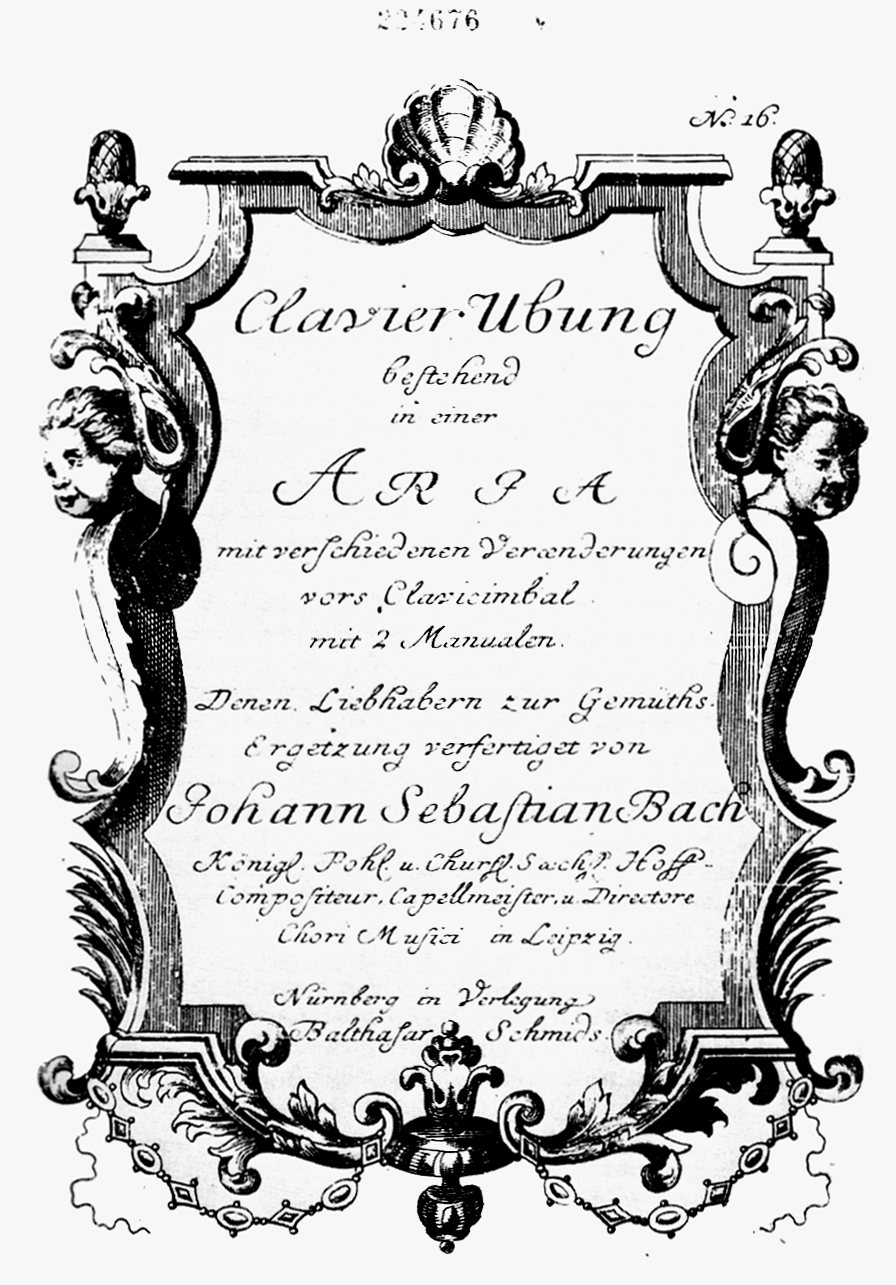
Bach published the work in 1741, and the printer was his friend Balthasar Schmid of Nuremberg. The title page advertises a keyboard exercise made of an aria with diverse variations, written for a harpsichord with two manuals — that instruction matters, and we will come back to it. The volume is generally counted as the fourth installment of Bach’s Clavier-Übung series, the run of publications through which he issued his major keyboard music to the public.
There is a postscript to the print that almost nobody mentions. Bach’s own copy surfaced in Strasbourg in 1974, and the blank pages at the back carry fourteen more canons on the same bass line, now catalogued as BWV 1087. He was still mining this material privately years after the book went on sale. That is the tell about what the piece meant to him: not a commission to be delivered and forgotten, but a structure he kept returning to.
The Blueprint: What Actually Varies
Here is the single fact that changes how the piece sounds. The variations are not variations on the aria’s melody. That ornate, sighing tune you hear at the start is decoration on top of something else — a bass line and a harmonic plan running thirty-two bars — and it is the bass that gets varied. Bach keeps the foundation and rebuilds the house thirty times.
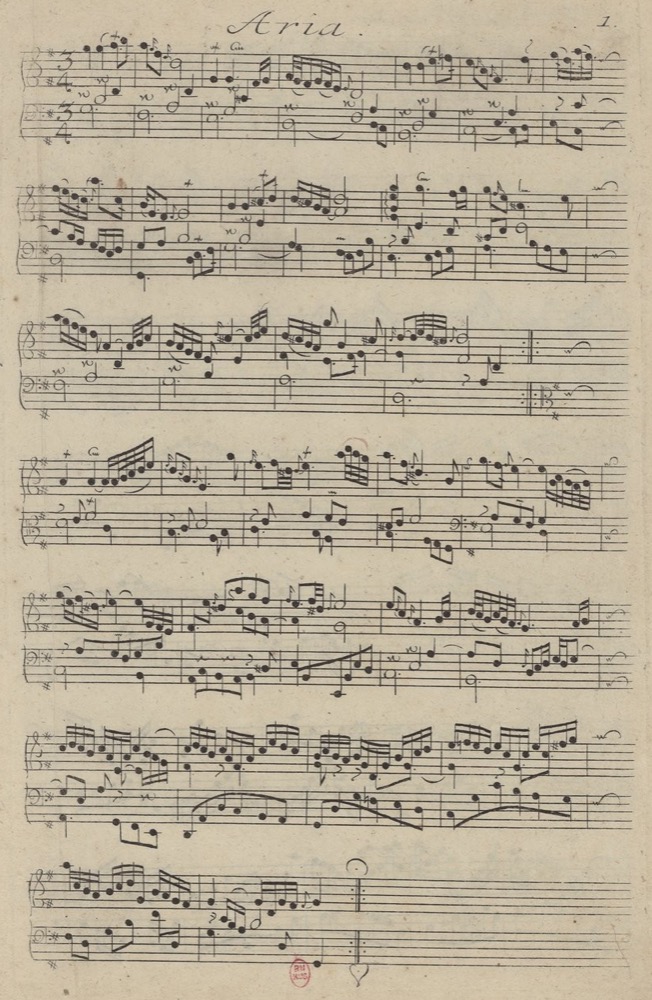
Once you know that, the shape snaps into focus. The thirty variations run in ten groups of three, and each group does the same three jobs in the same order: a character piece or dance, then a two-handed showpiece, then a canon. Every third variation is a canon, and the canons climb. Variation 3 is a canon at the unison, Variation 6 a canon at the second, and the ladder rises by one step each time until Variation 27, a canon at the ninth.
This should be unbearable. A rigid grid, announced in advance, repeated ten times. Instead it is the reason the piece never sags: the pattern gives you a handrail, and Bach spends his energy making each rung sound like it was arrived at freely. When you catch yourself thinking that was a canon? three variations in a row, the trick has worked.
The two-manual instruction is not a footnote either. Several variations cross the hands over each other constantly, which a double-manual harpsichord makes possible and a piano does not — the pianist has to untangle it with one keyboard’s worth of space. That is why piano and harpsichord versions of the same variation can feel like different pieces. On a concert video shoot, the hand-crossing variations are the ones a director points a camera at, because they are the only moments in this work where the difficulty is visible from the balcony.
Five Things to Listen For
Variation 16, the French overture. Bach puts a grand double-dotted overture exactly halfway through, at the head of the second half. It is a curtain going up in the middle of the show. If you are listening on shuffle you will miss the joke entirely.
The three in G minor. Almost everything here is in bright G major. The exceptions are Variations 15, 21 and 25, all in G minor, and they are spaced far enough apart that each one arrives like a cloud crossing the sun.
Variation 25, the long lament. The harpsichordist Wanda Landowska called this one the black pearl of the set, and the name stuck because nothing else in the piece sounds like it: a slow, chromatic line that keeps bending away from where the ear expects it to land. It runs longer than anything around it, and in slower performances it can feel like a separate, sadder piece embedded in the set.
Variation 29, the wall of sound. Hammered chords, alternating hands, no counterpoint to admire — Bach writing something closer to a keyboard tantrum. Placing it right before the finale is what makes the ending work.
Variation 30, the quodlibet. The pattern says variation 30 should be a canon at the tenth. Instead Bach stacks popular tunes of the day over his bass line, usually identified as Ich bin so lang nicht bei dir gewest and Kraut und Rüben haben mich vertrieben. After all that disciplined counterpoint, the master builder steps back from the cathedral and cracks a joke about cabbage and turnips.
Then the aria comes back, note for note, and this is the moment the whole design exists for. Nothing in the music has changed. You have. Hearing the same thirty-two bars after everything that has been extracted from them is the closest thing keyboard music has to a plot twist.
If you want to watch the machinery while you listen, the free Open Goldberg recording is scrolled against the score below. Kimiko Ishizaka’s performance was released into the public domain in 2012, which makes it the rare case where the best study copy is also the free one.
🎧 Also on: Apple Music · Spotify
The Recordings Worth Your Time
This piece has a discography problem: one performer owns the popular imagination, and he recorded it twice, in two directions. Start with the arguments, not the reputations.
Glenn Gould / piano / 1955 / Columbia Masterworks. Gould recorded it in June 1955, aged twenty-two, and Columbia released the album in 1956. It runs 38 minutes and 34 seconds, and the reason it is that short is that he leaves out most of the written repeats. What is left is fast, dry, articulated to the millimetre, and completely unsentimental — the counterpoint comes at you as rhythm rather than as decoration. It is still the best first listen for someone who thinks Baroque keyboard music is wallpaper. What you give up is space: the aria is brisk to the point of brusque, and Variation 25 gets no room to grieve.
▶ Listen on YouTube · Apple Music · Spotify
Glenn Gould / piano / 1981 / CBS Masterworks. He came back to it in 1981, and the second recording, released in 1982, runs 51 minutes and 18 seconds. That extra quarter of an hour is not padding — it is a different reading of what the bass line is for, with the slow variations weighted and the fast ones held just short of the earlier abandon. The 1981 recording won Best Instrumental Soloist Performance at the 1983 Grammy ceremony. Gould died on 4 October 1982, weeks after it appeared, which has encouraged people to hear it as a farewell; treat that as reception history rather than intent. Judged on sound alone it is the more searching of the two and the worse introduction, because it assumes you already know what is being weighed.
▶ Listen on YouTube · Apple Music · Spotify
Pierre Hantaï / harpsichord / 1992 / Opus 111. If you only ever hear this music on a piano you are hearing a translation. Hantaï recorded it in June 1992, and the double manual does what the print asks: the hand-crossing variations stop sounding like feats and start sounding like conversation between two registers. His rhythm is springy rather than metronomic, which is the quality most harpsichord Goldbergs lack. The trade-off is dynamic range — the instrument cannot swell, so the emotional weather of Variation 25 has to come from timing and voicing alone. Some listeners find that austere. I find it clarifying.
▶ Listen on YouTube · Apple Music · Spotify
Murray Perahia / piano / 2000 / Sony Classical. Perahia recorded his version in July 2000, and it is the one to own if you want the piece to sound like music rather than like a position in an argument. He takes the repeats, he lets lines breathe, and the counterpoint is voiced so that you can follow any strand you choose without being told which one matters. Against Gould it can sound reasonable — that is the criticism, and it is fair on the showpieces, where the sheer nerve of the 1955 account is missing. On the canons and the G minor variations, Perahia is the better guide.
▶ Listen on YouTube · Apple Music · Spotify
Beatrice Rana / piano / 2016 / Warner Classics. Rana recorded the set at Teldex Studio in Berlin in November 2016, and it is the modern account I return to most. She builds the thing in long spans — you can hear her thinking three variations ahead — and she is unafraid of a hard attack when the writing calls for one, so Variation 29 actually bites. It is not a safe reading, and a few of her tempo relationships will annoy anyone raised on Perahia. Start here if the historical recordings feel like homework.
🎧 Also on: Apple Music · Spotify
The Verdict
Buy Perahia. It is the version that will still be in rotation in five years, because it neither shouts nor apologises, and it gives you all the repeats, which means you actually hear the binary structure Bach wrote rather than a highlights reel.
Hear Gould’s 1955 first anyway — an afternoon, not a purchase; it is short enough to absorb in one sitting and it will convince you the piece is thrilling before you know why. Then go to Hantaï when you want to know what the composer was hearing, and to the 1981 Gould once the shape of the work is in your head, where it belongs. If money is the constraint, the free Open Goldberg recording is a genuinely good performance and not a charity case.
What I would skip: any playlist that serves you individual variations out of order. This is one of the few large works where sequence carries the argument, and Variation 30 lands as a punchline only if you have sat through the twenty-nine before it.
Where to Go Next
If the counterpoint is what grabbed you, the next stop is Bach at his largest scale — try our guide to Bach’s Mass in B Minor, BWV 232, where the same architectural instinct plays out across voices and orchestra. If it was the solo-instrument intimacy instead, Bach’s Cello Suites apply the dance-suite logic to one unaccompanied line. And for the keyboard road onward from Bach, our guide to Beethoven’s piano sonatas picks up where the variation principle turns into drama.
Sources and Notes
The publication facts — the 1741 first edition Bach had printed by his friend Balthasar Schmid of Nuremberg, what its title page says, the canon on every third variation, the three variations in G minor, the quodlibet tunes — are checkable in the score and in the print itself, and were read against the standard reference entries on the work. The insomnia legend traces back to a single origin, the Bach biography Johann Nikolaus Forkel published in 1802, and no document from Bach’s lifetime supports it, so the article keeps it labelled as legend rather than history.
Recording details — dates, labels, running times, and the Grammy the second Gould set won at the 1983 ceremony — come from label release pages and published discographies of the work: Columbia and CBS for the two Gould albums, Opus 111 for Hantaï, Sony Classical for Perahia, Warner Classics for Rana. Kimiko Ishizaka’s Open Goldberg recording is free because the project released it into the public domain, as stated on the project’s own site. Anything I could not stand up independently is not in here, and where the record is thin rather than settled the article says so instead of quietly filling the gap.