Schumann wrote sixteen numbers of music for Byron’s Manfred. Fifteen of them have all but vanished from concert life. The sixteenth — the overture — never left, and it is the piece I hand to anyone still convinced Schumann was a miniaturist who lost his footing the moment he picked up a full orchestra.
The case takes one sentence. In somewhere between eleven and thirteen minutes, this overture covers ground that Tchaikovsky needed a four-movement symphony to cover from the same poem. It is deliberately lopsided, it refuses a triumphant ending, and it dissolves rather than finishes. If your Schumann is the Piano Concerto and a handful of piano miniatures, this is the corrective.

Byron’s Manfred: the anti-hero everyone kept copying
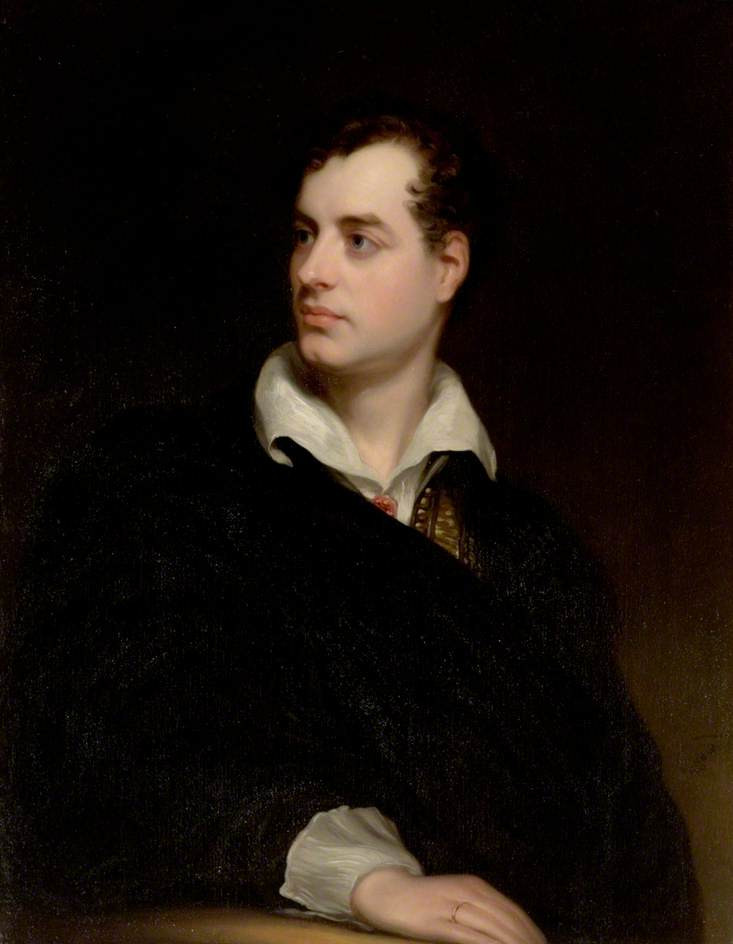
Byron published the dramatic poem Manfred in 1817. Its hero is a nobleman shut away in an Alpine castle, eaten by guilt over a woman named Astarte, summoning spirits and demanding that they wipe his memory clean. They refuse. He bows to neither church nor devil and dies on terms he sets himself.
Byron did not write it for the stage. It has three acts, but almost nothing happens in them: the drama is interior, and the text is mostly Manfred arguing with entities who cannot give him what he wants. That is exactly why composers kept reaching for it. There is no plot to be faithful to, only a psychological weather system — which means a composer can set the whole thing as a single arc of feeling and lose nothing.
The Byronic hero — magnetic, guilty, unforgivable, and quietly convinced he is right — became the template half of Romantic Europe worked from. Schumann’s response to that figure was the least literal one available: rather than narrate the poem, he compressed it.
Dresden, 1848: why this text and not another
Schumann sketched the music in the summer of 1848, shortly after finishing his opera Genoveva, and the score grew into an overture plus fifteen further numbers — entr’acte, melodramas, solos and choruses. He did not want it billed as an opera or a Singspiel. He wanted it presented as a dramatic poem with music, which is roughly the nineteenth-century equivalent of insisting your record is not a concept album.
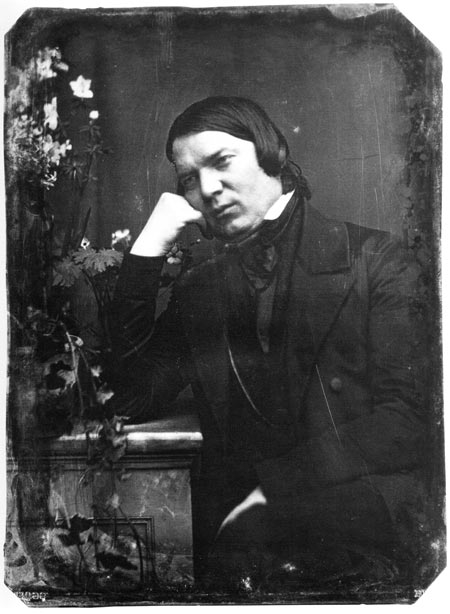
It is tempting to read Schumann’s own deteriorating health straight into the score, and plenty of writers do. I would label that as interpretation rather than fact. What is documented is thinner and more useful: he was gripped enough by rereading Byron to start setting it almost immediately, and he cared enough about the result to fight over how it was advertised. The rest — the biographical mirror, the projection — is a story we tell because it is satisfying, not because a letter proves it.
The overture had its first performance at the Gewandhaus in Leipzig on 14 March 1852, with Schumann himself conducting. The complete Manfred had its first performance at the German National Theatre in Weimar on 13 June 1852, conducted by Franz Liszt. The overture went into the repertoire and stayed; the other fifteen numbers did not.
What to actually listen for
Five mechanisms do nearly all the work here. Track them and the piece stops being a wall of dark orchestral noise and starts being an argument.
1. The three syncopated chords
The overture opens with three chords that land off the beat. Not on it — off it. You have no downbeat to hold on to, which means that before a single melody arrives you have already been denied your footing. Most overtures begin by telling you where the pulse is. This one begins by hiding it.
2. The oboe’s chromatic line
After the chords, the tempo collapses and the woodwind take over with a line that slides by half-steps rather than stepping cleanly through a scale. Chromatic motion like this has no gravity — every note could plausibly go up or down next — and that indecision is the seed of everything that follows. Learn this shape in the first minute and you will hear it warped, compressed and torn apart later.
3. Syncopation as a structural idea, not an effect
Once the fast music arrives, the off-beat displacement from the opening becomes the engine. The main theme keeps entering fractionally late, so the orchestra and the metre spend the whole piece slightly out of phase. Schumann had spent years doing this in his piano music, where a listener hears it as charm. Blown up to orchestral scale and set in a very dark key, it stops being charming and starts feeling like anxiety.
4. The development that will not stop
In a textbook sonata movement, the development section is the unstable middle and it is generally shorter than what surrounds it. Here it is enormous — proportionally the centre of gravity of the whole piece. Fragments of the introduction collide with the main theme and the lyrical second idea in ways that never resolve cleanly. The disproportion is the point: the piece spends most of its runtime in the state a normal overture only visits.
5. The ending that dissolves
And then the coda. The lyrical theme comes back slowed down, the textures thin out, and the music fades instead of closing. There is no cadence to applaud. Watch a live audience meet this ending and you get a few seconds of genuine uncertainty before anyone dares clap. That silence is written into the piece.
Key and colour: the thick-orchestration problem
Schumann is in E-flat minor here — notated with only three flats, which is one of those small notational eccentricities that tells you he was thinking about the sound rather than the bookkeeping. E-flat minor is awkward for string players. The awkwardness is audible, and it helps.
The scoring is compact for a piece this dark: double woodwind, four horns, three trumpets, three trombones, timpani and strings. No harp, no extra percussion, none of the colouristic hardware Berlioz would have reached for. Schumann gets his darkness from register and doubling instead.
Which brings up the standard complaint about Schumann’s orchestration: too much doubling, too much activity crammed into the middle of the texture, inner voices that fog over. It is a fair criticism of some of the symphonies. It is not a criticism of this piece, because here the fog is the subject. A congested, airless middle register is precisely what Manfred’s inner world should sound like. Mahler famously rescored Schumann’s symphonies to clean them up; nobody has felt much need to rescue Manfred.
That said, it puts a real burden on the conductor. Get the balance wrong and the whole thing turns to brown soup. Which is why the recordings diverge as much as they do.
Recordings: what I would actually put on
Kirill Petrenko / Berliner Philharmoniker (live concert video) — This is the one to start with, and specifically to watch rather than only hear. Petrenko goes for density over transparency: the strings dig in, the syncopations are attacked rather than smoothed, and the development gets genuinely violent. What the video adds is the ending — you see the players hold position while the sound evaporates, and you see the hall not knowing when to breathe. Best single introduction to the piece.
Kirill Petrenko conducts the Berliner Philharmoniker.
Marek Janowski / hr-Sinfonieorchester, Frankfurt Radio Symphony (live concert video) — The opposite approach, and the one to go to second. Janowski unpicks the texture instead of massing it: you can follow individual woodwind lines through passages where other conductors give you a single dark chord. The trade-off is real — it is less overwhelming, and the development loses some of its brutality. But if you want to understand how the piece is built rather than just be flattened by it, this is the clearer window.
Marek Janowski with the hr-Sinfonieorchester, Frankfurt Radio Symphony.
George Szell / The Cleveland Orchestra — Columbia, recorded 1958–1960, reissued by Sony Classical — My pick if you are buying one version. Szell’s Cleveland could play with a precision that makes Schumann’s doubling problem simply disappear, and he takes the syncopations dead straight, without the rubato most conductors use to soften them. The result is colder than Petrenko and more relentless than Janowski. The mono-era-adjacent sound is close and a little dry, which some listeners will hate; I think the dryness suits a piece that is already claustrophobic. ▶ Listen on YouTube
Rafael Kubelík / Berliner Philharmoniker — Deutsche Grammophon, recorded February 1964 — The humane alternative. Kubelík is lighter on his feet than anyone else here and refuses to make the piece grind; the second theme gets space to sing instead of being swallowed. If the Szell strikes you as punishing, this is the version that lets the lyrical material breathe. The cost is that the development sounds less desperate than it should. Get this one second, not first. ▶ Listen on YouTube
If you want to see the mechanics rather than infer them, this score-following video puts the notation on screen while the music runs. The syncopated opening and the oversized development are far easier to believe once you can watch the bar lines go by.
The overture with the score on screen.
Where to go after this
Tchaikovsky took the same poem and did the opposite. His Manfred Symphony, Op. 58, was written between May and September 1885 and had its first performance in Moscow on 23 March 1886 under Max Erdmannsdörfer. It is a four-movement narrative: wandering, the Alpine fairy, a pastoral scene, the underworld. Where Schumann compresses, Tchaikovsky illustrates. Neither is more faithful — Byron gave them almost no plot to be faithful to — but the comparison shows you two completely different theories of what programme music is for. Tchaikovsky’s orchestral imagination is the draw; if that is what pulls you, his Second Piano Concerto is another underplayed corner of the same catalogue.
The Brahms connection is the other thread worth pulling. Schumann published his essay Neue Bahnen on 28 October 1853, announcing an unknown twenty-year-old Brahms to the musical world. Brahms completed his First Symphony in 1876; it had its first performance on 4 November 1876 in Karlsruhe under Felix Otto Dessoff. Put the opening of that symphony next to this overture and the family resemblance is hard to miss: darkness first, syncopation as a structural device, an introduction that generates the material rather than merely announcing it. I would not claim Brahms was copying — he was working through the same problem in the same idiom. His First Piano Concerto, written in the wake of Schumann’s collapse, is the closest thing to a direct emotional response.
And if you want to hear the Schumann who is nothing like this — light, generous, extroverted — the Piano Concerto in A minor is the other half of the man.
The full score is free at IMSLP.