In the Berlin State Library there is a sheet of paper dated in Mozart’s handwriting: 10 August 1788. It is the last leaf of the autograph score of his final symphony. The word Jupiter appears nowhere on it, and would appear nowhere for another twenty-five years.
That gap is the most useful thing to know about this piece. Almost everything the program note tells you about the Jupiter — the name, the tragic backstory, the composer dying broke and unheard — was added later by other people. What Mozart left behind is stranger than the legend: a symphony in the key of state ceremony, built on a four-note scrap he had carried since he was eight, that ends by stacking five tunes on top of each other and getting away with it.
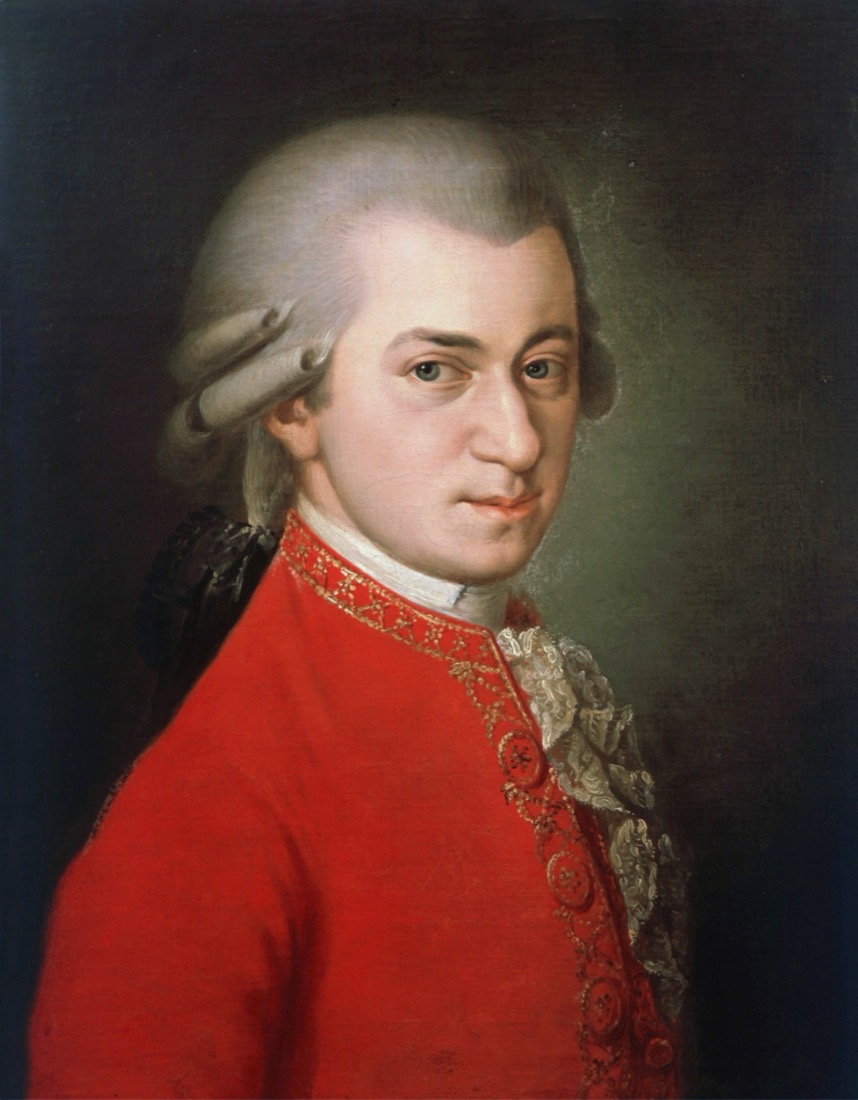
The Work in Brief
- Composer
- Wolfgang Amadeus Mozart (1756–1791)
- Work
- Symphony No. 41 in C major, Jupiter
- Catalogue
- K. 551 — the K numbers come from Ludwig von Köchel’s catalogue, first published in 1862
- Completed
- Vienna, 10 August 1788
- Movements
- I. Allegro vivace
II. Andante cantabile
III. Menuetto: Allegretto
IV. Molto allegro - Scoring
- Flute, 2 oboes, 2 bassoons, 2 horns, 2 trumpets, timpani, strings. No clarinets.
- Performance history
- Nothing confirmed in Mozart’s lifetime — but see the Leipzig question below
- Duration
- About 33 minutes
The Nickname Came from London, Twenty-Five Years Late
Mozart called it a symphony. That is the whole of it — his thematic catalogue and the autograph carry a date and nothing else. No god, no thunderbolts, no marketing.
The name has one decent source behind it. Vincent and Mary Novello, English publishers, travelled to Salzburg in 1829 to visit Mozart’s widow Constanze, and kept diaries. In them, Mozart’s younger son Franz Xaver says the impresario Johann Peter Salomon attached the name Jupiter to the symphony. Salomon is no minor figure — the promoter who brought Haydn to London and got twelve symphonies out of him. If anyone knew how to give music a stage name, it was him.
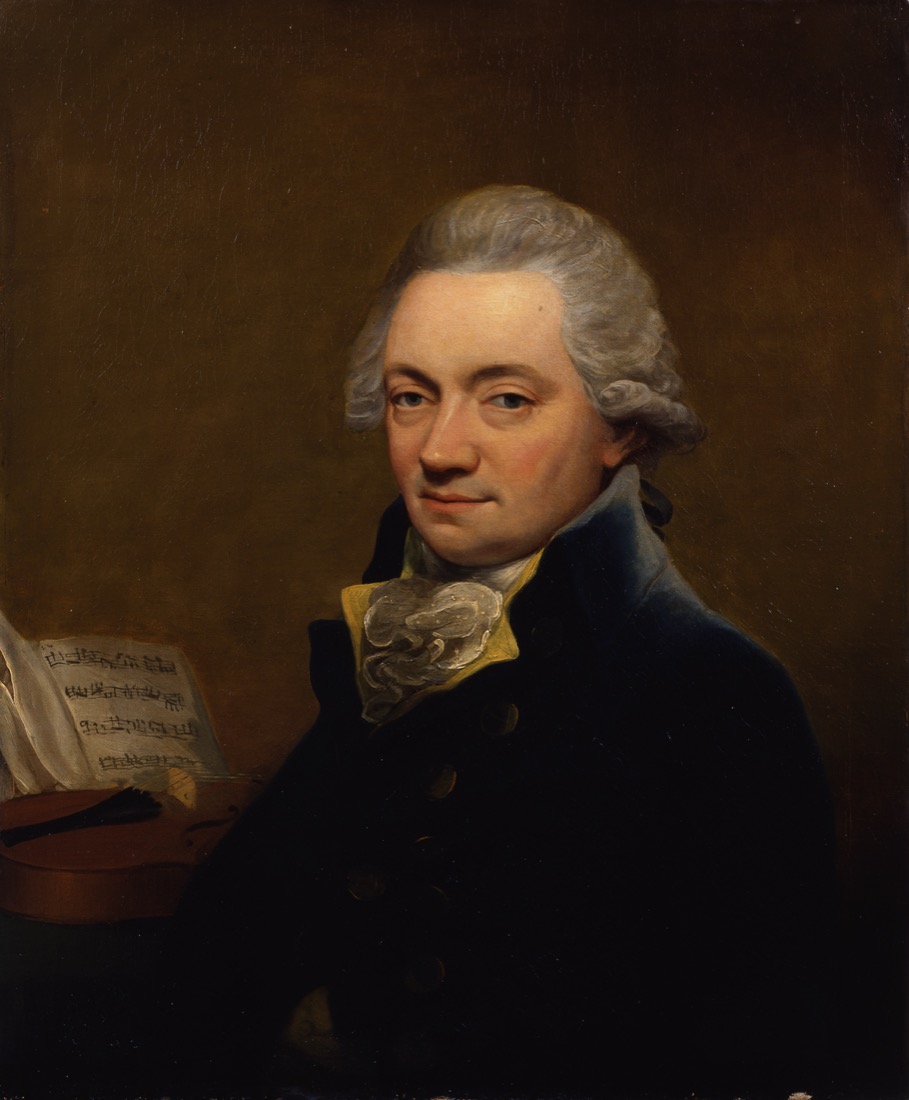
Here the usual telling goes wrong, and it is worth fixing because it circulates everywhere. Program notes will tell you the name first appeared in print in an Edinburgh concert programme on 20 October 1819. That date gets repeated far more often than it gets sourced. The earliest appearances anyone has actually documented are six years earlier, in two English papers: the Bath Journal of 19 April 1813 advertised a concert at the Bath Assembly Rooms including a Grand Sinfonia called Jupiter by Mozart, and The Morning Chronicle of 22 April 1813 used the name for a Royal Philharmonic Society concert. The Salomon attribution is not airtight either — the name has also been credited to the London publisher Johann Baptist Cramer, and both stories are secondhand. Treat Salomon as the best available answer, not a settled one.
Meanwhile German-speaking audiences were calling it something entirely different and much more literal: the Sinfonie mit der Schlussfuge, the symphony with the closing fugue. That title was still the main subtitle in the third edition of the Köchel catalogue in 1937. So for a century the piece had two names — one selling a Roman god, one describing the last four minutes. The English name won, which tells you which market was better at advertising.
Why Jupiter, though? Not arbitrary. For an eighteenth-century musician, C major with trumpets and drums was the sound of authority — coronations, salutes, the room standing when somebody important walked in. Whoever picked the name was reading the orchestration correctly. Good copywriting because it is accurate copywriting.
Three Symphonies in Six Weeks, and One Myth to Retire
The dates are not in dispute, because Mozart wrote them down himself: Symphony No. 39 finished on 26 June 1788, No. 40 on 25 July, No. 41 on 10 August. Three symphonies, six weeks, no known commission for any of them.
The surrounding summer was hard. Mozart was writing to his fellow freemason Michael Puchberg asking for money — the first of those letters is dated 17 June 1788, and in it he admits he still owes his previous landlord part of the rent. Then, on 29 June 1788, his daughter Theresia died. Born on 27 December 1787, she was six months old. She died at the family’s new apartment on the Alsergrund, at what is now Währingerstrasse 26, three days after he finished No. 39 and just as he started No. 40.
Now the myth. You will read almost everywhere — an earlier version of this article said it too — that the Mozarts moved to the suburbs that June because they could no longer afford the rent in town. The Viennese scholar Michael Lorenz, who has done more archival work on Mozart’s addresses than anyone, says the opposite: the move was not about cutting costs but about better conditions in more spacious surroundings. The apartment may have been an upgrade he could not quite afford — less tidy than the poverty narrative, and better supported.
This matters beyond pedantry. The tragic-genius version turns the Jupiter into a farewell note and invites you to hear grief in bars that may just be a working composer working. Mozart was thirty-two, in debt, burying a child, and writing three of the best symphonies in existence. All true at once. None has to explain the others.
Did He Ever Hear It?
Nobody knows, and the confident answer you get — never, not once — is too confident.
There is no documented first performance of K. 551 in his lifetime. That is the fact. But one thread is worth pulling: Mozart gave an all-Mozart concert at the Gewandhaus in Leipzig on 12 May 1789, and the programme listed two symphonies nobody has identified. On the strength of that programme, it has been argued that a new symphony in C was played at the Gewandhaus in Leipzig in 1789 — and the new symphony in C, in 1789, would be this one.
So honest positions run from probably never heard it to possibly conducted it himself, and the evidence does not close the gap. What is certain is that he died in 1791 before the piece entered the repertoire, and everything it later became — the name, the reputation, the ovations — happened in rooms he never sat in.
What to Listen For
Four movements, four different personalities. Where to put your attention in each:
I. Allegro vivace — no throat-clearing
There is no slow introduction, which is a choice — Symphonies No. 38 and No. 39 both open with one. The first two bars are a hard orchestral unison answered at once by something soft and pleading: loud, then sweet, then loud again, all inside eight bars. That is opera-house grammar, the vocabulary of a comic overture, and Mozart had just come off Don Giovanni, which opened in Prague in 1787. The curtain goes up the way an opera’s does — no warm-up, straight into the argument.
II. Andante cantabile — the one that flinches
A muted F major song, and then it fractures. The harmony slides darker, the rhythm trips, the line breaks off mid-phrase and restarts. Then the tune carries on as though nothing happened — the genuinely unsettling part.
You will hear this described as Mozart’s grief for Theresia written down in real time, and the calendar does tempt you — he was working on this music in the weeks she died. Resist it, or at least label it as guessing. What you can hear, with no biography at all, is a beautiful melody that keeps getting interrupted by something it refuses to discuss.
III. Menuetto: Allegretto — the trap
C major returns, trumpets and timpani with it. Listen past the elegance to the trio, because Mozart plants something there: the four-note figure about to take over the finale slips by, quietly, ahead of time. A character crossing the stage in costume before the act starts. Catch it in the trio and the opening of the fourth movement lands completely differently — you have already met it.
IV. Molto allegro — four notes and a fifty-year fuse
The finale’s first theme is four notes: C–D–F–E. Do, re, fa, mi. That is it — and it is not even Mozart’s. It is old plainchant vocabulary, and those notes open a famous exercise in Johann Joseph Fux’s Gradus ad Parnassum, the counterpoint textbook every eighteenth-century composer was raised on.
What is remarkable is how long he kept it in his pocket. Those four notes are in the slow movement of his Symphony No. 1, K. 16, composed in London in 1764, when he was eight. They return in the Credo of the Missa brevis in F major, K. 192, finished in Salzburg on 24 June 1774. And then at thirty-two, at the head of the last symphony he would finish, there they are again.
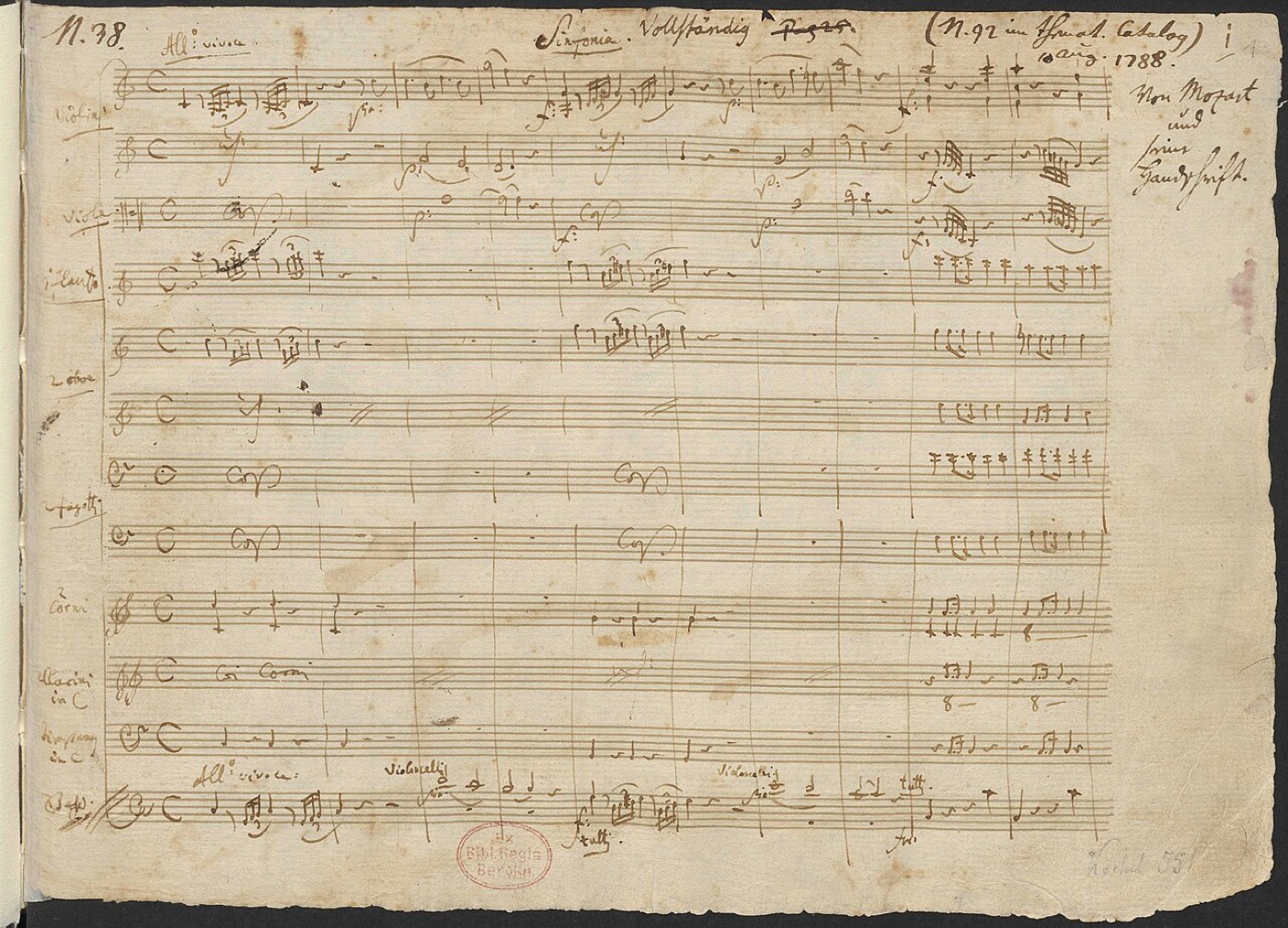
Then the coda. Five separate themes — the four-note motif plus the four other tunes the movement has been introducing all along — arrive at once, on top of each other, combining in a fugato at the close. Everything you spent eight minutes learning comes back simultaneously.
The technical name is invertible counterpoint: the parts are written so any of them can sit above or below any other and the harmony still works. What that means for you, with no theory required: play the coda once and follow the four-note motif alone, then play it again and follow a different line. You will not hear all five at once — nobody can, and that is not the point. The point is that the wall of sound is not a wall. It is five arguments running in parallel, each one grammatical, none stepping on the others.
The Symphony That Refused Its Composer’s Favourite Instrument
Mozart loved the clarinet. He wrote the Clarinet Quintet K. 581 and the Clarinet Concerto K. 622 for his friend Anton Stadler, and the concerto is the most personal orchestral music he produced — our guide to the Clarinet Concerto is the other half of this composer’s personality.
There is no clarinet in the Jupiter. Symphony No. 39 has them. Symphony No. 40 was written without them and then Mozart went back and added them. The Jupiter never has them, at any point.
One common reading, and the most persuasive to my ear, is that the omission is deliberate: a C major world built on trumpets and drums wants hard, bright light, and the clarinet’s warmth would have softened exactly the edges the piece needs. Put bluntly, this is a symphony that refuses to comfort you, and to get that sound Mozart left out the instrument he was most tender with. Whether he reasoned it through that way we cannot know — but the result is audible in the first bar.
Three Recordings, Three Different Symphonies
There are dozens of good Jupiters. Balanced praise helps nobody choose, so here are three that genuinely disagree with each other — and what each costs you.
Karl Böhm / Berlin Philharmonic / 1962 / Deutsche Grammophon. Heavy, grounded, unhurried — the recording where the old German name starts to work as a description, because Böhm treats the finale as architecture rather than a chase. The counterpoint is easy to follow; you can hear the seams. The trade: stately to the point of formality. If you want the last movement to feel dangerous, this is not that.
Leonard Bernstein / Vienna Philharmonic / January 1984 / Deutsche Grammophon. It runs hot. Bernstein pushes the finale past the point where the structure should strain, and the coda boils. This is the one that keeps you up. The trade is real: a full modern Vienna Philharmonic has nothing to do with the forces Mozart wrote for, and if Mozart should not sound this big is a position you hold, you will hate it.
Nikolaus Harnoncourt / Concentus Musicus Wien / Sony Classical / 2014. Period instruments, small band, quick tempos, gut strings that let inner voices cut through instead of blending into a cushion. Harnoncourt’s argument was that the last three symphonies form a single large work, and he programmes them that way. For the finale this is the most revealing of the three: when the five themes pile up, you can tell them apart. The trade: if you grew up on a big lush Mozart, this will feel lean and a bit severe.
My verdict. Start with Harnoncourt. The reason this piece is famous is the last four minutes, and his is the recording where those minutes are legible rather than merely impressive. Then go to Bernstein to hear the same passage played by someone refusing to be careful with it. Keep Böhm for the day you want to follow the fugue with a score.
If the six-weeks story pulled you in, the next stop is the composer who invented the format Mozart was working in — and who had his own way of ending a symphony with a stunt. Our guide to Haydn’s Farewell Symphony covers the piece where the players walk off one by one. For Mozart in a lighter mood, Eine kleine Nachtmusik is the same craftsman with nothing to prove.