- Composer
- Mozart
- Work
- Symphony No. 38 in D major ‘Prague’, K. 504
- Key
- [key not specified]
- Composed
- 1786 (completed Dec 6)
- Movements
- 3 movements
I. Adagio – Allegro (D major)
II. Andante (G major)
III. Finale: Presto (D major)
Mvt.1: slow – fast
Mvt.2: walking slowly
Mvt.3 Finale: very fast - Instrumentation
- flute 1, oboe 2, bassoon 2, horn 2, trumpet 2, timpani, strings (5 parts)
- Premiere
- Jan 19, 1787, Prague National Theatre, conducted by Mozart
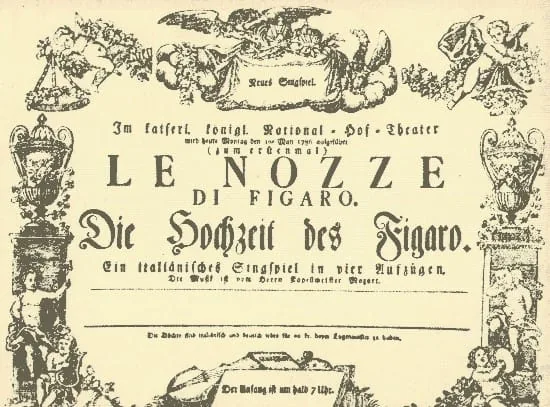
In January 1787, an audience in Prague heard a new symphony. Though it was their first time hearing it, the applause was thunderous, as if for an old favorite. There was a good reason for this: just a few weeks earlier, the city had been swept up in a frenzy over Mozart’s opera The Marriage of Figaro.
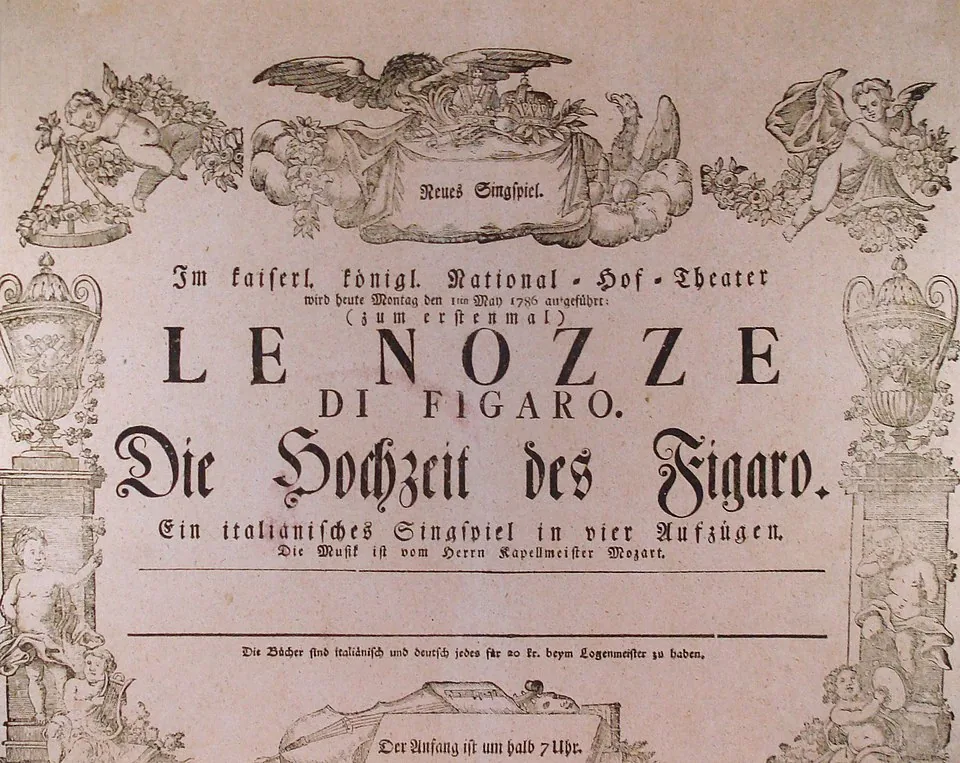
That same opera had closed in Vienna after a mere six performances. In Prague, it received a completely different welcome. After the curtain fell, its melodies spilled out into the streets, cafes, and ballrooms. Mozart himself later remarked, “My Praguers understand me.”
The symphony premiered amidst this feverish excitement is now known as the ‘Prague’ Symphony. Mozart completed it in December 1786 and conducted the premiere himself the following month. Its unusual three-movement structure makes it stand out even more.
Why Prague Embraced What Vienna Ignored
Mozart’s situation in 1786 wasn’t exactly comfortable. While The Marriage of Figaro was staged with the support of Vienna’s Emperor Joseph II, the aristocracy’s reaction was lukewarm. Their complaint? Why should they watch a story where a low-born servant outwits his noble master?
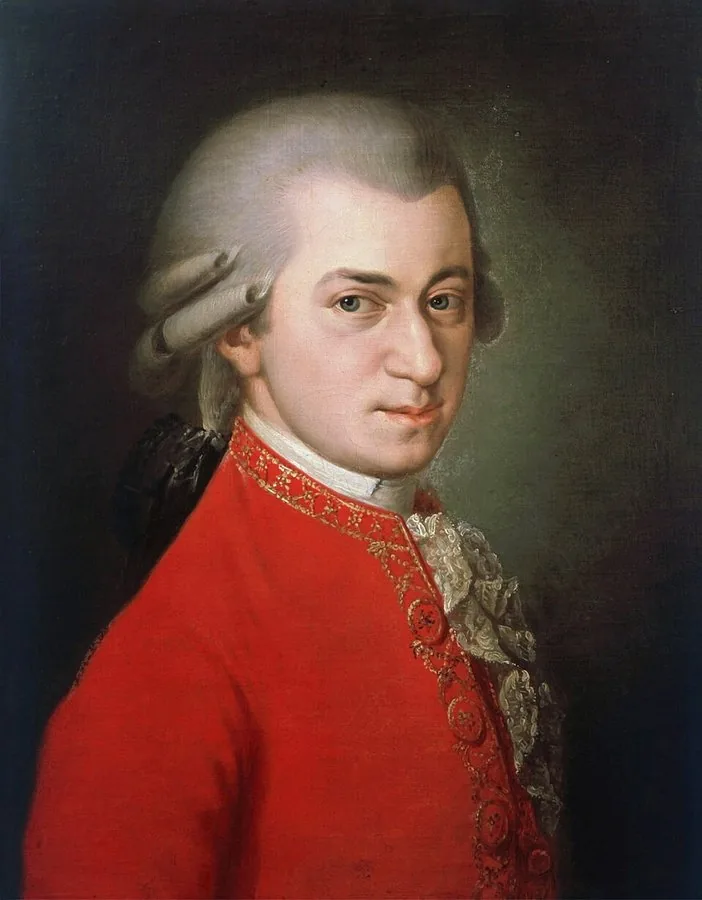
But the reaction in Prague was entirely different. At the time, the people of Bohemia (modern-day Czech Republic) were under the rule of the Habsburg Empire, living on its periphery. The story of Figaro standing up to power must have resonated with them on a personal level. It wasn’t just an opera; it felt like their own story.
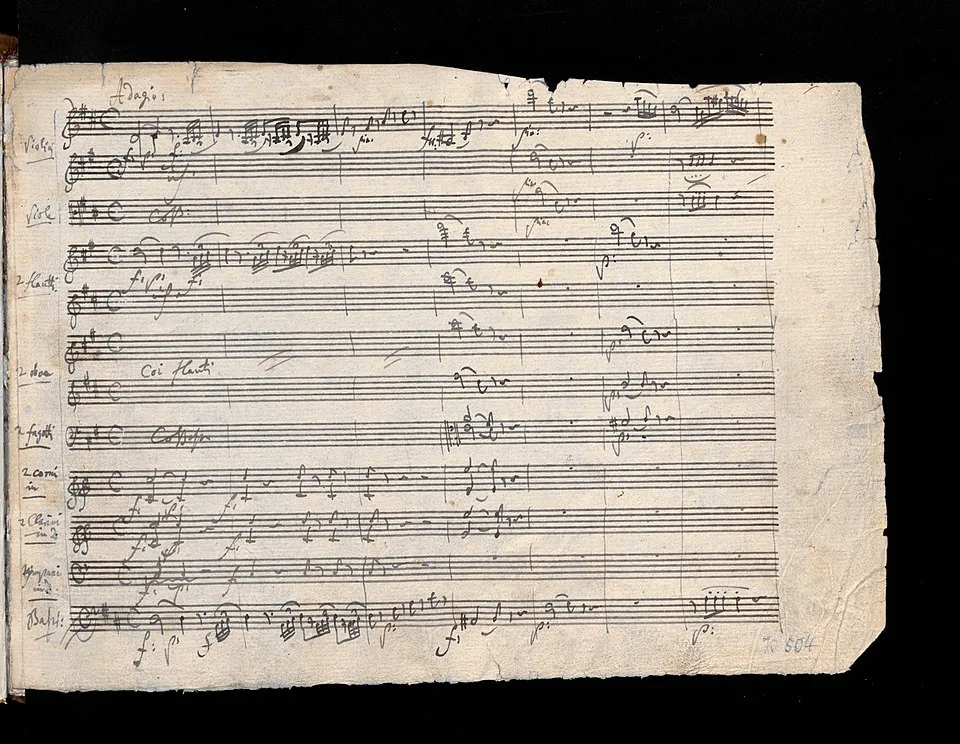
Mozart likely wanted to witness this enthusiasm firsthand. In January 1787, he traveled to Prague with his wife, Constanze, carrying the manuscript for this symphony. His autograph score is dated December 6, 1786, meaning it was a brand-new work, finished just weeks before his visit.
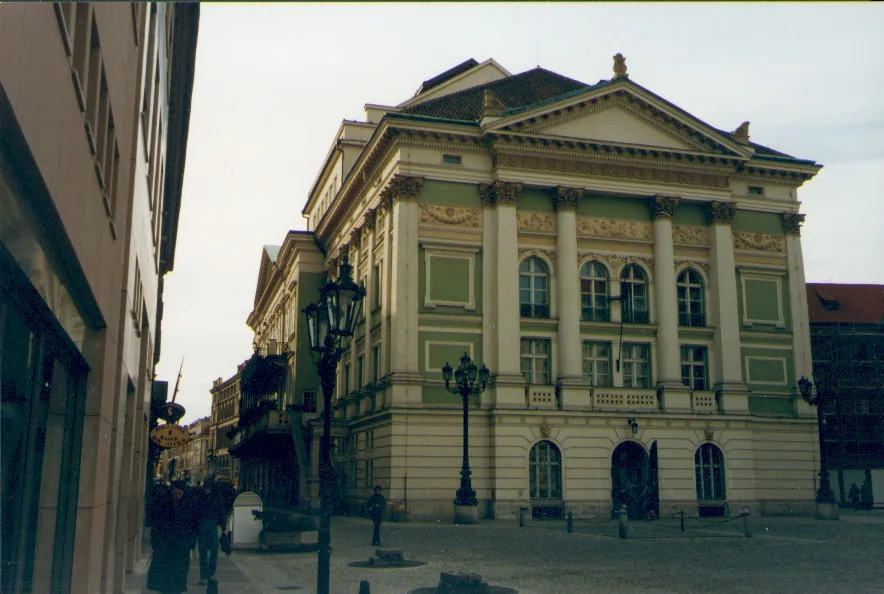
The premiere took place on January 19, 1787, with Mozart himself conducting. The audience was ecstatic. The response was so overwhelming that his next project was commissioned on the spot. The director of the Prague National Theater, Pasquale Bondini, asked for a new opera. The work born from that request was Don Giovanni.
Without Prague, there would be no Don Giovanni. This symphony effectively served as the prologue to that great opera. While the Viennese nobility turned their backs on Figaro, Prague gave it a standing ovation, and that applause became the foundation for Mozart’s next great work.
A Symphony Without a Minuet: The Meaning of the Three-Movement Structure
One thing makes this symphony particularly conspicuous among Mozart’s works: it has only three movements. The standard symphonic form of the era was four movements: a fast movement, a slow one, a minuet (a dance form), and another fast finale.
But the ‘Prague’ Symphony has no minuet. Among Mozart’s late symphonies, this is the only one with a three-movement structure. Was this a deliberate choice? Or did he simply run out of time and have to omit it?
Scholars are divided. Some argue he skipped it to finish the work quickly for his Prague trip, while others contend he intended a complete, self-contained structure without a minuet from the start. Whatever the reason, the result is clear. The absence of the minuet gives the symphony a more compressed, intense feeling. From the grand introduction of the first movement to the finale, it feels like it’s hurtling forward without a moment’s rest.
Interestingly, this choice makes the ‘Prague’ Symphony look like a preview of the genre’s future evolution. It was Beethoven who later transformed the minuet into the scherzo and redefined the four-movement structure, but Mozart provided a bold precedent by removing the minuet entirely. Whether this was an intentional experiment remains a mystery.
A Movement-by-Movement Guide
Mvt. 1: Tension from a Slow Introduction
The first movement, marked ‘Adagio-Allegro’, begins with a slow introduction followed by a fast main section. An introduction this long was not common in symphonies of the time. While Haydn used them in his later symphonies, the character of the intro here is quite different.
The atmosphere is immediately unsettling. The strings lay down a low D, but it feels unstable, and chromatic passages create a sense of aimlessness. Though the key is D major, there’s none of the key’s typical brightness. It’s like the uncertain path to an unfamiliar city, a mix of anticipation and tension.
The highlight of the movement is the moment this long introduction resolves and the Allegro begins. The strings present the first theme with a brisk energy, and the gloom of the intro vanishes in an instant. This dramatic contrast is the core of the first movement—a journey from anxiety to certainty, from hesitation to decision.
The development of the Allegro is quite intricate. Mozart develops multiple themes simultaneously, weaving different voices together in conversation. He unleashes his mastery of counterpoint—the technique of combining multiple independent melodic lines. In the development section, listen for the unsettling feeling created as the low strings descend chromatically, and then the sudden, bright burst that follows. It’s a moment that can make you sit up and take notice. This is where the influence of Mozart’s deep study of Bach’s counterpoint is most clearly felt.
Mvt. 2: An Andante Where Every Instrument Speaks
The second movement, an Andante in G major, steps back from the intensity of the first. Here, Mozart captivates the listener in a different way. The strings gently introduce the theme, like someone beginning a story at a walking pace (Andante).
But this story is not simple. Soon, the oboe joins in, the flute adds to the conversation, and the horns provide a soft backdrop. It’s interesting to note that there are no clarinets in this symphony’s orchestration. Why would Mozart, who adored the clarinet, leave it out? The reason was likely practical: he tailored the woodwind section around the oboe to fit the resources of the Prague orchestra.
That he could create such a rich soundscape without clarinets reveals just how flexible his approach to orchestration could be. In the middle section, the music briefly shifts to a minor key, casting a shadow before returning to the warmth of G major. The emotional impact of this return is special. The movement begins and ends quietly, but the dialogue within it is incredibly rich. It’s a movement that shows how a symphony can do more than just make sound; it can speak.
Mvt. 3: A Finale That Sprints Without a Minuet
Presto. Literally, “very fast.” With no minuet, the third movement has to absorb some of its role, but this Presto doesn’t dance gracefully. Instead of an elegant dance, it’s a breathless sprint.
The first theme begins in the strings, offering almost no time to breathe. The relentless forward drive of the rapid sixteenth notes is the lifeblood of this movement. But this finale is not just about ending with a bang. In the development section, Mozart brings back the contrapuntal techniques he used in the first movement.
The structure, where complex, interwoven melodies resolve into a clear, powerful statement, is proof of how meticulously this work was designed. Pay close attention to the moments where the music flows quietly and then suddenly erupts with the full orchestra at fortissimo (ff). It’s a classic Mozart joke, delivered without warning. Hearing it, you can easily imagine why the Prague audience went wild at the premiere.
When the finale concludes, the entire symphony feels like a single, cohesive entity. From the anxiety of the first movement’s introduction and the confidence of its Allegro, to the reflection of the second movement and the explosion of the third, it’s a complete journey—even without a minuet.
First Listen: What to Know
First and foremost, don’t miss the introduction to the first movement. If you have a habit of letting a symphony play in the background until the “main part” starts, that won’t work here. The first one to two minutes of tense, slow music are the key to the entire piece. You have to experience the thrilling contrast when the introduction ends and the fast section begins to fully appreciate the work’s initial charm.
Remember that this symphony has only three movements. You won’t be caught off guard expecting a fourth. The structure is concise, finished in just three breaths: Movement 1, Movement 2, Movement 3.
Keep your focus through the third movement. It’s easy to let a fast finale wash over you, but listen for the point in the middle where the melodies become tangled and complex. The feeling of release that comes after that “what is this?” moment is immensely satisfying. Hearing it will change how you perceive the entire movement.
The total performance time is around 30 minutes, a perfect length for a focused listen. Another interesting approach is to listen to this symphony after hearing Don Giovanni. The two works were born in the same context—Prague—and are like twins. Though in different genres, you can feel a similar atmosphere flowing through them. Comparing the dark colors of the symphony’s first-movement intro with the intensity of the Don Giovanni overture is particularly rewarding.
Why the ‘Prague’ Symphony Is Still Performed Today
Mozart’s final three symphonies (Nos. 39, 40, and 41 ‘Jupiter’) are often considered the pinnacle of the genre. As the work immediately preceding them, No. 38 sometimes receives less attention. But in the concert hall, it’s a different story. Many conductors love this piece, and the reason is likely the first movement’s introduction.
How that slow, chromatic introduction is interpreted can completely change the color of the entire work. It’s a piece rich with interpretive possibilities. The connection to Don Giovanni also makes it more compelling. The famous D minor chords of the Don Giovanni overture suggest death, threat, and dark fate—a mood that resonates strangely with the introduction of the ‘Prague’ Symphony. The fact that both were born in the same city around the same time doesn’t seem like a coincidence, does it?
Some musicologists also find the influence of Bach in this introduction. Just before composing this symphony, Mozart was intensively studying the works of Bach and Handel at Baron van Swieten’s salon in Vienna. It’s argued that this study is directly reflected in the contrapuntal writing of the introduction and the complex part-writing of the development section. This was a work that Vienna overlooked but Prague understood. That fact alone adds a special story to this symphony. It’s not the tired narrative of the unappreciated genius, but a story of a miraculous resonance between a city and an artist. Mozart and Prague were perfect partners, and this symphony is the proof of their meeting.
The Real Thrill of the Third Movement: Counterpoint and a Surprise Attack
To get the most out of the finale, remember one thing. In the middle development section, several melodies suddenly start playing at once. The technical term is ‘counterpoint,’ but you can think of it as a section where different parts sing their own tunes simultaneously, creating a tangled web of sound. It might sound complex at first, but as your ear adjusts, you can hear the individual parts chasing each other.
Right after this complex section ends, the entire orchestra suddenly erupts at fortissimo—very loud. There is no warning. It goes from quiet to a bang. This is Mozart’s signature humor, and it was moments like these that likely made the Prague audience cheer at the premiere.
We can’t know exactly how the audiences in Vienna and Prague differed. But based on their reactions to The Marriage of Figaro, it’s likely the Prague audience responded more to the content than the form. It’s fun to imagine how they would have received the jokes and surprises Mozart tucked into this third movement.
Creating Color Without Clarinets
Place this symphony next to Mozart’s other works from the period, and one difference stands out: the absence of clarinets.
Mozart loved the clarinet. He showcased its rich tone in many works, including his Clarinet Concerto in A major. Yet in this symphony, he uses only flutes, oboes, and bassoons. The clarinets are not included in the orchestration.
The reason was most likely the practicalities of the Prague orchestra. At the time, not all orchestras had clarinetists readily available. Mozart wrote for the instruments he had. But even without clarinets, the woodwind section in this symphony is plenty rich. The oboes absorb some of the clarinet’s role, leaving no gaps. In fact, the transparent sound created by the absence of clarinets gives the piece a unique character.
In contrast, his Symphony No. 39 in E-flat major, composed the same year, has no oboes but includes clarinets. Listening to the two symphonies back-to-back reveals just how flexibly the same composer could handle orchestration.
Why You Should Hear This Symphony Before the ‘Jupiter’
Mozart’s final three symphonies—No. 39, No. 40, and No. 41 ‘Jupiter’—are works that every classical music newcomer encounters. But if you listen to No. 38 ‘Prague’ before them, something changes.
No. 38 is smaller in scale and less famous than the final three, but it contains the seeds of elements that would be perfected in those later works: the dark tension of the first movement’s introduction, the contrapuntal development, and the energy of the finale. After hearing No. 38, if you listen to the last movement of No. 41 ‘Jupiter’, you can hear how the finale of the ‘Prague’ is almost a blueprint for the ‘Jupiter’s’ conclusion.
Of course, this might be an interpretation made with hindsight. In 1786, Mozart couldn’t have known he would write three more symphonies within two years. This symphony was a complete work in its own right, and that is the reality of the piece we hear today.
Listen with the Score
If you’d like to follow along with the score, the video below is recommended. It displays the score synchronized with a full performance.
The original score can be downloaded for free from IMSLP.
→ View the score for Symphony No. 38, K. 504 on IMSLP