December 16, 1893, Carnegie Hall, New York Anton Seidl / New York Philharmonic
Duration
Approx. 40 minutes
It’s 1969. Neil Armstrong, hurtling through the silent void of space toward the Moon, has a small cassette player. On it, a piece of music that feels both ancient and futuristic, a sound that bridges worlds. It’s Dvořák’s Symphony No. 9, “From the New World.” Fast forward to 2008. The New York Philharmonic, on a historic trip to Pyongyang, North Korea, performs for the country’s elite. The encore they choose? The Largo from that very same symphony.
How did a symphony written in 1893 by a Czech composer become an unofficial anthem for humanity, played in the most extreme and politically charged settings imaginable? The story of the New World Symphony is more than just notes on a page; it’s a story of immigration, ambition, a search for identity, and a bold declaration about the future of music.
New York Philharmonic’s 2008 performance in Pyongyang, conducted by Lorin Maazel.
## The Butcher’s Son Who Conquered America
Before New York, there was Nelahozeves, a small village on the Vltava river. This is where Antonín Dvořák was born, the son of an innkeeper and butcher. His father had a clear path for him: take over the family business. Music was a fine hobby, but a profession? Unthinkable. Yet, the pull was too strong. Dvořák defied expectations, scraped by, and honed his craft in Prague, slowly building a reputation.
His big break came from an unlikely corner: Johannes Brahms. The German master, usually grumpy and critical, saw the raw talent in Dvořák’s work. In 1877, Brahms wrote a glowing recommendation to his publisher, Fritz Simrock, kickstarting Dvořák’s international career.
But the biggest surprise was yet to come. Across the Atlantic, a wealthy philanthropist named Jeannette Thurber had a grand vision. She founded the National Conservatory of Music of America in New York City with the mission of creating a uniquely American school of classical music. To lead it, she needed a star. She needed Dvořák.
The offer was staggering: an annual salary of $15,000. To put that in perspective, it was about 25 times what he was earning in Prague. It was an offer he couldn’t refuse. In 1892, Dvořák and his family packed their bags for the New World.
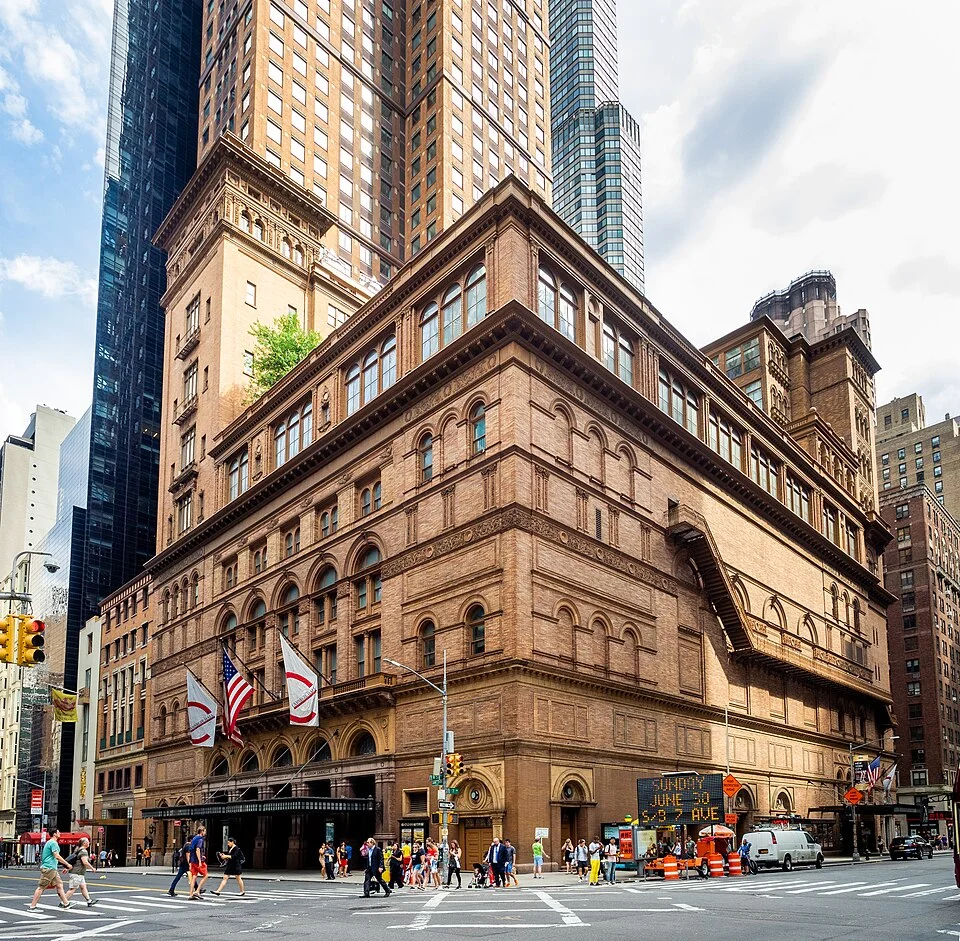
Carnegie Hall, the site of the symphony’s triumphant 1893 premiere.
## Finding Music in a New Land
Dvořák didn’t just come to New York to teach and collect a paycheck. He came to listen. He was fascinated by the sounds of the city, the energy, the mix of cultures. He wasn’t interested in mimicking the European masters he had left behind. He was searching for the folk music of America.
He found it in two powerful sources.
First, he was deeply moved by the African-American spirituals he encountered. One of his students at the conservatory, a young Black man named Harry T. Burleigh, would sing old plantation songs and spirituals for him. Dvořák was transfixed. He saw in them a power, a sadness, and a melodic richness that he believed was the bedrock of American music.
In a famous interview with the *New York Herald* on May 21, 1893, he made a declaration that sent shockwaves through the establishment: **”The future of music in this country must be founded upon what are called the Negro melodies.”** For a white European man of his stature to say this in 1893 was radical.
Second, he was captivated by the epic poem *The Song of Hiawatha* by Henry Wadsworth Longfellow, which romanticized Native American life and legends. He saw operatic and symphonic potential in the stories, particularly the scenes depicting Hiawatha’s wedding feast and the funeral of his wife, Minnehaha.
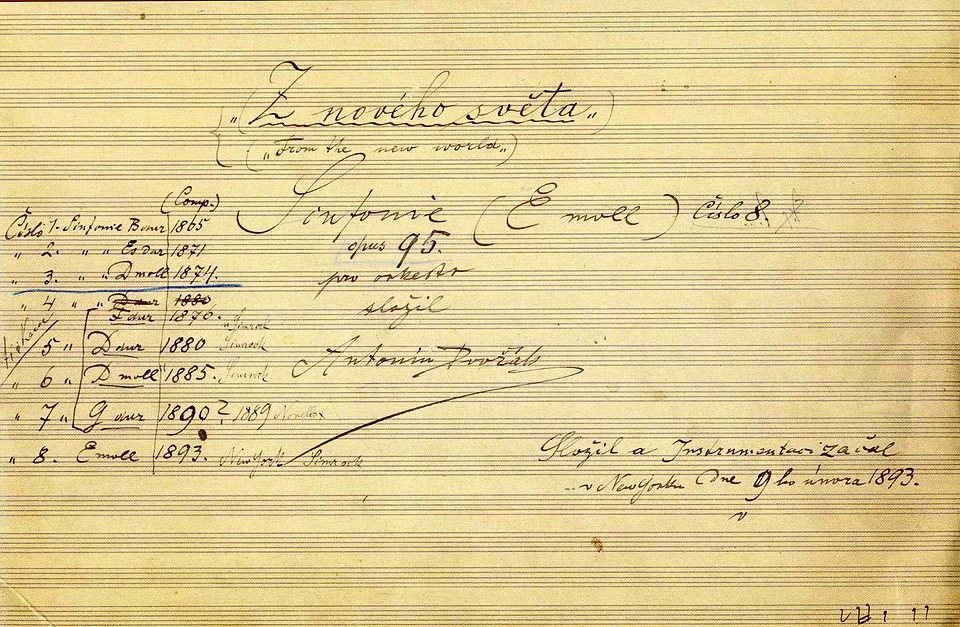
Armed with these influences, Dvořák retreated to his residence at 327 East 17th Street in New York City. Between January and May of 1893, he poured all these new sounds, ideas, and feelings into his new symphony.
A page from Dvořák’s manuscript. You can see the energy in his notation.
## A Movement-by-Movement Guide
Forget a dry analysis. Let’s listen to this symphony like a play-by-play sports commentary.
### **Movement I: Adagio – Allegro molto**
The opening is pure tension. The cellos hold a low, soft note, like the slow panning shot of a vast, empty landscape at dawn. It’s quiet but unsettling. Then, out of the mist, a syncopated, questioning phrase. Suddenly, BAM! A blast from the full orchestra, a jolt of energy. The main event has begun. The French horns introduce the iconic, syncopated main theme, a melody that feels like it’s constantly pushing forward. This movement is a clash of worlds: the quiet expanse of the American plains and the chaotic energy of New York City traffic.
### **Movement II: Largo**
This is it. The heart of the symphony. After a solemn procession of chords from the brass, the English horn enters with one of the most famous melodies ever written. It’s a song of profound longing, of homesickness, of spiritual depth. Dvořák originally gave this melody to the clarinet, but during rehearsals, he realized the English horn’s tone was closer to the sound he associated with Harry T. Burleigh’s voice. It’s so singable that one of Dvořák’s students, William Arms Fisher, later added lyrics to it, creating the beloved spiritual “Goin’ Home.” This movement is said to be inspired by the forest funeral of Minnehaha in Longfellow’s poem. It is a moment of absolute stillness and soul-searching.
The famous Largo, featuring the English horn solo.
### **Movement III: Scherzo. Molto vivace**
The wake is over. It’s time to dance. This movement is pure energy, inspired by the wedding feast scene in *Hiawatha*. The rhythm is relentless, almost furious. You can hear the stamping of feet, the whirl of celebration. But listen closely—in the midst of the party, Dvořák slyly re-introduces the main theme from the first movement, like a recurring memory or a premonition. It’s a brilliant trick, tying the whole symphonic story together.
### **Movement IV: Allegro con fuoco**
The title says it all: “Fast, with fire.” This is the finale, and Dvořák throws everything at it. A thundering theme from the brass announces the final chapter. This movement is a masterclass in symphonic storytelling, as themes from all three previous movements return, clash, and merge. The homesickness of the Largo, the celebration of the Scherzo, and the driving force of the first movement all battle for attention. Some have even suggested the relentless chugging rhythm was inspired by Dvořák’s lifelong obsession with railway trains. The symphony, which has been in the dark key of E minor for its entire duration, finally makes a dramatic shift in the closing bars. It lands on a triumphant, radiant E major chord—a Picardy third—a final blaze of hope and optimism.
The fiery finale, “Allegro con fuoco.”
## So, Is It Czech or American?
This question has fueled debates for over a century. Dvořák himself was clear: he used American sources as inspiration, not quotation. He didn’t lift a single spiritual or folk song directly. Instead, he absorbed their spirit—their pentatonic scales, their syncopated rhythms, their flattened “blue” notes—and filtered it all through his own Bohemian musical language.
The result is a hybrid. It’s a symphony that couldn’t have been written by an American at the time, because they were still trying to sound European. And it couldn’t have been written by Dvořák if he had stayed in Prague. It is the sound of an outsider looking in, hearing the music of a nation that the nation itself couldn’t yet hear, and showing it back to them in the grandest symphonic form.
## From Carnegie Hall to the Cosmos
The premiere on December 16, 1893, at Carnegie Hall was a sensation. The audience erupted in applause after every single movement, refusing to wait until the end. Conductor Anton Seidl and the New York Philharmonic had a monumental hit on their hands.
The symphony’s legacy, however, was just beginning.
– **1969:** Neil Armstrong chose it as the one piece of music to accompany him on the Apollo 11 mission to the Moon.
– **2008:** The New York Philharmonic used its famous Largo to build a bridge of cultural diplomacy in North Korea.
– **2019:** In a poll of 151 of the world’s leading conductors by BBC Music Magazine, the New World Symphony was voted the #4 greatest symphony of all time.
From a butcher’s shop in Bohemia to the streets of New York, from the stage of Carnegie Hall to the surface of the Moon, Dvořák’s Symphony No. 9 is more than just a piece of music. It is a journey. It’s a reminder that sometimes the most powerful art comes from listening to the voices that are just waiting to be heard.
## Follow the Score
For musicians and curious listeners, following the score reveals the intricate architecture of the piece. You can see how the themes are passed between instruments and how the different movements’ motifs are woven into the finale.
## Related Articles
* Dvořák, Cello Concerto in B minor, Op. 104
* Dvořák, Symphony No. 8 in G major
* Brahms, Symphony No. 3 in F major
Copyright notice · The Classic Note does not permit unauthorized reproduction, reposting, redistribution, or translation of its articles. Brief quotations are allowed only with clear attribution and a link to the original page. Please contact us for reuse or collaboration requests.