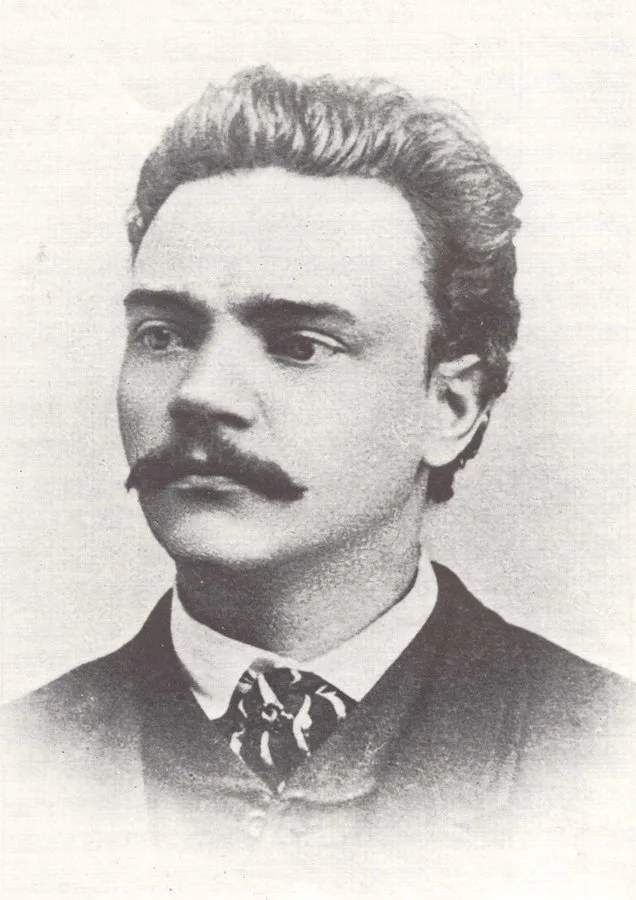
- Composer
- Antonín Dvořák
(1841–1904) - Work
- Piano Concerto in G minor, Op. 33, B. 63
- Composed
- Late August – 14 September 1876 (autograph). Extensively revised in 1882–1883 before publication.
- Movements
- Three movements
I. Allegro agitato
II. Andante sostenuto (D major)
III. Finale. Allegro con fuoco - Instrumentation
- Pf · 2 Fl · 2 Ob · 2 Cl · 2 Bsn · 2 Hn · 2 Tpt · Timp · Strings
- Premiere
- 24 March 1878, Provisional Theatre (Prozatímní divadlo), Prague
Piano: Karel Slavkovský
Conductor: Adolf Čech - Published
- 1883, Hainauer (Wrocław)
- Duration
- c. 38–40 minutes
“There is nothing in Liszt that is anywhere near as difficult to play as the Dvořák Piano Concerto. It is one of the most ungainly bits of piano writing ever printed.”
— Leslie Howard, the pianist who recorded the complete Liszt
“I see I am unable to write a Concerto for a virtuoso.”
— Antonín Dvořák, while writing the piece
It is unusual for one work to provoke two surrenders of this magnitude — one from the most authoritative living interpreter of nineteenth-century virtuoso piano music, the other from the composer himself. For roughly a hundred years this concerto (Op. 33) sat in a corner of the repertoire that almost nobody looked into. Then it was reborn. Twice. This is the story of Dvořák’s Piano Concerto in G minor.
The Forgotten Eldest of the Three Concertos
If you ask a general classical listener which Dvořák concerto they know, almost everyone names the Cello Concerto. A smaller circle adds the Violin Concerto of 1879. Push back another seven years and you arrive at the Piano Concerto of 1876 — and at that point, even seasoned concertgoers tend to blink. There is a Dvořák piano concerto? Yes. And it was the first of the three.
The first one written, the last one absorbed into the canon. Even Dvořák himself dragged his feet for seven years before letting a publisher have it. He completed the autograph on 14 September 1876, but did not send the manuscript to Hainauer until 1883. In between, he kept circling back to the same pages, crossing out, rewriting, layering corrections on top of corrections.
The pattern of those corrections tells you something the catalogue won’t. The orchestral writing was left more or less alone. The piano part is where the eraser lived. For seven years, the composer doubted his own soloist’s hand — and arguably never stopped doubting it. The concerto he finally released into the world was a concerto he had not fully made peace with.
A Century of Criticism in One Phrase: “As If for Two Right Hands”
By the late nineteenth century, a particular line had begun to circulate among pianists: “as if for two right hands.” The solo writing in this concerto was so awkward, the saying went, that even your left hand started to feel like a right one — stiff, uncooperative, in the wrong place at the wrong time. Nobody is sure who said it first. That is exactly what makes it interesting. A line nobody can claim is usually a line everyone secretly agreed with.
In 1883 the publisher Robert Lienau wrote directly to the composer:
“Like Beethoven, you choose to merge the piano closely with the orchestra, and this may not appeal to today’s concert artists.”
— Robert Lienau, letter to Dvořák
This is essentially a disclaimer typed on company letterhead and mailed in advance. The twentieth century inherited the assessment without much fuss. Harold C. Schonberg, the longtime New York Times critic and author of The Great Pianists, dispatched the work with a phrase: “a rather ineffective piano part.”
What that hundred-year chorus actually means is worth pausing on. The concerto is not poorly made. It is differently made. It does not belong to the line that runs from Chopin through Liszt to Rachmaninoff, where the keyboard sits up front and the orchestra holds its coat. It belongs to the other line — Beethoven’s Fourth, Brahms’s First, eventually Bartók’s First — concertos in which the piano refuses to play the hero. The Dvořák sits, almost exactly, in the middle of that family.
The Year Three Children Died
The biography turns the music sideways. Lay the dates next to one another and the piece stops sounding the way it did a minute ago.
- August 1875 — Josefa, the youngest daughter, dies two days after she is born.
- Late August – 14 September 1876 — Dvořák completes the autograph of the Piano Concerto.
- August 1877 — His daughter Růžena dies after accidentally ingesting phosphorus.
- September 1877 — His son Otakar dies of smallpox.
So this concerto was written one year after the death of the composer’s first child, and twelve months before he lost the other two. The grief that followed produced the Stabat Mater of 1877, the work everyone reaches for when they want to talk about Dvořák’s bereavement. The choral piece is so large and so devastating that it casts a long shadow, and the concerto written in the same emotional weather has tended to sit in that shadow unnoticed. The autograph carries the date 14 September 1876. On that page, the D major horn entry of the slow movement begins.
Dvořák attached no program to the music. You can listen with no biographical context and miss nothing technically. But knowing and not knowing are different listening experiences. The poise of the D major Andante reads differently once you know it was set down in September 1876. The notes do not change. Their weight does.
The Vanishing Dedication: The Hanslick Mystery
Dvořák intended to dedicate the concerto to Eduard Hanslick, the most powerful music critic in Vienna. By the time the score appeared from Hainauer in 1883, the dedication was gone. No surviving document explains who removed it, when, or why.
To grasp the size of the missing line, you need to know who Hanslick was. He was the imperial gatekeeper of Viennese musical opinion, the chief antagonist of the Wagner camp, and the most loyal flag-bearer for Brahms. In late-nineteenth-century Vienna, a single sentence in a Hanslick column could redirect a composer’s career.
The would-be dedication makes immediate sense in context. Brahms had discovered Dvořák in 1877 and recommended him to the publisher Simrock — the introduction that effectively launched his international reputation. Bowing toward Brahms’s most influential critic was a logical professional gesture. The most plausible scholarly guess is that Dvořák himself withdrew the dedication during the 1882–1883 revisions, just before publication. No letter has surfaced to confirm it. The case sits open.
What the vanished dedication exposes is less the politics of the score than the psychology of the composer. A man who had spent seven years quietly second-guessing his own solo writing was on the verge of laying that work at the feet of Vienna’s most feared critic — and pulled back at the last moment. The same hesitation that pencils corrections all over an autograph also, apparently, lifts a name off a title page.
Inside the Three Movements
I. Allegro agitato — A Concerto That Withholds Its Pianist for Four Minutes
The Italian marking does not pretend. Allegro agitato means, more or less, “fast and unsettled.” Add the fact that the soloist does not enter for nearly four minutes and the character of the piece is on the table before a single keyboard note sounds.
📜 Score reference: Dvořák Piano Concerto Op.33 — I. mm. 1–16 (IMSLP link unavailable)
The orchestra trades the G minor material around itself without help. Beethoven’s Fourth Concerto startled its first listeners by opening with solo piano; this concerto produces a comparable surprise by going in the opposite direction. The introduction feels less like the curtain on a concerto than the opening of a G minor symphony. By the time the soloist arrives, the center of gravity is already firmly planted in the orchestra.
And the entry, when it comes, is not a virtuoso’s arrival. There is no flashing cadenza — the unaccompanied solo display in which the orchestra steps back and the keyboard does its acrobatics — to mark territory. The piano slips into the orchestral texture as one voice among others. From that point onward it remains a partner rather than a star, sharing the weight equally.
📜 Score reference: Dvořák Piano Concerto Op.33 — I. around mm. 180–210 (the passage Kurz reworked most heavily — the “two right hands” exhibit) (IMSLP link unavailable)
This is the stretch critics circled for a hundred years. The figuration sits awkwardly under the hand; passages refuse to fall where the fingers expect them to. It is also the section Vilém Kurz reworked most aggressively eight decades later. The clip below shows what the same notation can do when shaped by a different sensibility on the keyboard.
🎬 Find on YouTube: Dvorak Piano Concerto Sviatoslav Richter Carlos Kleiber
II. Andante sostenuto — The Horn Offers Consolation First
“In a sustained walking pace.” The key turns from G minor to D major — the dominant, a fifth up. The composure of these nine minutes makes it almost impossible to believe their author was in the middle of burying children in the same calendar year.
📜 Score reference: Dvořák Piano Concerto Op.33 — II. first horn statement (IMSLP link unavailable)
The theme is given out, gently, by the horn. The piano takes it up and shapes a soft variation. As in the first movement, the soloist is a conversational partner rather than a hero — the most disciplined nine minutes in a forty-minute work.
If this is your first listen, do not start at the beginning. Begin with the Andante and circle back to the opening movement once its tone is in your ear. Eighteen minutes of the Allegro agitato is a lot to face cold; the slow movement is the friendliest doorway into the piece.
🎬 Find on YouTube: Dvorak Piano Concerto Sviatoslav Richter Carlos Kleiber
III. Finale. Allegro con fuoco — Arrival, Not Coronation
“Fast, with fire.” G minor at the curtain, G major at the coda — the closing section that ties off the work.
📜 Score reference: Dvořák Piano Concerto Op.33 — III. coda, G minor → G major (IMSLP link unavailable)
The genre’s instincts tell you that this is where the piano should turn loose. Audiences should rise out of their seats; the soloist’s hands should fly across the keyboard from end to end; the orchestra should be furniture. Dvořák refuses every one of those instincts. The finale honors the same rule of equal partnership the earlier movements set up. Even the coda’s swing to G major arrives as something the whole ensemble walks into together, not a private catharsis for the keyboard.
If you came in expecting the final-bar payoff of Tchaikovsky’s First or Rachmaninoff’s Second, the ending will feel tepid. The kindest way to read that disappointment is to recognize what it actually means: the composer kept his promise. From the first movement onward he refused to write the kind of concerto that ends with the soloist standing alone in a spotlight, and he refuses again at the last possible moment to break his own rule. The integrity of that refusal is half the point.
Vilém Kurz’s Eighty Years — and One Hour in Munich, June 1976
The real drama of this concerto begins after the composer is dead. Sometime in the 1890s, Vilém Kurz, the founding figure of the Czech piano school, rewrote large portions of the solo part. The stated justification was straightforward: the original lay so awkwardly under the hand that it needed to be reshaped along more “pianistic” lines. A posthumous rewrite of a major concerto by a later teacher is genuinely rare in the repertoire. This one happened.
The decisive moment came in 1919, when Kurz’s daughter Ilona Kurzová premiered her father’s revised version with the Czech Philharmonic under Václav Talich. Fifteen years after the composer’s death, the same piece had effectively been premiered twice. For the next eight decades, the Kurz revision was the standard. Recordings, scores, and concert programs all used it.
Then, in June 1976 in Munich, Sviatoslav Richter and Carlos Kleiber walked into the EMI studios with the Bavarian State Orchestra and recorded the original text for the first time in living memory. One album overturned eighty years of consensus.
That Kleiber barely recorded any concertos at all sharpens the message. His commercial concerto recordings can be counted on one hand. The fact that he chose this one, and chose to do it from the score that had been pushed to the margins for nearly a century, was a statement in itself.
The deeper plot twist came afterward. Rudolf Firkušný was a direct pupil of Kurz. His 1954 Cleveland recording with George Szell uses his teacher’s version. By the 1970s, the same Firkušný had quietly set that version aside and returned to the original. This was a generational fracture inside the Czech piano school itself, and one of the few documented cases where a single studio recording redirected an academic lineage.
The 2004 facsimile of the autograph from G. Henle Verlag, with a preface by András Schiff, accelerated the return. Twenty-first-century recordings tilt steadily toward the original. The Kurz revision has not vanished, but it has shifted into the historical-document category. A single album, in other words, eventually moved the editorial scholarship behind it.
🎬 Find on YouTube: Dvorak Piano Concerto Sviatoslav Richter Carlos Kleiber
Three Reasons to Spend Forty Minutes With This Piece
First, almost nobody around you is listening to it. If you are at the point in your classical-listening life where you want repertoire that does not appear on every “Top 50 Greatest” playlist, this concerto is unusually well-suited. There is also still relatively little serious long-form writing about it in English outside of academic journals, which means a fair amount of the satisfaction comes from piecing your own observations together as you listen.
Second, if you already love the Cello Concerto of 1894–1895, this is the first chapter of the same story. Hearing what the same composer was trying eighteen years earlier — what he was attracted to, what he was suspicious of, what he had not yet figured out — is its own kind of pleasure.
Third, the concerto was published with its composer’s explicit confession that he could not write a virtuoso concerto attached to it. That kind of authorial self-doubt does not survive into print very often in the nineteenth century. Listening to the work with that confession in mind is a different experience from listening to a piece that pretends to be confident. The same notes carry a different humility.
One honest warning. If you want the kind of concerto whose final chord lifts you out of your chair, this one is not built for that. The first movement runs about eighteen minutes — almost half the total length — and most of those eighteen minutes are weighted toward equal dialogue rather than soloistic display. For a first encounter, the Andante is by far the more inviting door.
Four Recordings, Four Personalities
Richter & Kleiber (Bavarian State Orchestra, EMI 1976, original text). Less a definitive performance than an event. This is the recording that pulled the original score back out of the storeroom after eighty years, and the tension Richter brings to the first movement has never quite been matched since. You cannot really write about this piece without it.
The reason I put it first is non-musical. Carlos Kleiber recorded almost no concertos in his lifetime. The fact that this is one of them is, in itself, the strongest possible advocacy any concerto could receive.
The downsides are real. The 1976 EMI sound shows its age, and the level of intensity Richter sustains is genuinely demanding. If this is your first encounter with the piece, you may walk away thinking Dvořák is harder work than Dvořák actually is. It is more rewarding as a second listen than as an introduction.
Ivo Kahánek & Jakub Hrůša (Bamberg Symphony, Supraphon 2019, original text). Winner of the 2020 BBC Music Magazine Award. As close to a definitive twenty-first-century reading as you are likely to find — Czech musicians playing the composer in their native musical language, with the latest engineering and a disciplined sense of balance.
This is the one to start with. If you arrive expecting the historical urgency of the 1976 release, you may find this version too poised. It is exactly right if “definitive standard” is what you want.
For listeners who measure a concerto recording by whether the final bar lifts them out of their seat, this is not the first choice. Save it for second.
Firkušný & Szell (Cleveland Orchestra, Sony 1954, Kurz revision). The most “concerto-like” of the four to listen to. The solo writing is more brilliant on the surface, and the fingers fall more comfortably under the hand.
The real value of this recording, though, is documentary rather than musical. It is the last-generation testimony of a direct Kurz pupil playing his teacher’s text — and the same Firkušný later set that text aside and returned to the original. Listening with both halves of his career in mind turns the album into a kind of small documentary about how performance traditions actually shift.
One audience this recording will not suit. If you only want to know the original, this is going to sound like a different piece. It is not the right place to start.
Richter & Kondrashin (Czech Philharmonic, live, Praga Digitals 1966, original text). A live document from ten years before the Kleiber studio recording. Early evidence that Richter had committed to the original score well before the world caught up, and a live performance that, in its rawness, hits harder than the 1976 reading.
The sound is rough. This belongs in your collection as a second purchase, picked up specifically to hear how the same soloist approached the piece a decade earlier and in concert rather than under studio lights. The grain of the live 1966 acoustic is part of the document.
Recommended Video Performances
🎬 Find on YouTube: Dvorak Piano Concerto Sviatoslav Richter Carlos Kleiber
Kahánek & Hrůša / Bamberg Symphony / 2019 — the safest first listen and the leading twenty-first-century reading of the original text.
🎬 Find on YouTube: Dvorak Piano Concerto Sviatoslav Richter Carlos Kleiber
Richter & Kondrashin / Czech Philharmonic, live / 1966 — recorded a decade before the Kleiber album, by the same soloist who would lead the original-text revival.
Listening With the Score
- I. mm. 1–16 — the orchestral introduction (the opening four minutes that withhold the pianist entirely).
- I. around mm. 180–210 — the passage critics have circled for a century, and the section Kurz reworked most heavily.
- II. First horn statement (D major) — the moment of consolation, written in September 1876.
- III. The coda — the point of arrival, G minor to G major.
The 1883 Hainauer first edition is freely available on IMSLP. The scholarly reference text is G. Henle Verlag’s HN 3215, the 2004 facsimile of the autograph with a preface by András Schiff. If you want to compare the original with the Kurz revision passage by passage, opening both on the same desk is the fastest way to see where the two versions diverge.
Frequently Asked Questions
I had no idea Dvořák wrote a piano concerto. How does it compare to the Cello Concerto?
What does “as if for two right hands” actually mean?
Should I listen to the original text or the Kurz revision?
The first movement feels very long. Do I have to listen all the way through?
How does Dvořák’s family tragedy figure into this piece?
Was the missing Hanslick dedication ever explained?
Further Reading
- Dvořák Cello Concerto in B minor, Op. 104 — where the same composer arrived eighteen years later
- Brahms Piano Concerto No. 1 in D minor, Op. 15 — the other man who wrote a concerto as a symphony
- Beethoven Piano Concerto No. 4 in G major, Op. 58 — where the nineteenth-century refusal of virtuoso display starts