Debussy’s Préludes, Books 1 & 2 — What the Impressionist Label Hides

What the Impressionist label hides

Debussy
Félix Nadar, c.1908, Public Domain
Composer
Claude Debussy
(1862–1918)
Work
Préludes, Books 1 & 2
Composed
Book 1: December 1909 – February 1910
Book 2: 1912 – early 1913
Movements
12 pieces per book, 24 total
(no key-cycle ordering)
Scoring
Solo piano
Premiere
Book 1 partial premiere: 25 May 1910, Société musicale indépendante (a contemporary-music society in Paris that championed new works), Debussy himself at the piano, four pieces only
Book 2 partial premiere: 5 March 1913, same society
Catalogue
L. 117 (Book 1), L. 123 (Book 2) — the “L.” refers to musicologist François Lesure’s catalogue of Debussy’s works

In September 1908, Debussy sat down to write to his publisher Jacques Durand. The line that came out, in plain French: “Impressionism — that’s the very word critics always use inappropriately, especially when they want to disguise their ignorance.”

It is also the word Wikipedia, every “Classical 101” survey class, every Spotify editorial blurb, and the back of every drugstore-bin Debussy CD have used to describe him for the better part of a century. Once you know where he hid the titles of his twenty-four Préludes, that label starts to feel less like a description and more like a coat someone draped over a man who was actively trying to take it off.

Twenty-four titles, all tucked under the last bar in parentheses

April 1910. Durand prints Book 1. The cover lists no titles. Open the score — still no titles at the top of any piece. Each prelude begins with a tempo marking in French and nothing else.

Then you reach the last measure. There, in tiny type, set below the final barline: “…(Danseuses de Delphes).” Three dots, a parenthesis, the title, a parenthesis. As if the piece is muttering its own name to itself after the room has emptied.

This is closer to a provocation than a layout decision. The whole tradition of program music — Berlioz’s Symphonie fantastique, Liszt’s tone poems — works in one direction: title first, music second. The listener reads “Witches’ Sabbath,” primes the imagination accordingly, then watches the music supply the pictures. Title is the prompt; music is the illustration.

Debussy inverted the entire transaction. You hear the music first. The last chord decays. Only then, like a faint after-image, the title arrives. “…oh. So that was Delphic dancers.”

The Henle Urtext edition (the German scholarly edition that goes back to Debussy’s autograph manuscripts and the corrected first printing) puts it plainly in its preface: this placement is “the composer’s most careful aesthetic choice, designed to prevent the title from dictating the music.” Read the title up front and the music shrinks into a footnote to the words. Hide the title at the end and the music is allowed to be itself for five minutes before being named.

📜 악보 지점: 드뷔시 전주곡 1권 1번 Danseuses de Delphes 마지막 페이지 ‘…(제목)’ 표기 (IMSLP 링크 미등록)

And then there is the speed at which all this happened. December 1909 to February 1910. Three months. Twelve pieces. He started Book 1 roughly two months after being diagnosed with rectal cancer. The scholarly consensus is that the cancer diagnosis sharpened a sense of running clock — Debussy worked faster after October 1909, not slower. With the deadline of his own body suddenly visible, he chose this — the most provocative notational gesture of his career — for the work he wrote in that window.

1908: the year the composer himself flinched at the word “Impressionism”

The full sentence in Debussy’s September 1908 letter to Durand reads: “L’impressionnisme… voilà bien le mot que les critiques emploient toujours mal à propos.” Roughly: “Impressionism — there’s the word critics always misuse.”

The temperature rises in the next line. Critics, he wrote, reach for the label specifically to cover their own incomprehension. They do not understand what he is doing, so they slot him next to Monet and Renoir and call it a day. Debussy, who had spent his life in cafés with poets and bookshops with novelists, found the comparison both lazy and embarrassing.

So whose influence did he actually claim? Not Monet. Not Renoir. Not Sisley. He pointed to Verlaine, Baudelaire, Mallarmé. Poets. More specifically, Symbolist poets — the movement that taught a generation of artists to chase suggestion over statement, hint over depiction. Musicology has been quietly tilting since the 1990s away from “Debussy the Impressionist” toward “Debussy the Symbolist,” and the reason is sitting right there in his bookshelf and his correspondence.

Look at the titles of the Préludes themselves. Book 1, No. 4 — Les sons et les parfums tournent dans l’air du soir (“Sounds and scents turn in the evening air”) — is a line lifted verbatim from Baudelaire’s poem Harmonie du soir. Book 1, No. 8 — La fille aux cheveux de lin — borrows its title from a poem by Leconte de Lisle. Book 2, No. 9 — Hommage à S. Pickwick Esq. P.P.M.P.C. — points across the Channel to Dickens’s Pickwick Papers. Every borrowed phrase, every literary nod: words on a page, not pigment on a canvas. The “Impressionist” label survives only if you don’t look at the references.

And yet a century later, English-language program notes still open with the line. “One of the great masters of musical Impressionism.” Spotify says it. The Wikipedia opening paragraph still hedges around it. Most concert-hall annotators still cannot resist the comparison to Monet’s water lilies — usually paired with a Monet thumbnail next to the album art, in case anyone was still in doubt. The composer’s own published, dated, ink-on-paper objection has been politely ignored for more than a hundred years.

Six pieces from the twenty-four, examined up close

Book 1, No. 6 — Des pas sur la neige (“Footprints in the Snow”)

Above the first bar of the autograph score, Debussy himself wrote a directive that almost no other composer would have signed off on. “Ce rythme doit avoir la valeur sonore d’un fond de paysage triste et glacé.” Translation: “This rhythm should have the sonic value of the background of a sad and frozen landscape.”

Not a tempo marking. Not a dynamic. A weather report. The instruction is, essentially: don’t play this. Be the air around this.

And what does he ask the pianist to actually do? The entire piece runs on four notes. D, E, F, G. A four-note motif repeats from bar one to the end of bar thirty-six, like footprints in fresh snow. What changes underneath is the harmony and the dynamic shading. The footprints stay the same. The walker keeps moving. The landscape keeps revealing different cold corners.

Pianists who teach this piece tend to describe it the same way: a kind of minimalism in which the weight of each note is different from the weight of every other note. There is a much-told anecdote from Michelangeli’s 1978 traversal — the entire hall holding its breath in the gap between two beats of a single measure. An audience refusing to exhale because of four notes. That is what the piece does when it works. Four notes, five minutes, an entire emotional climate.

📜 악보 지점: 드뷔시 전주곡 1권 6번 Des pas sur la neige 1마디 지시문 (IMSLP 링크 미등록)

Book 1, No. 8 — La fille aux cheveux de lin (A twenty-eight-year-old self-quote)

The Girl with the Flaxen Hair is, statistically, the Debussy most listeners meet first. It is the prelude that turns up in perfume commercials, in movie soundtracks, in the hold music of upscale dentists, in the soft-rotation classical playlists that hotel lobbies pay licensing fees for. If you grew up anywhere near a television, you have heard it. You probably can’t name it. You will recognize it within four bars.

Here is what the lobby Spotify will not tell you. The melody did not appear in 1910. It appeared in 1882. Debussy was a twenty-year-old conservatory student. He set Leconte de Lisle’s poem La fille aux cheveux de lin as a song for voice and piano — catalogued by Lesure as L. 81 — and then promptly filed it away. Twenty-eight years later, at age forty-eight, with rectal cancer in his body and a reputation as the leading French composer of his generation, he reached back into the drawer, pulled out the melody he had written as a music student, and rewrote it for solo piano.

Lesure’s catalogue shows the comparison measure by measure. L. 81 (1882) and L. 117 No. 8 (1910) are not “inspired by” each other or “thematically related.” They share the same opening melodic line, almost note for note, with the prelude smoothing the contour and reharmonizing the bass. It is the work of a twenty-year-old self being unearthed and given a second life by a forty-eight-year-old one.

Calling this self-plagiarism feels too cynical for what it actually is. It is more like a composer at the end of his life cycling back to find his own younger voice still usable, still good, still saying the thing he wanted to say. The melody in the perfume ad is older than the prelude. The man who wrote it had been carrying it around in his head, in some pocket of memory, for the entire length of his adult composing career.

Book 1, No. 10 — La cathédrale engloutie (The piece where the composer overruled his own printed score)

The legend: there was a city called Ys that sank into the sea. On certain mornings, when the fog is right, the cathedral rises again from the water for a few moments. You can hear the bells. You can hear the monks chanting. Then it sinks back.

That much you can read in any record-sleeve essay. The story that doesn’t make the sleeve is what happened in 1913, when Debussy walked into the Welte studios in Germany and sat down at one of their reproducing pianos.

The Welte-Mignon system was the most accurate piano-recording technology of its time. As the pianist played, the machine punched holes in a paper roll capturing not just the notes but the dynamics and pedaling. Played back on a properly maintained Welte instrument, the roll reproduces the performance — a paper photograph of a pianist’s hands. In 1913, Welte invited the major composers of Europe to record their own work. Debussy showed up. He recorded La cathédrale engloutie.

And his own performance contradicted his own printed score. Specifically: bars 28 to 40, the passage where the cathedral rises and the bells start to ring. The Durand edition tells the pianist to play this section at a tempo that, followed literally, produces something close to a stained-glass freeze-frame. Debussy on the piano roll plays it at exactly twice that speed.

For seventy years, no one made much of this. Then in 1983, the Australian musicologist Roy Howat published Debussy in Proportion, sat down with the metric structure of the entire piece, and reached a conclusion that has slowly rewritten how the piece is played. Howat’s argument: the printed score contains a typesetting error in this passage — half-note values were mis-set as quarter notes — and the piano roll preserves Debussy’s actual intent. The slow, processional bells you’ve been hearing on every recording made before 1990 are, in Howat’s reading, a century-long printer’s mistake.

Howat’s reading is now close to consensus. Zimerman’s 1991 Deutsche Grammophon recording took the “double-tempo” reading. So did most performers who came of age after that. If you bought a Debussy recital album in the last twenty years, you almost certainly bought the Howat interpretation. Meanwhile, the older lineage — Gieseking, Michelangeli, anyone trained in the direct Debussy succession — keeps playing it the slow way, on the principle that the printed score should be obeyed. It is one of the few cases in piano repertoire where two completely different performance traditions coexist, each citing the composer himself for support. You get to choose which Debussy you believe.

📜 악보 지점: 드뷔시 전주곡 1권 10번 La cathédrale engloutie 28-40마디 박자 비교 (IMSLP 링크 미등록)

Book 2, No. 1 — Brouillards (A bitonality experiment hiding under the title “Fog”)

Right hand: white keys only. Left hand: black keys only. Simultaneously.

The white keys outline a C-major collection. The black keys outline something close to an F-sharp pentatonic. Press both together and what you get is two key centers stacked on top of each other, vibrating against each other, refusing to resolve. For 1912, this is essentially a working experiment in bitonality — the technique of writing in two keys at once, the technique that twentieth-century textbooks usually credit to Stravinsky and Milhaud and Bartók.

Stravinsky had used the now-famous “Petrushka chord” (a C-major triad stacked against an F-sharp-major triad) in 1911, one year earlier. Brouillards arrives a year later but does the same thing differently — and, crucially, it does it on solo piano, in a context that puts the bitonal stacking front and center for the listener’s ear. It is widely credited as a direct stepping stone toward the bitonal writing that would shape Bartók’s middle-period piano music and Milhaud’s later orchestral works.

And the title is “Fog.” The most innocuous possible word. Look at the cover, and you would assume this is the most “Impressionist” of the lot — a pianistic Monet, all blurred edges and atmosphere. Look at the score, and you discover what Debussy actually put under that word: a structural experiment in tonal collision that points forward to the next forty years of European modernism. The gap between the label and the contents is wider in Brouillards than in almost any other piece in the collection.

Book 2, No. 9 — Hommage à Pickwick (The British national anthem, ridiculed in eight bars)

The full title is one of the more genuinely funny things in the collection: Hommage à S. Pickwick Esq. P.P.M.P.C. The acronym at the end is Dickens’s own — “Perpetual President, Member of the Pickwick Club,” the title Samuel Pickwick bestowed upon himself in The Pickwick Papers. So the piece is a musical bow to a fictional Victorian gentleman who is, in the novel, kind of a pompous old fool dressed up in club regalia.

The opening eight bars quote God Save the King. Straight. No disguise. The melody arrives in a stately register, with the score-marking “Avec une gravité un peu pompeuse” — “with a slightly pompous solemnity.” The British national anthem walks into the room, draped in ceremonial robes, looking very pleased with itself.

And then, at bar nine, the legs go out. The melody starts to wobble. The harmony slips sideways. The rhythm trips over its own dignity. The robes turn out to be too big for the man wearing them. The pompous solemnity collapses into something closer to a music-hall sketch — Pickwick, the fat old president of his own invented club, exposed as exactly the comic figure Dickens drew him as.

Debussy’s revenge on the British Empire, in roughly two minutes. In 1913. One year before the First World War. Eight bars of national anthem deflated into a joke. There is a reading of this prelude in which it is a charming literary tribute to a Victorian novelist. There is another reading in which a French composer, dying of cancer, took the time to spend a section of his last major piano work poking fun at the country across the Channel. Both can be true at once.

📜 악보 지점: 드뷔시 전주곡 2권 9번 Hommage à Pickwick 1-8마디 God Save the King 인용 (IMSLP 링크 미등록)

Book 2, No. 10 — Canope (A meditation on his own organs)

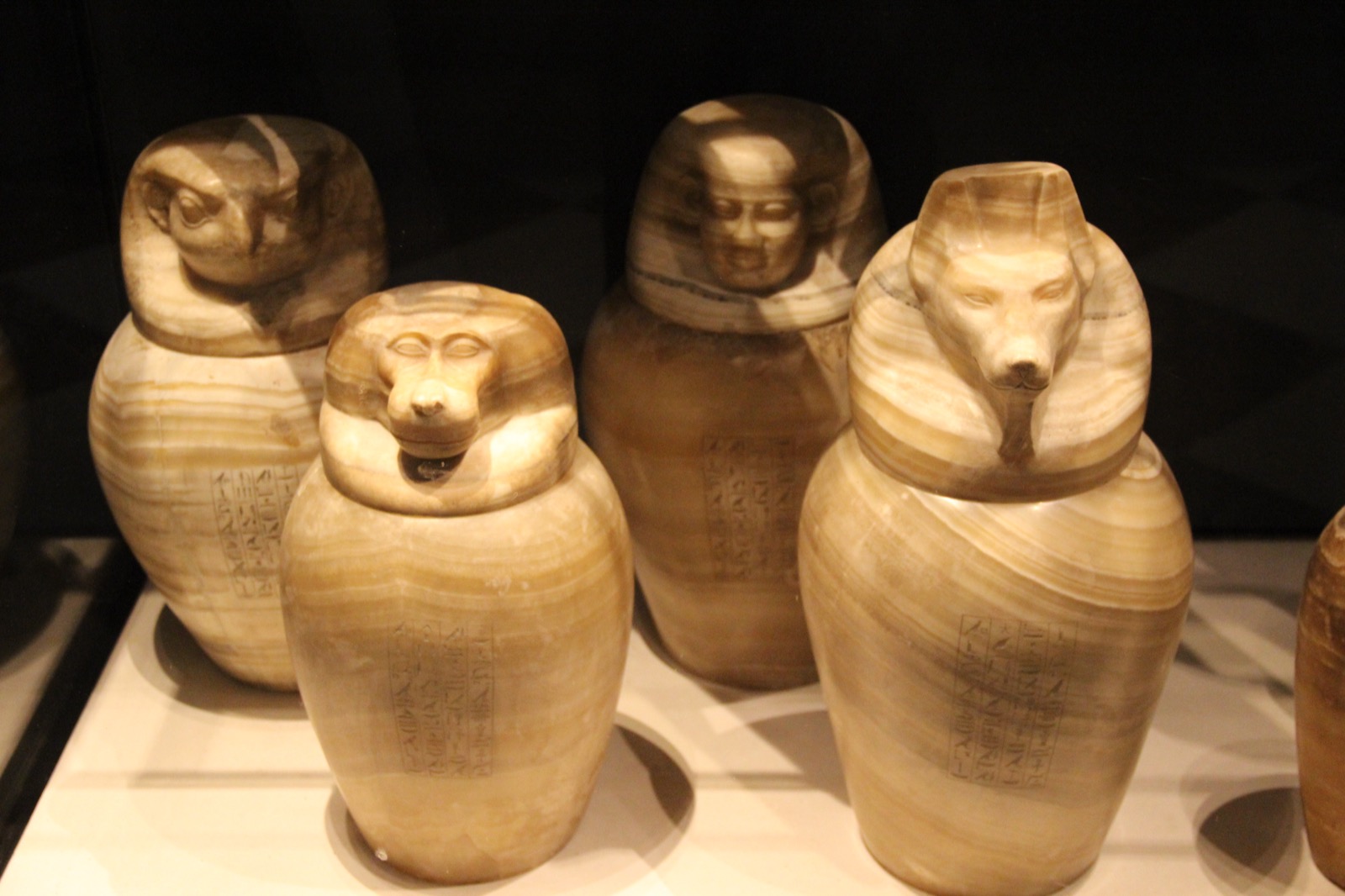
A canopic jar, in ancient Egyptian funerary practice, is the vessel used to hold the internal organs of the deceased during mummification. The viscera — liver, stomach, lungs, intestines — were removed during embalming and stored separately in four jars. The body went into the sarcophagus. The organs went into the jars. They were buried together.

Debussy received his rectal cancer diagnosis in 1909. He kept, according to Marguerite Long, a canopic jar on his desk in his studio. Long records this in her memoir Au piano avec Debussy. The honest caveat: Long worked closely with Debussy only after 1917, so the jar-on-the-desk image is not a contemporary 1912 eyewitness account; it is later recollection. The detail might be embellished. The composer’s awareness of his own mortality during the Book 2 years, however, is not in dispute — the medical record makes that part incontestable.

Either way, the framing of the piece does not depend on the jar being literally on the desk. It depends on a composer with a tumor in his abdomen writing a memorial titled after a vessel that holds the abdomen’s organs after death. That juxtaposition does not need decoration. It is, in its own quiet way, one of the more unsettling biographical alignments in the piano repertoire.

The piece is slow. The harmony hovers in open fifths — those thin, hollow intervals that lean toward antiquity rather than the lush full chords of Debussy’s earlier music. The melodic line is essentially monophonic, single voice, no harmonic padding. The texture feels like a fragment of Gregorian chant carried on the wind through an empty room. Five minutes. The composer looking directly at his own death with what reads, on the page, as something close to calm.

Book 2, No. 12 — Feux d’artifice (The Marseillaise, hidden in the last five bars)

14 July 1913. Bastille Day. The Parisian sky is full of fireworks.

The piece is a sonic photograph of that night. Rapid tremolos — single notes repeated as fast as the fingers can move them — produce the rolling fizz of a distant rocket. Two-handed glissandos — the hand swept along the white keys at speed — produce the rising trail. Crashing fortissimos produce the burst. The piece is one of the genuine technical nightmares of the piano repertoire; pianists who can sail through Liszt and Chopin sweat through this five-minute showpiece, because it requires not just speed but a kind of fragmented, sparkling control that few études prepare you for.

Then the last five bars. The fireworks die down. The smoke clears. And somewhere, very far away — across the Seine, in a different key, half-buried in the residual sparkle — you hear the opening phrase of La Marseillaise. Not stated. Not announced. Drifting in like the sound of a crowd a few streets over still singing their anthem at four in the morning after the show.

Now set this next to Hommage à Pickwick. God Save the King walks in at the front, dressed up, then gets undressed by the music. La Marseillaise arrives at the back, half-hidden, dissolving into mist. The British anthem is ridiculed; the French anthem is left to fade. In 1913, with Europe a year away from a war that would gut the continent, Debussy spent the closing pieces of his last major piano cycle quoting both anthems and treating them as material to be played with rather than honored. That is not nothing. It is, in retrospect, eerily exact about the cultural mood of the moment.

📜 악보 지점: 드뷔시 전주곡 2권 12번 Feux d’artifice 마지막 5마디 La Marseillaise 인용 (IMSLP 링크 미등록)

Peel off the “Impressionist” label and look at what’s actually there

Call these twenty-four pieces “the summit of musical Impressionism” and you have already lost half of the collection.

Brouillards is a bitonality experiment. Hommage à Pickwick is a parody of the British national anthem. Feux d’artifice is a half-buried quotation of the French one. Canope is a memorial written by a man who knew there was cancer in his abdomen, sitting beside a jar that held abdomens. La fille aux cheveux de lin is the recycled work of a twenty-year-old self by a forty-eight-year-old one. La cathédrale engloutie is the piece whose own composer’s piano-roll recording silently contradicted its own printed score for seventy years, until a musicologist in 1983 noticed.

Know any one of those six things and the piece you’re listening to changes. Know all six and the entire collection lifts off the page. The “Impressionist” label flattens these pieces into mood music — soft-focus, fog-coloured, pleasant for dinner parties. The actual collection is sharper, weirder, funnier, more self-quoting, more politically loaded, and more openly aware of its composer’s mortality than the label allows.

Debussy reached the English-speaking world dressed in fog and moonlight. The real Debussy was carrying a tumor, a stack of Symbolist poetry, a copy of Dickens, a canopic jar he may or may not have had on his desk, and a quiet conviction that the word “Impressionist” was an insult coined by people too lazy to listen. The most useful thing you can do as a listener, before approaching these twenty-four pieces, is to close the distance between the Debussy you have inherited and the Debussy who actually wrote them.

If you’ve never heard them — start with these four

Don’t listen to the twenty-four pieces in order on your first pass. The collection isn’t built that way; Debussy explicitly refused the key-cycle structure that Chopin used in his Op. 28, so there is no narrative running from piece 1 to piece 24. Listen out of order. There is a better entry path.

1. La fille aux cheveux de lin (Book 1, No. 8) — The most familiar one. The melody you have already heard, in some commercial, somewhere. Four minutes. A friendly opening door before anything more difficult.

2. La cathédrale engloutie (Book 1, No. 10) — Zimerman’s 1991 Deutsche Grammophon recording first. That gives you the modern, post-Howat reading of bars 28–40. Then, if you can find it, the 1913 Welte piano roll, to hear how the composer himself moved through that section. The distance between the two performances is the entire argument of this piece.

3. Des pas sur la neige (Book 1, No. 6) — Michelangeli’s 1978 recording. Four notes. Five minutes. Almost no music, in the conventional sense, and an unreasonable amount of feeling. This is the piece that teaches you what the rest of the collection is doing with silence.

4. Canope (Book 2, No. 10) — Save this one for after you know the first three. Five minutes of a dying composer looking at a jar that holds dead organs and writing a piece about both. The understatement of the piece becomes more devastating once you know the context.

From there, move to Brouillards, then Hommage à Pickwick, then Feux d’artifice. By the time you reach the full twenty-four-piece traversal, you will know which pieces you are entering with which set of expectations. Pick up the Zimerman complete set last; it serves as the closing chapter rather than the introduction.

Recommended recordings — if you can only buy one

Walter Gieseking / EMI 1953–54 (mono) — The canonical document of the direct-lineage tradition. The pedal-wash, the sans rigueur (“without rigor”) aesthetic, the idea that Debussy should be played like watercolor rather than oil — all of it was effectively standardized by these recordings. The honest caveat: La cathédrale engloutie here is glacially slow, played strictly from the printed score, before Howat’s argument existed. If you’ve spent any time with the Howat reading, the Gieseking version of those bars will feel like a hearse going through a cemetery. Worth owning anyway as the document of what mainstream Debussy playing sounded like in 1953. For traditionalists and historians; not necessarily for new listeners.

Arturo Benedetti Michelangeli / DG 1978 (Book 1) and 1988 (Book 2) — Obsessive. Des pas sur la neige is the headline reason to own this — each of those four repeated notes has a different physical weight, each is placed with the precision of someone arranging stones on a Japanese garden tray. The downside is the temperature. Michelangeli plays this music cold. When he plays a memorial piece, it is the kind of cold that makes you uncomfortable. If you want emotional warmth and an arm around your shoulder, this is the wrong set. If you want to hear what these pieces sound like when an obsessive technician decides every micro-decision matters, this is the one.

Krystian Zimerman / DG 1991 — The modern standard. Zimerman absorbed Howat’s argument and used the double-tempo reading of La cathédrale engloutie; the bars that take Gieseking nearly four minutes to traverse, Zimerman covers in half the time, and the cathedral starts to feel like an actual building rising out of an actual sea rather than a slow-motion ghost. The dynamic range across the full twenty-four is the broadest of any single-pianist traversal — Zimerman is willing to play extremely quietly and extremely loudly inside the same piece, and the contrast pays off. If you are going to own one recording of the complete Préludes, this is the one. The only push-back is from listeners who specifically dislike the polished, post-1980s digital sound; if you want analog warmth, look elsewhere.

Marc-André Hamelin / Hyperion 2014 — Hamelin is one of the few living pianists for whom the word “limit” doesn’t quite apply. The technical hurdles of Feux d’artifice disappear; the Marseillaise quotation in the last five bars, which most pianists smear into the sparkle, falls out of his hands as a clean, identifiable phrase. You will hear the quotation here when you might not hear it elsewhere. The trade-off is the one that follows Hamelin around: in his hands, certain pieces lose a layer of fantasy because they have become so clearly executed. Critics who push back on this set use the word “clinical.” If you listen analytically and want to hear what these pieces look like at peak resolution, Hamelin is unbeatable. If you want haze and mystery, this is not your set.

Debussy himself / Welte-Mignon piano rolls, 1913 (Pierian Recording Society 2000 reissue) — This is a historical document, not a listening session. The audio quality is what you get from a 1913 paper roll played back through a reproducing piano and digitally captured a century later. It can be harsh to twenty-first-century ears. You should still listen to it at least once. It is the only recording in which the composer of these pieces is the pianist of these pieces. It is also the primary evidence in the La cathédrale engloutie tempo controversy — you hear, with your own ears, Debussy taking bars 28–40 at double the printed speed. There is no other way to access that fact directly. Treat this set as a primary source rather than a recital album, and it earns its place on the shelf.

Recommended performance videos

  • Zimerman — La cathédrale engloutie (the post-Howat double-tempo reading)
  • Debussy himself, 1913 Welte-Mignon piano roll — La cathédrale engloutie (for direct comparison with the slow-tradition recordings)
  • Hamelin — Feux d’artifice (the Marseillaise quotation arrives audibly in the last five bars)
  • Gieseking — La fille aux cheveux de lin (the canonical direct-lineage reading)

Listening with the score

The 1910 and 1913 Durand first editions are both on IMSLP and freely downloadable. If you have never opened a Debussy score before, this is a low-cost upgrade to your listening: the “…(title)” placement at the end of each piece is not something you have to take on trust — you can see it on the printed page, exactly as the first 1910 buyers saw it. The instruction over bar one of Des pas sur la neige — that the rhythm should sound like the background of a sad, frozen landscape — is right there in Debussy’s own handwriting on the autograph and in print on the Durand edition. Open the PDF on a second screen while the recording plays. Things you would otherwise miss start to surface.

Two passages in particular reward the score-and-listen approach. The first eight bars of Hommage à Pickwick, with the God Save the King quotation, are unmistakable on the page once you know what to look for — Debussy makes no attempt to disguise the British anthem. And the last five bars of Feux d’artifice, with the half-hidden Marseillaise, become much clearer when you can actually see the phrase contour written out. Both quotations live in details that the ear, on its own, can miss. The score makes them obvious. Half the fun of these pieces is hearing them and then realizing what was hidden in plain sight.

Frequently asked questions

Do I really need to listen to all twenty-four Préludes?

No. From Book 1: No. 6 (Des pas sur la neige), No. 8 (La fille aux cheveux de lin), No. 10 (La cathédrale engloutie). From Book 2: No. 1 (Brouillards), No. 9 (Hommage à Pickwick), No. 10 (Canope), No. 12 (Feux d’artifice). Those seven cover everything this article actually talks about. Once they are in your ear, pick up the Zimerman 1991 DG complete set and listen to the remaining seventeen as a single arc. That is more than enough.

Did Debussy really hate being called an Impressionist?

Yes, and it is documented in his own hand. The September 1908 letter to his publisher Jacques Durand — collected in François Lesure’s edition of Debussy’s correspondence (Gallimard, 2005) — uses the word “inappropriate” and accuses critics of reaching for the label to disguise their ignorance. Modern Debussy scholarship has been moving away from the Impressionist framing since the 1990s and toward a Symbolist reading, which makes more sense given that the titles of the Préludes themselves borrow from Baudelaire, Leconte de Lisle, and Dickens — poets and novelists, not painters.

La cathédrale engloutie — fast or slow?

Current scholarly consensus leans toward fast. Roy Howat’s Debussy in Proportion (Cambridge, 1983) argues that the printed Durand edition contains a typesetting error in bars 28–40, that the bars should be read at half the printed note values, and that Debussy’s own 1913 Welte-Mignon piano-roll recording supports the faster reading. Zimerman’s 1991 recording follows this reading; most performers who came of age after that follow it as well. The older direct-lineage tradition — Gieseking, Michelangeli, others trained in that succession — keeps playing it slowly from the printed score. Both lineages are alive. Listen to one of each and decide which version is the piece you want in your head.

Is it a coincidence that Debussy wrote exactly twenty-four Préludes, the same count as Chopin’s Op. 28?

No. It is an explicit reply to Chopin’s 24 Préludes Op. 28 (1839). The crucial difference, though: Chopin cycled through all twenty-four major and minor keys (C major, A minor, G major, E minor, and so on through the entire circle of fifths). Debussy deliberately refused that organizing principle. His twenty-four pieces are arranged by mood and image, not by key. Scholarship (Schmitz, The Piano Works of Claude Debussy, reissued by Dover) reads this as a declaration of independence from formal scaffolding — a way of saying that the structural conventions of the previous century no longer applied.

Why did Debussy hide the titles at the end of each piece?

The most widely accepted reading is that he wanted the title to register as an after-image rather than a prompt. The Henle Urtext edition’s preface calls this placement “the composer’s most careful aesthetic choice, designed to prevent the title from dictating the music.” The standard program-music tradition — Berlioz, Liszt — puts the title up front so that the listener’s imagination is primed before the first note. Debussy reversed this. Listen to the music first; let the title arrive only after the last chord has faded, as something the piece confesses to itself in retrospect.

Related reading

Copyright notice · The Classic Note does not permit unauthorized reproduction, reposting, redistribution, or translation of its articles. Brief quotations are allowed only with clear attribution and a link to the original page. Please contact us for reuse or collaboration requests.