- Composer
- Ludwig van Beethoven
(1770–1827) - Work
- Symphony No. 5 in C minor, Op. 67
- Composed
- Beethoven composed the Symphony No. 5 in C minor, Op. 67 between 1804 and 1808.
- Movements
- I. Allegro con brio — C minor
II. Andante con moto — A♭ major
III. Allegro — C minor (runs into IV without a break)
IV. Allegro — C major - Orchestration
- Piccolo · 2 flutes · 2 oboes · 2 clarinets · 2 bassoons · contrabassoon · 2 horns · 2 trumpets · 3 trombones · timpani · strings
- Premiere
- The premiere of Beethoven’s Symphony No. 5 took place on December 22, 1808 at the Theater an der Wien in Vienna, with Beethoven conducting.
- Dedication
- The symphony is dedicated to Prince Franz Joseph von Lobkowitz and Count Andreas Razumovsky, and that dedication appeared in the first printed edition of April 1809.
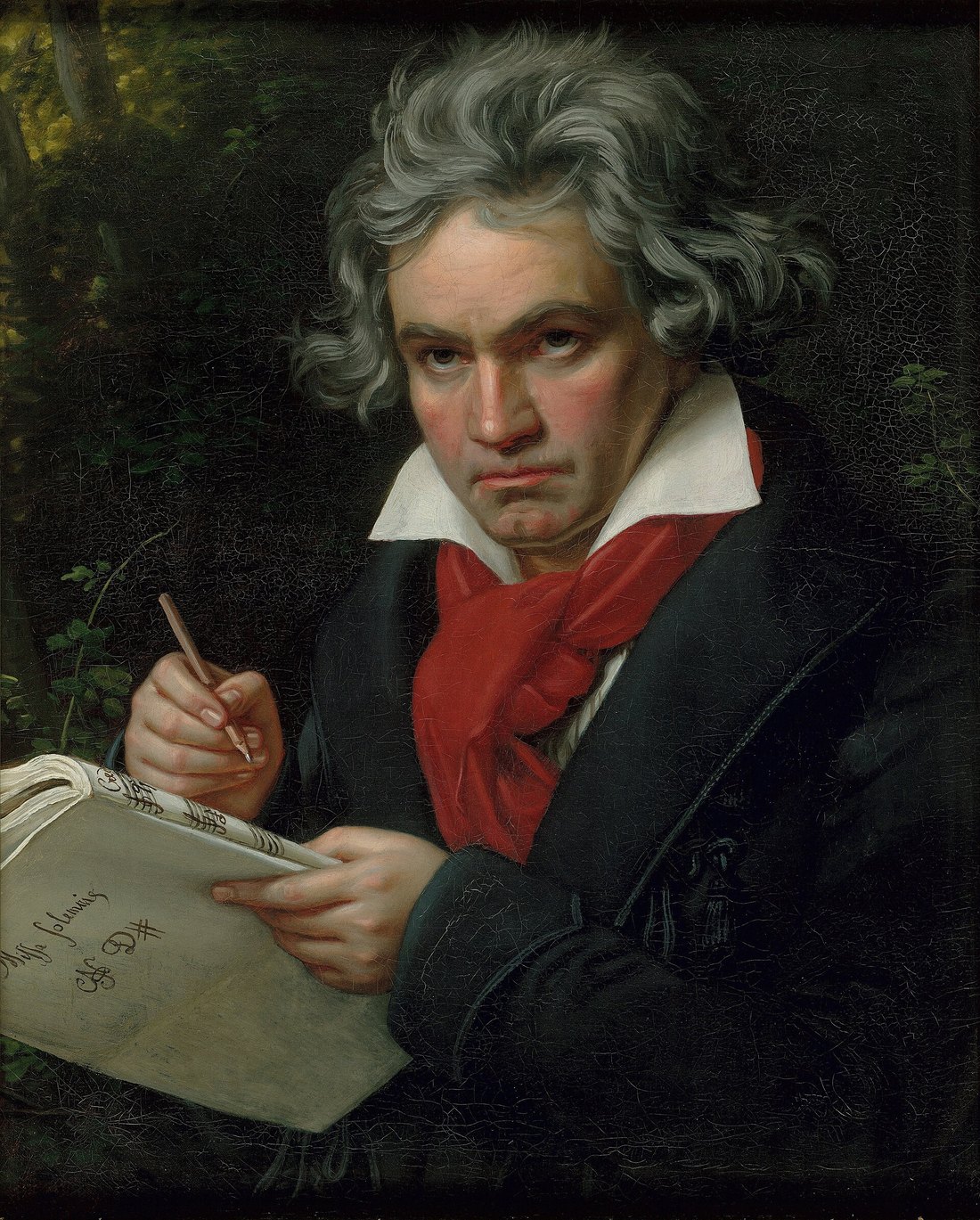
“Thus fate knocks at the door.” You have read it on a concert program, on a CD case, maybe in a textbook. It is the most quoted sentence in classical music, and there is no evidence Beethoven ever said it. The words come from Anton Schindler, the self-appointed secretary who wrote the composer’s first major biography — and who also faked entries in Beethoven’s notebooks after he died.
That is myth number one. Two more sit on this symphony’s back: that its premiere was a triumph, and that Beethoven himself framed the piece as a march from darkness into light. Neither survives the documents. This guide takes all three apart, then hands you what is actually in the score — plus a fourth myth hiding in the orchestration.
Myth one: the fate line came from a forger
Anton Schindler ran Beethoven’s errands in the composer’s last years, then spent the rest of his life as the official keeper of the flame. Much of the Beethoven we picture — the growling recluse, hair everywhere, wrestling with the universe — comes out of his prose. The trouble is what he did to the source material.
In 1977 the pianist and musicologist Peter Stadlen published a paper in The Musical Times showing that Schindler had inserted roughly 150 entries into Beethoven’s conversation books after the composer’s death. The Berlin editorial team working on the conversation books began labelling Schindler’s forgeries in the volumes published from 1978 onward. Anton Schindler attributed the remark “Thus fate knocks at the door” to Beethoven, and scholars now treat that attribution as unreliable precisely because Schindler forged entries in Beethoven’s conversation books. Some writers hand the poetic gloss to Ferdinand Ries instead of Schindler; either way, the trail never reaches Beethoven.
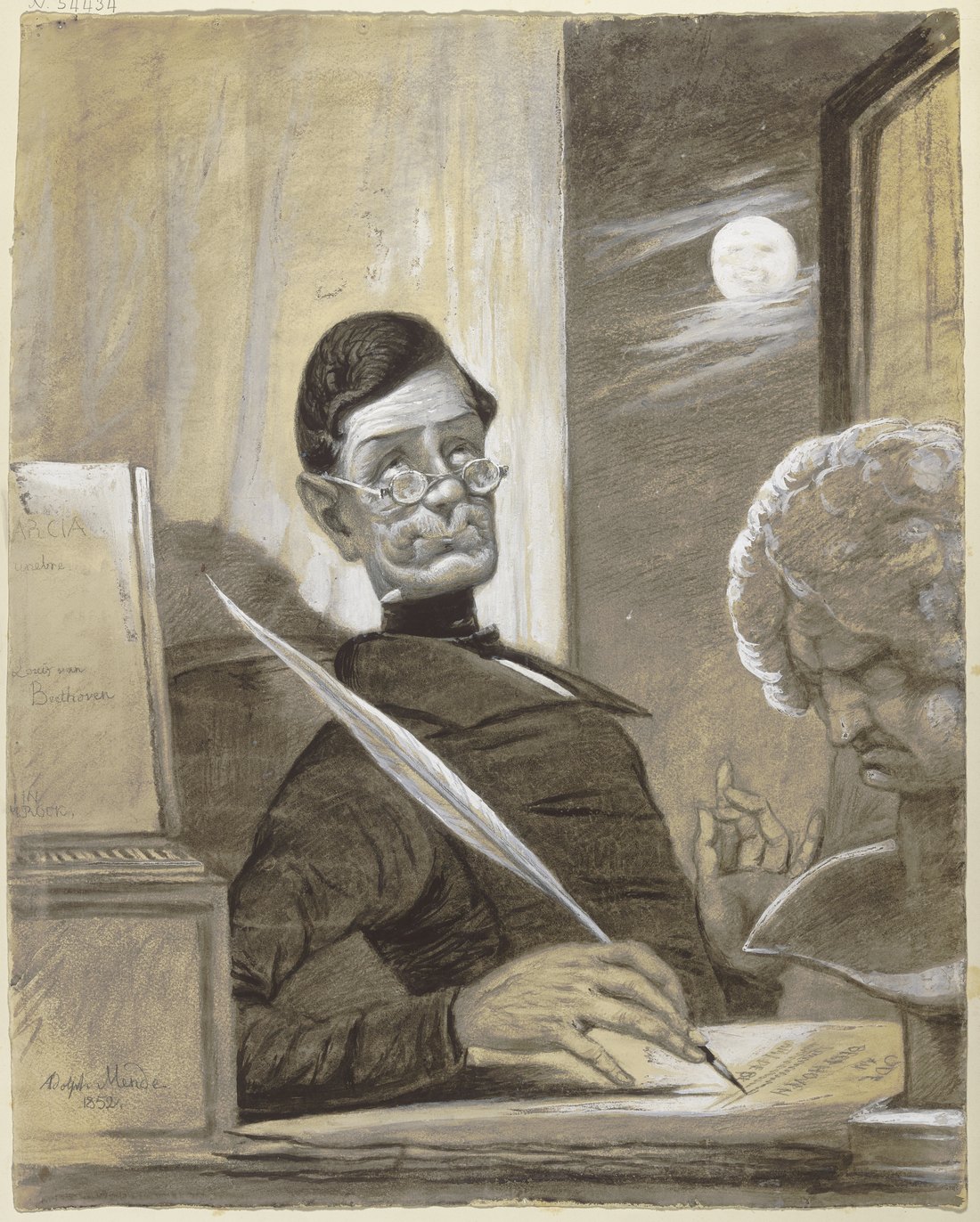
The better question is why the fake stuck. Nineteenth-century readers wanted a deaf titan trading blows with destiny, and Schindler handed them one in a single sentence. The twentieth century then printed the word Fate on record sleeves for decades. A secretary’s invention became a marketing asset, and those do not die.
Myth two: the triumphant premiere that never happened
Read the program from that night slowly. The length is doing half the storytelling.
- Symphony No. 6, Pastoral
- Concert aria Ah! perfido
- Gloria from the Mass in C
- Piano Concerto No. 4, with Beethoven at the keyboard
- Symphony No. 5
- Sanctus from the Mass in C
- An improvised piano fantasia
- Choral Fantasy
Eight items. All Beethoven. All new to the audience. In an unheated theatre, in Vienna, four days before Christmas. The composer Johann Friedrich Reichardt sat through it and wrote afterwards: “There we sat, in the most bitter cold, from half past six until half past ten.” Reichardt was a composer and former Prussian court Kapellmeister, and his verdict was that the room defeated the music.
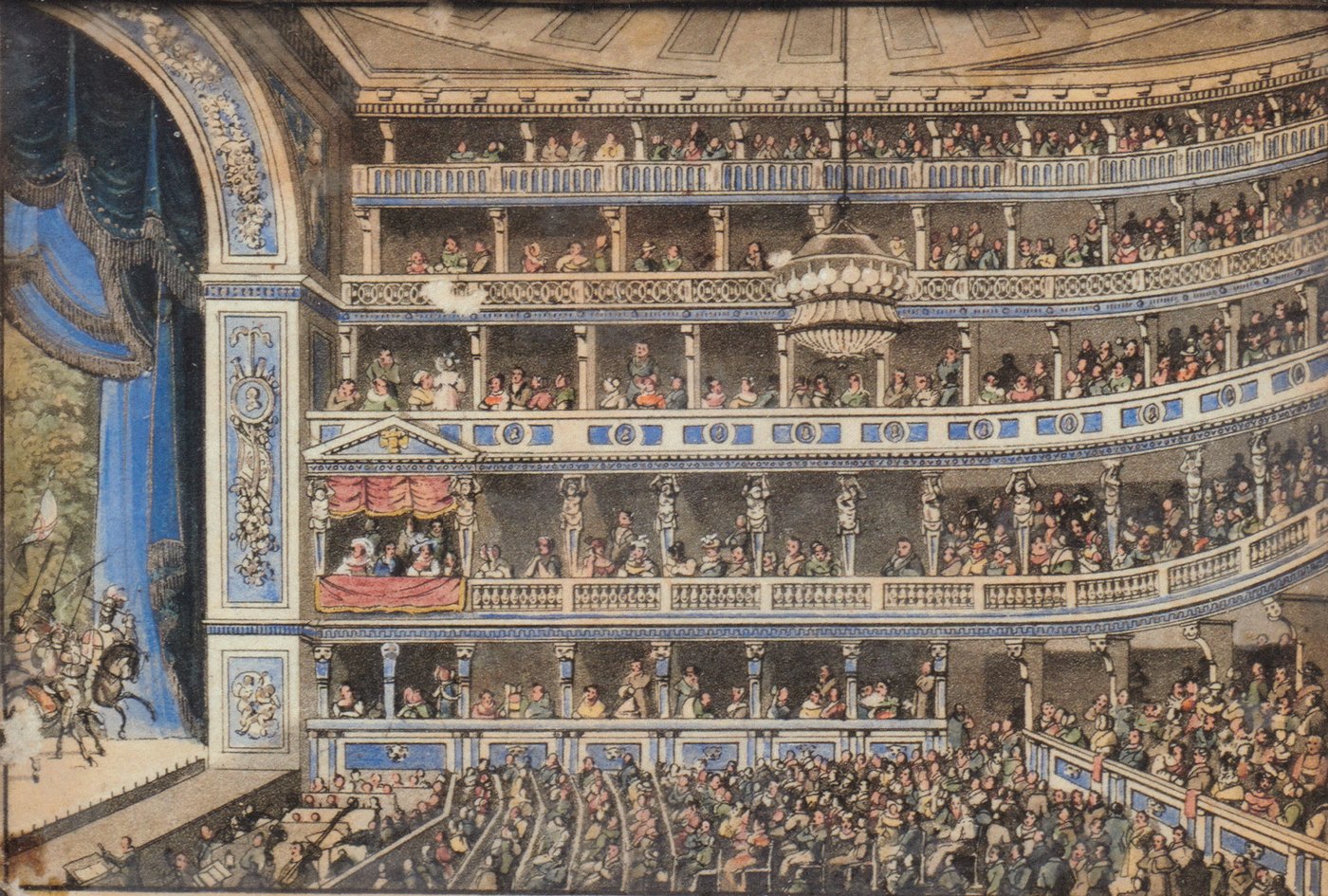
It went wrong before anyone played a note. The soprano Anna Milder withdrew after a quarrel, and the teenaged Josephine Killitschgy took over the concert aria and sang it badly, undone by nerves. And in the last work of the night, the Choral Fantasy, the ensemble came apart: Ignaz von Seyfried, who was there, described the collapse and the restart from the top — the last number of a four-hour concert, begun again, in front of an audience still in their coats.
Here is the part the disaster story leaves out. In November 1808 Beethoven had an offer from Jerôme Bonaparte, King of Westphalia, to run the music at his court in Kassel. To keep him in Vienna, three patrons signed an annuity contract on 1 March 1809 guaranteeing him 4,000 florins a year — Archduke Rudolph, Prince Ferdinand Kinsky and Prince Lobkowitz. The worst concert of his professional life was followed, ten weeks later, by the most secure contract of it.
Myth three: the saint who never counted money
Count Franz von Oppersdorff, a Silesian nobleman, commissioned symphonies from Beethoven and got the Fourth for his money. He paid in advance for the Fifth as well, expecting its dedication to follow. It did not. In a letter of 1 November 1808 Beethoven explained to Oppersdorff that financial pressure had forced him to sell the symphony elsewhere; the publishing rights went to Breitkopf & Härtel in Leipzig, and the dedication to Lobkowitz and Razumovsky — his biggest patron and the ambassador who kept buying his quartets.
This is the fact popular writing skips, because it does not fit the halo. Beethoven priced the dedication, took the better offer and put the refusal in writing to the man who had already paid. That is a working professional under pressure, and it makes the stubbornness in the score believable rather than saintly. For the other famous case of a Beethoven dedication changing hands under pressure, see the Eroica and the torn-up Napoleon page.
What to actually listen for
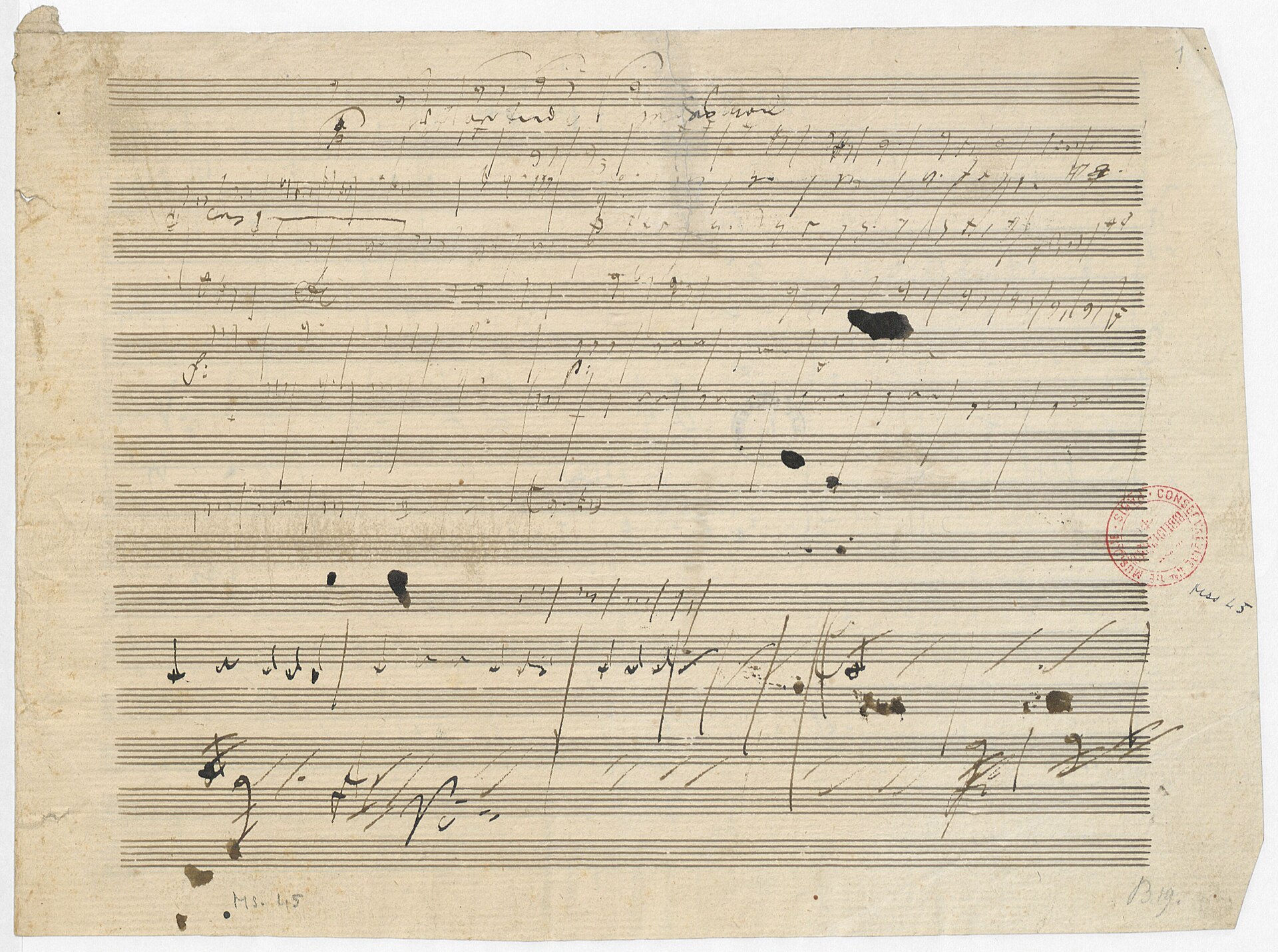
Strip the mythology away and the technical argument gets sharper. A symphonic first movement of the period normally runs on two singable themes. This one runs on a rhythm: three short notes and a long one, with barely any tune attached — a cell small enough to hide inside anything. Beethoven spends the movement proving it. It turns up in the accompaniment, in the bass, inside the horn call that announces the second theme, chopped into fragments during the development. Nothing else gets room.
I. Allegro con brio — the tempo argument
Beethoven’s own metronome mark for the first movement of the Fifth is 108 to the half note. That is brisk to the point of violence — roughly two bars a second, leaving no time to lean on the fermatas most conductors treat as the movement’s dramatic pillars. Period-instrument conductors take it literally; Furtwängler and Karajan did not, and neither does most of the modern tradition. Whether Beethoven meant it, mis-set the device or later changed his mind is still argued.
II. Andante con moto — the brass audition
A set of double variations in A-flat: two themes, alternating, each revisited in more elaborate clothing. Violas and cellos have the first theme in unison, low in the register. From inside the section that passage is a lesson in restraint — it sits in a warm part of the instrument and every player wants to make a meal of it, and the moment anyone does the line stops moving forward. Play it plainly and it aches; polish it and it sags.
Track the brass here. Trumpets in this period were mainly harmonic reinforcement: they held the key down and stayed out of the way. Beethoven repeatedly hands them fanfare material that behaves like a theme, in C major, inside a movement written in A-flat. Each time it runs out of momentum and sinks back into the variations. Those passages are auditions for the finale.
III → IV — the transition that changed the symphony
The third movement is scherzo-and-trio by shape, but the tone is wrong for a joke: cellos and basses crawling up from the bottom of the orchestra, horns barking the short-short-short-long figure over them, the trio flashing light mostly so you notice its absence afterwards. When the main material returns it is hollowed out, plucked and whispered, and then it refuses to end.
Instead the music thins to almost nothing: timpani tapping the four-note rhythm at the very bottom of the dynamic range, strings holding a long tone above, harmony frozen. Then a crescendo, and the finale arrives attacca — no pause, no breath. This is the passage every later composer stole: Brahms’s route into his own finale is unthinkable without it, which is why our guide to Brahms’s First keeps circling back here.
IV. Allegro — the orchestra gets bigger
The finale of Beethoven’s Symphony No. 5 brings in piccolo, contrabassoon and three trombones, and that is why the C major hits the way it does. The orchestra extends upward and downward in the same bar — piccolo above the old ceiling, contrabassoon and trombones below the old floor — so the ear registers a bigger room before it registers the key.
A fourth myth lives here, printed in more program notes than the other three. Those instruments did not make their symphonic debut in this finale. Franz Anton Hoffmeister and Franz Xaver Süssmayr wrote piccolo into Turkish-styled symphonies in the 1790s, and three trombones run through every movement of Joachim Nicolas Eggert’s Symphony No. 3 in E-flat major, first performed in Stockholm on 14 May 1807, more than a year before Vienna heard the Fifth. Only the contrabassoon claim survives the check: Beethoven is credited with the first separate contrabassoon part in a symphony. What he earned is narrower and more consequential — he made the enlargement stick. Trombones had lived in church and in the opera house. After this they lived in the symphony too, and a generation later Berlioz was writing for them at a scale nobody in 1808 could have predicted, as our Symphonie fantastique guide traces in detail.
Where the darkness-to-light story actually came from
Beethoven left no written program for this symphony. No letter, no note in the margin, no sketch page saying what the C minor stands for. The narrative arrived from outside, and we can name most of the people who supplied it.
E. T. A. Hoffmann reviewed the Fifth in the Allgemeine musikalische Zeitung in July 1810, and that review shaped how Europe hears Beethoven more than any criticism since. Hoffmann was arguing a theory of Romantic instrumental music, with this symphony as his proof. Readers took his account of the effect for a report of what Beethoven meant, and it hardened into fact.
Then the twentieth century added its own layer. In 1941 the BBC attached the four-note figure to its wartime broadcasts, because three short beats and a long one spell the letter V in Morse code and V stood for victory. A German composer’s opening bars became an Allied signal. Nothing in the score changed; the meaning did — which is the honest summary of this piece’s reception history, and a good reason to distrust any program note that tells you what the music is about.
Three recordings, three arguments
Carlos Kleiber / Vienna Philharmonic / recorded 1974 (Deutsche Grammophon)
Carlos Kleiber recorded the Fifth with the Vienna Philharmonic in 1974, and Deutsche Grammophon released it in 1975. Start here. The balances are so clear you can follow the four-note cell through the inner parts without being told where it is, and the transition into the finale is built rather than merely arrived at. My reservation is real: it is a beautifully upholstered performance of a piece its first listeners found rough and hard to follow. Nothing here sounds difficult, and once you know the work that reads as a missing dimension.
🎧 Also on: Apple Music · Spotify
Wilhelm Furtwängler / Berlin Philharmonic / live, 25 May 1947
Wilhelm Furtwängler conducted the Berlin Philharmonic in Beethoven’s Symphony No. 5 at the Titania-Palast on 25 May 1947, his first Berlin concert after the ban on his conducting was lifted. The sound is mono, distorted and full of audience noise. Take it anyway. Furtwängler argues the tempo out while the music is running: the first movement stretches and contracts, the transition into the finale is drawn out past comfort, and the last pages are pushed to where the ensemble is audibly holding on. If you only hear tidy accounts of this piece you will never understand why anyone once found it frightening.
🎧 Also on: Apple Music · Spotify
John Eliot Gardiner / Orchestre Révolutionnaire et Romantique (Archiv Produktion)
John Eliot Gardiner recorded the Fifth with the Orchestre Révolutionnaire et Romantique for Archiv Produktion in March 1994. This one settles the tempo question by simply doing it: gut strings, valveless horns, narrower trombones, and a first movement close to the printed mark. The gain is transparency — the winds read as individual voices rather than a blended cushion, and the finale’s new instruments announce themselves instead of dissolving into a modern brass section. The cost is weight. If you want the C major to land like a wall falling on you, go back to Furtwängler.
🎧 Also on: Apple Music · Spotify
Kleiber for a first hearing, Furtwängler for a tenth, Gardiner the moment you start caring why conductors disagree. Play the same ninety seconds — end of the third movement into the opening of the finale — in all three, back to back. Three different pieces of music come out of one page, and that comparison teaches more than any amount of reading, including this article.
What survives once the myths are gone is a rhythm that will not let go, written by a man who kept working while his hearing failed, while his orchestra fought him, and while he negotiated the price of a dedication. For the same refusal in a smaller frame, the Appassionata sonata is the piece to hear next.