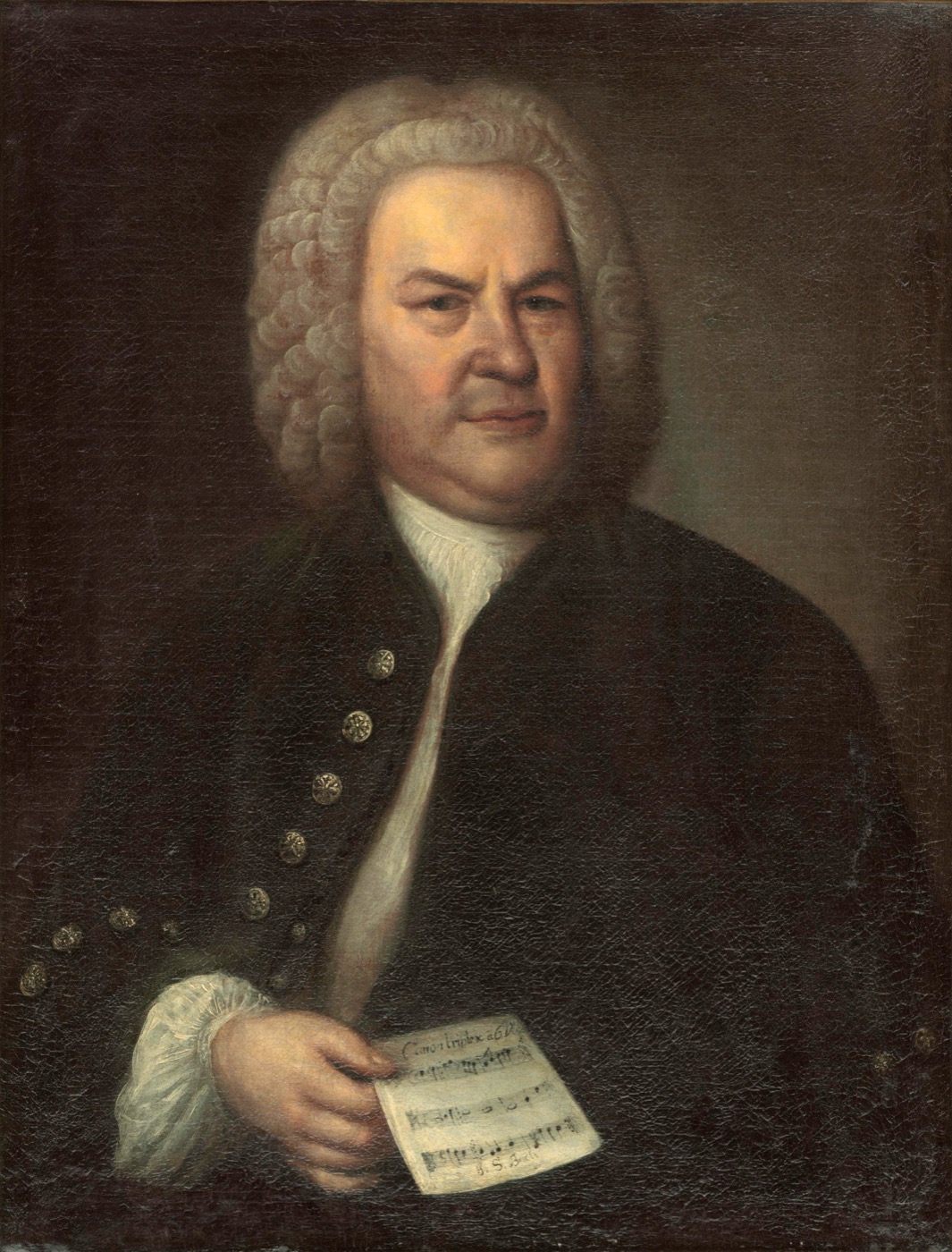
Bach never heard this piece. He assembled two hours of music, bound it into a score, and died without anyone singing it through. The first documented complete public performance came in 1859, more than a century after his burial, conducted by a man who made his living in the silk trade.
That fact sits under every reverent program note about the Mass in B minor. This guide takes it seriously: what Bach actually sent to Dresden, what he later stitched together, what to listen for in each of the four parts, and which recording to put on first.
- Composer
- Johann Sebastian Bach
(1685 to 1750) - Work
- Mass in B minor, BWV 232
- Assembly
- Missa (Kyrie and Gloria) in 1733
Remaining parts added in 1748 and 1749 - Movements
- 27 movements in 4 parts
I. Missa (Kyrie and Gloria)
II. Symbolum Nicenum (Credo)
III. Sanctus
IV. Osanna, Benedictus, Agnus Dei, Dona nobis pacem - Forces
- 5-part chorus and 5 soloists
2 flutes, 2 oboes (including oboe d amore), 2 bassoons
1 horn (corno da caccia), 3 trumpets
timpani
strings, basso continuo - Duration
- About 1 hour 50 minutes
- First complete public performance
- 1859, Leipzig
Karl Riedel and the Riedel-Verein
What Bach Actually Sent to Dresden
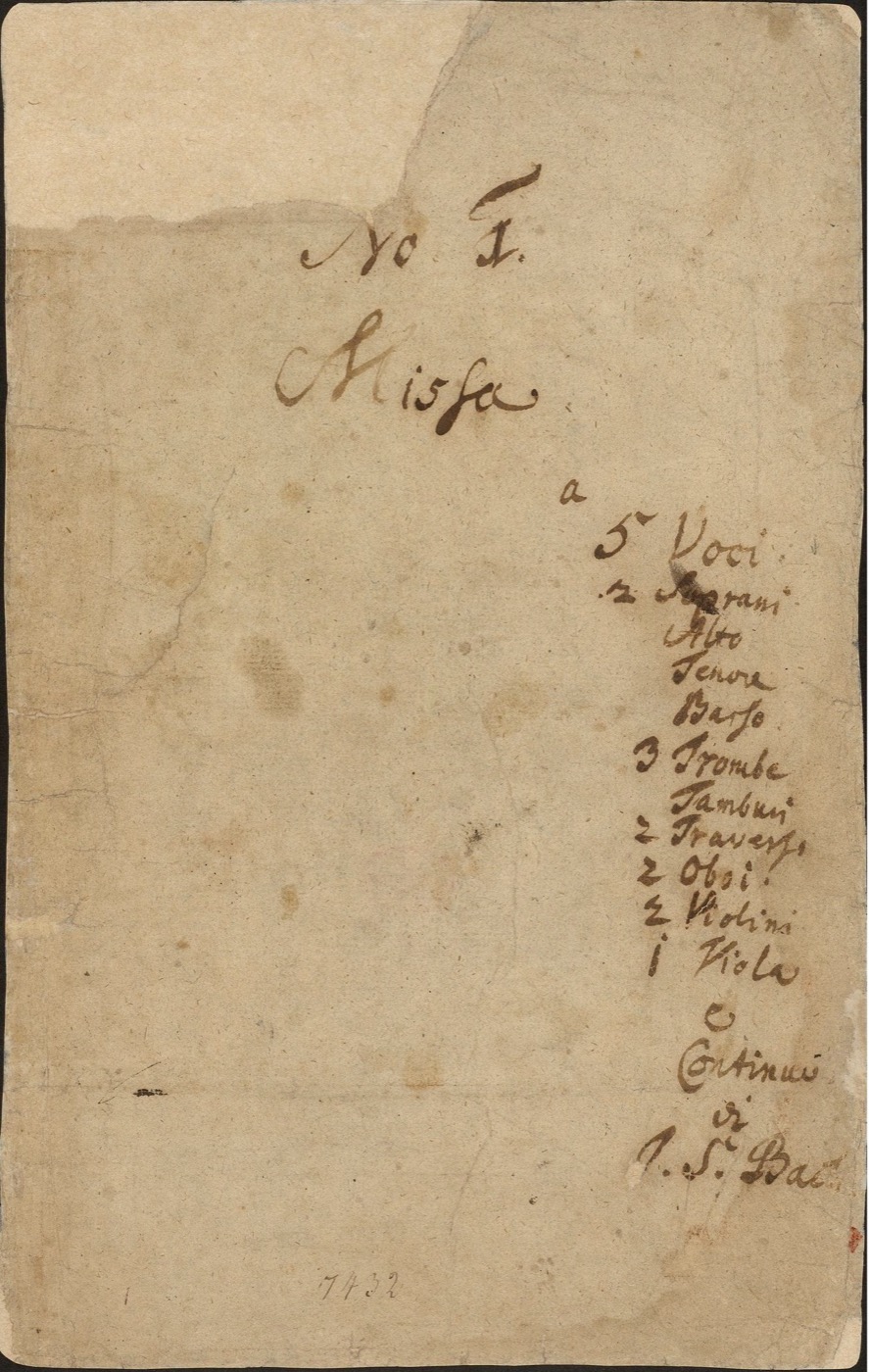
Program notes compress this into one clause: in 1733 Bach dedicated a Mass to the Elector of Saxony. Almost everything interesting is inside that clause.
Two Movements, Not a Mass
What went to Dresden in 1733 was a Kyrie and a Gloria. Twelve movements, not twenty-seven. In Lutheran practice this pairing had its own name and its own use, so Bach was not sending an unfinished Catholic Mass. He was sending a complete Kyrie-Gloria Mass, a genre he would write four more times.
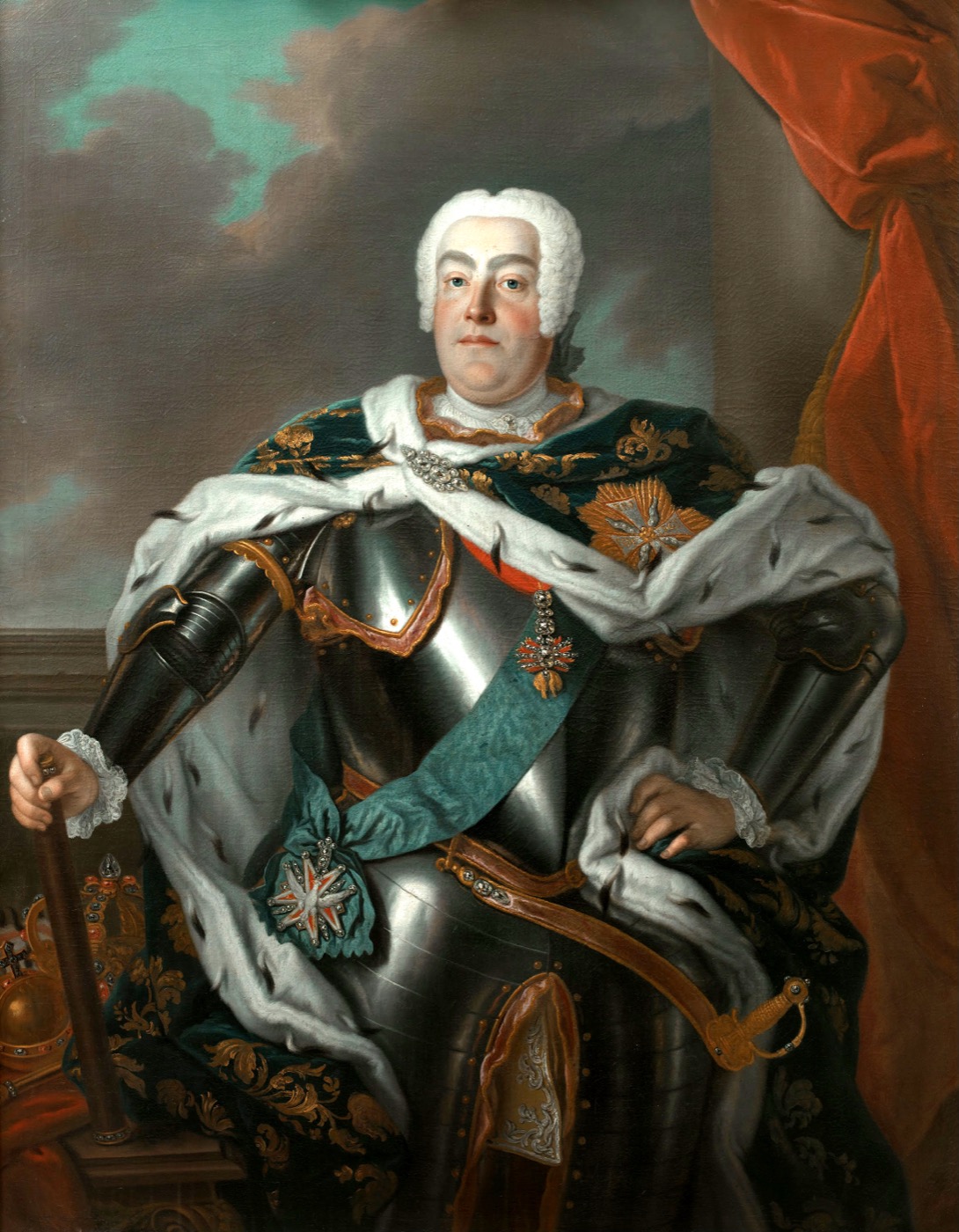
The circumstances mattered. Augustus the Strong died on the first of February 1733, and the mourning period that followed shut down public music-making in Saxony. Bach was between obligations, and the accession of a new elector was exactly the moment a petitioner moves.
The Letter Is a Job Application
The accompanying letter, dated the twenty-seventh of July 1733, is not about art. Bach asks the new elector, Frederick August II, for a court title. Read plainly, it is a request for standing, written by a forty-eight-year-old church musician who was losing an argument with his employer.
The argument is documented. In 1730 Bach had handed the Leipzig town council a memorandum, the Entwurff einer wohlbestallten Kirchen Music, setting out the minimum forces he needed and complaining that he did not have them. A title from Dresden was leverage he could carry back into that room.
There is a confessional wrinkle too. The Saxon ruling house had turned Catholic in 1697 so that Augustus the Strong could take the Polish throne, while the territory stayed Lutheran. A Lutheran cantor was petitioning a Catholic sovereign with a setting of the Latin Ordinary. Whether that choice was tactical or simply generic court practice is not something a letter can settle, and honest accounts leave it open.
The Answer Took Three Years
Dresden did not reply quickly. The title of court composer was granted on the nineteenth of November 1736, three years after the score went out, and only after Bach applied a second time. It was honorary: no salary, no move, no duties at the court chapel. A line for a title page, which is what he used it for.
The catalogue number is a later imposition too, as our guide to what BWV, K. and D. numbers actually mean explains. Nothing about the name of this piece came from Bach.
What to Listen For
This piece hands you architecture rather than tunes. Four things carry the whole span.
1. The Opening Is Two Different Kinds of Music
The Kyrie opens with a short block of full chorus and orchestra, dropped on you with no preparation. Then everything stops and a long instrumental line begins the fugue proper. That first block is a gate, not a theme. Once the fugue starts, the subject climbs by half steps and the five-part choir stays thick enough that no single voice wins. This is the sound the rest of the work argues with.
Then the Gloria arrives in D major with three trumpets and timpani, in a lilting triple time, and the contrast is almost rude. Only five of the twenty-seven movements sit in B minor. Twelve are in D major. The title names the darkest room in a building that is mostly bright.
2. The Credo Is Built as an Arch
The Symbolum Nicenum is the part to study if you only study one. Its movements are laid out symmetrically, and the centre of the arch is Crucifixus. On one side of it sits Et incarnatus est, on the other Et resurrexit. Descent, death, rising: the shape of the text is also the shape of the music.
Crucifixus itself is a passacaglia. A four-bar bass line falls by chromatic steps and then starts again, and again, under changing harmony above. The effect is of ground giving way beneath you at a fixed rate. At the very end the harmony slips into the major on the word about burial, and then Et resurrexit detonates without a pause. If you listen to nothing else in this Mass, listen to that seam.
3. Most of the Music Is Older Than the Mass
Much of what you hear is Bach reworking his own earlier pieces, a practice his century treated as ordinary craft rather than a shortcut. Crucifixus comes from the opening chorus of Cantata BWV 12, written in 1714. Gratias agimus tibi and the closing Dona nobis pacem both come from Cantata BWV 29, written in 1731. Qui tollis comes from Cantata BWV 46. New text, existing music, refitted.
Because Gratias and Dona nobis pacem share their music, the Mass ends by returning to something you heard ninety minutes earlier. The standard reading calls this cyclic design; a blunter one notes that a man with failing eyesight had a deadline. Both can be true. Listen for the recognition instead: if the return lands on you, the design worked, whatever drove it.
4. One Movement Really Is New
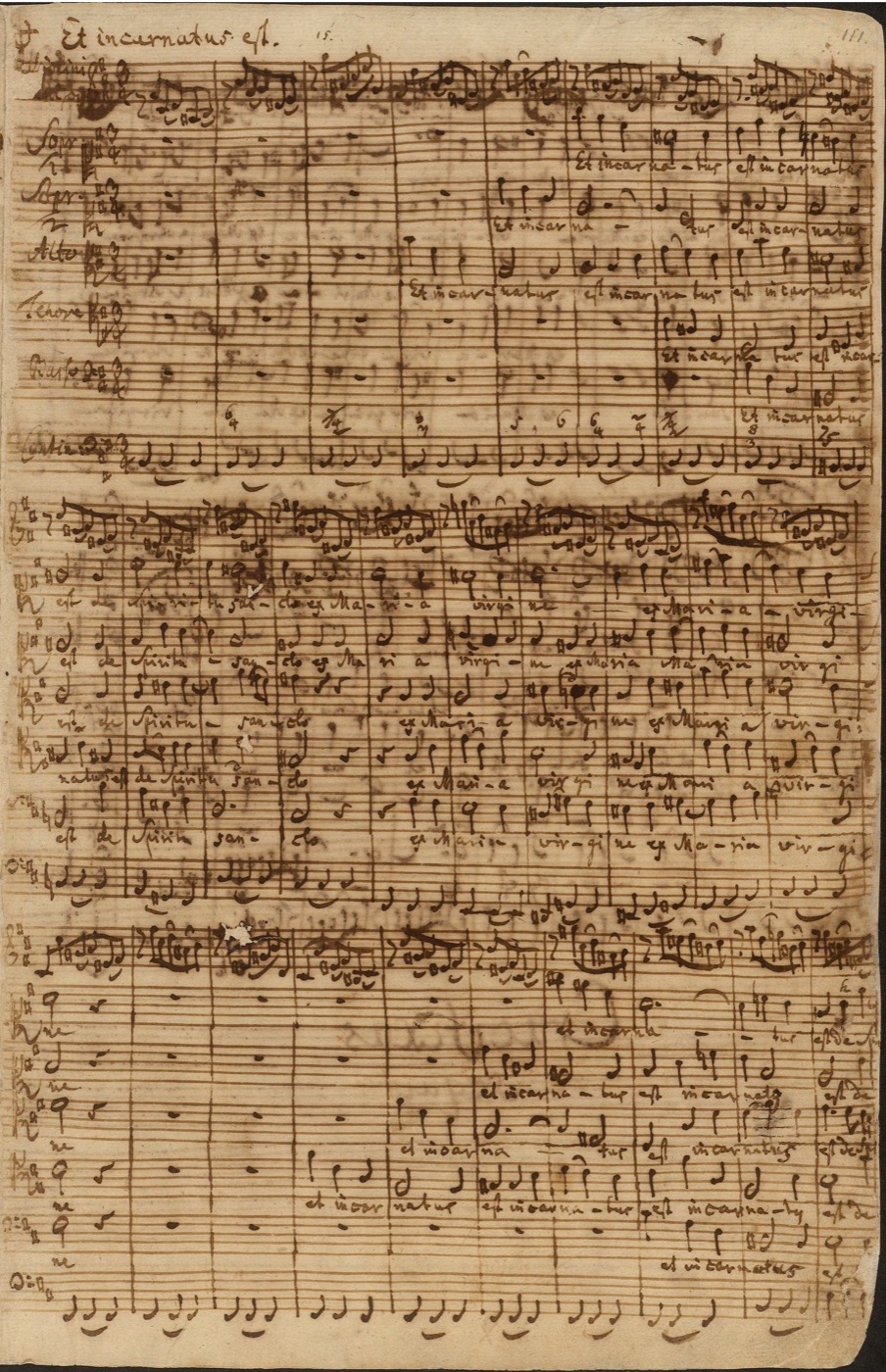
Et incarnatus est appears to have been freshly composed for the assembly, and some scholars argue it is among the last substantial pieces of music Bach wrote. Its text had previously been folded into the duet before it. He pulled the words out and built a separate chorus around them, which means the architecture of the Credo as we hear it is a late decision, not an original plan.
Listen to how little it does. Strings circle a small falling figure, the voices enter low and stay compressed, nothing opens out. From a composer who spent decades filling every register, the restraint is the event.
The Four Parts, in Order
I. Missa (Kyrie and Gloria). The 1733 material, roughly an hour on its own. Three Kyrie movements, then nine of Gloria, alternating big choruses with arias for solo voice and one obbligato instrument.
II. Symbolum Nicenum (Credo). Nine movements, arch-shaped. Denser and stranger than Part I, and the reason most listeners come back.
III. Sanctus. Six vocal parts instead of five, with the chorus rocking in triplets over a wide-spaced orchestra. Bach had performed this music at a Leipzig Christmas service in 1724, long before it belonged to a Mass, which is why it feels like a self-contained event dropped into the middle.
IV. Osanna, Benedictus, Agnus Dei, Dona nobis pacem. The Osanna splits the choir into two four-part groups that throw the same material at each other. The Benedictus thins it to a single tenor with one solo line above. The Agnus Dei is an alto aria with the violins in unison, the loneliest sound in the work. Then the closing chorus returns to Gratias, and it ends without a peroration.
One production note from the other side of the camera: this work is punished by dry acoustics. The five-part writing needs a room that lets the inner voices blur slightly, or the counterpoint reads as clutter instead of weave. That variable, more than tempo, separates recordings that sound alive from ones that sound like a rehearsal.
Why It Sat Unheard for So Long
Bach died in 1750. Only the Sanctus is known to have been performed in his lifetime, as a separate Christmas piece.
In 1786, his son Carl Philipp Emanuel Bach put the Symbolum Nicenum on a charity concert in Hamburg, billed as a Credo rather than as part of a Mass. It is the earliest well-documented posthumous outing for any large stretch of the work.
Then the practical problems took over. A setting this long could not fit inside a service of any denomination, its text was Latin and its shape the Catholic Ordinary, and a Protestant German concert culture was busy rediscovering Bach through the Passions instead. And print came in halves: Nägeli of Zurich and Simrock of Bonn engraved the Kyrie and Gloria in 1833, without a title page, and Simrock’s second volume of 1845 — the source of the title Hohe Messe in h-moll — finally carried the rest. There was no complete printed score to buy before then.
Fourteen years after that, in 1859, Karl Riedel and his Riedel-Verein finally performed the whole thing in Leipzig. Riedel was not a career musician. He ran a choral society alongside a business in silk. The professional establishment had had a hundred and nine years and did not get there first.
The autograph score itself is now in the Berlin State Library, and it is dying: the iron gall ink Bach used is corroding the paper, eating holes through the Credo in particular. In 2015 the manuscript was added to the UNESCO Memory of the World register, which is what you do for an object you cannot fully save.
Recordings: Where to Start
This is a partisan list. The B minor Mass divides on one question, how many singers per line, and your first choice should turn on that rather than on label prestige.
Philippe Herreweghe / Collegium Vocale Gent (1996, Harmonia Mundi): start here. A small period-instrument chorus, unhurried tempi, and the clearest balance between choral weight and internal detail on record. What it does that others do not: the inner alto and second soprano lines stay audible through the big fugues, so the counterpoint sounds like argument rather than mass. The trade-off is drama. The Osanna is not going to lift you out of your chair. For a first complete listen that leaves you understanding the piece, nothing else is close.
▶ Listen on YouTube · Apple Music · Spotify
John Butt / Dunedin Consort (2010, Linn): the one that changed my mind. Butt uses the small-scale reading of Bach’s forces and the Breitkopf edition prepared by Joshua Rifkin, and the result is fast, transparent, and rhythmically sprung. The Credo moves like chamber music. If Herreweghe teaches you the architecture, this teaches you that the piece can dance. Some listeners find it undersized in the Sanctus, and they have a point.
▶ Listen on YouTube · Apple Music · Spotify
Joshua Rifkin / The Bach Ensemble (1982, Nonesuch): the argument in its raw form. The first one-voice-per-part recording of the work. There is no chorus at all: the choral movements are sung by the soloists. On first hearing it sounds thin, and on second hearing you notice you can follow every line, which is the whole point of the experiment. Historically contested, musically indispensable. Do not make it your only version.
▶ Listen on YouTube · Apple Music · Spotify
Masaaki Suzuki / Bach Collegium Japan (2007, BIS): the best-engineered of the modern set. Suzuki’s chorus is small but not soloistic, and the recording gives it air, which matters more here than in almost any other choral work. Clean attacks, no smearing in the fast Gloria movements, superb bass definition under Crucifixus. A reasonable second complete cycle once Herreweghe is familiar.
▶ Listen on YouTube · Apple Music · Spotify
Herbert von Karajan / Berlin Philharmonic (1974, Deutsche Grammophon): the useful opposite. Large chorus, modern instruments, long smooth lines. It never tried to be historically plausible. Play the Kyrie after Herreweghe and you hear exactly what the period-practice generation was reacting against. As a first version it teaches the wrong habits.
▶ Listen on YouTube · Apple Music · Spotify
Netherlands Bach Society / Jos van Veldhoven (All of Bach): free, and on video. The full performance sits on the ensemble’s own channel at no cost, filmed well enough that you can see who plays the obbligato line in each aria. For a work this long that is a real aid, and it is the version to send a newcomer.
🎧 Also on: Apple Music · Spotify
If you want one movement to decide by, take Et incarnatus est alone. Five minutes, no context required.
How to Get Through Two Hours
Do not attempt the whole span on first contact. The four parts are genuinely separable, and the work survives being taken apart because it was assembled in pieces anyway.
Session one: the three Kyrie movements and the Sanctus, about fifteen minutes, enough to tell you whether the sound world holds you. Session two: the whole Credo without stopping, because the arch only works whole. Session three: everything in order, on a day when you have the afternoon.
If you finish it and want more Bach at that scale of ambition, the two obvious next stops are the Goldberg Variations, which solve a similar problem of building an hour out of one idea, and the Cello Suites, which do it with one instrument and no help at all.
Strip away the talk of spiritual testaments and summits of Western music, most of it applied by nineteenth-century admirers rather than by Bach, and what remains is still enormous: decades of choral writing re-fitted by a nearly blind man into a two-hour object he never expected to hear. The reverence came later. The weight was always in the notes.