- Composer
- Rachmaninoff
- Work
- Prelude in C-sharp minor, Op. 3 No. 2
- Key
- C-sharp minor
- Composed
- 1892
- Movements
- 1 movements
Single movement — ABA ternary form (C-sharp minor) - Instrumentation
- Solo piano
- Premiere
- September 26, 1892
Moscow Electrical Exhibition Concert
There is a story about Rachmaninoff that sounds almost too perfect to be true.
Toward the end of his life, someone asked him which of his own pieces he loved most. He reportedly paused, then said something like this: “The one I’ve played the most is the one I like the least.” He was referring to this prelude — the two-minute piece he had written at nineteen and never quite escaped. For the next fifty years, no matter the city, no matter the venue, audiences demanded it as an encore. By the time he died in 1943, he had played it thousands of times.
That a composer could become so thoroughly possessed by a youthful sketch — that he played it so many times it stopped meaning anything to him — is one of the stranger ironies in piano music history.
The Piece That Followed Him Everywhere
The Prelude in C-sharp minor was written in 1892 as part of a five-piece collection Rachmaninoff called Morceaux de fantaisie (Pieces of Fantasy), Op. 3. He was nineteen and still a student at the Moscow Conservatory — the same institution where he had arrived at age nine with unusually large hands and an even more unusual ear.
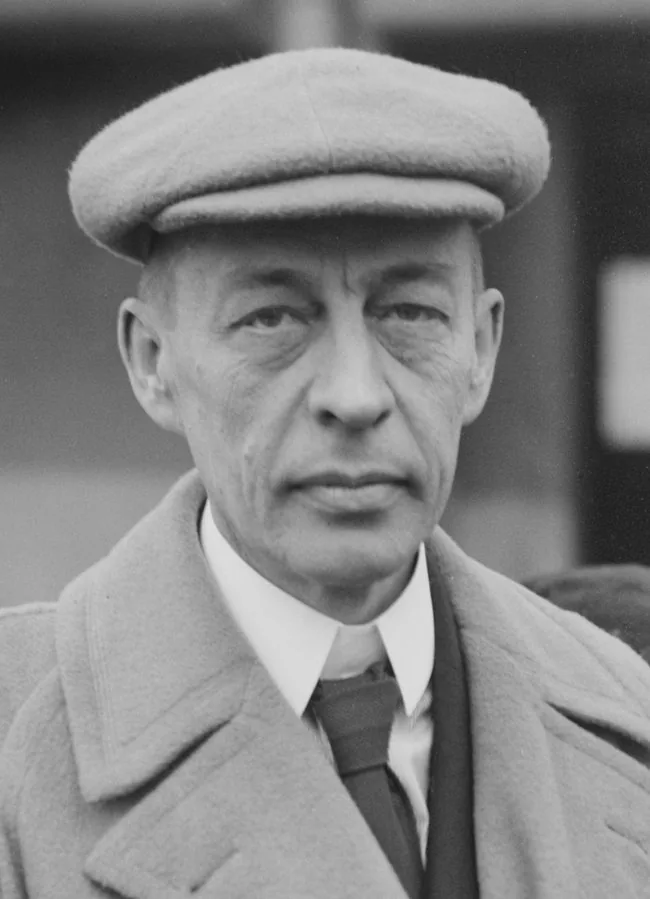
The premiere took place on September 26, 1892, at a concert held in conjunction with a Moscow electrical exhibition. It was not exactly Carnegie Hall. But the audience’s reaction to the second piece on the program — this prelude — was apparently overwhelming.
What Rachmaninoff didn’t fully reckon with at the time was the copyright situation. He sold the publishing rights to the publisher Gutheil for a modest sum, not imagining the piece would become internationally famous. The result: the most-played piece of his career generated almost nothing for him financially. The piece he came to resent most was also the piece he profited from least.
The financial dimension of the story is bleaker than it might appear. International copyright protections for Russian composers were inconsistent throughout the early twentieth century, which meant the prelude was widely reprinted, performed, and recorded in the United States without generating royalties. Rachmaninoff watched the piece circulate through American popular culture — it appeared in sheet music collections, school syllabi, and eventually film scores — while seeing almost nothing from it. One of the most-recognized short piano pieces of the century was essentially given away when its composer was nineteen and didn’t know any better.
He began touring the United States in 1909, and the story repeated itself in every American city. New York, Boston, Chicago, Philadelphia — different halls, same ending. Some accounts say he would occasionally play the prelude early in the evening, before the audience had a chance to demand it, hoping to satisfy the craving in advance. It rarely worked.
What Happens in Two Minutes
The structure here is as close to pure as it gets: ABA, ternary form. Three sections. The piece begins, something happens in the middle, and then the beginning returns. That’s it.
But the experience of listening to it is not simple at all.
> For first-time listeners: Listen for the three heavy chords at the very start — low, slow, deliberate. Those chords are the piece’s anchor. Then a melody arrives in the right hand. The middle section will suddenly become much faster and more agitated. After that storm passes, the opening returns. That’s the whole arc. Give yourself permission to just feel the weight of those opening chords.
The Opening — Three Chords That Announce Everything
The prelude begins with the left hand alone, playing three low, sustained chords in C-sharp minor — each held for an entire measure under the Lento marking (measures 1, 2, and 3). Slow. Heavy. This is the sound that earned the piece its unofficial nickname in Germany and Russia — The Bells (Das Glöckchen). In France it was sometimes called Le Destin (Fate).
Rachmaninoff himself apparently found both nicknames slightly embarrassing. He had written a piano piece, not a tone poem. But audiences heard what they heard.
The bell association has something to do with acoustics and something to do with cultural memory. In Russian Orthodox culture, bells marked the hours and called people to prayer; they announced celebrations and funerals. For Russian listeners in the 1890s, those three low chords landed on something already deeply resonant.
After the three-measure introduction, the right hand enters at measure 4 with the main theme — a melody that feels simultaneously resigned and searching. Rachmaninoff was nineteen when he wrote it, which makes its emotional complexity all the more striking. The melody doesn’t resolve cleanly; it keeps reaching toward something it doesn’t quite arrive at. Listen for how the line rises in the fourth and fifth measures, then falls back without finding any solid resting point — it circles rather than concludes.
The A section also demonstrates something technically interesting: the right hand melody and the left hand accompaniment operate in different rhythmic layers simultaneously. The melody is in quarter notes; the accompaniment is in eighth notes. These two rhythmic streams running together create a kind of productive friction that keeps the music slightly unsettled, even at its slowest.
The Middle Section — The Storm
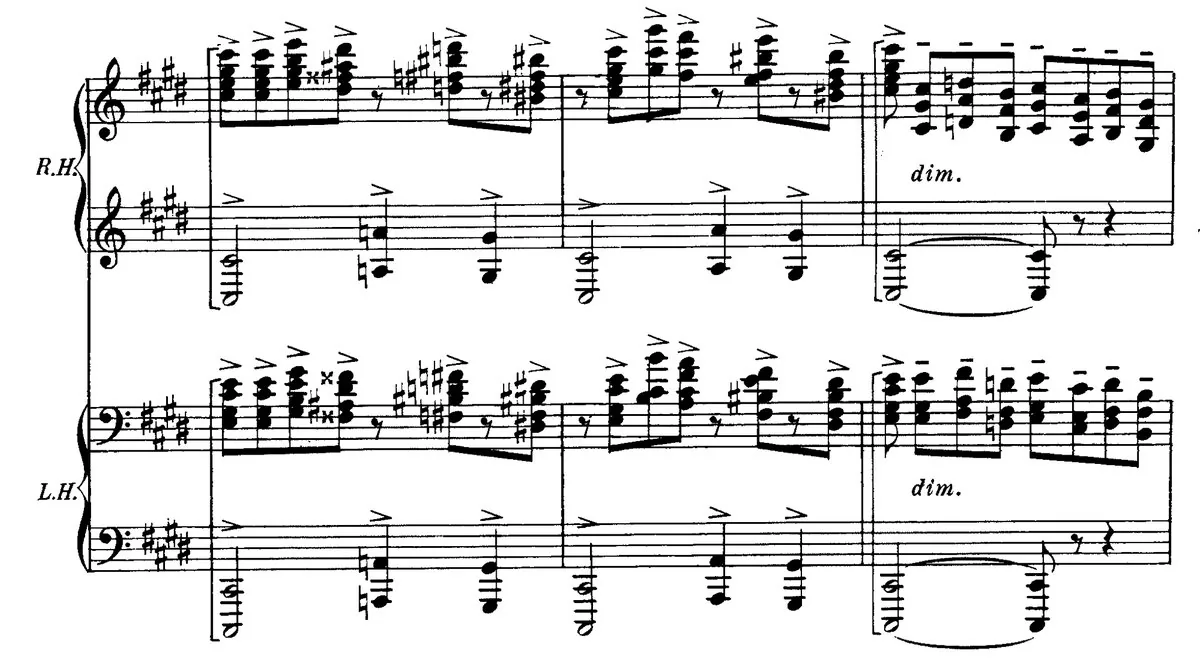
The transition to the Agitato middle section — arriving roughly thirty seconds into most recordings, at around measure 14 — is one of the most effective moments in all of piano literature for sheer physical impact. The music that was slow and heavy suddenly becomes rapid and relentless. Sixteenth notes flood in. The dynamic level surges from piano to forte within a single bar.
This is where Rachmaninoff’s famous hands — reportedly capable of spanning twelve notes, compared to the seven or eight most pianists can reach — make themselves felt most acutely. Some of the chord positions in the Agitato section are simply easier if your hands are large. Pianists with smaller hands have to make adjustments that he never needed to make, and those adjustments always cost something.
The middle section isn’t only technical display, though. The main theme from the A section returns here, transformed — the same melodic material from measure 4, but now urgent rather than resigned, demanding rather than searching. Around measure 22, that opening motive reappears embedded within the rushing sixteenth-note texture: recognizable, but barely. The emotional shift between the two versions of the same material is part of what gives the prelude its feeling of inner conflict.
The Return — When the Same Thing Sounds Different
When the opening material returns — another set of three low chords, the same melody — it sounds different than the first time. This is partly because of the physical experience of having been through the storm of the middle section. A passage that felt heavy at the start can feel almost peaceful after something more violent.
This is a basic effect in music — recapitulation as psychological relief — but the prelude executes it with unusual efficiency. In under two minutes, Rachmaninoff creates a world, disrupts it, and restores it. The restoration is never quite the same as the original; it carries the weight of everything that happened between.
The piece ends quietly, the final chord decaying into silence. Concert halls often hold a moment before applause begins — that pause is not accidental. The audience is absorbing the resolution, completing the arc that the three opening chords began less than two minutes earlier. The piece earns its silence.
What Listeners Keep Coming Back To
For a two-minute piece, the Prelude in C-sharp minor generates a disproportionate amount of strong opinion.
It consistently appears in discussions of gateway classical music — the pieces most likely to turn a casual listener into someone who starts seeking out more. “I heard this in a film and looked up who wrote it immediately” is a recurring story. The piece functions as a kind of portal: its brevity makes it accessible, its emotional directness makes it memorable, and its structural clarity invites further exploration. Many listeners who discovered Rachmaninoff through this prelude trace a direct line from it to the Second Piano Concerto, then the Third, then deeper into his catalog. It is unusually effective at generating curiosity rather than just satisfaction.
There’s a persistent debate about tempo among people who listen closely. Rachmaninoff’s own 1921 recording runs approximately 1:45 — significantly faster than most modern interpretations, and roughly forty seconds shorter than Horowitz’s famous 1950 version. Listeners who grew up with Horowitz’s reading sometimes find the composer’s own tempo almost clinical; the opening chords don’t toll so much as knock. The argument cuts both ways: at Rachmaninoff’s tempo, the structural economy of the sketch is exposed; at Horowitz’s, the piece becomes a meditation on weight and fate. The recording you encounter first tends to shape how every subsequent version sounds.
One observation that keeps surfacing is how differently the recapitulation lands compared to the opening, even when the notes are identical. Listeners consistently describe the return of the three low chords as arriving with “earned heaviness” — the phrase doing real emotional work after the violence of the middle section. The compression works in the piece’s favor: you can hold the entire arc in memory while listening, which makes the recapitulation feel personal in a way that large-scale movements sometimes fail to achieve. In under two minutes, something genuinely happens.
Rachmaninoff the Pianist vs. Rachmaninoff the Composer
There is a revealing gap between what Rachmaninoff valued in his own output and what his audiences chose to love.
He considered the Second Piano Concerto his most important achievement. He worried over the Third Concerto obsessively. He was proud of the Symphonic Dances he wrote in exile. The prelude was something else — a sketch, essentially, a student work, a piece written quickly at nineteen that had somehow gotten out of control.
A letter he wrote late in life captures the ambivalence: “The piece I have played the most times is the one I wrote the least time on.” He was not entirely joking.
The dynamic is common in music history. Bach cared less about the Goldberg Variations than we do. Schubert kept his Unfinished Symphony in a drawer. Rachmaninoff disliked the piece that defined his public image for fifty years. The audience always votes, and the audience’s vote is not the same as the composer’s preference.
But here is what makes Rachmaninoff’s case slightly different: he kept playing it anyway. He felt an obligation to give audiences what they came for, even when it meant playing a piece he had grown to resent. That particular form of self-sacrifice — the performer’s responsibility to the audience over the composer’s pride — is its own kind of integrity.
A Brief Musical Education in Two Minutes
Part of why this prelude has survived so well in pedagogy is that it teaches several things at once.
It is a model ABA form — the simplest structural logic in Western music, and one of the most emotionally satisfying. Hearing it here, where the contrast between sections is so stark and the return so clearly felt, is one of the best introductions to how musical structure shapes emotional experience.
It also demonstrates something about dynamic contrast that purely visual analysis can’t convey. The difference in density between the A sections and the Agitato middle is something you feel in your chest before you understand it analytically. Playing it, even badly, teaches you about physical control — the difference between slow and heavy and fast and light, and how to move between them.
Students who learn this piece often remember the moment they first played the three opening chords at the right tempo and felt the weight of them. It’s one of those pieces where getting the sound even approximately right produces an immediate physical response. That immediate feedback loop is why it works as a teaching piece at all.
For First-Time Listeners
– The three opening chords (mm. 1–3): slow, low, deliberate. Those are the piece’s heartbeat. Notice how they feel heavy in your chest, not just your ears.
– The melody that follows (from m. 4): searching, not quite resolved. Pay attention to how it rises but doesn’t arrive where you expect.
– The explosion in the middle (around m. 14, roughly 0:30 in): when it comes, it will come faster than you expect. The contrast is intentional and extreme.
– The transformed motive (~0:50–1:00): listen for the opening theme reappearing inside the storm, barely recognizable, urgent where it was once grave.
– The return (~1:20 in most recordings): the same material, but heavier. Notice whether it feels different to you than the first time.
– The final silence: after the last chord, before the applause. That silence belongs to the piece.
Listening with the Score
The score for this prelude is available for free on IMSLP. Following along is particularly useful for seeing the contrast in notation density between the A sections and the Agitato — the page looks different even before you hear the difference.
Recommended Recordings
Sergei Rachmaninoff (1921, Victor)
Rachmaninoff’s own piano roll recording. Faster than most modern performances — his tempo runs approximately 1:45, a full forty seconds shorter than Horowitz’s 1950 version — and more angular throughout. The opening chords don’t toll; they knock. The Agitato arrives on schedule and exits with the same efficiency. What the composer’s tempo reveals is the structural economy underneath the romanticism: this is a tightly constructed sketch, not a meditation, and at this speed you can hear that. If you want to understand what Rachmaninoff thought he had written at nineteen, this is where to start.
Vladimir Horowitz (1950, RCA)
The extreme opposite of the composer’s own version, and arguably the most influential interpretation of the twentieth century — not because it is faithful to Rachmaninoff’s intent, but because it is faithful to what audiences wanted to hear. Horowitz treats the three opening chords as pronouncements, pausing between each one long enough to let the resonance fully decay in the hall before the next arrives. His Agitato is a controlled detonation — the loudest and most sustained fortissimo in any recording of this piece, sustained so long it almost tips into parody, and then withdrawn so completely that the return of the A section arrives with genuine psychological weight. Critics have debated for seventy years whether Horowitz is playing Rachmaninoff or playing Horowitz on Rachmaninoff’s notes. The honest answer is probably both, and that is part of why this recording still matters.
Evgeny Kissin (2017, live)
Kissin has been playing this piece in recitals for decades, long enough to have internalized both the interpretive traditions described above and found a third path between them. His 2017 live performance is technically exact and emotionally controlled — the A sections are unhurried but not slow, the Agitato is forceful without the theatrical extremity of Horowitz’s version. Where Rachmaninoff’s own recording exposes the structural economy beneath the romanticism and Horowitz transforms it into something epic and operatic, Kissin’s reading treats the score as sufficient: he plays what is there, with enough personal inflection to make it feel inhabited rather than reproduced. For a listener coming to this prelude for the first time, wanting a technically precise baseline before forming strong opinions, this is the most useful starting point.