A Sea Composed Where There Was No Sea
- Composer
- Claude Debussy
(1862–1918) - Work
- La Mer, trois esquisses symphoniques pour orchestre
(The Sea, three symphonic sketches for orchestra) - Composed
- 1903–1905
- Key
- D♭ major
- Movements
- I. De l’aube à midi sur la mer (From Dawn to Noon on the Sea)
II. Jeux de vagues (Play of the Waves)
III. Dialogue du vent et de la mer (Dialogue of the Wind and the Sea) - Forces
- Large orchestra: triple woodwind, a pair of harps, heavy brass and percussion, strings
- Duration
- c. 24 minutes
- Premiere
- 15 October 1905, Concerts Lamoureux, Paris
Conductor: Camille Chevillard
Here is the joke at the centre of one of the most vivid seascapes ever written: Debussy composed most of La Mer nowhere near the sea. Large stretches took shape in landlocked Burgundy, in a hamlet ringed by vineyards, and he finished the score inland before ever hearing it played. The ocean in this music is a remembered ocean — reconstructed from longing rather than copied from a view. That gap between the subject and the setting is not a trivia-quiz footnote. It is the key to why the piece sounds the way it does.
My take, up front: La Mer is the single best place to start with Debussy the orchestrator, more so than the better-known Prélude à l’après-midi d’un faune, because it shows him building weather instead of melodies — and that is the thing he did that nobody had done before. If you have twenty-four minutes and headphones, this is the piece.
First, the Name: This Is Not the Love Song
If you searched La Mer and landed here slightly unsure, you are not alone. In English the phrase collides with two other famous things. It is not Beyond the Sea, the swinging Bobby Darin hit from 1959 — that is Jack Lawrence’s English lyric grafted onto a Charles Trenet chanson, a love song about a girl waiting across the water, unrelated to Debussy. And it is not the skincare brand. Debussy’s La Mer is a purely orchestral work from 1905, no voice, no lyrics — three linked movements that try to put the physical behaviour of the sea into sound. Clear that up and everything below makes sense.

The Wave on the Cover
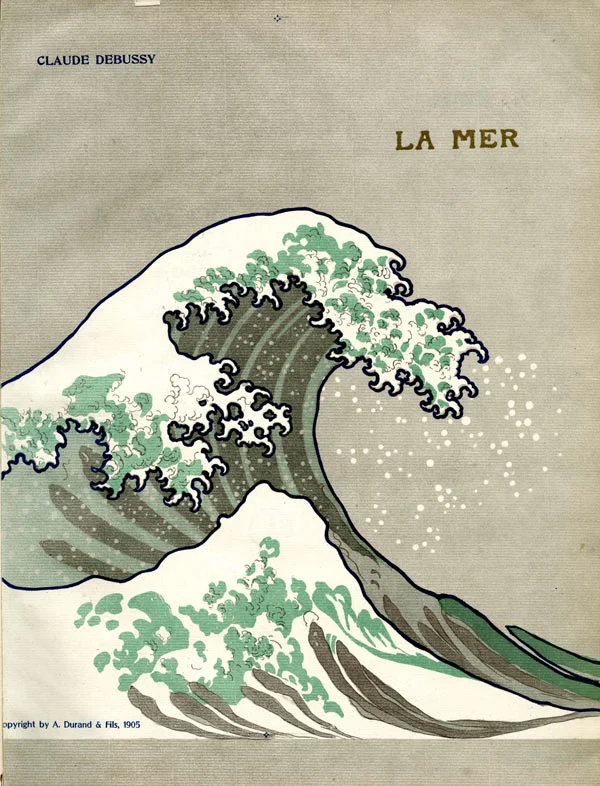
Most English speakers meet La Mer through an image before they ever meet it through sound. Hokusai’s The Great Wave off Kanagawa, cut as a colour woodblock around 1831, is now a museum-shop poster, a phone wallpaper, the ancestor of the 🌊 emoji. What fewer people know is that the wave and the music are formally connected: when Durand published the score in 1905, the cover reproduced the left portion of Hokusai’s print, a choice Debussy curated himself. A Japanese ukiyo-e wave on the front of a French orchestral score was a statement of allegiance. He was signalling where he stood, and it was outside the German symphonic tradition he had been trained to inherit.
Late nineteenth-century Paris was gripped by Japonisme. Monet hoarded Japanese prints; Debussy’s study was full of them. Hokusai’s wave earns the cover because of what it does with nature. Where the European landscape tradition uses mathematical perspective to master a scene, Hokusai freezes one instant of motion and drops tiny boats inside the wave — not conquering it, coexisting with it, absorbed by it. That is exactly the relationship Debussy wanted with the sea in music: not to narrate it, not to defeat it with a heroic theme, but to dissolve into it. Keep the print in mind while you listen. The music is trying to do what the picture does.
The Sea From Memory
Debussy grew up with the Mediterranean near Cannes in his ears, and as an adult he wrote, only half-joking, that he had been born to be a sailor. So when he told the composer André Messager that endless remembered impressions of the sea were worth more to him than a single glimpse of the real thing, he meant it as method, not modesty. He completed the composition on 5 March 1905 in Paris, where he was by then living with Emma Bardac, the nearest coast still hundreds of kilometres away. Later that summer he took the printed proofs to correct at the Grand Hotel in Eastbourne, on the English Channel — a nice irony often mangled into the claim that he wrote it by the sea in England. He did not. He edited it there, after the real work was done inland.
Think of what Monet did with Rouen Cathedral, repainting the same façade again and again, not to document the stone but to catch how the light rebuilt it hour by hour. Debussy’s project is the musical twin of that. He is not after the mechanics of a wave. He is after the impression the sea leaves on a mind — the sea as memory and sensation reassemble it. That is also why he refused the grander labels. The title he chose is trois esquisses symphoniques — three symphonic sketches. Not a symphony, not a symphonic poem. Esquisse, sketch, is precise: rapid studies of light and motion, the sound equivalent of a painter’s field notes.
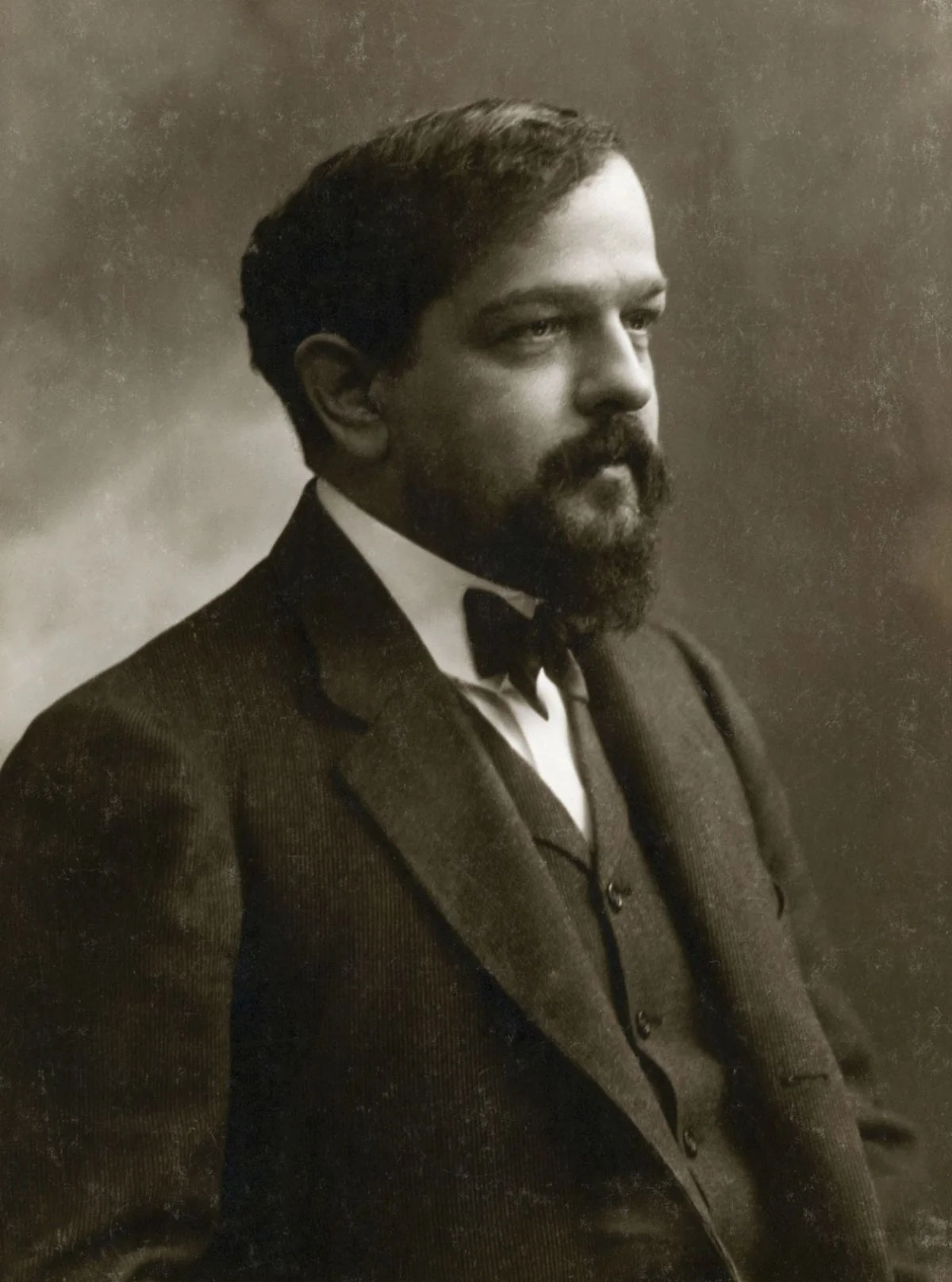
The instinct to trust his ear over the rulebook was there from the start. As a boy at the Paris Conservatoire he drove his harmony teachers to distraction by writing the forbidden parallel fifths on purpose; pressed to name the rule he followed, he is said to have answered that his only rule was his own pleasure — mon plaisir. He won the Prix de Rome in 1884 with the cantata L’Enfant prodigue, then found the prize residency in Rome so stifling he could barely work. The turning point came in 1889, when a Javanese gamelan played at the Paris Exposition Universelle: bronze instruments in scales that fell between the cracks of European tuning, ravishing and completely outside the major-minor system. That sound cracked his ears open. His mature harmonic language — whole-tone scales, church modes, pentatonic colours — grows straight out of it. And where his contemporaries worshipped Wagner, Debussy admired then walked away, calling him a sunset that people had mistaken for a sunrise.
The Storm Behind the Score
The calm of the finished seascape hides a private wreck. Debussy began La Mer just as his life was detonating. His first wife, Rosalie Texier — Lilly — was warm and sociable but indifferent to the one thing that was oxygen to him; he complained that talking music with her was like telling jokes to a statue. Then Emma Bardac arrived: a cultivated amateur soprano who had already captivated Gabriel Fauré, and who understood Debussy’s art at a level Lilly never could. He left Lilly for Emma. In October 1904 Lilly shot herself in the chest; she survived, but the bullet stayed lodged in her body for the rest of her life. Paris turned on him — friends fell away, the courts ordered damages, and his always-fragile finances collapsed. Through all of it, he kept drawing the sea. If you want the full affair, the fallout, and its music, that is a story of its own: Debussy’s Betrayal: A Bullet, an Affair, and a Masterpiece.
What to Actually Listen For
Forget hunting for tunes. In La Mer the melody is rarely the point; the colour is. If it is your first time, track three things and you will hear more than most seasoned listeners do.
Follow the light, not the theme, in the first movement. De l’aube à midi sur la mer — From Dawn to Noon — opens in near-darkness: a low rumble in timpani, cellos and basses, the hour before the sky and water separate. Then the surface begins to catch light, harp glissandi glinting like the first sun on water, an oboe and cor anglais threading a line upward. The genius is in the pacing: there is no dramatic rush to a climax, just the felt passage of real time. When noon finally arrives, a brass chorale blazes out vertically, like the midday sun standing straight overhead. If you listen to one ninety-second stretch of this piece, make it that arrival. It is the peak.
Hear the same fragment recoloured in the second movement. Jeux de vagues — Play of the Waves — is the lightest, most dazzling panel: an afternoon of glittering, restless surface. There is almost no thematic development in the textbook sense. Instead a short motif is handed from flute to clarinet to violin, and each pass changes its tint completely — less a change of instrument than a change in the angle of the light. This is Debussy’s orchestration at its most alchemical; the movement exists to show you that timbre alone can carry a piece.
Wait for the wave that refuses to be a victory in the finale. Dialogue du vent et de la mer — Dialogue of the Wind and the Sea — is where the drama lives. Wind rises, sea answers, brass cries out, percussion heaves. A motif from the very opening returns transformed, no longer the stirring of dawn but the growl of a swell bearing down. And here Debussy does the most radical thing in the piece: he declines the Beethovenian ending. Wind and sea meet as equals, collide, retreat, collide again, and when trumpets lift one last colossal wave, the music simply stops. No triumph, no hero. Just weather, and then silence. Set against the delicacy of everything before it, that abrupt end leaves a physical chill.
Taken together the three sketches trace a single day — dawn to noon, noon to afternoon, afternoon to storm. Read it as a biography of one day at sea, written in sound. That framing is the fastest way in.
When Paris Missed the Sea
The first audience did not get it. At the premiere on 15 October 1905, under Camille Chevillard at the Concerts Lamoureux, the applause was tepid. Rehearsal time had been short, the players were baffled by a score with no ordinary themes to hold on to, and the hall carried a moral verdict into the concert: this was the man who had abandoned one wife for another man’s. Ten days later, on 25 October 1905, the critic Pierre Lalo delivered his pan in Le Temps — “I do not hear, I do not see, I do not smell the sea” — one of the most quoted put-downs in music history, conceding the cleverness while denying it any feeling.
History overruled him, fast. Debussy conducted the work himself to warmer and warmer receptions, and its first London performance, at Queen’s Hall on 1 February 1908 under the composer’s own baton, was a genuine triumph. Within a generation La Mer had become one of the load-bearing scores of the orchestral repertoire — and the reason is bigger than one seascape. For a century after Beethoven, orchestral music had been architecture: themes raised, developed and recapitulated inside the iron logic of sonata form. Debussy swapped architecture for weather. Texture over structure, sensation over argument, flux over repetition. The way composers imagined the orchestra was not quite the same afterwards.
Where to Start: Two Recordings
Two very different accounts will serve almost anyone, and they sit at opposite ends of the interpretive spectrum.
Herbert von Karajan / Philharmonia Orchestra (1953, EMI) — start here. This early mono recording is still the one I hand beginners. Karajan shapes the piece as one long, glowing crescendo of sound, weighty and seamless, and the Philharmonia plays it with a sheen that makes the light in the first movement almost tactile. The mono sound is the trade-off — close and slightly airless next to modern engineering — but the interpretation is so sure-footed it barely matters.
Claudio Abbado / Lucerne Festival Orchestra (2003, live, Deutsche Grammophon) — the transparent reference. If Karajan gives you the sea as one radiant mass, Abbado gives you every drop of spray. This live account is all clarity and inner detail: you can follow that recoloured motif in Jeux de vagues from desk to desk, and the modern engineering lets the finale’s storm hit without congestion. Start with Karajan for the sweep, then come here to hear how much is actually going on inside the sound.
One reason recordings of La Mer can diverge more than you would expect: the score itself has two versions. In the 1909 revision Debussy thinned out a brass fanfare near the end of the finale — reportedly because the tune drew titters for sounding like the popular song Ciribiribin — while some conductors who knew the earlier reading restored it. So a blazing wall of brass in the closing bars on one recording, and a leaner finish on another, may not be a matter of taste at all; they may be playing different editions. If Debussy’s orchestral colour hooks you, the obvious next stop is Ravel, his great French rival in the art: try Ravel’s Boléro, a study in orchestration built on a single unchanging tune. The full La Mer score, if you want to follow along, is free on IMSLP.