- Composer
- Modest Mussorgsky
(1839–1881) - Work
- Pictures at an Exhibition
- Composed
- 1874 (piano original); 1922 (Ravel orchestration)
- Instrumentation
- 3 flutes (piccolo), 2 oboes (cor anglais), 2 clarinets (E♭ and bass), 2 bassoons, contrabassoon, alto saxophone, 4 horns, 3 trumpets, 3 trombones, tuba, timpani, multiple percussion, harp, celesta, strings
- Structure
- Promenade + 10 pieces
1. Gnomus
2. The Old Castle
3. Tuileries
4. Bydło
5. Ballet of the Unhatched Chicks
6. Samuel Goldenberg and Schmuÿle
7. The Market at Limoges
8. Catacombae
9. The Hut on Fowl’s Legs (Baba Yaga)
10. The Great Gate of Kiev - Duration
- Approx. 33 minutes
In the summer of 1874, a man walked through an art exhibition and wrote a masterpiece. The artist whose paintings hung on the walls had been dead for barely a year. The man walking through was his closest friend — and he, too, had only seven years left to live.
The artist was Viktor Hartmann. The friend was Modest Mussorgsky. And the music he wrote in a white-hot three weeks of inspiration became Pictures at an Exhibition: one of the most vivid, original, and enduring works in the entire classical repertoire.
Viktor Hartmann and the Friendship Cut Short
Viktor Hartmann was an architect and artist — visionary, eclectic, steeped in Russian folk art. He and Mussorgsky were part of a circle of Russian nationalists who believed art should draw from Russian life rather than imitating the West. They were kindred spirits.
On August 4, 1873, Hartmann died suddenly of an aneurysm. He was 39. Mussorgsky was devastated. “Why should a dog, a horse, a rat have life,” he wrote, quoting King Lear, “and Hartmann must die?”
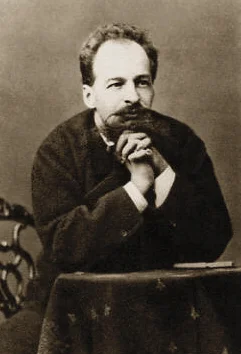
In February 1874, the art critic Vladimir Stasov organized a memorial exhibition of Hartmann’s works — over 400 drawings, watercolors, and architectural designs. Mussorgsky attended, and within weeks he was composing at a furious pace. By June 1874, the piece was complete.
The Concept: Walking Through a Gallery
The structure of Pictures at an Exhibition is brilliantly simple and wholly original. Between musical portraits of ten paintings, a recurring “Promenade” theme represents the composer himself walking from picture to picture. The Promenade changes character each time — sometimes confident, sometimes contemplative, sometimes weary — reflecting Mussorgsky’s shifting emotional state as he moves through the gallery.
No one had done anything like this before. The idea of using a connecting theme to simulate physical movement through a space was entirely new. It turned a piano suite into a narrative journey.
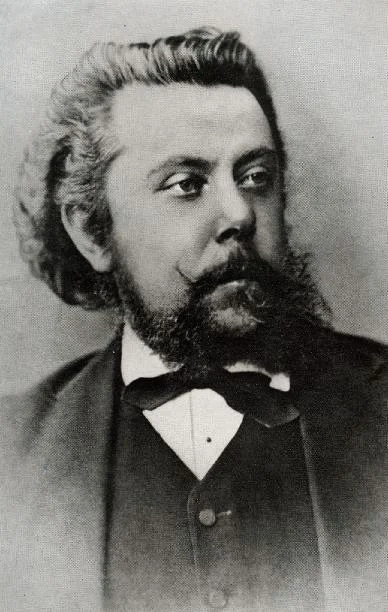
The Pictures: A Tour
1. Gnomus (E♭ minor) — A grotesque gnome lurches and scurries across the canvas. Sudden pauses, jagged rhythms, violent outbursts. The music stutters and screams in turns — Mussorgsky portrays not just the figure but its pain and rage. The piece ends with the gnome dissolving into silence, as if swallowed by its own darkness.
2. The Old Castle (G♯ minor) — A troubadour sings beneath the walls of a medieval castle. One of the most hauntingly beautiful melodies Mussorgsky ever wrote — a long, winding siciliana over a drone bass that seems to go on forever, its very repetition creating a hypnotic spell. In Ravel’s orchestration, the alto saxophone delivers the melody with aching tenderness — a bold choice of instrument that was almost unheard of in the concert hall at the time. In the piano original, the left hand’s relentless accompaniment pattern conjures an even darker, more intimate atmosphere.
3. Tuileries (B major) — Children quarreling and playing in the Tuileries Garden in Paris, with nursemaids scolding them. Mussorgsky subtitled this movement “Children’s Quarrel at Play.” Short, darting phrases imitate the children’s chatter; heavier, lower-register phrases suggest the nursemaids’ reproaches. The entire piece lasts less than a minute, but it’s a perfect demonstration of Mussorgsky’s gift for scene-painting.
4. Bydło (G♯ minor) — A heavy Polish ox-cart rumbles across the countryside. In Ravel’s version, the tuba carries the melody — one of the few moments in orchestral literature where the tuba sings a genuinely lyrical theme. The cart approaches from far away, passes at crushing fortissimo, and slowly recedes. Notably, Ravel based his version on Rimsky-Korsakov’s edited score, which starts piano (soft), while Mussorgsky’s original manuscript begins fortissimo — a fundamentally different dramatic concept.
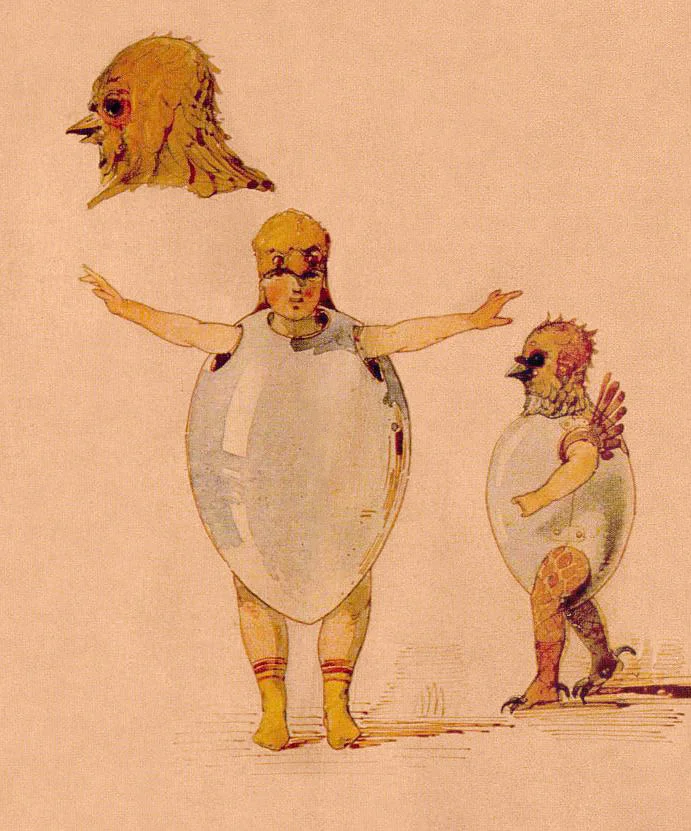
5. Ballet of the Unhatched Chicks (F major) — Based on Hartmann’s 1871 costume designs for the Bolshoi Theatre ballet Trilby. Dancers encased in eggshells waddle across the stage. Staccato notes and grace notes evoke the pecking of tiny beaks — humorous yet musically sophisticated. The entire movement is barely a minute long.
6. Samuel Goldenberg and Schmuÿle (B♭ minor) — Two Jewish men from Mussorgsky’s Poland: one rich and imperious, the other poor and wheedling. Goldenberg enters with a stately unison theme in a low register; Schmuÿle chatters anxiously on a repeated high note. When the two themes collide, the rich man remains immovable while the poor man’s voice gradually fades. In Ravel’s orchestration, strings in unison versus a muted trumpet sharpens the contrast. These were paintings Mussorgsky personally owned.
7. The Market at Limoges (E♭ major) — French market women haggling over gossip. Mussorgsky originally wrote French dialogue in the manuscript (“Big news! Monsieur de Puissangeout has just recovered his cow!”) before crossing it out. A burst of chattering energy that accelerates breathlessly until — without a single beat of rest — it plunges into the darkness of the catacombs. One of the most shocking transitions in the entire suite.
8. Catacombae / Cum mortuis in lingua mortua (B minor) — The deepest point of the journey. Massive chord blocks echo through the underground vault like fists pounding on stone. Hartmann’s watercolor shows himself and a guide exploring the Paris catacombs by lantern-light, surrounded by skulls and bones. Then comes “Cum mortuis in lingua mortua” — “With the dead in a dead language” — and the Promenade theme returns over trembling tremolo, ghostly and transformed. According to Stasov, Mussorgsky wrote that the dead Hartmann’s skull begins to glow from within. This is no longer a gallery stroll. It is the suite’s most intimate moment: a living man speaking to his dead friend.
9. The Hut on Fowl’s Legs (Baba Yaga) (C major/minor) — Hartmann’s design was actually a bronze clock shaped like a hut perched on chicken legs. But Mussorgsky saw the witch herself: Baba Yaga careening through the forest in her mortar and pestle. The outer sections are wild and savage; the quiet middle section conjures the eerie stillness of the deep forest. Structurally, it mirrors “Gnomus” — the suite’s bookends of darkness. Then, without pause, it crashes directly into the blazing light of the finale.
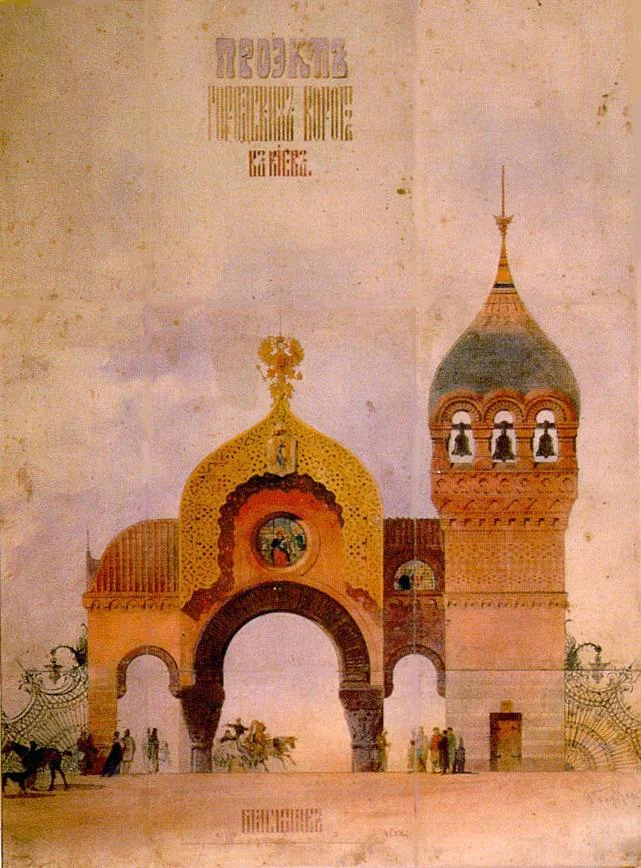
10. The Great Gate of Kiev (E♭ major) — Hartmann’s 1869 design for a monumental city gate commemorating Tsar Alexander II’s survival of an assassination attempt. The gate was never built, but in Mussorgsky’s music it stands forever. The structure is deceptively intricate: the grand gate theme appears twice, separated by a Russian Orthodox chant. The Promenade returns one final time — no longer a stroll, but a farewell. In Ravel’s orchestration, full brass, bells, timpani, and the entire orchestra create a sound like a cathedral’s bell tower ringing across a city. It is one of the most overwhelming endings in all orchestral music — a tribute not just to a gate, but to a friendship, and to the power of art to outlive death.
Mussorgsky’s Piano and Ravel’s Orchestra
An essential fact: Pictures at an Exhibition was originally a piano work. Mussorgsky wrote it for solo piano, and it was published posthumously in 1886 (in a somewhat “corrected” edition by Rimsky-Korsakov). The piano original is raw, unpolished, and startlingly modern — full of bare octaves, unusual harmonies, and passages that seem to push the piano beyond its limits.
In 1922, the conductor Serge Koussevitzky — who ran a music publishing house in Paris — commissioned Maurice Ravel to orchestrate the work. Ravel had already studied Mussorgsky’s opera Boris Godunov deeply and immediately recognized the orchestral potential hiding within the piano score. His version is a masterclass in orchestration: every color in the orchestra is deployed with stunning precision. The “Gnomus” snarls through brass and low woodwinds; “The Old Castle” sings through an alto saxophone (a radical choice for the 1920s concert hall); the “Unhatched Chicks” peck through staccato woodwinds; “Bydło” rumbles through the tuba; the “Great Gate of Kiev” blazes through full brass and bells. Ravel also changed each Promenade’s instrumentation to reflect the viewer’s shifting mood — a subtle but crucial interpretive choice that gives the orchestral version its sense of emotional progression. He did, however, omit one Promenade (before “Samuel Goldenberg”) and strengthened the attacca transition from Limoges into Catacombae.
Ravel’s orchestration has become the standard version. But the piano original remains a formidable concert piece in its own right — rawer and more personal than the orchestral version. It was the twentieth-century virtuosos — Richter, Horowitz, Brendel — who established it in the concert repertoire, embracing its brutal physical demands. Before them, it was sometimes dismissed as salon music. Horowitz even added his own embellishments, inserting extra octaves in “Baba Yaga” for even greater ferocity.
Recommended Recordings
Fritz Reiner / Chicago Symphony (1957) — The gold standard. Precision, color, and dramatic pacing in perfect balance.
Valery Gergiev / Vienna Philharmonic (2000) — Rich, massive, deeply Russian. The “Great Gate” is overwhelming.
Ravel orchestration, Giulini / Chicago Symphony (1976) — Warmth and grandeur. The “Old Castle” is heartbreaking.
Piano original: Sviatoslav Richter (Sofia, 1958) — The definitive piano account. Raw power and uncompromising individuality.
Follow the Score
The full score is freely available at IMSLP. View the Pictures at an Exhibition score on IMSLP
What is the story behind Mussorgsky’s “Pictures at an Exhibition”?
Mussorgsky composed the suite in 1874 to honor his friend, artist Viktor Hartmann, who had recently died. The music depicts a walk through an exhibition of Hartmann’s artworks. The ten movements are based on specific drawings and paintings, connected by a recurring “Promenade” theme that represents the viewer walking between the pieces.
How long does it take to perform “Pictures at an Exhibition”?
The original solo piano version typically has a duration of about 30 to 35 minutes. Maurice Ravel’s popular orchestral arrangement from 1922 is similar in length, usually lasting around 35 minutes, though performance times vary with the conductor.
Is “Pictures at an Exhibition” a piano piece or an orchestral piece?
It was originally written as a suite for solo piano by Modest Mussorgsky in 1874. However, it is most famously known today through its 1922 orchestration by French composer Maurice Ravel. While many orchestrations exist, Ravel’s version is the one most frequently performed and recorded.
How difficult is “Pictures at an Exhibition” to play on the piano?
The work is considered exceptionally difficult and is a staple of the virtuoso repertoire. It demands significant technical skill, power, and endurance from the pianist. Movements like “The Hut on Fowl’s Legs (Baba Yaga)” and “The Great Gate of Kiev” require massive chords and rapid, powerful passages.
Frequently Asked Questions
When and why was Pictures at an Exhibition composed?
The work was composed in 1874 (piano original. 33 minutes { "@context": "https://schema.org", "@type": "MusicComposition", "name": "Pictures at an Exhibition", "composer": { "@type": "Person", "name": "Modest Mussorgsky" }, "description": "Music written while walking through a dead friend’s art exhibition — Mussorgsky’s Pictures at an Exhibition", "inLanguage": "en", "url": "https://theclassicnote.com/mussorgsky-pictures-at-an-exhibition/" } In the summer of 1874, a man walked through an art exhibition and wrote a masterpiece.
Which recordings of Pictures at an Exhibition are recommended for first-time listeners?
A legendary recording of razor-sharp precision and vivid color. A performance of immense color and dramatic weight. In 1922, the conductor Serge Koussevitzky — who ran a music publishing house in Paris — commissioned Maurice Ravel to orchestrate the work.
What is the historical significance of Pictures at an Exhibition?
Then comes "Cum mortuis in lingua mortua" — "With the dead in a dead language" — and the Promenade theme returns over trembling tremolo, ghostly and transformed. Ravel also changed each Promenade’s instrumentation to reflect the viewer’s shifting mood — a subtle but crucial interpretive choice that gives the orchestral version its sense of emotional progression.
Was this originally a piano piece or an orchestral piece?
A piano piece. Mussorgsky wrote it for solo piano in 1874. Maurice Ravel orchestrated it in 1922, and Ravel’s version is now the most commonly performed.
Do the original paintings still exist?
Only a few. Most of Hartmann’s works from the 1874 exhibition have been lost. The surviving pieces include the chick costume designs and the Great Gate of Kiev sketch.
Is this a good starting point for classical music?
Absolutely. The structure is easy to follow — you’re walking through a gallery, stopping at each picture. The music is vivid, varied, and immediately engaging. It’s one of the best entry points in the repertoire.
Ravel’s orchestration omits a Promenade — is that true?
Yes. Mussorgsky’s original has five Promenade interludes, but Ravel cut the one before “Samuel Goldenberg and Schmuÿle.” He also reinforced the attacca (seamless) transition from “The Market at Limoges” into “Catacombae.”
What about the Emerson, Lake & Palmer rock version?
ELP’s 1971 live album retains the suite’s overall structure but freely rearranges and adds original material. Keith Emerson plays Moog synthesizer and Hammond organ. It’s a landmark of progressive rock, and its commercial success—reaching No. 3 on the Billboard 200—proved how naturally Mussorgsky’s music translates across genres.
Further Reading
- → Symphony Beginner’s Guide — Three Essential First Listens
- → The Classic Note Composer & Works Map
🎼 View the Score — Free score download at IMSLP